PUBLISHER: Mordor Intelligence | PRODUCT CODE: 2113515

PUBLISHER: Mordor Intelligence | PRODUCT CODE: 2113515
Incident Response Services - Market Share Analysis, Industry Trends & Statistics, Growth Forecasts (2026 - 2031)
According to Mordor Intelligence, incident response services market size in 2026 is estimated at USD 49.71 billion, growing from 2025 value of USD 41.95 billion with 2031 projections showing USD 116.17 billion, growing at 18.52% CAGR over 2026-2031.
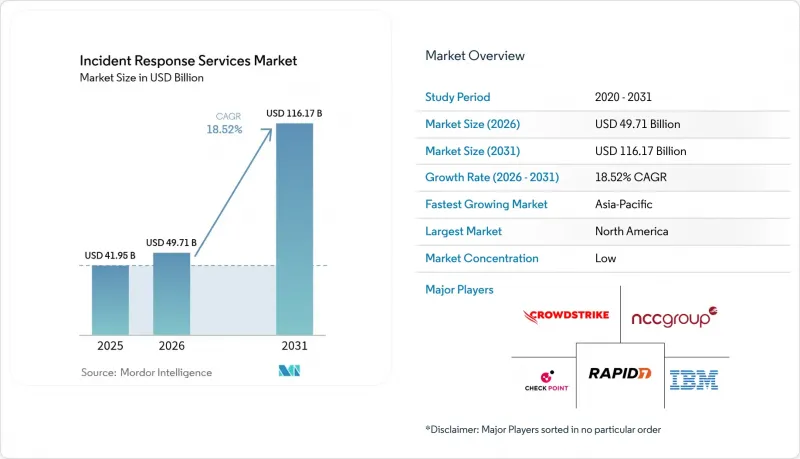
This report is Segmented by Service Type (Containment and Mitigation, Remediation and Recovery, and More), by Deployment Mode (On-Premises, Cloud-Based, and More), by Enterprise Size (Small and Medium Enterprises and Large Enterprises), by End-User Industry (BFSI, Government and Defense, and More), by Geography. The Market Forecasts are Provided in Terms of Value (USD).
Global Incident Response Services Market Trends and Insights
Surge in Frequency and Sophistication of Cyber-Attacks in BFSI and Critical Infrastructure
Financial institutions and utility operators now contend with attack dwell times measured in minutes rather than days, forcing a pivot to containment-first playbooks that emphasize rapid isolation of endpoints and network segments. The Unit 42 Global Incident Response Report recorded that 86% of 2024 breaches disrupted business operations, while adversaries exfiltrated data inside the first hour of compromise. Legacy system convergence with open banking APIs compounds risk in BFSI, whereas operational technology (OT) environments in energy and transport require response teams to preserve uptime even while eradicating malware. Government guidance, such as the Texas Department of Banking's 2025 notice that basic cyber hygiene blocks 98% of threats, reinforces the view that specialized responders are essential for the remaining high-grade incidents.
Stricter Data-Protection Regulations Driving Compliance-Mandated Investments
The European Union's NIS2 directive obliges essential entities to report significant incidents within 24 hours and faces violators with fines up to EUR 10 million (USD 11.3 million). Similar momentum exists in North America, where PCI-DSS 4.0 and evolving state privacy laws demand verifiable incident response programs that extend beyond technical logs to downstream reporting and stakeholder communication. Compliance overlap across regions has spurred multinational firms to seek global response partners that can align evidence collection, legal holds, and public disclosure standards in one coordinated workflow.
Global Shortage of Skilled Incident Responders Constraining Growth
The worldwide cybersecurity workforce gap climbed significantly in 2025, with incident responders among the scarcest skill sets. Staffing deficits raise time-to-contain metrics and inflate breach liabilities; IBM estimates an average USD 1.76 million premium for firms lacking dedicated incident response resources. Outsourcing partners benefit, yet capacity bottlenecks persist during multi-client surge events, spurring investments in AI-driven triage to extend human expertise
Other drivers and restraints analyzed in the detailed report include:
- Cloud-First Adoption Expanding Attack Surface
- Rise of Ransom-Cloud and BEC 3.0 Exploiting OAuth Tokens
- High Cost of Premium IR Retainers Limiting SME Adoption
For complete list of drivers and restraints, kindly check the Table Of Contents.
Segment Analysis
Containment and Mitigation captured 32.75% of the incident response services market in 2025, reflecting the urgency to isolate compromised assets before attackers pivot or exfiltrate data. Rapid isolation of endpoints and privileged credentials has become standard practice as median attacker dwell time shrinks. Over the forecast horizon, Managed Detection and Response will expand at a 20.6% CAGR, elevating continuous threat-hunting and proactive remediation from optional add-ons to core contract deliverables.
MDR momentum is powered by AI-assisted analytics that surface anomalies human analysts might miss. Vendors infuse large-language-model copilots that accelerate root-cause discovery and automated playbook execution, slashing response hours. Remediation and Recovery maintain relevance, particularly when regulatory reporting or litigation requires certified evidence handling. Digital Forensics and Analytics is evolving through machine-learning-based pattern recognition, enabling incident responders to reconstruct attacker timelines faster while satisfying evidentiary standards for court proceedings.
On-Premises installations still held 56.45% share of the incident response services market size in 2025 due to sovereignty mandates and board-level preferences for local custody of sensitive logs. Financial institutions and public agencies continue to limit external data transfers, especially in jurisdictions that prohibit customer information from leaving national borders. Yet cloud-based response tooling will outpace overall growth at a 19.85% CAGR as security teams embrace plug-and-play scalability.
Hybrid deployment models now fuse local log retention with cloud analytics engines, giving organizations the forensic visibility they require without sacrificing elastic compute capacity. Zero-trust philosophies reinforce the shift by de-emphasizing network location as a security boundary and normalizing remote examination of forensic artifacts. Providers differentiate by offering "bring-your-own-key" encryption and in-region data storage to satisfy compliance audits.
Complete Report Scope:
- By Service Type
- Containment and Mitigation
- Remediation and Recovery
- Digital Forensics and Analytics
- Managed Detection and Response (MDR)
- Others
- By Deployment Mode
- On-Premises
- Cloud-based
- Hybrid
- By Enterprise Size
- Small and Medium Enterprises
- Large Enterprises
- By End-User Industry
- BFSI
- Government and Defense
- IT and Telecom
- Healthcare and Life Sciences
- Industrial Manufacturing
- Energy and Utilities
- Retail and E-commerce
- Others
- By Geography
- North America
- United States
- Canada
- Mexico
- South America
- Brazil
- Argentina
- Rest of South America
- Europe
- Germany
- United Kingdom
- France
- Spain
- Italy
- Russia
- Rest of Europe
- Asia-Pacific
- China
- Japan
- India
- Australia
- South Korea
- Rest of Asia-Pacific
- Middle East and Africa
- Middle East
- Saudi Arabia
- United Arab Emirates
- Turkey
- Rest of Middle East
- Africa
- South Africa
- Rest of Africa
- Middle East
- North America
Geography Analysis
North America retained the regional lead with 37.85% incident response services market share in 2025, propelled by mature breach-notification laws and robust security ecosystems. United States financial regulators, such as the New York Department of Financial Services, require formalized incident response plans, reinforcing demand across large banks and fintechs. Canada's critical-infrastructure directives and Mexico's expanding fintech rules extend regional volume.
Asia-Pacific is on track for a 20.12% CAGR to 2031. Regulatory harmonization in Japan, Singapore, and Australia now mandates 24-hour breach disclosure and certified response processes, encouraging organizations to secure retainers before incidents occur. The region recorded 34% of global attacks in 2024, intensifying demand for bilingual, cross-jurisdictional responders who can navigate local rules and diverse cloud stacks.
Europe's compliance-driven adoption accelerates under NIS2, which broadens the scope of "essential entities" and elevates fines for insufficient preparedness. Organizations must harmonize GDPR data-breach reporting with NIS2 security-incident disclosure, fueling bundled privacy-plus-security response engagements. Eastern European members look to consultancies for playbook localization, while larger economies deepen contracts to cover supply-chain and OT threats.
Latin America, the Middle East, and Africa remain nascent but rising. Digital-commerce expansion and new data-protection statutes open opportunities, though budgetary and talent constraints temper immediate growth. International providers partner with local MSSPs to bridge language, culture, and compliance gaps, a model expected to scale as regional investment in cyber resilience continues.
- CrowdStrike Holdings Inc.
- Check Point Software Technologies Ltd.
- BlackBerry Cybersecurity (Cylance)
- Mandiant Inc. (Google Cloud)
- Kaspersky Lab
- Rapid7 Inc.
- IBM Corporation
- NCC Group plc
- Optiv Security Inc.
- Secureworks Inc.
- Trustwave Holdings Inc.
- KPMG International Ltd.
- Deloitte Touche Tohmatsu Ltd.
- Ernst and Young Global Ltd.
- PricewaterhouseCoopers (PwC)
- Accenture plc
- Palo Alto Networks (Unit 42)
- Cisco Systems Inc. (Talos IR)
- Booz Allen Hamilton Inc.
- BAE Systems Digital Intelligence
Additional Benefits:
- The market estimate (ME) sheet in Excel format
- 3 months of analyst support
TABLE OF CONTENTS
1 INTRODUCTION
- 1.1 Scope of the Study
2 RESEARCH METHODOLOGY
3 EXECUTIVE SUMMARY
4 MARKET LANDSCAPE
- 4.1 Market Drivers
- 4.1.1 Surge in frequency and sophistication of cyber-attacks in BFSI and critical infrastructure
- 4.1.2 Stricter data-protection regulations (GDPR, CCPA, PCI-DSS 4.0, NIS2)
- 4.1.3 Cloud-first adoption expanding attack surface and driving cloud IR demand
- 4.1.4 Rise of ransom-cloud and BEC 3.0 exploiting OAuth tokens
- 4.1.5 Cyber-insurance scoring models mandating pre-approved IR retainers
- 4.1.6 ICS/OT digital-twin analytics accelerating post-breach root-cause investigations
- 4.2 Market Restraints
- 4.2.1 Global shortage of skilled incident responders
- 4.2.2 High cost of premium IR retainers limiting SME uptake
- 4.2.3 Overlap with XDR/SOAR platforms causing buyer confusion
- 4.2.4 Zero-trust architectures shortening dwell time, reducing full-scale IR engagements
- 4.3 Supply-Chain Analysis
- 4.4 Regulatory Landscape
- 4.5 Technological Outlook
- 4.6 Porters Five Force Analysis
- 4.6.1 Bargaining Power of Suppliers
- 4.6.2 Bargaining Power of Buyers
- 4.6.3 Threat of New Entrants
- 4.6.4 Threat of Substitutes
- 4.6.5 Intensity of Competitive Rivalry
- 4.7 Industry Stakeholder Analysis
5 MARKET SIZE AND GROWTH FORECASTS (VALUE)
- 5.1 By Service Type
- 5.1.1 Containment and Mitigation
- 5.1.2 Remediation and Recovery
- 5.1.3 Digital Forensics and Analytics
- 5.1.4 Managed Detection and Response (MDR)
- 5.1.5 Others
- 5.2 By Deployment Mode
- 5.2.1 On-Premises
- 5.2.2 Cloud-based
- 5.2.3 Hybrid
- 5.3 By Enterprise Size
- 5.3.1 Small and Medium Enterprises
- 5.3.2 Large Enterprises
- 5.4 By End-User Industry
- 5.4.1 BFSI
- 5.4.2 Government and Defense
- 5.4.3 IT and Telecom
- 5.4.4 Healthcare and Life Sciences
- 5.4.5 Industrial Manufacturing
- 5.4.6 Energy and Utilities
- 5.4.7 Retail and E-commerce
- 5.4.8 Others
- 5.5 By Geography
- 5.5.1 North America
- 5.5.1.1 United States
- 5.5.1.2 Canada
- 5.5.1.3 Mexico
- 5.5.2 South America
- 5.5.2.1 Brazil
- 5.5.2.2 Argentina
- 5.5.2.3 Rest of South America
- 5.5.3 Europe
- 5.5.3.1 Germany
- 5.5.3.2 United Kingdom
- 5.5.3.3 France
- 5.5.3.4 Spain
- 5.5.3.5 Italy
- 5.5.3.6 Russia
- 5.5.3.7 Rest of Europe
- 5.5.4 Asia-Pacific
- 5.5.4.1 China
- 5.5.4.2 Japan
- 5.5.4.3 India
- 5.5.4.4 Australia
- 5.5.4.5 South Korea
- 5.5.4.6 Rest of Asia-Pacific
- 5.5.5 Middle East and Africa
- 5.5.5.1 Middle East
- 5.5.5.1.1 Saudi Arabia
- 5.5.5.1.2 United Arab Emirates
- 5.5.5.1.3 Turkey
- 5.5.5.1.4 Rest of Middle East
- 5.5.5.2 Africa
- 5.5.5.2.1 South Africa
- 5.5.5.2.2 Rest of Africa
- 5.5.5.1 Middle East
- 5.5.1 North America
6 COMPETITIVE LANDSCAPE
- 6.1 Market Concentration
- 6.2 Strategic Moves
- 6.3 Market Share Analysis
- 6.4 Company Profiles (includes Global level Overview, Market level overview, Core Segments, Financials as available, Strategic Information, Market Rank/Share, Products and Services, Recent Developments)
- 6.4.1 CrowdStrike Holdings Inc.
- 6.4.2 Check Point Software Technologies Ltd.
- 6.4.3 BlackBerry Cybersecurity (Cylance)
- 6.4.4 Mandiant Inc. (Google Cloud)
- 6.4.5 Kaspersky Lab
- 6.4.6 Rapid7 Inc.
- 6.4.7 IBM Corporation
- 6.4.8 NCC Group plc
- 6.4.9 Optiv Security Inc.
- 6.4.10 Secureworks Inc.
- 6.4.11 Trustwave Holdings Inc.
- 6.4.12 KPMG International Ltd.
- 6.4.13 Deloitte Touche Tohmatsu Ltd.
- 6.4.14 Ernst and Young Global Ltd.
- 6.4.15 PricewaterhouseCoopers (PwC)
- 6.4.16 Accenture plc
- 6.4.17 Palo Alto Networks (Unit 42)
- 6.4.18 Cisco Systems Inc. (Talos IR)
- 6.4.19 Booz Allen Hamilton Inc.
- 6.4.20 BAE Systems Digital Intelligence
7 MARKET OPPORTUNITIES AND FUTURE OUTLOOK
- 7.1 White-space and Unmet-need Assessment

