PUBLISHER: Mordor Intelligence | PRODUCT CODE: 2113570

PUBLISHER: Mordor Intelligence | PRODUCT CODE: 2113570
Smart Fabrics - Market Share Analysis, Industry Trends & Statistics, Growth Forecasts (2026 - 2031)
According to Mordor Intelligence, the smart fabrics market size was valued at 7.75 million units in 2025 and estimated to grow from 8.58 million units in 2026 to reach 14.25 million units by 2031, at a CAGR of 10.68% during the forecast period (2026-2031).
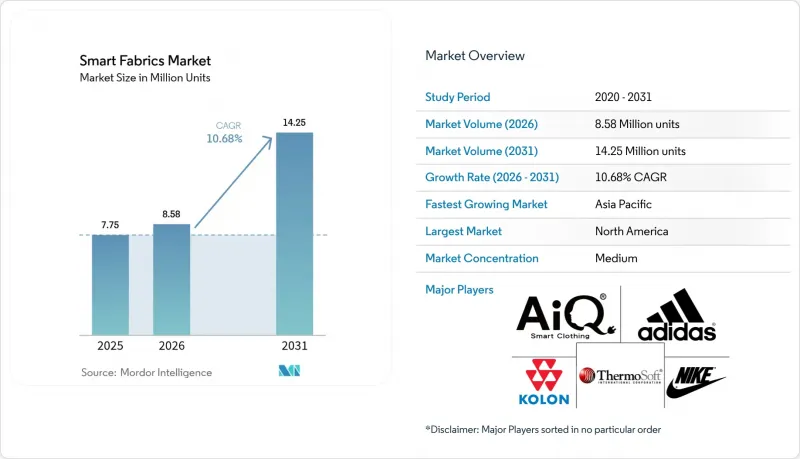
This report is Segmented by Type (Passive Smart Fabrics, Active Smart Fabrics, Ultra-Smart Fabrics), Functionality (Sensing, Thermoregulation, and More), Material (Cotton-Based, Polyester and Nylon, High-Performance), Application (Fashion and Entertainment, Sports and Fitness, and More), and Geography. The Market Forecasts are Provided in Terms of Volume (Units).
Global Smart Fabrics Market Trends and Insights
Growth in Wearable-Electronics Ecosystem
Demand for smart garments has surged in tandem with the wider wearable device boom. Researchers at the University of Waterloo demonstrated fabrics that harvest solar and body-heat energy, removing the need for external batteries. Cornell University's SeamFit shirts classified exercises with 93.4% accuracy using conductive threads stitched into everyday tees. Healthcare prototypes are progressing quickly, including smart bandages from the California Institute of Technology that predict wound-healing timelines at expert-level precision. The Guardian reported fiber-based electronics that draw ambient electromagnetic energy, turning the human body into part of the circuit and fueling ultra-low-power sensors embedded inside clothing. Collectively, these advances blur the line between attire and electronics, expanding the smart fabrics market into lifestyle, medical, and industrial realms.
Rapid Miniaturization and Flexible-IC Integration
The threshold at which integrated electronics compromise fabric comfort has shifted. MIT engineers produced elastic fiber computers containing micro-devices, sensors, and Bluetooth modules that survive machine washes, enabling Arctic mission wearables that monitor vital signs without bulk.Embroidered triboelectric nanogenerators yielded 307.5 µJ per sliding cycle, showcasing viable energy capture through regular garment motion. Organic electrochemical transistors developed at the University of Hong Kong now process data locally on the fabric, lowering transmission loads and boosting privacy. These breakthroughs place sophisticated processing power inside textiles while preserving drape and flexibility, enhancing consumer acceptance.
High Fabrication Cost and Cybersecurity Risks
Production lines require specialized equipment for embedding conductors, sensors, and microcontrollers, pushing unit costs above those of regular textiles. Inflation and supply chain disruptions in 2024 further squeezed margins for U.S. textile mills, many of which diverted capex away from automation upgrades. Data security remains a parallel concern because garments collect biometrics that fall under health-data regulations. Encryption adds component expense and mandates software updates throughout a product's life, increasing total cost of ownership. Smaller brands face hurdles securing capital for compliant design, slowing penetration in low-income markets.
Other drivers and restraints analyzed in the detailed report include:
- Textile-Embedded Energy-Harvesting Supercapacitors
- Military Mandates for Cognitive-Load Monitoring Gear
- Absence of Global E-Textile Interoperability Standards
For complete list of drivers and restraints, kindly check the Table Of Contents.
Segment Analysis
Ultra-smart variants are forecast to post the segment-leading 11.06% CAGR to 2031 as predictive analytics and automated adaptation move from labs into volume production. Passive formats still command 44.62% of the smart fabrics market due to proven durability across basic sensing tasks. Active fabrics, which modify properties like breathability in response to stimuli, bridge the gap but must overcome power and durability trade-offs. Smart acoustic cloth using piezoelectric threads translates bending and touch into precise electrical signals, maintaining airflow and thermal stability for day-long wear. R&D pipelines are embedding on-textile neural networks that learn wearer patterns and predict anomalies, unlocking proactive wellness alerts. These capabilities give Ultra-smart fabrics a clear value premium, propelling their share of the smart fabrics market in high-performance sportswear, defense, and chronic-care monitoring.
Smart acoustics also benefit Passive and Active categories. Tailored layering schemes now boost signal-to-noise ratios, enhancing entry-level balance monitoring belts and low-cost posture trainers. Builders of Passive goods leverage established looms, so they scale faster than Ultra-smart newcomers. As manufacturing lines converge, patent sharing between loom makers and chip vendors will compress yields, balancing growth across tiers.
Energy Harvesting functions show the highest forecast CAGR of 13.28%, though Sensing retained a 55.42% share of the smart fabrics market in 2025. Thermoregulation sweaters that heat or cool through phase-change inks and microfluidic channels fulfill niche performance needs, while luminescent fabrics enrich aesthetic footwear and event costumes. Efficient triboelectric nanogenerators woven into arm bands now deliver over 3 mW cm-2 during intense motion, enabling continuous Bluetooth beacons without external power arxiv.org. Moisture-enabled supercapacitors pair with those generators to retain charge for days, removing the daily charging chore. These power systems make autonomous field jackets viable for rescue crews and enable hospital gowns that track vitals even when patients lack mobility.
Sensing retains leadership through ubiquitous heart-rate and temperature modules in workout tees. Textile-based inductive coils measure muscle oxygenation, expanding the role of sports gear in injury prevention. As manufacturers integrate multi-functional yarns, product families combine sensing with micro-energy cells, making the categories mutually reinforcing rather than mutually exclusive.
Complete Report Scope:
- By Type
- Passive Smart Fabrics
- Active Smart Fabrics
- Ultra-smart Fabrics
- By Functionality
- Sensing
- Thermoregulation
- Energy Harvesting
- Luminescent and Aesthetic
- By Material
- Cotton-based
- Polyester and Nylon
- High-performance (Kevlar, Dyneema, etc.)
- By Application
- Fashion and Entertainment
- Sports and Fitness
- Medical and Healthcare
- Transportation - Automotive and Aerospace
- Military and Defense
- Industrial and Safety
- By Geography
- North America
- United States
- Canada
- Mexico
- South America
- Brazil
- Argentina
- Rest of South America
- Europe
- Germany
- United Kingdom
- France
- Italy
- Spain
- Netherlands
- Rest of Europe
- Asia-Pacific
- China
- Japan
- South Korea
- India
- Rest of Asia-Pacific
- Middle East and Africa
- Middle East
- Saudi Arabia
- United Arab Emirates
- Rest of Middle East
- Africa
- South Africa
- Nigeria
- Rest of Africa
- Middle East
- North America
Geography Analysis
North America led with 28.12% market share in 2025 on the back of strong defense budgets, vibrant health-tech ecosystems, and consumer enthusiasm for innovative sportswear. The Department of Defense funds fiber computers and climate-adaptive uniforms, ensuring domestic demand for high-spec fabrics. MIT, University of Waterloo, and Caltech spin out start-ups that license their textile platforms, keeping regional innovation pipelines full. Several mills moved to near-shore production to mitigate supply shocks, unlocking government incentives aimed at rebuilding local manufacturing.
Asia Pacific is the growth engine, projected at a 12.05% CAGR through 2031. China's technical textile segment already forms over 20% of its broader textile industry, posting 9-13% annual growth in medical, filtration, and protective categories. Beijing MatrixTech's Y-Warm insulation delivers superior thermal retention and antimicrobial properties, offering export potential to cold-weather sportswear brands. Japanese suppliers refine ultrafine conductive filaments, while Korean groups commercialize washable OLED thread patterns for interactive apparel. India nurtures start-ups that craft price-competitive smart bandages for rural clinics, demonstrating the region's wide application spread. Europe sits at the convergence of sustainability mandates and advanced engineering. The bloc's progressive PFAS restrictions drive research into alternative coatings that cut toxic risk yet retain conductivity. Lenzing's minority stake in TreeToTextile fast-tracks cellulose fibers that lower water and energy footprints. Germany, France, and Spain foster textile recycling clusters, but consumer surveys reveal price sensitivity to sustainability premiums. Universities collaborate with automotive suppliers on seat fabrics that detect driver fatigue, broadening industrial uptake and reinforcing Europe's role as an innovation hub in the smart fabrics market.
- Adidas AG
- NIKE Inc.
- AIQ Smart Clothing Inc.
- DuPont de Nemours Inc.
- Kolon Industries Inc.
- Sensoria Inc.
- ThermoSoft International Corp.
- Interactive Wear AG
- Ohmatex ApS
- Schoeller Textil AG
- Toray Industries Inc.
- Hexoskin / Carre Technologies Inc.
- Gentherm Inc.
- VF Corporation (The North Face)
- Under Armour Inc.
- Laird PLC (Advanced Thermal)
- Jabil Inc. (BlueSky e-textile)
- Google LLC (Jacquard by Levi's)
- Textronics Inc.
- Wearable X
- VT Garment Co. (Gravitech)
Additional Benefits:
- The market estimate (ME) sheet in Excel format
- 3 months of analyst support
TABLE OF CONTENTS
1 INTRODUCTION
- 1.1 Study Assumptions and Market Definition
- 1.2 Scope of the Study
2 RESEARCH METHODOLOGY
3 EXECUTIVE SUMMARY
4 MARKET LANDSCAPE
- 4.1 Market Overview
- 4.2 Market Drivers
- 4.2.1 Growth in wearable-electronics ecosystem
- 4.2.2 Rapid miniaturization and flexible-IC integration
- 4.2.3 Surge in conductive-yarn patent filings (post-2025)
- 4.2.4 Textile-embedded energy-harvesting supercapacitors
- 4.2.5 Military mandates for cognitive-load monitoring gear
- 4.2.6 Sustainability premiums from circular-textile brands
- 4.3 Market Restraints
- 4.3.1 High fabrication cost and cybersecurity risks
- 4.3.2 Absence of global e-textile interoperability standards
- 4.3.3 Emerging toxicity rules on nano-coatings
- 4.3.4 End-of-life recycling complexity of e-textile waste
- 4.4 Supply-Chain Analysis
- 4.5 Regulatory Landscape
- 4.6 Technological Outlook
- 4.7 Porter's Five Forces Analysis
- 4.7.1 Threat of New Entrants
- 4.7.2 Bargaining Power of Suppliers
- 4.7.3 Bargaining Power of Buyers
- 4.7.4 Threat of Substitutes
- 4.7.5 Competitive Rivalry
- 4.8 Assesment of Macroeconomic Factors on the Market
5 MARKET SIZE AND GROWTH FORECASTS (UNITS)
- 5.1 By Type
- 5.1.1 Passive Smart Fabrics
- 5.1.2 Active Smart Fabrics
- 5.1.3 Ultra-smart Fabrics
- 5.2 By Functionality
- 5.2.1 Sensing
- 5.2.2 Thermoregulation
- 5.2.3 Energy Harvesting
- 5.2.4 Luminescent and Aesthetic
- 5.3 By Material
- 5.3.1 Cotton-based
- 5.3.2 Polyester and Nylon
- 5.3.3 High-performance (Kevlar, Dyneema, etc.)
- 5.4 By Application
- 5.4.1 Fashion and Entertainment
- 5.4.2 Sports and Fitness
- 5.4.3 Medical and Healthcare
- 5.4.4 Transportation - Automotive and Aerospace
- 5.4.5 Military and Defense
- 5.4.6 Industrial and Safety
- 5.5 By Geography
- 5.5.1 North America
- 5.5.1.1 United States
- 5.5.1.2 Canada
- 5.5.1.3 Mexico
- 5.5.2 South America
- 5.5.2.1 Brazil
- 5.5.2.2 Argentina
- 5.5.2.3 Rest of South America
- 5.5.3 Europe
- 5.5.3.1 Germany
- 5.5.3.2 United Kingdom
- 5.5.3.3 France
- 5.5.3.4 Italy
- 5.5.3.5 Spain
- 5.5.3.6 Netherlands
- 5.5.3.7 Rest of Europe
- 5.5.4 Asia-Pacific
- 5.5.4.1 China
- 5.5.4.2 Japan
- 5.5.4.3 South Korea
- 5.5.4.4 India
- 5.5.4.5 Rest of Asia-Pacific
- 5.5.5 Middle East and Africa
- 5.5.5.1 Middle East
- 5.5.5.1.1 Saudi Arabia
- 5.5.5.1.2 United Arab Emirates
- 5.5.5.1.3 Rest of Middle East
- 5.5.5.2 Africa
- 5.5.5.2.1 South Africa
- 5.5.5.2.2 Nigeria
- 5.5.5.2.3 Rest of Africa
- 5.5.5.1 Middle East
- 5.5.1 North America
6 COMPETITIVE LANDSCAPE
- 6.1 Market Concentration
- 6.2 Strategic Moves
- 6.3 Market Share Analysis
- 6.4 Company Profiles (includes Global level Overview, Market level overview, Core Segments, Financials as available, Strategic Information, Market Rank/Share for key companies, Products and Services, and Recent Developments)
- 6.4.1 Adidas AG
- 6.4.2 NIKE Inc.
- 6.4.3 AIQ Smart Clothing Inc.
- 6.4.4 DuPont de Nemours Inc.
- 6.4.5 Kolon Industries Inc.
- 6.4.6 Sensoria Inc.
- 6.4.7 ThermoSoft International Corp.
- 6.4.8 Interactive Wear AG
- 6.4.9 Ohmatex ApS
- 6.4.10 Schoeller Textil AG
- 6.4.11 Toray Industries Inc.
- 6.4.12 Hexoskin / Carre Technologies Inc.
- 6.4.13 Gentherm Inc.
- 6.4.14 VF Corporation (The North Face)
- 6.4.15 Under Armour Inc.
- 6.4.16 Laird PLC (Advanced Thermal)
- 6.4.17 Jabil Inc. (BlueSky e-textile)
- 6.4.18 Google LLC (Jacquard by Levi's)
- 6.4.19 Textronics Inc.
- 6.4.20 Wearable X
- 6.4.21 VT Garment Co. (Gravitech)
7 MARKET OPPORTUNITIES AND FUTURE OUTLOOK
- 7.1 White-space and Unmet-need Assessment

