PUBLISHER: Mordor Intelligence | PRODUCT CODE: 2113580

PUBLISHER: Mordor Intelligence | PRODUCT CODE: 2113580
Africa Dairy-Based Beverages - Market Share Analysis, Industry Trends & Statistics, Growth Forecasts (2025 - 2031)
According to Mordor Intelligence, the Africa dairy-based beverages market size was valued at USD 4.36 billion in 2025 and is estimated to grow from USD 4.62 billion in 2026 to reach USD 6.42 billion by 2031, at a CAGR of 6.80% during the forecast period (2026-2031).
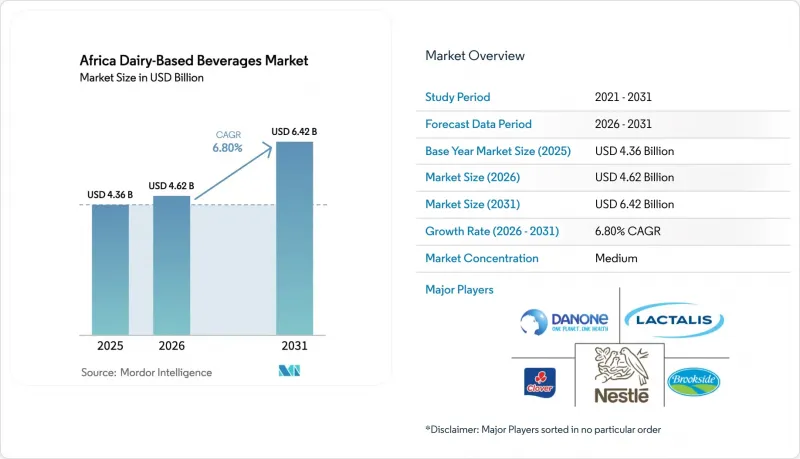
This report is Segmented by Product Type (Probiotic Milk, Yogurt Drink, and More), Fat Content (Whole/Fat, Low-Fat, and Skimmed/Non-fat), Packaging Type (Cartons, Bottles, Pouches and More), Distribution Channel (On-Trade, and Off-Trade), and Geography (South Africa, Egypt, Nigeria, Kenya, and Rest of Africa). The Market Forecasts are Provided in Terms of Value (USD) and Volume (Liters).
Africa Dairy-Based Beverages Market Trends and Insights
Rising demand for functional and probiotic beverages
Across Africa, consumers are increasingly viewing dairy beverages as products that deliver live cultures offering digestive and immune health benefits, rather than simply as sources of protein and calcium. Research published in the Journal of Dairy Science highlights that lactic acid bacteria and bifidobacteria strains can survive gastric transit and colonize the gut when included in fermented milk at concentrations exceeding 107 colony-forming units per milliliter. De Novo Dairy's precision-fermentation platform, which produces dairy proteins without relying on cows, secured partnerships in 2024 to supply African co-packers seeking clean-label probiotic bases. In Egypt, Juhayna's Greek and stirred yogurt lines have successfully leveraged this trend, contributing to the company's 59 percent market share in drinkable yogurt and 30 percent share in spoonable yogurt during fiscal 2024. Additionally, urban retailers in Nairobi and Johannesburg have reported that probiotic-labeled stock-keeping units (SKUs) command price premiums of 15 percent to 25 percent over standard yogurt drinks, reflecting a growing consumer willingness to pay for perceived health benefits.
Innovation in flavored and value-added milk
Flavored milk products, enriched with vitamins, minerals, or plant extracts, are steadily replacing plain white milk on supermarket shelves as manufacturers aim for higher profit margins and cater to younger consumers. The Dairy Standard Agency of South Africa reported that the production of sweetened, flavored, or colored milk increased by 9% during the first nine months of 2024 compared to the same period in the previous year, surpassing the growth rate of plain fluid milk. In 2024, Nestle Nigeria expanded its NIDO fortified milk powder range and introduced ready-to-drink MILO. Furthermore, Kerry Group launched lactase enzyme solutions in East African dairies, which allow the production of lactose-free chocolate and strawberry milk without compromising sweetness or texture. A pilot project conducted by the International Livestock Research Institute in Kenya demonstrated that lactose-hydrolyzed milk achieved a 92% consumer acceptability score while effectively addressing digestive discomfort in lactose-intolerant participants .
High prevalence of lactose intolerance and dairy allergies
Approximately 68% of the global population experiences some level of lactose malabsorption, with rates surpassing 80% in countries such as Nigeria, Ethiopia, and Uganda, according to data from the National Institute of Diabetes and Digestive and Kidney Diseases (NIDDK). Lactose malabsorption refers to the body's reduced ability to digest lactose, a sugar found in milk and dairy products, due to insufficient production of the enzyme lactase. A 2024 study published in *Nutrients* found that 52% of Tanzanian adults and 42% of Kenyan adults exhibited lactose intolerance in breath-hydrogen tests, which measure the amount of hydrogen in the breath as an indicator of undigested lactose. This condition limits their ability to consume conventional fluid milk without experiencing gastrointestinal discomfort, such as bloating, diarrhea, or abdominal pain. Genetic research has identified specific variants of the lactase (LCT) gene, commonly found in African populations, that reduce lactase production after weaning. This genetic trait creates a structural barrier to dairy consumption, making it challenging for individuals to include traditional dairy products in their diets. While lactose-free and lactose-reduced products provide a solution to this issue, they require additional processing steps and enzyme inputs, which increase production costs by 8% to 12%. These higher costs compress profit margins for dairy processors, particularly in price-sensitive markets where affordability is a key concern. Additionally, dairy allergies, which are distinct from lactose intolerance, affect a smaller portion of consumers. Unlike lactose intolerance, which is related to enzyme deficiency, dairy allergies involve immune system reactions that can trigger severe symptoms, further narrowing the addressable market for dairy products.
Other drivers and restraints analyzed in the detailed report include:
- Emergence of lactose-reduced and easier-to-digest dairy drinks
- Adoption of ready-to-drink formats for on-the-go lifestyles
- Competition from plant-based and non-dairy alternatives
For complete list of drivers and restraints, kindly check the Table Of Contents.
Segment Analysis
Yogurt Drinks accounted for 27.43% of market revenue in 2025, reflecting consumer demand for tangy, probiotic-rich beverages that serve as both snacks and meal replacements. Kefir and Other Fermented Dairy Drinks, while smaller in overall volume, are projected to grow at an annual rate of 7.04% through 2031. This growth is driven by urban consumers' interest in traditional fermentation methods and higher live-culture content. Probiotic Milk, which includes fortified fluid milk with added Lactobacillus or Bifidobacterium strains, appeals to health-conscious households willing to pay a premium for functional health benefits.
The Others category includes flavored milk, sweetened condensed milk drinks, and hybrid products that combine dairy with fruit juice or plant proteins. Juhayna's drinkable yogurt portfolio, which holds a majority market share in Egypt, demonstrates how manufacturers can dominate a segment by offering Greek-style, stirred, and fruit-blended variants to meet diverse consumer preferences. Tetra Pak's ambient drinking-yogurt solutions, introduced in Nigeria and Egypt in 2024 and 2025, provide a 12-month shelf life without refrigeration. This innovation enables distribution to inland areas and helps reduce spoilage-related losses.
Whole-fat or full-fat dairy beverages are projected to account for 55.21% of volume in 2025, driven by consumer preferences for taste, satiety, and cultural norms that associate richness with quality. However, low-fat formulations are expected to grow at an annual rate of 7.49% through 2031, as urban consumers increasingly adopt calorie-conscious diets and respond to public health messaging regarding cardiovascular risks. Skimmed or non-fat variants remain a niche category, primarily appealing to fitness enthusiasts and diabetic patients who prioritize protein intake over fat content.
According to South Africa's Dairy Standard Agency, retail sales of ultra-high-temperature milk increased by 1.6% in the 12 months ending July 2024, with low-fat and skimmed SKUs accounting for a significant share of the incremental volume. Nestle Nigeria's beverage portfolio, which generated NGN 342.3 billion (USD 228 million) in 2024, includes both full-cream and reduced-fat NIDO variants, enabling the company to cater to diverse consumer segments.
Complete Report Scope:
- By Product Type
- Probiotic Milk
- Yogurt Drink
- Kefir and Other Fermented Dairy Drinks
- Others
- By Fat Content
- Whole/Fat
- Low-fat
- Skimmed/Non-fat
- By Packaging Type
- Cartons
- Bottles
- Pouches
- Cans
- Others
- By Distribution Channel
- On-Trade
- Off-Trade
- Supermarkets / Hypermarkets
- Convenience Stores
- Specialty Stores
- Online Retail Stores
- Others
- By Geography
- South Africa
- Egypt
- Nigeria
- Kenya
- Rest of Africa
List of Companies Covered in this Report:
- Danone S.A.
- Nestle S.A.
- Lactalis Group
- Clover Industries Ltd
- Brookside Dairy Ltd
- FrieslandCampina WAMCO
- Parmalat South Africa
- Promasidor Holdings
- Arla Foods
- Almarai Co.
- Juhayna Food Industries
- Chi Ltd (Coca-Cola Nigeria)
- Inyange Industries
- Seprod Ltd
- Pearl Dairy Farms (Lato Milk)
- Sodiaal
- Morinaga Nutritional Foods Inc.
- Chobani LLC
- First Choice
- Saputo Inc.
Additional Benefits:
- The market estimate (ME) sheet in Excel format
- 3 months of analyst support
TABLE OF CONTENTS
1 INTRODUCTION
- 1.1 Study Assumptions and Market Definition
- 1.2 Scope of the Study
2 RESEARCH METHODOLOGY
3 EXECUTIVE SUMMARY
4 MARKET LANDSCAPE
- 4.1 Market Overview
- 4.2 Market Drivers
- 4.2.1 Rising demand for functional and probiotic beverages
- 4.2.2 Innovation in flavored and value-added milk
- 4.2.3 Emergence of lactose-reduced and easier-to-digest dairy drinks
- 4.2.4 Adoption of ready-to-drink (RTD) formats for on-the-go lifestyles
- 4.2.5 Expansion of modern retail and refrigerated shelves
- 4.2.6 Growing popularity of drinkable yogurt and yogurt smoothies
- 4.3 Market Restraints
- 4.3.1 High prevalence of lactose intolerance and dairy allergies
- 4.3.2 Competition from plant-based and non-dairy alternatives
- 4.3.3 Volatility in raw milk supply and quality
- 4.3.4 Disease outbreaks in dairy herds
- 4.4 Supply Chain Analysis
- 4.5 Regulatory Outlook
- 4.6 Porter's Five Forces
- 4.6.1 Threat of New Entrants
- 4.6.2 Bargaining Power of Buyers/Consumers
- 4.6.3 Bargaining Power of Suppliers
- 4.6.4 Threat of Substitute Products
- 4.6.5 Intensity of Competitive Rivalry
5 MARKET SIZE AND GROWTH FORECASTS (VALUE AND VOLUME)
- 5.1 By Product Type
- 5.1.1 Probiotic Milk
- 5.1.2 Yogurt Drink
- 5.1.3 Kefir and Other Fermented Dairy Drinks
- 5.1.4 Others
- 5.2 By Fat Content
- 5.2.1 Whole/Fat
- 5.2.2 Low-fat
- 5.2.3 Skimmed/Non-fat
- 5.3 By Packaging Type
- 5.3.1 Cartons
- 5.3.2 Bottles
- 5.3.3 Pouches
- 5.3.4 Cans
- 5.3.5 Others
- 5.4 By Distribution Channel
- 5.4.1 On-Trade
- 5.4.2 Off-Trade
- 5.4.2.1 Supermarkets / Hypermarkets
- 5.4.2.2 Convenience Stores
- 5.4.2.3 Specialty Stores
- 5.4.2.4 Online Retail Stores
- 5.4.2.5 Others
- 5.5 By Geography
- 5.5.1 South Africa
- 5.5.2 Egypt
- 5.5.3 Nigeria
- 5.5.4 Kenya
- 5.5.5 Rest of Africa
6 COMPETITIVE LANDSCAPE
- 6.1 Market Concentration
- 6.2 Strategic Moves
- 6.3 Market Ranking Analysis
- 6.4 Company Profiles (includes Global-level Overview, Market-level Overview, Core Segments, Financials (if available), Strategic Information, Market Rank/Share, Products and Services, Recent Developments)
- 6.4.1 Danone S.A.
- 6.4.2 Nestle S.A.
- 6.4.3 Lactalis Group
- 6.4.4 Clover Industries Ltd
- 6.4.5 Brookside Dairy Ltd
- 6.4.6 FrieslandCampina WAMCO
- 6.4.7 Parmalat South Africa
- 6.4.8 Promasidor Holdings
- 6.4.9 Arla Foods
- 6.4.10 Almarai Co.
- 6.4.11 Juhayna Food Industries
- 6.4.12 Chi Ltd (Coca-Cola Nigeria)
- 6.4.13 Inyange Industries
- 6.4.14 Seprod Ltd
- 6.4.15 Pearl Dairy Farms (Lato Milk)
- 6.4.16 Sodiaal
- 6.4.17 Morinaga Nutritional Foods Inc.
- 6.4.18 Chobani LLC
- 6.4.19 First Choice
- 6.4.20 Saputo Inc.
7 MARKET OPPORTUNITIES AND FUTURE OUTLOOK

