PUBLISHER: Mordor Intelligence | PRODUCT CODE: 2113583

PUBLISHER: Mordor Intelligence | PRODUCT CODE: 2113583
Acrylonitrile Butadiene Styrene (ABS) Resin - Market Share Analysis, Industry Trends & Statistics, Growth Forecasts (2026 - 2031)
According to Mordor Intelligence, the acrylonitrile butadiene styrene resin market size is expected to grow from 9.35 Million tons in 2025 to 9.78 Million tons in 2026 and is forecast to reach 12.26 Million tons by 2031 at 4.63% CAGR over 2026-2031.
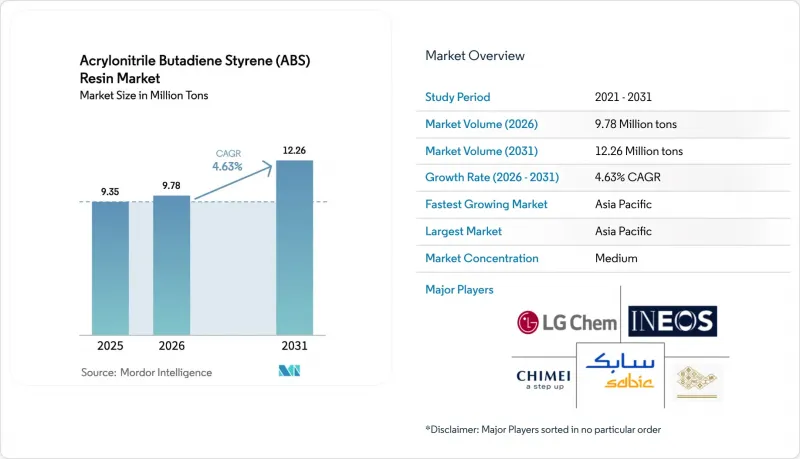
This report is Segmented by Processing Technology (Injection Blow Molding, Extrusion Blow Molding, and More), ABS Grade (General-Purpose, High-Impact, and More), End-User Industry (Automotive and Transportation, Electronics, and More), and Geography (Asia-Pacific, North America, Europe, and More). The Market Forecasts are Provided in Terms of Volume (Tons).
Global Acrylonitrile Butadiene Styrene (ABS) Resin Market Trends and Insights
Lightweighting and Metal Replacement in E-Mobility Platforms
Electric-vehicle makers are swapping steel and aluminum for reinforced ABS to offset battery mass and extend range. SABIC's ENLITE long-glass-fiber ABS, commercialized in 2025, trims 25-30% weight from battery-tray covers while meeting UL 94 HB flammability limits. Trinseo co-developed door modules that remove 18 kg per vehicle and add roughly 2 km of driving range per charge. Chinese start-ups still favor polypropylene in under-body shields, but European OEMs specify ABS where surface appearance matters. The American Chemistry Council puts ABS use in North American light vehicles at 24 lb in 2023, a figure set to rise with battery-electric platforms. EU 2027 CO2 targets tighten the push toward lightweighting, nudging automakers to pre-qualify flame-retardant grades that pass ISO 3795 burn tests.
Smart-Home Appliances Requiring High-Gloss Heat-Resistant Grades
Touch-enabled refrigerators, IoT washing machines, and inductive cooktops need ABS compounds that stay glossy, resist heat, and shield electronics from static discharge. LG Electronics' 2025 premium refrigerators use heat-resistant ABS with a deflection temperature above 95 °C, allowing thinner walls and larger displays during South Asian summer transport. Samsung debuted a grade whose surface resistivity under 101° Ω/sq minimizes electrostatic discharge around Wi-Fi modules. India's Bureau of Energy Efficiency raises appliance energy-label hurdles in 2026, and Whirlpool has lifted ABS content in its top-load washers from 8% to 12% of material cost since 2023. Halogen-free flame retardants add 3-5% to compounding cost but satisfy RoHS and REACH export requirements.
Volatile Acrylonitrile Feedstock Prices
Acrylonitrile makes up 35-40% of ABS cost, and a 25% drop in Northeast Asian spot prices during 2024 slashed margins for non-integrated producers in Europe and the United States. German and Texan facilities idled lines in Q3 2025 after margin compression of USD 150-200 per ton. Propylene volatility compounds the issue: U.S. Gulf Coast contracts spiked 18% in early 2025 after refinery outages, only to retreat once Asian naphtha crackers ramped. Automotive Tier 1 suppliers increasingly insist on quarterly resin price resets, pushing risk back upstream. Vertically integrated players such as INEOS and Formosa Plastics enjoy a USD 100-120 per ton advantage and can weather downdrafts. The International Energy Agency expects broadly stable crude through 2027 but flags Middle East propane supply as a wild card.
Other drivers and restraints analyzed in the detailed report include:
- Asia-Pacific Capacity Expansions and Down-Stream Integration
- Demand for Electroplatable ABS in 5G mmWave Radomes
- Substitution by Bio-Based/Compostable Polymers in Electronics
For complete list of drivers and restraints, kindly check the Table Of Contents.
Segment Analysis
Injection blow molding held a 48.21% share of the acrylonitrile butadiene styrene (ABS) resin market size in 2025 and is forecast to secure a 5.2% CAGR through 2031 as appliance, auto, and electronics producers favor its short cycle times. ENGEL's 2025 servo-hydraulic machine with in-mold labeling cut per-part energy use 18% amid surging European electricity prices. Extrusion blow molding is growing slowly as rotational molding competes for large-format parts. Injection stretch blow molding is used mainly for cosmetic and pharma bottles and faces single-use plastics bans in the EU and India.
Chinese machinery makers such as Haitian and Borch rolled out all-electric injection-blow systems priced 25-30% below European rivals in 2024, accelerating uptake across ASEAN and South Asia. BMW's 2025 iX electric SUV uses injection-blow-molded ABS ducts for battery thermal control, underscoring the technology's versatility. Co-injection blow molding that sandwiches recycled polypropylene between ABS skins is being piloted by Bosch to hit EU Ecodesign recycled-content rules. ISO 16012 validation practices are spreading, and tier-one suppliers cite tighter tolerances as a factor favoring injection blow molding.
Complete Report Scope:
- By Processing Technology
- Injection Blow Molding
- Extrusion Blow Molding
- Injection Stretch Blow Molding
- By ABS Grade
- General-Purpose
- High-Impact
- Electro-plating
- Flame-Retardant
- Heat-Resistant
- By End-user Industry
- Automotive and Transportation
- Electronics
- Consumer Goods and Appliances
- Construction
- Other End-user Industries
- By Geography
- Asia-Pacific
- China
- India
- Japan
- South Korea
- Thailand
- Vietnam
- Malaysia
- Indonesia
- Rest of Asia-Pacific
- North America
- United States
- Canada
- Mexico
- Europe
- Germany
- United Kingdom
- France
- Italy
- Spain
- Russia
- Turkey
- Nordics
- Rest of Europe
- South America
- Brazil
- Argentina
- Colombia
- Rest of South America
- Middle East and Africa
- Saudi Arabia
- United Arab Emirates
- Qatar
- Egypt
- South Africa
- Nigeria
- Rest of Middle East and Africa
- Asia-Pacific
Geography Analysis
Asia-Pacific captured 76.12% of volume in 2025 and will grow at 5.23% CAGR through 2031, anchored by mega-integrated complexes such as INEOS-Sinopec Ningbo and Zhejiang Petrochemical Zhoushan that slice USD 80-100 per ton in feedstock logistics and blunt acrylonitrile gyrations. India's demand rises significantly on surging appliance output, with Bureau of Energy Efficiency 2026 labels nudging heat-resistant ABS adoption. ASEAN growth accelerates as PTT Global Chemical and Chandra Asri add capacity serving relocated appliance lines.
North America market growth is influenced by flat auto builds and TPO substitution in interiors. SABIC's Texas plant supplies flame-retardant grades for data-center racks, while Mexico's re-export of chrome-plated trim keeps electroplating ABS afloat despite looming USMCA chromium limits.
Europe's market is growing under tightening VOC and carbon-border rules that elevate costs for smaller molders. German OEMs shift to PC-ABS blends, and Covestro's Bayblend won 2025 dashboards at Volkswagen and BMW. Brazil's auto and appliance sectors lead South America ABS demand, though exchange-rate swings squeeze Unigel's margins. The Middle East and Africa's ABS demand is backed by SABIC's low-cost Jubail output and Saudi downstream diversification.
- BEPL
- CHIMEI
- ELIX POLYMERS
- Eni S.p.A.
- Formosa Plastics Group
- INEOS
- JSR Corporation
- KUMHO PETROCHEMICAL
- LG Chem
- LOTTE Chemical Corporation
- NIPPON A&L INC.
- PetroChina Company Limited
- SABIC
- Shandong INEOS-YPC
- Techno-UMG Co., Ltd.
- TORAY INDUSTRIES, INC.
- TotalEnergies
- Trinseo
Additional Benefits:
- The market estimate (ME) sheet in Excel format
- 3 months of analyst support
TABLE OF CONTENTS
1 Introduction
- 1.1 Study Assumptions and Market Definition
- 1.2 Scope of the Study
2 Research Methodology
3 Executive Summary
4 Market Landscape
- 4.1 Market Drivers
- 4.1.1 Lightweighting and Metal-Replacement in E-Mobility Platforms
- 4.1.2 Smart-Home Appliances Requiring High-Gloss Heat-Resistant Grades
- 4.1.3 Asia-Pacific Capacity Expansions and Down-Stream Integration
- 4.1.4 Demand for Electroplatable ABS in 5G mmWave Radomes
- 4.1.5 Halogen-Free Flame-Retardant Cockpit Components for Regional Jets
- 4.2 Market Restraints
- 4.2.1 Volatile Acrylonitrile Feedstock Prices
- 4.2.2 Substitution by Bio-Based/Compostable Polymers in Electronics
- 4.2.3 Stringent Nordic VOC Limits on ABS Processing Plants
- 4.3 Value Chain Analysis
- 4.4 Pricing Trends
- 4.5 Regulatory Outlook
- 4.6 Porter's Five Forces
- 4.6.1 Bargaining Power of Suppliers
- 4.6.2 Bargaining Power of Buyers
- 4.6.3 Threat of New Entrants
- 4.6.4 Threat of Substitutes
- 4.6.5 Degree of Competition
5 Market Size and Growth Forecasts (Volume)
- 5.1 By Processing Technology
- 5.1.1 Injection Blow Molding
- 5.1.2 Extrusion Blow Molding
- 5.1.3 Injection Stretch Blow Molding
- 5.2 By ABS Grade
- 5.2.1 General-Purpose
- 5.2.2 High-Impact
- 5.2.3 Electro-plating
- 5.2.4 Flame-Retardant
- 5.2.5 Heat-Resistant
- 5.3 By End-user Industry
- 5.3.1 Automotive and Transportation
- 5.3.2 Electronics
- 5.3.3 Consumer Goods and Appliances
- 5.3.4 Construction
- 5.3.5 Other End-user Industries
- 5.4 By Geography
- 5.4.1 Asia-Pacific
- 5.4.1.1 China
- 5.4.1.2 India
- 5.4.1.3 Japan
- 5.4.1.4 South Korea
- 5.4.1.5 Thailand
- 5.4.1.6 Vietnam
- 5.4.1.7 Malaysia
- 5.4.1.8 Indonesia
- 5.4.1.9 Rest of Asia-Pacific
- 5.4.2 North America
- 5.4.2.1 United States
- 5.4.2.2 Canada
- 5.4.2.3 Mexico
- 5.4.3 Europe
- 5.4.3.1 Germany
- 5.4.3.2 United Kingdom
- 5.4.3.3 France
- 5.4.3.4 Italy
- 5.4.3.5 Spain
- 5.4.3.6 Russia
- 5.4.3.7 Turkey
- 5.4.3.8 Nordics
- 5.4.3.9 Rest of Europe
- 5.4.4 South America
- 5.4.4.1 Brazil
- 5.4.4.2 Argentina
- 5.4.4.3 Colombia
- 5.4.4.4 Rest of South America
- 5.4.5 Middle East and Africa
- 5.4.5.1 Saudi Arabia
- 5.4.5.2 United Arab Emirates
- 5.4.5.3 Qatar
- 5.4.5.4 Egypt
- 5.4.5.5 South Africa
- 5.4.5.6 Nigeria
- 5.4.5.7 Rest of Middle East and Africa
- 5.4.1 Asia-Pacific
6 Competitive Landscape
- 6.1 Market Concentration
- 6.2 Strategic Moves
- 6.3 Market Share Analysis
- 6.4 Company Profiles (includes Global-level Overview, Market-level Overview, Core Segments, Financials, Strategic Info, Products and Services, Recent Developments)
- 6.4.1 BEPL
- 6.4.2 CHIMEI
- 6.4.3 ELIX POLYMERS
- 6.4.4 Eni S.p.A.
- 6.4.5 Formosa Plastics Group
- 6.4.6 INEOS
- 6.4.7 JSR Corporation
- 6.4.8 KUMHO PETROCHEMICAL
- 6.4.9 LG Chem
- 6.4.10 LOTTE Chemical Corporation
- 6.4.11 NIPPON A&L INC.
- 6.4.12 PetroChina Company Limited
- 6.4.13 SABIC
- 6.4.14 Shandong INEOS-YPC
- 6.4.15 Techno-UMG Co., Ltd.
- 6.4.16 TORAY INDUSTRIES, INC.
- 6.4.17 TotalEnergies
- 6.4.18 Trinseo
7 Market Opportunities and Future Outlook
- 7.1 White-Space and Unmet-Need Assessment
- 7.2 Growing usage of PC-ABS Resin in Industrial Applications

