PUBLISHER: Mordor Intelligence | PRODUCT CODE: 2113595

PUBLISHER: Mordor Intelligence | PRODUCT CODE: 2113595
North America Coffee - Market Share Analysis, Industry Trends & Statistics, Growth Forecasts (2026 - 2031)
According to Mordor Intelligence, the North America coffee market size was valued at USD 41.96 billion in 2025 and estimated to grow from USD 44.13 billion in 2026 to reach USD 56.78 billion by 2031, at a CAGR of 5.17% during the forecast period (2026-2031).
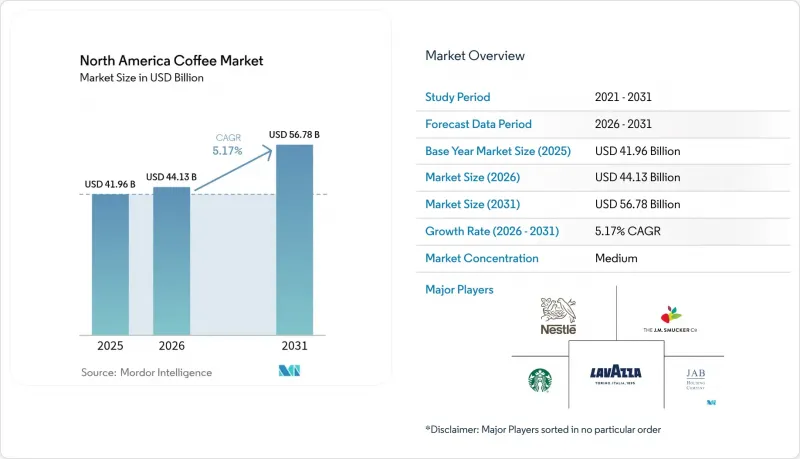
This report is Segmented by Product Type (Whole Bean, Ground Coffee, Instant Coffee, Coffee Pods and Capsules, RTD Coffee), Category (Conventional Coffee, Specialty), Coffee Species (Arabica, Robusta, Liberica, Others), Distribution Channel (On-Trade, Off-Trade), and Geography (United States, Canada, Mexico, Rest of North America). Market Forecasts are Provided in Terms of Value (USD) and Volume (Units).
North America Coffee Market Trends and Insights
Rising Interest in "Better-for-You" Coffee
Functional coffee has evolved from a niche wellness product to a popular choice, as consumers increasingly look for added health benefits in their daily routines. In June 2024, Laird Superfood introduced its Protein Instant Latte, which provides 10 grams of plant-based protein per serving. This product also includes MCTs and a blend of functional mushrooms such as lion's mane, cordyceps, maitake, and chaga, offering a combination of convenience, natural ingredients, and cognitive support. Priced at approximately USD 3 per serving, it is positioned between premium coffee-shop offerings and basic instant coffee, demonstrating how functional benefits can justify higher pricing. Coffee brands are leveraging this research to differentiate their creamers and ready-to-drink (RTD) beverages. This trend is no longer limited to specialty health-food stores. Retailers like Sprouts Farmers Market and Amazon now carry functional coffee products, reflecting their growing acceptance and wider availability in the market.
Rising Demand for Convenience Options Such as Single-Serve Pods, RTD Coffees
Rising demand for convenience-centric formats such as single-serve pods and ready-to-drink coffees is becoming a key growth driver for the North America coffee market, as consumers increasingly prioritize speed, portability, and consistent quality. Single-serve pod systems offer customized brewing with minimal effort, appealing to busy households and workplaces seeking cafe-style beverages at home. RTD coffees continue to expand rapidly due to their on-the-go functionality and alignment with health trends, with brands introducing low-sugar, functional, and protein-enhanced variants. This shift is also reinforced by younger consumers who prefer grab-and-go options over traditional brewed coffee. Manufacturers are responding with wider flavor ranges, premium formulations, and sustainable packaging innovations. Overall, the convenience trend is reshaping product innovation, retail shelf allocation, and consumption habits across the region.
Competition from substitute beverages and functional drinks
Competition from substitute beverages and functional drinks is increasingly restraining growth in the North America coffee market, as consumers diversify their beverage choices toward options promising added health or performance benefits. Energy drinks, functional teas, enhanced waters, and nootropic beverages attract younger demographics seeking convenience and targeted outcomes like focus, hydration, or sustained energy. This broadening landscape fragments consumer attention and reduces reliance on traditional coffee, especially in afternoon and on-the-go occasions. The rise of plant-based and low-caffeine alternatives also appeals to health-conscious segments that perceive coffee as acidic or overstimulating. As a result, brands face heightened pressure to innovate with functional ingredients, cleaner labels, and differentiated formats.
Other drivers and restraints analyzed in the detailed report include:
- Increasing Consumer Focus on Ethical, Sustainable, and Traceable Sourcing
- Continuous Innovation in Flavors and Formats
- Detrimental Impact of Coffee Pods and Capsules on the Environment
For complete list of drivers and restraints, kindly check the Table Of Contents.
Segment Analysis
In 2025, instant coffee held 42.85% of the market share, driven by strong demand from Hispanic households, where 84% in Mexico prefer instant formats, and older consumers who value speed and shelf stability. Leading brands like Nestle's Nescafe and Starbucks VIA use freeze-dried and spray-dried technologies to retain aroma and enable preparation in under 30 seconds. While volume growth remains flat, premiumization drives value growth, with single-origin and micro-lot freeze-dried coffees priced 20-30% higher than standard blends. Ground and whole-bean coffee target similar demographics but differ in preferences. Whole-bean buyers, often specialty coffee enthusiasts, prioritize freshness and terroir, while ground coffee appeals to convenience-focused households using drip machines. Coffee pods and capsules face challenges like environmental concerns and rising material costs, but Keurig's K-Cup and Nespresso's aluminum capsules retain customer loyalty through brewer compatibility and consistent quality.
Ready-to-drink (RTD) coffee is the fastest-growing segment, with a 7.12% CAGR through 2031, driven by new formats and expanded distribution in convenience stores, gas stations, and vending machines. In March 2024, Starbucks launched multi-serve cold-brew bottles to target households, offering lower per-ounce costs compared to single-serve cans and competing with at-home brewing. Chameleon's shelf-stable cold-brew cans, with a 12-month shelf life, reduce refrigeration needs, cut distributor costs, and improve inventory turnover. Costa Coffee's 11-ounce Iced Coffee Lattes, placed in 7-Eleven and QuikTrip stores through Coca-Cola's direct-store-delivery network, capture impulse purchases by positioning near energy drinks. Nitro cold brew, infused with nitrogen for a creamy texture without dairy, has moved from specialty cafes to RTD cans, led by brands like La Colombe and Chameleon. RTD coffee growth depends on maintaining cafe-quality taste while managing costs for aseptic packaging, cold-chain logistics, and retail placement, favoring companies with strong co-packing and distribution capabilities.
In 2025, conventional coffee dominated 63.70% of the market share, driven by its strong presence in grocery, club, and discount channels where affordability is key. Leading brands like Folgers, Maxwell House, and Dunkin' rely on extensive distribution, frequent promotions, and long-standing brand recognition. These brands achieve consistent flavor profiles through supply-chain efficiencies, blending multiple origins at scale, and benefit from lower marketing costs compared to specialty roasters. However, younger consumers, entering peak coffee-drinking years, show less loyalty to conventional brands and prefer experimenting with specialty and direct-to-consumer options. To adapt, conventional players are introducing premium sub-brands and limited-edition blends to protect shelf space and boost margins without affecting core products.
Specialty coffee is projected to grow at an 7.86% CAGR through 2031, the fastest among all segments, as third-wave roasters expand into retail and e-commerce. Defined by the Specialty Coffee Association as scoring above 80 on a 100-point scale, specialty coffee emphasizes origin transparency, processing, and precise roasting. In 2024, Blue Bottle Coffee, owned by Nestle, expanded its e-commerce and subscription services, using data analytics to personalize recommendations and automate orders, increasing customer retention and value. Intelligentsia and La Colombe have entered mainstream retail through Whole Foods, Target, and regional chains, making specialty coffee more accessible. Single-origin coffees from Ethiopia, Colombia, and Guatemala, priced at USD 15-25 per 12-ounce bag, remain popular among Millennials and Gen Z, who value coffee as an experience and prioritize certifications like Fair Trade and Rainforest Alliance. Specialty roasters also benefit from direct-trade relationships, ensuring supply, enhancing traceability, and capturing margins typically taken by intermediaries.
Complete Report Scope:
- By Product Type
- Whole Bean
- Ground Coffee
- Instant Coffee
- Coffee Pods and Capsules
- RTD Coffee
- By Category
- Conventional Coffee
- Specialty
- By Coffee Species
- Arabica
- Robusta
- Liberica
- Others
- By Distribution Channel
- On-Trade
- Off-Trade
- Supermarkets/Hypermarkets
- Convenience/ Grocery Stores
- Specialty Stores
- Online Retail Stores
- Other Off-trade Channels
- By Country
- United States
- Canada
- Mexico
- Rest of North America
List of Companies Covered in this Report:
- Starbucks Corporation
- Nestle S.A.
- Keurig Dr Pepper Inc.
- JAB Holding Company
- The J.M. Smucker Company
- Luigi Lavazza S.p.A.
- Massimo Zanetti Beverage Group S.p.A.
- The Kraft Heinz Company
- Tchibo GmbH
- Tata Consumer Products Ltd.
- Inspire Brands Inc.
- JDE Peet's N.V.
- Blue Bottle Coffee, Inc.
- Caribou Coffee Company, Inc.
- Community Coffee Company, L.L.C.
- Death Wish Coffee Company
- La Colombe Coffee Roasters
- Intelligentsia Coffee & Tea, Inc.
- Restaurant Brands International Inc.
- The J.M. Smucker Company
Additional Benefits:
- The market estimate (ME) sheet in Excel format
- 3 months of analyst support
TABLE OF CONTENTS
1 INTRODUCTION
- 1.1 Study Assumptions and Market Definition
- 1.2 Scope of the Study
2 RESEARCH METHODOLOGY
3 EXECUTIVE SUMMARY
4 MARKET LANDSCAPE
- 4.1 Market Overview
- 4.2 Market Drivers
- 4.2.1 Rising interest in "better-for-you" coffee
- 4.2.2 Rising demand for convenience options such as single-serve pods, RTD coffees
- 4.2.3 Increasing consumer focus on ethical, sustainable, and traceable sourcing
- 4.2.4 Continuous innovation in flavors and formats
- 4.2.5 Expansion of cafe culture and specialty coffee shops
- 4.2.6 Growing adoption of home brewing technology
- 4.3 Market Restraints
- 4.3.1 Competition from substitute beverages and functional drinks
- 4.3.2 Supply-chain/logistics bottlenecks
- 4.3.3 Health concerns over caffeine and sugar
- 4.3.4 Detrimental impact of coffee pods and capsules on the environment
- 4.4 Supply Chain Analysis
- 4.5 Regulatory Landscape
- 4.6 Technological Outlook
- 4.7 Porter's Five Forces Analysis
- 4.7.1 Threat of New Entrants
- 4.7.2 Bargaining Power of Buyers
- 4.7.3 Bargaining Power of Suppliers
- 4.7.4 Threat of Substitutes
- 4.7.5 Intensity of Competitive Rivalry
5 MARKET SIZE AND GROWTH FORECASTS (VALUE AND VOLUME)
- 5.1 By Product Type
- 5.1.1 Whole Bean
- 5.1.2 Ground Coffee
- 5.1.3 Instant Coffee
- 5.1.4 Coffee Pods and Capsules
- 5.1.5 RTD Coffee
- 5.2 By Category
- 5.2.1 Conventional Coffee
- 5.2.2 Specialty
- 5.3 By Coffee Species
- 5.3.1 Arabica
- 5.3.2 Robusta
- 5.3.3 Liberica
- 5.3.4 Others
- 5.4 By Distribution Channel
- 5.4.1 On-Trade
- 5.4.2 Off-Trade
- 5.4.2.1 Supermarkets/Hypermarkets
- 5.4.2.2 Convenience/ Grocery Stores
- 5.4.2.3 Specialty Stores
- 5.4.2.4 Online Retail Stores
- 5.4.2.5 Other Off-trade Channels
- 5.5 By Country
- 5.5.1 United States
- 5.5.2 Canada
- 5.5.3 Mexico
- 5.5.4 Rest of North America
6 COMPETITIVE LANDSCAPE
- 6.1 Market Concentration
- 6.2 Strategic Moves
- 6.3 Market Share Analysis
- 6.4 Company Profiles (includes Global level Overview, Market level overview, Core Segments, Financials as available, Strategic Information, Market Rank/Share for key companies, Products and Services, and Recent Developments)
- 6.4.1 Starbucks Corporation
- 6.4.2 Nestle S.A.
- 6.4.3 Keurig Dr Pepper Inc.
- 6.4.4 JAB Holding Company
- 6.4.5 The J.M. Smucker Company
- 6.4.6 Luigi Lavazza S.p.A.
- 6.4.7 Massimo Zanetti Beverage Group S.p.A.
- 6.4.8 The Kraft Heinz Company
- 6.4.9 Tchibo GmbH
- 6.4.10 Tata Consumer Products Ltd.
- 6.4.11 Inspire Brands Inc.
- 6.4.12 JDE Peet's N.V.
- 6.4.13 Blue Bottle Coffee, Inc.
- 6.4.14 Caribou Coffee Company, Inc.
- 6.4.15 Community Coffee Company, L.L.C.
- 6.4.16 Death Wish Coffee Company
- 6.4.17 La Colombe Coffee Roasters
- 6.4.18 Intelligentsia Coffee & Tea, Inc.
- 6.4.19 Restaurant Brands International Inc.
- 6.4.20 The J.M. Smucker Company
7 MARKET OPPORTUNITIES AND FUTURE OUTLOOK

