PUBLISHER: Mordor Intelligence | PRODUCT CODE: 2113596

PUBLISHER: Mordor Intelligence | PRODUCT CODE: 2113596
Artificial Blood Vessels - Market Share Analysis, Industry Trends & Statistics, Growth Forecasts (2026 - 2031)
According to Mordor Intelligence, the artificial blood vessels market size was valued at USD 3.25 billion in 2025 and is estimated to grow from USD 3.45 billion in 2026 to reach USD 4.68 billion by 2031, at a CAGR of 6.25% during the forecast period (2026-2031).
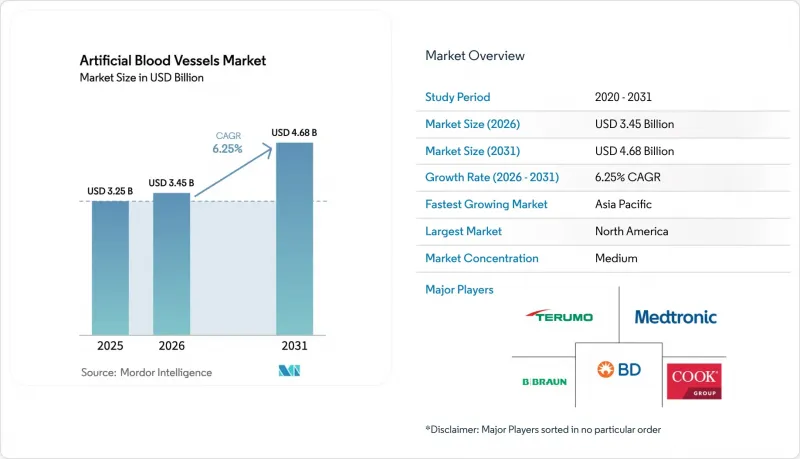
This report is Segmented by Application (Aortic Disease, Peripheral Artery Disease, Hemodialysis, and More), Polymer Type (Polydioxanone, Polyurethane, and More), End User (Hospitals, Ambulatory Surgical Centers, and More), Device Type (Synthetic Vascular Grafts, and More), and Geography (North America, and More). The Market Provides the Value (in USD) for the Above-Mentioned Segments.
Global Artificial Blood Vessels Market Trends and Insights
Rising Prevalence of Cardiovascular & Peripheral Artery Disease
Peripheral artery disease affected 113 million people worldwide in 2025, including 6.5 million U.S. patients, and prevalence doubles with each decade of life after age 50. The aging demographic profiles of Japan, Germany, and South Korea therefore anchor long-term demand for durable vascular conduits. While supervised exercise therapy now precedes many interventions per the 2024 guideline, patients who progress to revascularization often present with advanced disease that mandates a reliable graft when autogenous vein is unavailable. Consequently, the Artificial Blood Vessels market benefits from a smaller yet higher-acuity treatment pool.
Advances in Biomaterials & Tissue-Engineered Graft Platforms
SYMVESS achieved 67% primary patency at 30 days and became the first tissue-engineered graft cleared in the United States in December 2024. The milestone validated two decades of extracellular-matrix research and is compressing review cycles for follow-on platforms. Bacterial nanocellulose synthesized by Komagataeibacter xylinus replicates collagen's nanofibrillar structure, surpasses 200 MPa tensile strength, and promotes endothelial adhesion, positioning it as the fastest-growing polymer in the Artificial Blood Vessels market. China's TEDA Bioprinting recorded 95% cell viability in 10 cm patient-specific grafts in 2024 and begins clinical trials in 2025.
High Procedure and Device Costs
Medicare's 2025 ambulatory payment range of USD 5,702-17,957 per vascular code does not fully offset total episode-of-care costs, which include premium graft pricing, radiology, anesthesia, and surveillance. BEST-CLI showed 32% fewer major limb events with autogenous vein, reinforcing payer skepticism toward synthetic grafts in infra-inguinal disease. Outside high-income markets, out-of-pocket expenditure above 40% in India and Indonesia narrows the addressable base for bioengineered products.
Other drivers and restraints analyzed in the detailed report include:
- Expansion of the Global Hemodialysis Population
- 3-D Printing & Digital-Twin Personalization of Patient-Specific Grafts
- Stringent Multi-Jurisdictional Regulatory Pathways
For complete list of drivers and restraints, kindly check the Table Of Contents.
Segment Analysis
Traumatic vascular injury drove an 11.25% CAGR outlook from 2026 to 2031, fueled by military procurement and level-1 trauma centers prioritizing shelf-stable grafts that bypass vein harvesting delays. SYMVESS's 67% primary patency and 9% amputation rate in extremity trauma demonstrate outcome parity with legacy synthetics while cutting operative time. Aortic disease, by contrast, retained 42.56% of the Artificial Blood Vessels market share in 2025 behind the ascendancy of thoracic endovascular repair, which now handles 81% of abdominal aneurysm cases in the United States. Open surgical volumes are falling, yet each hybrid stent-graft incorporates polyethylene terephthalate or polytetrafluoroethylene fabric, sustaining material demand. Peripheral artery disease applications encounter guideline-driven headwinds favoring autogenous vein, whereas dialysis vascular access remains resilient due to fistula maturation failure rates that exceed 38%.
Bacterial nanocellulose is on track for a 12.85% CAGR through 2031, propelled by mechanical compliance mirroring collagen and superior cell adhesion that reduces intimal hyperplasia risk. Polyethylene terephthalate kept a 36.53% foothold in 2025 as woven and knitted PET grafts remain the standard for large-diameter aortic repairs, especially in Europe where surgeons value burst strength and kink resistance. Expanded polytetrafluoroethylene continues to dominate small- and medium-diameter bypasses, augmented by heparin-bonded surfaces like PROPATEN that lengthen patency. Hybrid composite polymers are emerging in complex arch repairs, combining polytetrafluoroethylene luminal surfaces with PET structural meshes to balance compliance and radial strength.
Complete Report Scope:
- By Application
- Aortic Disease
- Peripheral Artery Disease
- Hemodialysis
- Coronary Artery Bypass Grafting
- Traumatic Vascular Injury
- Pediatric Congenital Vessel Repair
- By Polymer Type
- Polydioxanone
- Polyurethane
- Polyethylene Terephthalate
- Expanded PTFE
- Biosynthetic / Tissue-Engineered
- Bacterial Nanocellulose
- Hybrid Composite Polymers
- By End User
- Hospitals
- Ambulatory Surgical Centers
- Cardiac Catheterization Laboratories
- Specialty Vascular Clinics
- Military & Emergency Trauma Centers
- By Device Type
- Synthetic Vascular Grafts
- Bioengineered Acellular Vessels
- Drug-Eluting Vascular Grafts
- Smart Sensor-Enabled Grafts
- By Geography
- North America
- United States
- Canada
- Mexico
- Europe
- Germany
- United Kingdom
- France
- Italy
- Spain
- Rest of Europe
- Asia-Pacific
- China
- India
- Japan
- Australia
- South Korea
- Rest of Asia-Pacific
- Middle East and Africa
- GCC
- South Africa
- Rest of Middle East and Africa
- South America
- Brazil
- Argentina
- Rest of South America
- North America
Geography Analysis
North America retained 42.13% of global revenues in 2025 amid substantial Medicare reimbursement, yet vein-first clinical guidance and the competitively successful BEST-CLI study curb infra-inguinal prosthetic usage. Still, 6.5 million U.S. peripheral artery disease patients and a surge in thoracic endovascular repairs sustain baseline demand. Canadian and Mexican uptake trails, but Humacyte's SYMVESS approval sets a precedent that is catalyzing U.S. investigational device submissions for follow-on tissue-engineered grafts.
Asia-Pacific is projected to post the fastest 10.51% CAGR, leveraging high cardiovascular disease prevalence in China and India. However, healthcare spending patterns marked by > 40% out-of-pocket outlays in several markets dampen uptake of premium bioengineered products. China's TEDA Bioprinting is positioning to export patient-specific conduits, while Japan and South Korea apply fast-track approvals for locally manufactured grafts to meet dialysis and peripheral artery disease demand. Australia's universal insurance and South Korea's single-payer system support rapid adoption of endovascular techniques and associated grafts.
Europe's growth lags North America and Asia-Pacific but benefits from a mature vascular surgery infrastructure. The 2025 European Society of Vascular Surgery consensus reported 7.3% in-hospital mortality and 5.0% stroke during arch TEVAR, prompting iterative design upgrades in stent-graft geometry and delivery systems. Germany, France, and the United Kingdom remain volume anchors; Spain and Italy contribute smaller but steady demand. MDR compliance presents cost and time-to-market challenges that favor incumbents, yet CE-first strategies, as executed by PECA Labs with its growth-accommodating exGraft, remain attractive for U.S. start-ups. Latin America and the Middle East & Africa are nascent, with Dubai and Riyadh tertiary centers importing high-end grafts, while Brazil favors cost-effective synthetics in its public system.
- B. Braun
- Beckton Dickinson
- Boston Scientific
- Cardinal Health
- Cook Group
- CryoLife Inc. (Artivion)
- Endologix LLC
- Getinge AB (Maquet)
- Humacyte
- InnAVasc Medical Inc.
- Japan Lifeline Co., Ltd.
- JOTEC
- LeMaitre Vascular
- Medtronic
- Suokang Medical (Shanghai)
- Techshot Inc.
- Terumo Medical Corp.
- Vascudyne Inc.
- W. L. Gore & Associates
- Xeltis AG
Additional Benefits:
- The market estimate (ME) sheet in Excel format
- 3 months of analyst support
TABLE OF CONTENTS
1 Introduction
- 1.1 Study Assumptions & Market Definition
- 1.2 Scope of the Study
2 Research Methodology
3 Executive Summary
4 Market Landscape
- 4.1 Market Overview
- 4.2 Market Drivers
- 4.2.1 Rising prevalence of cardiovascular & peripheral artery diseases
- 4.2.2 Growing adoption of minimally-invasive/endovascular procedures
- 4.2.3 Advances in biomaterials & tissue-engineered graft platforms
- 4.2.4 Expansion of global hemodialysis population needing vascular access
- 4.2.5 3-D printing & digital-twin personalization of patient-specific grafts
- 4.2.6 Defense-funded trauma programs seeking shelf-stable off-the-shelf vessels
- 4.3 Market Restraints
- 4.3.1 High procedure & device costs
- 4.3.2 Stringent, multi-jurisdictional regulatory pathways
- 4.3.3 Drug-eluting stent alternatives lowering standalone graft demand
- 4.3.4 PTFE & PET supply-chain disruptions constraining production
- 4.4 Supply-Chain Analysis
- 4.5 Regulatory Landscape
- 4.6 Technological Outlook
- 4.7 Porter's Five Forces
- 4.7.1 Threat of New Entrants
- 4.7.2 Bargaining Power of Buyers
- 4.7.3 Bargaining Power of Suppliers
- 4.7.4 Threat of Substitutes
- 4.7.5 Intensity of Competitive Rivalry
5 Market Size & Growth Forecasts (Value, USD)
- 5.1 By Application
- 5.1.1 Aortic Disease
- 5.1.2 Peripheral Artery Disease
- 5.1.3 Hemodialysis
- 5.1.4 Coronary Artery Bypass Grafting
- 5.1.5 Traumatic Vascular Injury
- 5.1.6 Pediatric Congenital Vessel Repair
- 5.2 By Polymer Type
- 5.2.1 Polydioxanone
- 5.2.2 Polyurethane
- 5.2.3 Polyethylene Terephthalate
- 5.2.4 Expanded PTFE
- 5.2.5 Biosynthetic / Tissue-Engineered
- 5.2.6 Bacterial Nanocellulose
- 5.2.7 Hybrid Composite Polymers
- 5.3 By End User
- 5.3.1 Hospitals
- 5.3.2 Ambulatory Surgical Centers
- 5.3.3 Cardiac Catheterization Laboratories
- 5.3.4 Specialty Vascular Clinics
- 5.3.5 Military & Emergency Trauma Centers
- 5.4 By Device Type
- 5.4.1 Synthetic Vascular Grafts
- 5.4.2 Bioengineered Acellular Vessels
- 5.4.3 Drug-Eluting Vascular Grafts
- 5.4.4 Smart Sensor-Enabled Grafts
- 5.5 By Geography
- 5.5.1 North America
- 5.5.1.1 United States
- 5.5.1.2 Canada
- 5.5.1.3 Mexico
- 5.5.2 Europe
- 5.5.2.1 Germany
- 5.5.2.2 United Kingdom
- 5.5.2.3 France
- 5.5.2.4 Italy
- 5.5.2.5 Spain
- 5.5.2.6 Rest of Europe
- 5.5.3 Asia-Pacific
- 5.5.3.1 China
- 5.5.3.2 India
- 5.5.3.3 Japan
- 5.5.3.4 Australia
- 5.5.3.5 South Korea
- 5.5.3.6 Rest of Asia-Pacific
- 5.5.4 Middle East and Africa
- 5.5.4.1 GCC
- 5.5.4.2 South Africa
- 5.5.4.3 Rest of Middle East and Africa
- 5.5.5 South America
- 5.5.5.1 Brazil
- 5.5.5.2 Argentina
- 5.5.5.3 Rest of South America
- 5.5.1 North America
6 Competitive Landscape
- 6.1 Market Concentration
- 6.2 Market Share Analysis
- 6.3 Company Profiles (includes Global level Overview, Market level overview, Core Segments, Financials as available, Strategic Information, Market Rank/Share, Products & Services, and Recent Developments)
- 6.3.1 B. Braun Melsungen AG
- 6.3.2 Becton, Dickinson & Co.
- 6.3.3 Boston Scientific Corp.
- 6.3.4 Cardinal Health
- 6.3.5 Cook Medical Inc.
- 6.3.6 CryoLife Inc. (Artivion)
- 6.3.7 Endologix LLC
- 6.3.8 Getinge AB (Maquet)
- 6.3.9 Humacyte Inc.
- 6.3.10 InnAVasc Medical Inc.
- 6.3.11 Japan Lifeline Co., Ltd.
- 6.3.12 Jotec GmbH
- 6.3.13 LeMaitre Vascular Inc.
- 6.3.14 Medtronic plc
- 6.3.15 Suokang Medical (Shanghai)
- 6.3.16 Techshot Inc.
- 6.3.17 Terumo Medical Corp.
- 6.3.18 Vascudyne Inc.
- 6.3.19 W. L. Gore & Associates
- 6.3.20 Xeltis AG
7 Market Opportunities & Future Outlook
- 7.1 White-space & Unmet-Need Assessment

