PUBLISHER: Mordor Intelligence | PRODUCT CODE: 2113600

PUBLISHER: Mordor Intelligence | PRODUCT CODE: 2113600
Pancreatic Cancer Therapeutics And Diagnostics - Market Share Analysis, Industry Trends & Statistics, Growth Forecasts (2026 - 2031)
According to Mordor Intelligence, the pancreatic cancer therapeutics and diagnostics market size is expected to grow from USD 4.90 billion in 2025 to USD 5.25 billion in 2026 and is forecast to reach USD 7.39 billion by 2031 at 7.08% CAGR over 2026-2031.
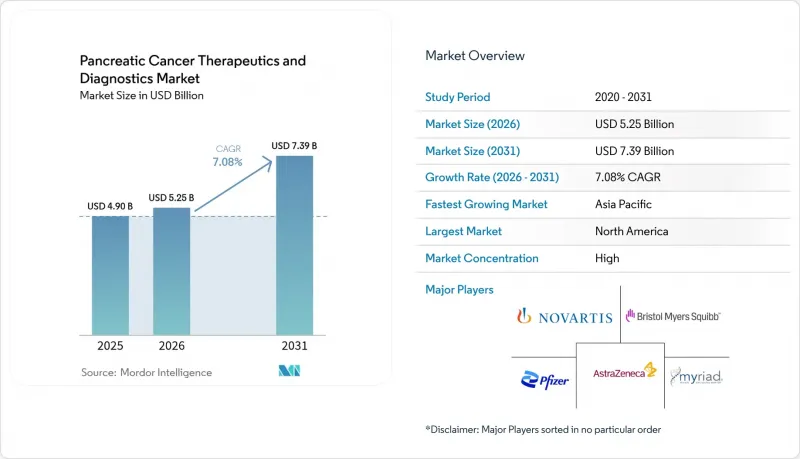
This report is Segmented by Product (Therapeutic Modality, Diagnostic Modality), End User (Hospitals & Academic Medical Centers, Oncology Specialty Clinics, Diagnostic Laboratories, Research Institutes), and Geography (North America, Europe, Asia-Pacific, South America, Middle East and Africa). The Market Forecasts are Provided in Terms of Value (USD).
Global Pancreatic Cancer Therapeutics And Diagnostics Market Trends and Insights
Rising incidence & earlier-stage detection rates
Population aging and lifestyle shifts are sending pancreatic adenocarcinoma incidence climbing, especially in China and the United States. Surveillance programs that monitor familial and genetic high-risk cohorts now report 50% five-year survival for screen-detected cases versus 9% for symptomatic presentations . High-resolution MRI coupled with liquid-biopsy assays capable of 95% sensitivity are detecting pre-malignant lesions, moving treatment intent from palliation to cure. Surgical centers are expanding robotics suites to meet early-stage resection demand, while neoadjuvant chemotherapy protocols such as PAXG deliver 31% three-year event-free survival, more than doubling historical outcomes . The combined epidemiologic and diagnostic momentum materially lifts procedure volumes and systemic-therapy utilization across the pancreatic cancer therapeutics and diagnostics market.
Accelerated FDA fast-track designations for novel therapies
The U.S. FDA has labeled multiple pancreatic cancer assets-Daraxonrasib for KRAS mutations, EBC-129 ADC, and the DAMO PANDA AI diagnostic tool-as breakthrough products, trimming typical timelines by nearly two years. Parallel companion-diagnostic reviews streamline synchronized market entry for test-and-treat bundles. Such regulatory velocity incentivizes investors, boosting valuations and expediting Phase II/III financing rounds for start-ups positioned inside the pancreatic cancer therapeutics and diagnostics market. European and Asian regulators frequently reciprocate accelerated reviews, amplifying global spillover.
High attrition rates in late-stage clinical trials
Pancreatic tumors' dense stroma and immunosuppressive microenvironment render many promising agents ineffective in Phase III. Recent high-profile immunotherapy combinations failed to demonstrate significant survival benefit, triggering portfolio reshuffles and depressing follow-on funding. Regulators now mandate larger cohorts and longer follow-up, pushing development costs above USD 450 million per asset. These setbacks delay the flow of new treatments into the pancreatic cancer therapeutics and diagnostics market and heighten investors' risk perception.
Other drivers and restraints analyzed in the detailed report include:
- Surge in biomarker-guided precision medicine trials
- Growing reimbursement for next-generation sequencing panels
- Limited patient pools constrain trial enrollment
For complete list of drivers and restraints, kindly check the Table Of Contents.
Segment Analysis
Therapeutic modalities captured 59.84% of pancreatic cancer therapeutics and diagnostics market share in 2025, underpinned by combination regimens like NALIRIFOX that extend median overall survival beyond 12 months. Chemotherapy remains the foundation, yet targeted KRAS-blocking agents and subcutaneous checkpoint inhibitors add differentiated options. Radiopharmaceutical advances and stereotactic ablative radiotherapy further diversify the therapeutic armamentarium. Manufacturers pair new drugs with companion diagnostics to ensure precise patient selection, driving bundled revenue streams. Competitive rivalry centers on pipeline depth and speed to secure additional breakthrough designations that can convert into first-mover advantage.
Diagnostic modalities expand at a 7.55% CAGR, the fastest within the pancreatic cancer therapeutics and diagnostics market. Liquid-biopsy platforms integrating exosomal microRNA panels now achieve 97% accuracy when combined with CA19-9, enabling stage I detection. AI-enhanced endoscopic ultrasound improves lesion delineation, shortening procedure time and minimizing false negatives. Multi-omics assays that merge genomics, proteomics, and metabolomics shape next-generation companion diagnostics. Vendor differentiat ion hinges on analytical sensitivity and frictionless integration into oncologists' ordering systems, fostering high switching costs.
Complete Report Scope:
- By Product
- Therapeutic Modality
- Chemotherapy
- Targeted Therapy
- Immunotherapy
- Radiotherapy
- Combination Therapy
- Diagnostic Modality
- Imaging (CT, MRI, PET)
- Endoscopic Ultrasound (EUS)
- Biomarker Tests
- Liquid Biopsy
- Molecular Diagnostics
- Therapeutic Modality
- By End User
- Hospitals & Academic Medical Centers
- Oncology Specialty Clinics
- Diagnostic Laboratories
- Research Institutes
- By Geography
- North America
- United States
- Canada
- Mexico
- Europe
- Germany
- United Kingdom
- France
- Italy
- Spain
- Rest of Europe
- Asia-Pacific
- China
- India
- Japan
- South Korea
- Australia
- Rest of Asia-Pacific
- South America
- Brazil
- Argentina
- Rest of South America
- Middle East and Africa
- GCC
- South Africa
- Rest of Middle East and Africa
- North America
Geography Analysis
North America generated 43.92% of 2025 revenue. Accelerated FDA reviews and Medicare reimbursement for next-generation sequencing underpin high adoption levels. Yet cost-effectiveness scrutiny intensifies; analyses peg NALIRIFOX at USD 206,341 per QALY, pushing payers toward value-based contracting . Academic expansions, such as the approved 300-bed Dana-Farber hospital, deepen regional expertise and clinical-trial throughput.
Asia-Pacific is forecast to post an 7.86% CAGR, the strongest globally. China's aging population, rising obesity, and smoking prevalence propel incidence, while public-private partnerships finance molecular-testing labs and precision-oncology parks. Japan's regulatory harmonization with U.S. breakthrough-therapy policies shortens drug-approval lags to under six months, facilitating swift diffusion of innovative regimens. Governments allocate funds for surgeon-training programs in robotic resection, elevating curative-intent procedure volumes.
Europe maintains moderate growth as the European Medicines Agency approved 28 oncology therapies in 2024, including NALIRIFOX. Health-technology assessments by NICE increasingly factor pharmacogenomics, incentivizing payers to reimburse sequencing. Cross-border clinical-trial consortia streamline enrollment for rare biomarker cohorts, while EU investments in isotope-production facilities mitigate sporadic shortages that hamper diagnostic imaging. Still, stringent price negotiations curb immediate revenue upside for manufacturers within the pancreatic cancer therapeutics and diagnostics market.
- Roche
- Bristol-Myers Squibb
- Celgene
- Novartis
- AstraZeneca
- Pfizer
- Merck
- Eli Lilly and Company
- Amgen
- Ipsen
- Abbvie
- Johnson & Johnson
- Thermo Fisher Scientific
- Illumina
- QIAGEN
- Guardant Health
- Exact Sciences
- Siemens Healthineers
- GE Healthcare Technologies Inc.
- Abbott Laboratories
Additional Benefits:
- The market estimate (ME) sheet in Excel format
- 3 months of analyst support
TABLE OF CONTENTS
1 Introduction
- 1.1 Study Assumptions & Market Definition
- 1.2 Scope of the Study
2 Research Methodology
3 Executive Summary
4 Market Landscape
- 4.1 Market Overview
- 4.2 Market Drivers
- 4.2.1 Rising incidence & earlier-stage detection rates
- 4.2.2 Accelerated FDA fast-track designations for novel therapies
- 4.2.3 Surge in biomarker-guided precision medicine trials
- 4.2.4 Growing reimbursement for next-generation sequencing panels
- 4.2.5 Venture-capital inflow into liquid-biopsy start-ups
- 4.2.6 AI-driven imaging algorithms improving diagnostic accuracy
- 4.3 Market Restraints
- 4.3.1 High attrition rates in late-stage clinical trials
- 4.3.2 Limited patient pools constrain trial enrollment
- 4.3.3 Complex supply chain for radiopharmaceutical tracers
- 4.3.4 Rising pricing pressure from payers & HTA bodies
- 4.4 Value / Supply-Chain Analysis
- 4.5 Regulatory Landscape
- 4.6 Technological Outlook
- 4.7 Porter's Five Forces
- 4.7.1 Threat of New Entrants
- 4.7.2 Bargaining Power of Suppliers
- 4.7.3 Bargaining Power of Buyers
- 4.7.4 Threat of Substitutes
- 4.7.5 Competitive Rivalry
5 Market Size & Growth Forecasts (Value)
- 5.1 By Product
- 5.1.1 Therapeutic Modality
- 5.1.1.1 Chemotherapy
- 5.1.1.2 Targeted Therapy
- 5.1.1.3 Immunotherapy
- 5.1.1.4 Radiotherapy
- 5.1.1.5 Combination Therapy
- 5.1.2 Diagnostic Modality
- 5.1.2.1 Imaging (CT, MRI, PET)
- 5.1.2.2 Endoscopic Ultrasound (EUS)
- 5.1.2.3 Biomarker Tests
- 5.1.2.4 Liquid Biopsy
- 5.1.2.5 Molecular Diagnostics
- 5.1.1 Therapeutic Modality
- 5.2 By End User
- 5.2.1 Hospitals & Academic Medical Centers
- 5.2.2 Oncology Specialty Clinics
- 5.2.3 Diagnostic Laboratories
- 5.2.4 Research Institutes
- 5.3 By Geography
- 5.3.1 North America
- 5.3.1.1 United States
- 5.3.1.2 Canada
- 5.3.1.3 Mexico
- 5.3.2 Europe
- 5.3.2.1 Germany
- 5.3.2.2 United Kingdom
- 5.3.2.3 France
- 5.3.2.4 Italy
- 5.3.2.5 Spain
- 5.3.2.6 Rest of Europe
- 5.3.3 Asia-Pacific
- 5.3.3.1 China
- 5.3.3.2 India
- 5.3.3.3 Japan
- 5.3.3.4 South Korea
- 5.3.3.5 Australia
- 5.3.3.6 Rest of Asia-Pacific
- 5.3.4 South America
- 5.3.4.1 Brazil
- 5.3.4.2 Argentina
- 5.3.4.3 Rest of South America
- 5.3.5 Middle East and Africa
- 5.3.5.1 GCC
- 5.3.5.2 South Africa
- 5.3.5.3 Rest of Middle East and Africa
- 5.3.1 North America
6 Competitive Landscape
- 6.1 Market Concentration
- 6.2 Market Share Analysis
- 6.3 Company Profiles (includes Global level Overview, Market level overview, Core Segments, Financials as available, Strategic Information, Market Rank/Share for key companies, Products & Services, and Recent Developments)
- 6.3.1 F. Hoffmann-La Roche AG
- 6.3.2 Bristol-Myers Squibb Company
- 6.3.3 Celgene Corporation
- 6.3.4 Novartis AG
- 6.3.5 AstraZeneca PLC
- 6.3.6 Pfizer Inc.
- 6.3.7 Merck & Co., Inc.
- 6.3.8 Eli Lilly and Company
- 6.3.9 Amgen Inc.
- 6.3.10 Ipsen Pharma
- 6.3.11 AbbVie Inc.
- 6.3.12 Johnson & Johnson (Janssen)
- 6.3.13 Thermo Fisher Scientific Inc.
- 6.3.14 Illumina Inc.
- 6.3.15 Qiagen N.V.
- 6.3.16 Guardant Health Inc.
- 6.3.17 Exact Sciences Corporation
- 6.3.18 Siemens Healthineers AG
- 6.3.19 GE Healthcare Technologies Inc.
- 6.3.20 Abbott Laboratories
7 Market Opportunities & Future Outlook
- 7.1 White-space & Unmet-Need Assessment

