PUBLISHER: Mordor Intelligence | PRODUCT CODE: 2113603

PUBLISHER: Mordor Intelligence | PRODUCT CODE: 2113603
South America Feed Binders - Market Share Analysis, Industry Trends & Statistics, Growth Forecasts (2026 - 2031)
According to Mordor Intelligence, the South America feed binders market size is expected to grow from USD 300 million in 2025 to USD 318.12 million in 2026 and is forecast to reach USD 426.48 million by 2031 at 6.04% CAGR over 2026-2031.
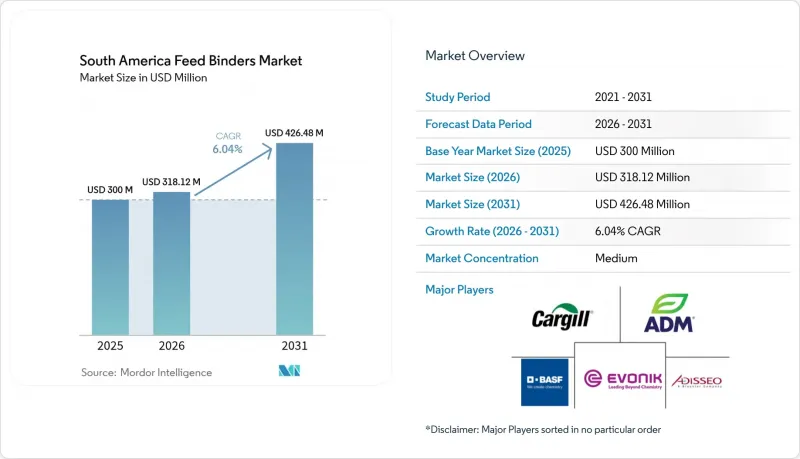
This report is Segmented by Type (Natural and Synthetic), by Animal (Ruminant, Poultry, Swine, Aquaculture, and Other Animal Types), and by Country (Brazil, Argentina, and More). The Market Forecasts are Provided in Terms of Value (USD).
South America Feed Binders Market Trends and Insights
Growing Livestock Production
Commercial animal numbers continue to climb in Brazil and Colombia, lifting compound feed output and creating a sustained pull for durable binders that cut fines and improve pellet density. According to FAOSTAT, Brazil's production of poultry meat was 14.9 million metric tons in 2022, which increased by 15.0 million metric tons in 2023. Even in Argentina, where cattle numbers slipped in 2024, export-oriented feedlots still rely on consistent binder performance to secure premium carcass yields. Peru's cash-positive broiler and swine operators are also shifting from mash to pelleted formulations, opening opportunities for specialized binding systems compatible with lower-throughput mills.
Focus on Animal Health and Nutrition
The regional shift toward antibiotic-free production systems has elevated the importance of functional feed binders that deliver gut health benefits beyond mechanical pellet integrity. Argentina's Resolution 445/2024 prohibits antimicrobial use for growth promotion and sub-therapeutic dosing, creating immediate market opportunities for binders incorporating prebiotics, organic acids, or botanical extracts. Brazilian broiler integrators now ask for plant tannin or yeast-derived binders that combine physical cohesion with microbiome modulation. Chilean salmon producers pursue kelp-based hydrocolloids enriched with prebiotics to enhance disease resistance during warm-water stress events. These multifaceted requirements favor suppliers that can deliver turnkey technical advice alongside the product.
High Raw-Material Price Volatility
Commodity price fluctuations for key binder ingredients create significant margin pressure and formulation instability for regional feed manufacturers. Corn-based starch prices, fundamental to many binding systems, experience seasonal variations exceeding 25% annually, while guar gum imports from India face currency exchange risks and supply chain disruptions. Currency devaluation in Argentina magnifies import bills for specialty polymers while Brazilian mills fight freight surcharges tied to river droughts. Contracting long-term supply and diversifying toward locally available lignocellulosic sources are the main mitigation strategies, and supplier consolidation limits bargaining leverage.
Other drivers and restraints analyzed in the detailed report include:
- Sustainability and Natural Feed Additives
- Expansion of Precision Pelletization and Micro-Batch Feed Mills
- Capital Requirement for Modern Pellet Mills
For complete list of drivers and restraints, kindly check the Table Of Contents.
Segment Analysis
Natural binders command 61.35% South America feed binder market size in 2025 and are forecast to expand at a 7.34% CAGR, reflecting the region's accelerating transition toward sustainable feed additive solutions. Clay-based binders, particularly bentonite and kaolin, maintain strong positions in traditional livestock applications due to their cost-effectiveness and proven durability in pellet performance. Plant-based solutions, including guar gum and starch derivatives, are gaining traction in premium feed formulations, supported by local production capabilities and compatibility with organic certification. Hydrocolloids such as carrageenan and xanthan demonstrate particular strength in aquaculture applications where water stability requirements favor marine-derived binding agents over terrestrial alternatives.
Synthetic alternatives primarily serve cost-sensitive applications and specialized industrial feed requirements. Polyvinyl acetate and acrylic polymers maintain relevance in high-throughput commercial operations where consistent binding performance outweighs sustainability considerations. Regulatory pressure and consumer preferences are increasingly constraining the adoption of synthetic binders, particularly in export-oriented livestock operations serving European and North American markets with stringent residue standards.
Complete Report Scope:
- By Type
- Natural
- Synthetic
- By Animal Type
- Poultry
- Swine
- Ruminants
- Aquaculture
- Other Animal Types
- By Country
- Brazil
- Argentina
- Chile
- Colombia
- Peru
- Rest of South America
List of Companies Covered in this Report:
- Cargill, Incorporated
- Archer-Daniels-Midland Company
- Evonik Industries AG
- BASF SE
- Adisseo Nutrition Group Limited
- Kemin Industries, Inc.
- Bentoli, Inc.
- Uniscope, Inc.
- Borregaard ASA
- Avebe U.A.
- CP Kelco Inc.
- Darling Ingredients Inc.
- Gelita AG
- Roquette Freres S.A
- International Flavors & Fragrances Inc.
Additional Benefits:
- The market estimate (ME) sheet in Excel format
- 3 months of analyst support
TABLE OF CONTENTS
1 Introduction
- 1.1 Study Assumptions and Market Definition
- 1.2 Scope of the Study
2 Research Methodology
3 Executive Summary
4 Market Landscape
- 4.1 Market Overview
- 4.2 Market Drivers
- 4.2.1 Growing Livestock Production
- 4.2.2 Focus on Animal Health and Nutrition
- 4.2.3 Sustainability and Natural Feed Additives
- 4.2.4 Expansion of Precision Pelletization and Micro-Batch Feed Mills
- 4.2.5 Surging Aquaculture Intensification along Amazon Basin
- 4.2.6 Government Carbon-Intensity Programs Driving Methane-Reducing Binders
- 4.3 Market Restraints
- 4.3.1 High Raw-Material Price Volatility
- 4.3.2 Capital Requirement for Modern Pellet Mills
- 4.3.3 Low Density of Cold-Chain and Humidity Control in Remote Ports
- 4.3.4 Regulatory Uncertainty on Secondary-Metabolite Residue Limits
- 4.4 Regulatory Landscape
- 4.5 Technological Outlook
- 4.6 Porter's Five Forces Analysis
- 4.6.1 Bargaining Power of Suppliers
- 4.6.2 Bargaining Power of Buyers
- 4.6.3 Threat of New Entrants
- 4.6.4 Threat of Substitutes
- 4.6.5 Intensity of Competitive Rivalry
5 Market Size and Growth Forecasts (Value)
- 5.1 By Type
- 5.1.1 Natural
- 5.1.2 Synthetic
- 5.2 By Animal Type
- 5.2.1 Poultry
- 5.2.2 Swine
- 5.2.3 Ruminants
- 5.2.4 Aquaculture
- 5.2.5 Other Animal Types
- 5.3 By Country
- 5.3.1 Brazil
- 5.3.2 Argentina
- 5.3.3 Chile
- 5.3.4 Colombia
- 5.3.5 Peru
- 5.3.6 Rest of South America
6 Competitive Landscape
- 6.1 Market Concentration
- 6.2 Strategic Moves
- 6.3 Market Share Analysis
- 6.4 Company Profiles (includes Global level Overview, Market level overview, Core Segments, Financials as available, Strategic Information, Market Rank/Share for key companies, Products and Services, and Recent Developments)
- 6.4.1 Cargill, Incorporated
- 6.4.2 Archer-Daniels-Midland Company
- 6.4.3 Evonik Industries AG
- 6.4.4 BASF SE
- 6.4.5 Adisseo Nutrition Group Limited
- 6.4.6 Kemin Industries, Inc.
- 6.4.7 Bentoli, Inc.
- 6.4.8 Uniscope, Inc.
- 6.4.9 Borregaard ASA
- 6.4.10 Avebe U.A.
- 6.4.11 CP Kelco Inc.
- 6.4.12 Darling Ingredients Inc.
- 6.4.13 Gelita AG
- 6.4.14 Roquette Freres S.A
- 6.4.15 International Flavors & Fragrances Inc.
7 Market Opportunities and Future Outlook

