PUBLISHER: Mordor Intelligence | PRODUCT CODE: 2113610

PUBLISHER: Mordor Intelligence | PRODUCT CODE: 2113610
Asia-Pacific Feed Anti-Caking Agent - Market Share Analysis, Industry Trends & Statistics, Growth Forecasts (2026 - 2031)
According to Mordor Intelligence, Asia-Pacific feed anti-caking agent market size in 2026 is estimated at USD 598.35 million, growing from 2025 value of USD 560.67 million with 2031 projections showing USD 828.29 million, growing at 6.72% CAGR over 2026-2031.
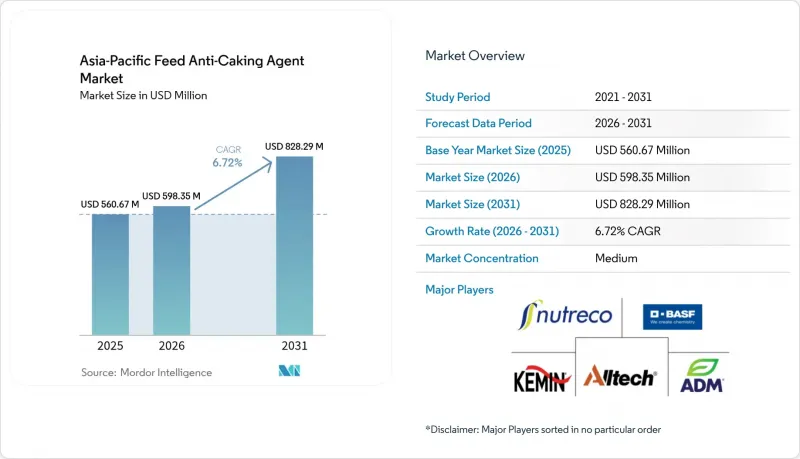
This report is Segmented by (Silicon-Based, Sodium-Based, Calcium-Based, Potassium-Based, and Other Chemical Types), by Animal Type (Ruminants, Poultry, Swine, Aquaculture, and Other Animal Types), by Geography (China, India, Japan, Australia, and the Rest of Asia-Pacific). The Market Forecasts are Provided in Terms of Value (USD).
Asia-Pacific Feed Anti-Caking Agent Market Trends and Insights
Rising Demand for Livestock Protein
Per-capita meat intake across the region is converging toward 50 kg per year, a threshold that historically catalyzes feed-mill automation and standardized premix use. China's 2024 compound feed output surpassed 220 million metric tons, necessitating reliable anti-caking agents to keep tall silos flowing smoothly. India's layer segment added 12% new capacity in 2024, each complex requiring flow aids to stabilize hygroscopic mineral blends . Aquafeed in Vietnam and Thailand is absorbing additives twice as fast as ruminant rations because pellet durability is critical once submerged. As integrators discover that a 0.1% dosage uptick can trim feed waste by 3-4% in automated systems, anti-caking adoption tightens in lockstep with rising protein demand.
Expansion of Industrial Feed Mills
More than USD 2 billion in greenfield feed-mill investments closed during 2024 across India, Indonesia, and the Philippines. Plants rated above 30 metric tons/hectare employ continuous mixers where any bridging halts lines and triggers contract penalties. Cargill now issues regional anti-caking tenders instead of site-level buys, a move that concentrates volume and sharpens price competition . Even smaller rural mills are adopting flow aids to comply with ISO 22000 certification tied to government subsidies. The Asia-Pacific feed anti-caking market therefore benefits directly from every ton of new automated capacity that comes online.
High Cost of Specialized Additives
Potassium and calcium variants cost 25-40% more than sodium aluminosilicate, squeezing mills where raw materials already consume 75% of budgets. In India, half of compound feed comes from small mills that substitute cheaper natural clays outside monsoon months. Deferred upgrades keep sodium products dominant in price-sensitive tiers, damping the Asia-Pacific feed anti-caking market's premium mix until working-capital constraints ease.
Other drivers and restraints analyzed in the detailed report include:
- Mandatory Feed Safety Regulations
- Surge in Insect-Protein Inclusion Raising Free-Flow Challenges
- Availability of Natural Alternatives
For complete list of drivers and restraints, kindly check the Table Of Contents.
Segment Analysis
Sodium-based agents led with 40.55% of the Asia-Pacific feed anti-caking market share in 2025, while potassium-based variants are forecast to expand at a 9.03% CAGR to 2031, raising their Asia-Pacific feed anti-caking market share in premium premix channels. Bulk feed mills still favor sodium aluminosilicate for its proven efficacy at inclusion rates below 0.3%, but regulatory scrutiny over arsenic and the need to protect tight dosing tolerances are tilting new investment toward potassium and calcium alternatives. Silicon-based flow aids will retain relevance where throughput exceeds 30 metric tons/hectare, yet suppliers are increasingly documenting low-metal content to maintain access to Japan and Australia. Other chemistries, such as magnesium stearate, serve niche markets in aquaculture where pellet buoyancy is crucial.
Innovation momentum sits firmly with potassium. Evonik demonstrated that its sorbate-based powder reduced hopper bridging incidents by 30% in high-speed lines, convincing Japanese and South Korean premix plants to standardize on the chemistry. This carve-out signals diverging product portfolios, cost-driven commodity feed remains sodium territory, while precision-driven premix and specialty aquafeed migrate to potassium or calcium blends. Suppliers able to span both ends of this spectrum will capture the broadest slice of the Asia-Pacific feed anti-caking market.
Complete Report Scope:
- By Chemical Type
- Silicon-based
- Sodium-based
- Calcium-based
- Potassium-based
- Other Chemical Types
- By Animal Type
- Ruminants
- Poultry
- Swine
- Aquaculture
- Other Animal Types
- By Geography
- China
- India
- Japan
- Australia
- Rest of Asia-Pacific
List of Companies Covered in this Report:
- BASF SE
- Kemin Industries, Inc.
- Archer Daniels Midland Company
- Novus International, Inc. (Mitsui & Co., Ltd.)
- Nutreco N.V. (SHV Holdings N.V.)
- Alltech, Inc.
- Royal De Heus Animal Nutrition B.V.
- Cargill, Incorporated
- Evonik Industries AG
- Bluestar Adisseo Company (China National Bluestar Co.)
- Bentonite Performance Minerals LLC (Minerals Technologies Inc.)
- Imerys S.A.
- Huvepharma EAD (Advance Properties OOD)
- Kent Nutrition Group, Inc. (Kent Corporation)
- Uniscope, Inc.
Additional Benefits:
- The market estimate (ME) sheet in Excel format
- 3 months of analyst support
TABLE OF CONTENTS
1 Introduction
- 1.1 Study Assumptions and Market Definition
- 1.2 Scope of the Study
2 Research Methodology
3 Executive Summary
4 Market Landscape
- 4.1 Market Overview
- 4.2 Market Drivers
- 4.2.1 Rising demand for livestock protein
- 4.2.2 Expansion of industrial feed mills
- 4.2.3 Mandatory feed safety regulations
- 4.2.4 Surge in insect-protein inclusion raising free-flow challenges
- 4.2.5 Climate-driven rise in feed moisture during monsoons
- 4.2.6 Shift to precision micro-dosing in premixes requiring flow aids
- 4.3 Market Restraints
- 4.3.1 High cost of specialized additives
- 4.3.2 Availability of natural alternatives
- 4.3.3 Growing zero-additive labeling in premium feed
- 4.3.4 Stringent heavy-metal limits on silicate products
- 4.4 Regulatory Landscape
- 4.5 Porter's Five Forces Analysis
- 4.5.1 Bargaining Power of Suppliers
- 4.5.2 Bargaining Power of Buyers
- 4.5.3 Threat of New Entrants
- 4.5.4 Threat of Substitutes
- 4.5.5 Intensity of Competitive Rivalry
5 Market Size and Growth Forecasts (Value)
- 5.1 By Chemical Type
- 5.1.1 Silicon-based
- 5.1.2 Sodium-based
- 5.1.3 Calcium-based
- 5.1.4 Potassium-based
- 5.1.5 Other Chemical Types
- 5.2 By Animal Type
- 5.2.1 Ruminants
- 5.2.2 Poultry
- 5.2.3 Swine
- 5.2.4 Aquaculture
- 5.2.5 Other Animal Types
- 5.3 By Geography
- 5.3.1 China
- 5.3.2 India
- 5.3.3 Japan
- 5.3.4 Australia
- 5.3.5 Rest of Asia-Pacific
6 Competitive Landscape
- 6.1 Market Concentration
- 6.2 Strategic Moves
- 6.3 Market Share Analysis
- 6.4 Company Profiles (Includes Global Level Overview, Market Level Overview, Core Segments, Financials as Available, Strategic Information, Market Rank/Share for Key Companies, Products and Services, and Recent Developments)
- 6.4.1 BASF SE
- 6.4.2 Kemin Industries, Inc.
- 6.4.3 Archer Daniels Midland Company
- 6.4.4 Novus International, Inc. (Mitsui & Co., Ltd.)
- 6.4.5 Nutreco N.V. (SHV Holdings N.V.)
- 6.4.6 Alltech, Inc.
- 6.4.7 Royal De Heus Animal Nutrition B.V.
- 6.4.8 Cargill, Incorporated
- 6.4.9 Evonik Industries AG
- 6.4.10 Bluestar Adisseo Company (China National Bluestar Co.)
- 6.4.11 Bentonite Performance Minerals LLC (Minerals Technologies Inc.)
- 6.4.12 Imerys S.A.
- 6.4.13 Huvepharma EAD (Advance Properties OOD)
- 6.4.14 Kent Nutrition Group, Inc. (Kent Corporation)
- 6.4.15 Uniscope, Inc.
7 Market Opportunities and Future Outlook

