PUBLISHER: Mordor Intelligence | PRODUCT CODE: 2113626

PUBLISHER: Mordor Intelligence | PRODUCT CODE: 2113626
Main Battle Tank - Market Share Analysis, Industry Trends & Statistics, Growth Forecasts (2026 - 2031)
According to Mordor Intelligence, main battle tank (MBT) market size in 2026 is estimated at USD 6.96 billion, growing from 2025 value of USD 6.77 billion with 2031 projections showing USD 7.97 billion, growing at 2.75% CAGR over 2026-2031.
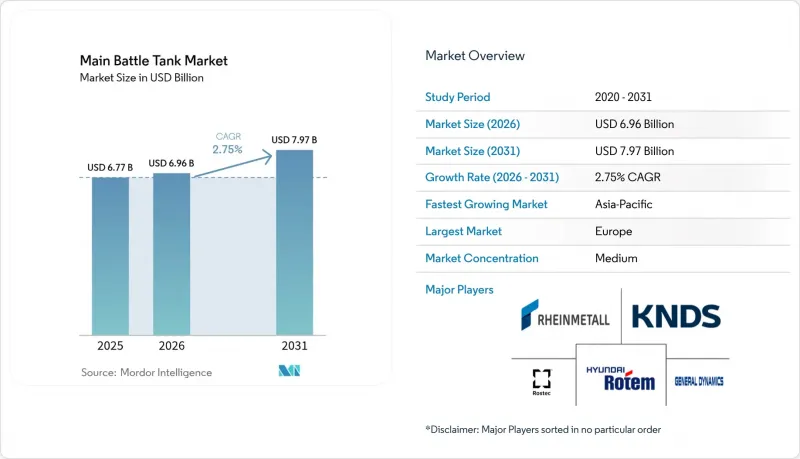
This report is Segmented by Type (Light, Medium, and Heavy), Propulsion (Conventional Diesel and Hybrid-Electric), Procurement Status (New-Build and Upgrade/Retrofit), Component (Hull and Armor Modules, Turret and Main Gun Systems, Powerpack and Drivetrain, and Fire-Control and Vetronics), and Geography (North America, Europe, and More). The Market Forecasts are Provided in Terms of Value (USD).
Global Main Battle Tank Market Trends and Insights
Escalating Geopolitical Tensions Drive Urgent Procurement
Russia's 2022 invasion of Ukraine compressed NATO tank acquisition timelines by 18 to 24 months, pushing Poland to finalize a USD 6.5 billion K2 order and Germany to authorize 105 Leopard 2A8 units within a single budget cycle. The MBT market now faces backlogs stretching beyond 36 months, a significant deviation from pre-crisis 24-month norms. US Congressional approval of USD 2 billion for Abrams line modernization assures surge capacity, yet supply chains for armor steel, thermal imagers, and power-pack castings remain fragile. Rising delivery lead times compel buyers to place multi-year block orders, locking in pricing but limiting flexibility for later technology insertions. Producers respond by dual-sourcing subsystems and pre-financing long-lead items to avoid penalties, reinforcing the MBT market's trend toward industrial consolidation and vertically integrated risk sharing.
Cold War Fleet Replacement Accelerates Modernization Cycles
NATO inventories still field roughly 8,000 legacy MBTs requiring replacement or deep overhaul before 2030. Programs in Bulgaria, the Czech Republic, and Romania illustrate the scale: unit upgrades cost 40-60% of new builds yet extend service life by only 15-20 years. This calculus steers wealthier states toward fresh platforms that embed active protection, open architecture vetronics, and hybrid drives from inception. Mid-tier allies, unable to fund clean-sheet development, pursue incremental modernization, thereby sustaining a parallel demand stream for retrofit kits. The dual-track approach enlarges the MBT market by blending high-value new-build contracts with lower-margin upgrade work, stabilizing OEM production rates and sparing governments from capability gaps.
High Acquisition and Operating Costs Compared to Other Defense Priorities
Unit prices for Western MBTs routinely exceed USD 12 million, while through-life support may quadruple that figure over 30 years. When juxtaposed with cheaper precision-guided artillery or unmanned systems, many treasuries hesitate to allocate scarce funds to armor. Fuel, track wear, and depot-level maintenance further strain budgets; for instance, the US Army annually costs USD 115,000 in fuel per M1 at 2025 prices. Such economics limit order sizes, impeding economies of scale and perpetuating cost inflation, restraining MBT market expansion.
Other drivers and restraints analyzed in the detailed report include:
- Active Protection Systems Integration Reshapes Platform Requirements
- Adoption of Hybrid-Electric Propulsion Addresses Logistical Vulnerabilities
- Rising Vulnerability to Drone-Based Top-Attack and Loitering Munitions
For complete list of drivers and restraints, kindly check the Table Of Contents.
Segment Analysis
Heavy MBTs commanded 54.12% of 2025 revenue, reflecting entrenched preferences for maximal protection, 120/125 mm main guns, and layered active protection. These tanks constitute the backbone of NATO deterrence formations and dominate premium export orders to Eastern Europe and the Gulf. Though smaller in revenue, light MBTs register the swiftest 3.11% CAGR on the strength of expeditionary requirements, urban maneuverability, and lower infrastructure demands. The US M10 Booker illustrates the class's ability to deliver direct fire while air-deployable within a C-17 load plan. Emerging doctrines envision mixed brigades where light units secure flanks and penetrate complex terrain. At the same time, heavy spearheads exploit breakthroughs, ensuring the MBT market addresses a spectrum of threat environments.
Operational data suggests heavy types endure longer when facing advanced anti-tank guided missiles thanks to modular composite armor, whereas light variants rely on mobility and sensor fusion. Asian buyers with archipelagic territories, such as the Philippines, favor lighter hulls to traverse limited bridge networks, while European states bordering Russia insist on Leopard 2A8-equivalent protection levels. The bifurcation sustains parallel production lines, expanding supplier opportunities for tailored drivetrains, suspension systems, and gun-mount configurations. Consequently, both weight classes are expected to coexist through 2030, supporting a resilient MBT market that pivots between strategic depth and tactical agility.
Conventional diesel engines powered 93.22% of deliveries in 2025 owing to their maturity, established depot infrastructure, and lower procurement costs. The MTU 883, Caterpillar C32, and Ukrainian 6TD families remain standard across NATO and non-aligned inventories. However, hybrid-electric prototypes record a 6.18% CAGR outlook as nations pursue reduced fuel logistics and enlarged onboard electrical reserves for sensors and directed-energy defense. Early modeling indicates 20-30% fuel savings and silent-watch endurance of >8 hours, an attractive radar signature mitigation asset.
While battery thermal-runaway risks and high-voltage maintenance complexities curb immediate mass adoption, the US M1E3's 2025 preliminary design review validates a path toward serial production by 2029. Europe's MGCS consortium and Korea's K-drive project plan have similar architectures, suggesting a tipping point in the late 2020s when hybrid propulsion penetrates frontline units. Providers of power electronics, cooling subsystems, and energy management software gain leverage, expanding the MBT market size for propulsion-adjacent solutions.
Complete Report Scope:
- By Type
- Light
- Medium
- Heavy
- By Propulsion
- Conventional Diesel
- Hybrid-Electric
- By Procurement Status
- New-Build
- Upgrade/Retrofit
- By Component
- Hull and Armor Modules
- Turret and Main Gun Systems
- Powerpack and Drivetrain
- Fire-Control and Vetronics
- By Geography
- North America
- United States
- Canada
- Mexico
- Europe
- United Kingdom
- France
- Germany
- Italy
- Rest of Europe
- Asia-Pacific
- China
- India
- Japan
- South Korea
- Rest of Asia-Pacific
- South America
- Brazil
- Rest of South America
- Middle East and Africa
- Middle East
- Saudi Arabia
- United Arab Emirates
- Rest of Middle East
- Africa
- South Africa
- Rest of Africa
- Middle East
- North America
Geography Analysis
Europe generated 30.98% of 2025 revenue, driven by Germany's commitment to defense spending at 3.5% of GDP by 2029 and large-scale Leopard 2A8 procurements. The Franco-German MGCS program aligns industrial champions KNDS, Rheinmetall, and Thales in a flagship collaboration that is expected to define future European requirements. Simultaneous Eastern European demand, motivated by proximity to the Ukraine conflict, further reinforces continental dominance in the MBT market.
Asia-Pacific presents the most dynamic outlook with a 3.41% CAGR, underpinned by India's 10% defense budget hike, Japan's record allocations, and Korea's K2 export momentum to Poland and prospective customers in the Gulf. Australia's LAND 400 Phase 3 and the Philippines' armored modernization add breadth, while China's indigenous production ensures regional competitive pressure. North America retains strategic importance through continuous Abrams upgrades and the transformational M1E3 project, whereas the Middle East exhibits selective, high-value acquisitions balanced by fiscal reforms and localization mandates. Africa's demand remains episodic due to infrastructure and finance constraints, limiting its contribution to the global MBT market.
- General Dynamics Corporation
- BAE Systems plc
- Rheinmetall AG
- KNDS N.V.
- Hyundai Rotem Company (Hyundai Motor Group)
- Dzerzhinsky Uralvagonzavod Research and Production Corporation (Rostec)
- Mitsubishi Heavy Industries, Ltd.
- Hanwha Corporation
- Otokar Otomotiv ve Savunma Sanayi A.S.
- BMC Otomotiv Sanayi ve Ticaret A.S.
- China North Industries Group Corporation Limited (NORINCO)
- Leonardo S.p.A.
- Rheinmetall BAE Systems Land Limited (Rheinmetall AG)
Additional Benefits:
- The market estimate (ME) sheet in Excel format
- 3 months of analyst support
TABLE OF CONTENTS
1 INTRODUCTION
- 1.1 Study Assumptions and Market Definition
- 1.2 Scope of the Study
2 RESEARCH METHODOLOGY
3 EXECUTIVE SUMMARY
4 MARKET LANDSCAPE
- 4.1 Market Overview
- 4.2 Market Drivers
- 4.2.1 Escalating geopolitical tensions driving new MBT acquisitions
- 4.2.2 Replacement demand for aging Cold War-era armored fleets
- 4.2.3 Increasing need for active protection system (APS)-compatible platforms
- 4.2.4 Adoption of hybrid-electric propulsion to reduce logistical burden
- 4.2.5 Integration of digital twin and predictive maintenance technologies to lower lifecycle costs
- 4.2.6 Availability of export credit facilities supporting international MBT sales
- 4.3 Market Restraints
- 4.3.1 High acquisition and operating costs compared to other defense priorities
- 4.3.2 Rising vulnerability to drone-based top-attack and loitering munitions
- 4.3.3 Infrastructure limitations due to bridge-load and mobility constraints in emerging regions
- 4.3.4 ESG and climate-related policies restricting access to defense capital
- 4.4 Value Chain Analysis
- 4.5 Regulatory Landscape
- 4.6 Technological Outlook
- 4.7 Porter's Five Forces Analysis
- 4.7.1 Bargaining Power of Suppliers
- 4.7.2 Bargaining Power of Buyers
- 4.7.3 Threat of New Entrants
- 4.7.4 Threat of Substitute Products
- 4.7.5 Intensity of Competitive Rivalry
5 MARKET SIZE AND GROWTH FORECASTS (VALUE)
- 5.1 By Type
- 5.1.1 Light
- 5.1.2 Medium
- 5.1.3 Heavy
- 5.2 By Propulsion
- 5.2.1 Conventional Diesel
- 5.2.2 Hybrid-Electric
- 5.3 By Procurement Status
- 5.3.1 New-Build
- 5.3.2 Upgrade/Retrofit
- 5.4 By Component
- 5.4.1 Hull and Armor Modules
- 5.4.2 Turret and Main Gun Systems
- 5.4.3 Powerpack and Drivetrain
- 5.4.4 Fire-Control and Vetronics
- 5.5 By Geography
- 5.5.1 North America
- 5.5.1.1 United States
- 5.5.1.2 Canada
- 5.5.1.3 Mexico
- 5.5.2 Europe
- 5.5.2.1 United Kingdom
- 5.5.2.2 France
- 5.5.2.3 Germany
- 5.5.2.4 Italy
- 5.5.2.5 Rest of Europe
- 5.5.3 Asia-Pacific
- 5.5.3.1 China
- 5.5.3.2 India
- 5.5.3.3 Japan
- 5.5.3.4 South Korea
- 5.5.3.5 Rest of Asia-Pacific
- 5.5.4 South America
- 5.5.4.1 Brazil
- 5.5.4.2 Rest of South America
- 5.5.5 Middle East and Africa
- 5.5.5.1 Middle East
- 5.5.5.1.1 Saudi Arabia
- 5.5.5.1.2 United Arab Emirates
- 5.5.5.1.3 Rest of Middle East
- 5.5.5.2 Africa
- 5.5.5.2.1 South Africa
- 5.5.5.2.2 Rest of Africa
- 5.5.5.1 Middle East
- 5.5.1 North America
6 COMPETITIVE LANDSCAPE
- 6.1 Market Concentration
- 6.2 Strategic Moves
- 6.3 Market Share Analysis
- 6.4 Company Profiles (includes Global level Overview, Market level overview, Core Segments, Financials as available, Strategic Information, Market Rank/Share for key companies, Products and Services, and Recent Developments)
- 6.4.1 General Dynamics Corporation
- 6.4.2 BAE Systems plc
- 6.4.3 Rheinmetall AG
- 6.4.4 KNDS N.V.
- 6.4.5 Hyundai Rotem Company (Hyundai Motor Group)
- 6.4.6 Dzerzhinsky Uralvagonzavod Research and Production Corporation (Rostec)
- 6.4.7 Mitsubishi Heavy Industries, Ltd.
- 6.4.8 Hanwha Corporation
- 6.4.9 Otokar Otomotiv ve Savunma Sanayi A.S.
- 6.4.10 BMC Otomotiv Sanayi ve Ticaret A.S.
- 6.4.11 China North Industries Group Corporation Limited (NORINCO)
- 6.4.12 Leonardo S.p.A.
- 6.4.13 Rheinmetall BAE Systems Land Limited (Rheinmetall AG)
7 MARKET OPPORTUNITIES AND FUTURE OUTLOOK
- 7.1 White-space and Unmet-Need Assessment

