PUBLISHER: Mordor Intelligence | PRODUCT CODE: 2113627

PUBLISHER: Mordor Intelligence | PRODUCT CODE: 2113627
Pregnancy Detection Kits - Market Share Analysis, Industry Trends & Statistics, Growth Forecasts (2026 - 2031)
According to Mordor Intelligence, the pregnancy detection kits market size is expected to grow from USD 1.79 billion in 2025 to USD 1.88 billion in 2026 and is forecast to reach USD 2.41 billion by 2031 at 5.09% CAGR over 2026-2031.
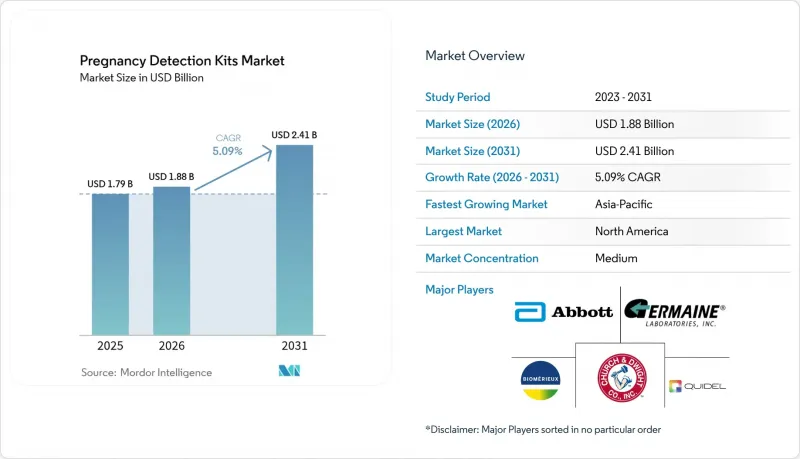
This report is Segmented by Product Type (Line Pregnancy Tests, Digital Devices, and Others), Type of Test (Urine HCG Test, Blood HCG Test), Distribution Channel (Hospital Pharmacies, Independent Pharmacies, and Others), End User (Home-Care Individuals, Gynecology Clinics, and Others), and Geography (North America, Europe, and Others). The Market Forecasts are Provided in Terms of Value (USD).
Global Pregnancy Detection Kits Market Trends and Insights
Growing Incidence of Unplanned Pregnancies
The World Health Organization estimates 121 million unintended pregnancies occur worldwide each year, sustaining baseline demand that buffers the pregnancy detection kits market against economic cycles. Demographic momentum in developing regions enlarges the target population, while delayed childbearing in developed markets elevates testing frequency as older women monitor fertility more closely. Pregnancy tests thus function as necessity goods rather than discretionary purchases, preserving revenue even when household budgets tighten. Public-health campaigns promoting early detection further normalize repeat self-testing. Combined, these factors anchor stable unit volumes and underpin incremental upgrades to higher-margin digital formats.
Increasing Disposable Income and Willingness to Spend on Self-care
Rising middle-class income in Asia-Pacific strengthens spending power and unlocks premiumization opportunities for Bluetooth-enabled devices that deliver app-based guidance and data tracking. Consumers view pregnancy testing as part of a proactive wellness routine, aligning with broader self-care and quantified-health trends. Employers in technology and finance add fertility benefits that reimburse pregnancy tests, integrating them into comprehensive reproductive-health programs led by platforms such as Maven and Kindbody. As reimbursement expands, manufacturers can justify price premiums by emphasizing accuracy, connectivity, and data security.
Low Awareness & Access in Low-income Nations
Gaps in healthcare infrastructure restrict the pregnancy detection kits market in rural Africa and South Asia, where pharmacies are scarce and supply chains fragmented. Studies in Kenya and Uganda show many women are unaware of home-testing alternatives, relying instead on clinic visits that entail travel costs and wait times. Price sensitivity further limits adoption of digital formats, reinforcing reliance on the lowest-cost strips. Development agencies and NGOs pilot educational outreach and subsidized distribution, yet results remain localized. Until connectivity and retail logistics improve, market penetration in these areas will progress slowly, capping global CAGR uplift.
Other drivers and restraints analyzed in the detailed report include:
- Wider Retail & E-commerce Penetration of Home-testing Products
- Regulatory Backing for Self-diagnostics in Major Markets
- Social Stigma in Parts of MEA & South Asia
For complete list of drivers and restraints, kindly check the Table Of Contents.
Segment Analysis
Line pregnancy tests retained 61.78% revenue in 05, reflecting cost leadership and universal pharmacy presence. That dominance translates into a (USD 1.11 billion) slice of the pregnancy detection kits market size and underpins the category's scale efficiencies. Yet smart-connected devices post a 6.6% CAGR to 01, outpacing any other format by layering Bluetooth readers, companion apps, and personalized content that justify higher price points. Digital devices occupy a middle position, offering electronic readouts without connectivity-attractive to consumers seeking clarity but wary of data privacy.
Competitive responses illustrate an innovation stair-step. Church & Dwight's 04 Multi Check kit integrates an EasyCup collector that simplifies sampling while holding price premiums below fully connected tests. FDA clearances for MissLan(TM) and Clearblue(R) Early Digital reinforce regulatory confidence in enhanced readability. Pipeline products such as Salignostics' saliva-based kit, cleared by Australia's TGA in December 04, hint at future disruption by eliminating urine collection entirely. Manufacturers that bridge utility and affordability across formats are best placed to capture the evolving pregnancy detection kits market.
Urine-based hCG tests represented 9.61% of sales in 05 and form the baseline technology of the pregnancy detection kits market. Robust clinician acceptance, CLIA waivers, and consumer familiarity anchor this share while economies of scale keep unit prices low. Blood-based rapid tests, though small, expand at 5.7% CAGR because they detect pregnancy 6-10 days earlier, appealing to fertility-focused couples.
Atomo Diagnostics and NG Biotech secured a CE-marked blood-based kit in 04, targeting professional and later home-use markets. Home finger-stick adoption faces hurdles: consumer comfort, safe lancet disposal, and added regulatory scrutiny. However, early-detection benefits position blood tests as complementary rather than replacement products, widening the clinical toolkit for obstetricians and tele-fertility platforms. If U.S. FDA clearance follows, blood tests could nudge the pregnancy detection kits market share away from the urine oligopoly.
Complete Report Scope:
- By Product Type
- Line Pregnancy Tests
- Test Cassette Format
- Test Strip Format
- Test Midstream Format
- Digital Devices
- Smart-Connected Devices
- Line Pregnancy Tests
- By Type of Test
- Urine hCG Test
- Blood hCG Test
- By Distribution Channel
- Hospital Pharmacies
- Independent Pharmacies & Drug Stores
- Online Pharmacies
- Modern Retail & Hypermarkets
- By End User
- Home-care (Individuals)
- Gynecology & Obstetrics Clinics
- Hospitals & Diagnostic Centers
- By Geography
- North America
- United States
- Canada
- Mexico
- Europe
- Germany
- United Kingdom
- France
- Italy
- Spain
- Rest of Europe
- Asia-Pacific
- China
- Japan
- India
- Australia
- South Korea
- Rest of Asia-Pacific
- Middle East and Africa
- GCC
- South Africa
- Rest of Middle East and Africa
- South America
- Brazil
- Argentina
- Rest of South America
- North America
Geography Analysis
North America's leadership stems from high retail density, advanced health insurance coverage, and FDA approval efficiency that accelerates product launch cycles. Consumers demonstrate strong brand allegiance, which sustains high repeat-purchase rates and encourages premium line extensions. Regulatory transparency under the CLIA waiver program and data-privacy legislation fosters consumer confidence in connected devices, supporting upscale growth within the pregnancy detection kits market.
Asia-Pacific provides the steepest growth curve, with India and China alone adding millions of new households to the addressable base annually. Urban working women favor discreet e-commerce purchases, while rising smartphone penetration accelerates adoption of Bluetooth-enabled tests that channel results into local language mobile apps. Government maternal-health initiatives in Indonesia and Vietnam include subsidized pregnancy test distribution, widening retail reach and stimulating volume gains.
Europe presents a mature, quality-focused environment prioritizing clinical validation and environmental stewardship. Cross-border e-pharmacies thrive under harmonized EU regulations, though local language labeling requirements demand tailored packaging. Sustainability credentials, such as reduced single-use plastics, influence purchasing decisions and create differentiation angles for incumbents attuned to eco-conscious preferences. Overall, regional nuances dictate marketing mix, packaging design, and regulatory strategy within the global pregnancy detection kits market.
- Abbott Laboratories
- Axis Medicare
- bioMerieux
- Cardinal Health
- Church & Dwight
- Germaine Laboratories
- Mankind Pharma
- Piramal Enterprises Ltd.
- Procter & Gamble
- QuidelOrtho
- SPD Swiss Precision Diagnostics GmbH
- Roche
- Siemens Healthineers
- Beckton Dickinson
- Nantong Egens Biotechnology
- Guangzhou Wondfo Biotech
- Prestige Consumer Healthcare
- Biosynex SA
- BTNX
- AdvaCare
Additional Benefits:
- The market estimate (ME) sheet in Excel format
- 3 months of analyst support
TABLE OF CONTENTS
1 Introduction
- 1.1 Study Assumptions & Market Definition
- 1.2 Scope of the Study
2 Research Methodology
3 Executive Summary
4 Market Landscape
- 4.1 Market Overview
- 4.2 Market Drivers
- 4.2.1 Growing Incidence of Unplanned Pregnancies
- 4.2.2 Increasing Disposable Income and Willingness to Spend on Self-care
- 4.2.3 Wider Retail & E-commerce Penetration of Home-testing Products
- 4.2.4 Regulatory Backing for Self-diagnostics in Major Markets
- 4.2.5 Smartphone-linked Digital Test Innovation
- 4.2.6 Male-partner Involvement Campaigns Boosting Early Testing
- 4.3 Market Restraints
- 4.3.1 Low Awareness & Access in Low-income Nations
- 4.3.2 Social stigma in Parts of MEA & South Asia
- 4.3.3 Supply-chain Counterfeit Risks
- 4.3.4 Data-privacy Concerns with Connected Test Apps
- 4.4 Supply-Chain Analysis
- 4.5 Regulatory Landscape
- 4.6 Technological Outlook
- 4.7 Porter's Five Forces
- 4.7.1 Threat of New Entrants
- 4.7.2 Bargaining Power of Buyers/Consumers
- 4.7.3 Bargaining Power of Suppliers
- 4.7.4 Threat of Substitute Products
- 4.7.5 Intensity of Competitive Rivalry
5 Market Size & Growth Forecasts (Value)
- 5.1 By Product Type
- 5.1.1 Line Pregnancy Tests
- 5.1.1.1 Test Cassette Format
- 5.1.1.2 Test Strip Format
- 5.1.1.3 Test Midstream Format
- 5.1.2 Digital Devices
- 5.1.3 Smart-Connected Devices
- 5.1.1 Line Pregnancy Tests
- 5.2 By Type of Test
- 5.2.1 Urine hCG Test
- 5.2.2 Blood hCG Test
- 5.3 By Distribution Channel
- 5.3.1 Hospital Pharmacies
- 5.3.2 Independent Pharmacies & Drug Stores
- 5.3.3 Online Pharmacies
- 5.3.4 Modern Retail & Hypermarkets
- 5.4 By End User
- 5.4.1 Home-care (Individuals)
- 5.4.2 Gynecology & Obstetrics Clinics
- 5.4.3 Hospitals & Diagnostic Centers
- 5.5 By Geography
- 5.5.1 North America
- 5.5.1.1 United States
- 5.5.1.2 Canada
- 5.5.1.3 Mexico
- 5.5.2 Europe
- 5.5.2.1 Germany
- 5.5.2.2 United Kingdom
- 5.5.2.3 France
- 5.5.2.4 Italy
- 5.5.2.5 Spain
- 5.5.2.6 Rest of Europe
- 5.5.3 Asia-Pacific
- 5.5.3.1 China
- 5.5.3.2 Japan
- 5.5.3.3 India
- 5.5.3.4 Australia
- 5.5.3.5 South Korea
- 5.5.3.6 Rest of Asia-Pacific
- 5.5.4 Middle East and Africa
- 5.5.4.1 GCC
- 5.5.4.2 South Africa
- 5.5.4.3 Rest of Middle East and Africa
- 5.5.5 South America
- 5.5.5.1 Brazil
- 5.5.5.2 Argentina
- 5.5.5.3 Rest of South America
- 5.5.1 North America
6 Competitive Landscape
- 6.1 Market Concentration
- 6.2 Strategic Moves
- 6.3 Market Share Analysis
- 6.4 Company Profiles (includes Global level Overview, Market level overview, Core Segments, Financials as available, Strategic Information, Market Rank/Share for key companies, Products & Services, and Recent Developments)
- 6.4.1 Abbott Laboratories
- 6.4.2 Axis Medicare
- 6.4.3 bioMerieux SA
- 6.4.4 Cardinal Health Inc.
- 6.4.5 Church & Dwight Co., Inc.
- 6.4.6 Germaine Laboratories Inc.
- 6.4.7 Mankind Pharma
- 6.4.8 Piramal Enterprises Ltd.
- 6.4.9 Procter & Gamble Co.
- 6.4.10 QuidelOrtho Corporation
- 6.4.11 SPD Swiss Precision Diagnostics GmbH
- 6.4.12 Roche Diagnostics
- 6.4.13 Siemens Healthineers
- 6.4.14 Becton, Dickinson and Company
- 6.4.15 Nantong Egens Biotechnology
- 6.4.16 Guangzhou Wondfo Biotech
- 6.4.17 Prestige Consumer Healthcare
- 6.4.18 Biosynex SA
- 6.4.19 BTNX Inc.
- 6.4.20 AdvaCare Pharma
7 Market Opportunities & Future Outlook
- 7.1 White-space & Unmet-need Assessment

