PUBLISHER: Mordor Intelligence | PRODUCT CODE: 2113635

PUBLISHER: Mordor Intelligence | PRODUCT CODE: 2113635
India Automotive Sensors - Market Share Analysis, Industry Trends & Statistics, Growth Forecasts (2026 - 2031)
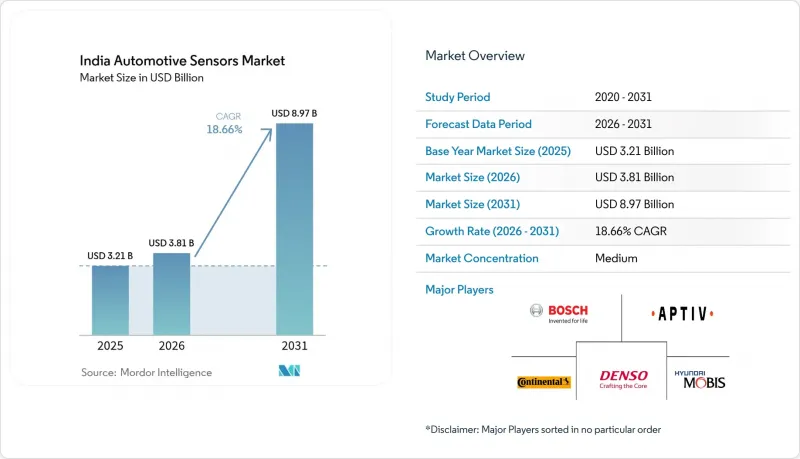
According to Mordor Intelligence, the India automotive sensors market size was valued at USD 3.21 billion in 2025 and estimated to grow from USD 3.81 billion in 2026 to reach USD 8.97 billion by 2031, at a CAGR of 18.66% during the forecast period (2026-2031).
This report is Segmented by Sensor Type (Pressure Sensors, Temperature Sensors, and More), Vehicle Drive-Train (ICE Vehicles and Electric Vehicles), Application (Engine & Drivetrain, Vehicle Electronics, Vehicle Safety Systems, and Other Applications), and Vehicle Type (Passenger Cars, Light Commercial Vehicles, and More). The Market Forecasts are Provided in Terms of Value (USD).
India Automotive Sensors Market Trends and Insights
Mandatory ADAS & TPMS Regulations Post-AIS-145
Ministry of Road Transport and Highways (MoRTH) has proposed amendments to the Central Motor Vehicles Rules (CMVR), which obliges vehicles exceeding eight seats to integrate advanced emergency braking, lane departure, and driver-drowsiness warning systems from April 2026. Traditionally late adopters, commercial fleets must now deploy radar, camera, and inertial sensors across platforms. TPMS rules augment demand for wheel-mounted pressure sensors that generate a continuing aftermarket. The regulation coincides with a vehicle scrappage program that cycles older trucks out of service, accelerating new sensor uptake. Suppliers able to certify ISO 26262 compliance and functional-safety performance are likely to capture premium contracts.
Rapid Electrification of India's Two- & Three-Wheeler Fleet
Electric two-wheeler sales surged to 1.14 million units in FY2025, and the segment now integrates up to 20 sensors per vehicle versus 8 in comparable ICE models. Battery-thermal, cell-voltage, and motor-position sensors dominate the bill of materials, while regenerative braking systems add torque and wheel-speed sensing. Three-wheelers accounted for more than half of new registrations in 2024, concentrating demand in urban last-mile networks. Price-sensitive OEMs favor domestically packaged MEMS devices to contain costs, spurring capacity additions at new Indian fabs.
Cost-Sensitive OEM Pricing and Razor-Thin Supplier Margins
Six leading automakers controlled the majority of domestic sales in FY2024, creating monopsony power that compels vendors to price sensors more than one-fifth below global averages. Electric models add 3-4 times more sensor content yet must hold retail prices flat to win mass-market acceptance. Higher logistics and energy costs render Indian parts costlier than Mexican equivalents, squeezing exporter profit. Sustained margin pressure limits R&D budgets, delaying next-generation sensor rollouts.
Other drivers and restraints analyzed in the detailed report include:
- PLI & SPECS Incentives Localising MEMS Sensor Production
- OEM-Led Shift to Domain/Zone E-E Architectures
- Lag in Tier-II Wafer-Level Packaging Capacity
For complete list of drivers and restraints, kindly check the Table Of Contents.
Segment Analysis
Pressure sensors dominated the India automotive sensors market in 2025 with a 43.12% share, largely due to mandatory TPMS adoption and widespread engine-management use cases. This legacy base ensures steady volume even as electric powertrains add battery-coolant monitoring and brake-pressure sensing. Electro-optical sensors, including cameras and infrared modules, log the fastest 18.79% CAGR through 2031 as ADAS features cascade into mid-segment models. Temperature and speed sensors continue incremental gains tied to Bharat Stage VI emission control and anti-lock braking mandates.
Electromagnetic devices capture share through proximity and position applications such as e-axle monitoring and automated parking assist. Emerging inertial and gas sensors populate the "other" category, where cabin-air-quality and vehicle-dynamics functions highlight rising customer expectations. Domestic players like Sona Comstar now prototype short-range radar for blind-spot detection, underlining India's shift from commodity sensing to advanced perception modules within the India automotive sensors market.
Internal-combustion platforms held 62.58% of India automotive sensors market size in 2025, buoyed by established fueling infrastructure and slower rural electrification. Electric vehicles lead growth at an 18.71% CAGR as two- and three-wheelers proliferate in cities. EVs integrate three-fifths more sensors per unit, spanning battery voltage, pack temperature, and high-voltage isolation monitoring. Hybrid variants, though niche, layer both ICE and EV sensing, representing the most complex bill of materials.
ICE vehicles nonetheless sustain high sensor content through particulate-filter monitoring and advanced fuel-injection control demanded by BS-VI norms. As charging networks widen and battery prices fall, OEMs project EV volumes to top one-fifth of new registrations by 2030, creating a structural pivot for suppliers focused on drivetrain-specific sensors within the India automotive sensors market.
Complete Report Scope:
- By Sensor Type
- Pressure Sensors
- Temperature Sensors
- Speed Sensors
- Electro-Optical Sensors
- Electro-Magnetic Sensors
- Other Sensors
- By Vehicle Drive-train
- ICE Vehicles
- Electric Vehicles
- By Application
- Engine & Drivetrain
- Vehicle Electronics
- Vehicle Safety Systems
- Other Applications
- By Vehicle Type
- Two-Wheelers
- Passenger Cars
- Light Commercial Vehicles
- Medium and Heavy Commercial Vehicles
List of Companies Covered in this Report:
- Robert Bosch GmbH
- Continental AG
- DENSO Corporation
- Infineon Technologies AG
- Sensata Technologies Inc.
- Aptiv plc
- Hitachi Astemo Ltd.
- Hella GmbH & Co. KGaA
- Hyundai Mobis Co. Ltd.
- CTS Corporation
- Allegro MicroSystems LLC
- NXP Semiconductors N.V.
- Texas Instruments Inc.
- Renesas Electronics Corp.
- TE Connectivity Ltd.
- Murata Manufacturing Co. Ltd.
- Valeo SA
- Analog Devices Inc.
- IC Haus GmbH
Additional Benefits:
- The market estimate (ME) sheet in Excel format
- 3 months of analyst support
TABLE OF CONTENTS
1 Introduction
- 1.1 Study Assumptions & Market Definition
- 1.2 Scope of the Study
2 Research Methodology
3 Executive Summary
4 Market Landscape
- 4.1 Market Overview
- 4.2 Market Drivers
- 4.2.1 Mandatory ADAS & TPMS Regulations Post-AIS-145
- 4.2.2 Rapid Electrification Of India'S Two- & Three-Wheeler Fleet
- 4.2.3 PLI & Specs Incentives Localising Mems Sensor Production
- 4.2.4 OEM-Led Shift To Domain/Zone E-E Architectures
- 4.2.5 Ultra-Low-Cost 8-Bit MCUs Enabling Sensor Fusion In Mass-Market Cars
- 4.2.6 Usage-Based-Insurance (UBI) Adoption Spurring Demand For In-Vehicle Telematics Sensors
- 4.3 Market Restraints
- 4.3.1 Cost-Sensitive OEM Pricing And Razor-Thin Supplier Margins
- 4.3.2 Lag In Tier-Ii Wafer-Level Packaging Capacity
- 4.3.3 Fragmented After-Sales Service Network For Safety Sensors
- 4.3.4 Import Duties On Sensor-Grade Silicon Wafers Elevating Bom Costs
- 4.4 Value / Supply-Chain Analysis
- 4.5 Regulatory Landscape
- 4.6 Technological Outlook
- 4.7 Porter's Five Forces
- 4.7.1 Threat of New Entrants
- 4.7.2 Bargaining Power of Buyers
- 4.7.3 Bargaining Power of Suppliers
- 4.7.4 Threat of Substitutes
- 4.7.5 Competitive Rivalry
5 Market Size & Growth Forecasts (Value (USD))
- 5.1 By Sensor Type
- 5.1.1 Pressure Sensors
- 5.1.2 Temperature Sensors
- 5.1.3 Speed Sensors
- 5.1.4 Electro-Optical Sensors
- 5.1.5 Electro-Magnetic Sensors
- 5.1.6 Other Sensors
- 5.2 By Vehicle Drive-train
- 5.2.1 ICE Vehicles
- 5.2.2 Electric Vehicles
- 5.3 By Application
- 5.3.1 Engine & Drivetrain
- 5.3.2 Vehicle Electronics
- 5.3.3 Vehicle Safety Systems
- 5.3.4 Other Applications
- 5.4 By Vehicle Type
- 5.4.1 Two-Wheelers
- 5.4.2 Passenger Cars
- 5.4.3 Light Commercial Vehicles
- 5.4.4 Medium and Heavy Commercial Vehicles
6 Competitive Landscape
- 6.1 Market Concentration
- 6.2 Strategic Moves
- 6.3 Market Share Analysis
- 6.4 Company Profiles (Includes Global Level Overview, Market Level Overview, Core Segments, Financials as Available, Strategic Information, Market Rank/Share for Key Companies, Products and Services, SWOT Analysis, and Recent Developments)
- 6.4.1 Robert Bosch GmbH
- 6.4.2 Continental AG
- 6.4.3 DENSO Corporation
- 6.4.4 Infineon Technologies AG
- 6.4.5 Sensata Technologies Inc.
- 6.4.6 Aptiv plc
- 6.4.7 Hitachi Astemo Ltd.
- 6.4.8 Hella GmbH & Co. KGaA
- 6.4.9 Hyundai Mobis Co. Ltd.
- 6.4.10 CTS Corporation
- 6.4.11 Allegro MicroSystems LLC
- 6.4.12 NXP Semiconductors N.V.
- 6.4.13 Texas Instruments Inc.
- 6.4.14 Renesas Electronics Corp.
- 6.4.15 TE Connectivity Ltd.
- 6.4.16 Murata Manufacturing Co. Ltd.
- 6.4.17 Valeo SA
- 6.4.18 Analog Devices Inc.
- 6.4.19 IC Haus GmbH
7 Market Opportunities & Future Outlook
- 7.1 White-space & Unmet-Need Assessment

