PUBLISHER: Mordor Intelligence | PRODUCT CODE: 2113646

PUBLISHER: Mordor Intelligence | PRODUCT CODE: 2113646
Feed Carotenoids - Market Share Analysis, Industry Trends & Statistics, Growth Forecasts (2026 - 2031)
According to Mordor Intelligence, feed carotenoids market size in 2026 is estimated at USD 3.41 billion, growing from 2025 value of USD 3.21 billion with 2031 projections showing USD 4.59 billion, growing at 6.14% CAGR over 2026-2031.
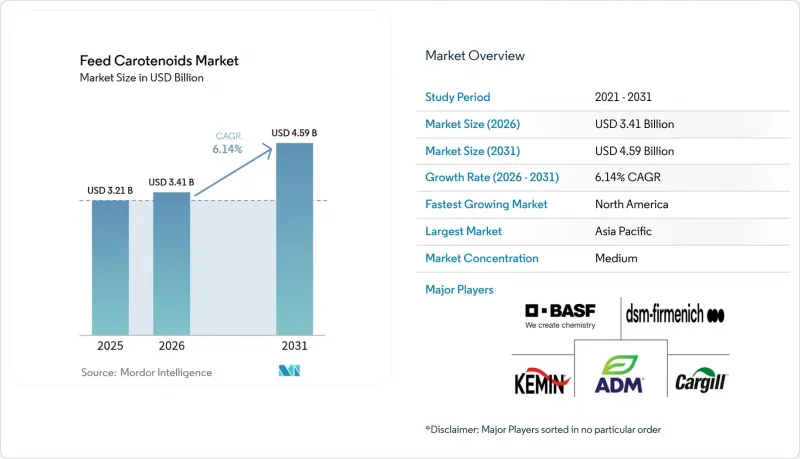
This report is Segmented by Product Type (Beta-Carotene, Lycopene, Lutein, Astaxanthin, Canthaxanthin, and Other Types), by Form (Beadlet, Powder, and More), by Animal Type (Ruminant, Poultry, Swine, Aquaculture, and Other Animal Types), and by Geography (North America, Europe, Asia-Pacific, South America, and More). The Market Forecasts are Provided in Terms of Value (USD).
Global Feed Carotenoids Market Trends and Insights
Rising Demand for Salmonid Aquafeed Pigmentation
Salmon farmers link flesh coloration directly with consumer premium willingness, and Norwegian producers report a 15 - 20% price uplift for optimally pigmented fish. The European Food Safety Authority's 2024 reaffirmation of astaxanthin safety limits at 100 mg/kg for ornamental fish provides regulatory clarity that supports expanded usage in commercial aquaculture. Freight cost for temperature-controlled carotenoids reaches 12% of ingredient value in remote sites, pushing farms to secure nearby warehousing and on-farm stability testing.
Industrial-Scale Poultry Production in Emerging Economies
Poultry sector consolidation in Asia-Pacific markets creates concentrated demand for standardized pigmentation solutions that ensure consistent egg yolk coloration and broiler skin appearance across large production volumes. The shift from traditional smallholder systems to integrated operations creates opportunities for premium carotenoid suppliers who can provide technical support and quality assurance programs. Brazil's poultry export growth necessitates compliance with international color standards, driving the adoption of standardized carotenoid supplementation protocols that ensure consistent product appearance across diverse genetic lines and production environments.
Volatility in Carotenoid-Rich Biomass Supplies
Agricultural extraction of carotenoids from marigold petals, paprika, and other plant sources faces increasing volatility due to climate variability and competing land use pressures that affect raw material availability and pricing. Weather disruptions in major growing regions can create price swings within single seasons, forcing feed manufacturers to maintain larger inventory buffers that increase working capital requirements. The concentration of extraction facilities in specific geographic regions creates supply chain vulnerabilities, as demonstrated by recent disruptions that affected multiple ingredient categories simultaneously. Alternative sourcing strategies require extensive validation and regulatory approvals that can take 18-24 months to complete, limiting short-term flexibility in responding to supply disruptions.
Other drivers and restraints analyzed in the detailed report include:
- Shift from Synthetic to Natural Carotenoids
- Microalgae and Precision-Fermentation Cost Breakthroughs
- Regulatory Uncertainty Around Novel Fermentation Strains
For complete list of drivers and restraints, kindly check the Table Of Contents.
Segment Analysis
Astaxanthin held 31.95% feed carotenoids market share in 2025, driven by salmon pigmentation premiums. It leads growth at a 7.36% CAGR as retailers promote non-synthetic seafood labels. The feed carotenoids market size attributable to beta-carotene remains sizable in poultry and swine due to its dual Vitamin A role. Lutein retention in table-egg programs supports differentiated shell-egg Stock keeping units (SKU), while canthaxanthin usage stays constrained by dosage ceilings.
The dominance of astaxanthin creates a price umbrella enabling niche carotenoids such as zeaxanthin to float at specialty premiums. Salmon processors tie bonus payments to fillet hue metrics, cementing steady demand even during feed cost inflation cycles. The regulatory landscape creates competitive advantages for astaxanthin and beta-carotene alternatives that offer similar pigmentation benefits without associated safety concerns. Other carotenoid types, including zeaxanthin and capsanthin, target niche applications where specific color profiles or functional benefits justify premium pricing compared to mainstream alternatives.
Complete Report Scope:
- By Product Type
- Beta-Carotene
- Lycopene
- Lutein
- Astaxanthin
- Canthaxanthin
- Other Types
- By Form
- Beadlet
- Powder
- Oil Suspension
- Emulsion
- By Animal Type
- Ruminant
- Poultry
- Swine
- Aquaculture
- Other Animal Types
- By Geography
- North America
- United States
- Canada
- Mexico
- Rest of North America
- Europe
- Germany
- United Kingdom
- France
- Spain
- Italy
- Russia
- Rest of Europe
- Asia-Pacific
- China
- India
- Japan
- Australia
- Rest of Asia-Pacific
- South America
- Brazil
- Argentina
- Rest of South America
- Middle East
- Saudi Arabia
- Turkey
- Rest of Middle East
- Africa
- South Africa
- Egypt
- Rest of Africa
- North America
Geography Analysis
Asia-Pacific contributed 29.55% of the feed carotenoids market in 2025. China accounts for a significant share of the world's aquaculture harvest, and the consolidation of mega-farms accelerates the standardization of nutrients. India and Vietnam adopt European-style broiler genetics, demanding higher carotenoid density for export-grade skin coloration. Regional governments subsidize recirculating aquaculture systems, magnifying astaxanthin uptake per metric ton of fish produced.
North America is projected to register the fastest CAGR of 7.55% from 2026 to 2031. North America posts steady gains backed by large poultry complexes and a regulatory environment that balances innovation speed with safety. FDA approvals for fermentation-derived inputs move faster than EU processes, enticing venture investors to build United States manufacturing. Canada's Atlantic salmon farms secure supply contracts that include delivery contingencies tied to BASF SE and DSM outage risk mitigation. South America leverages Brazil's poultry export surge to integrate standardized pigmentation protocols, whereas Africa's emerging tilapia farms explore low-cost beadlets to raise harvest value.
Europe, with Norway's salmon value chain and Germany's premix hubs acting as anchor demand centers. EFSA's stringent review procedures tilt formulations toward natural inputs, and Germany offers technical hubs that refine beadlet encapsulation lines. Nordic aquafeed factories fine-tune astaxanthin dosage to comply with 25 mg/kg fillet targets and minimize residual loss.
- BASF SE
- DSM-Firmenich AG
- Kemin Industries, Inc.
- Synthite Industries Ltd.
- Nutrex NV
- Divi's Laboratories Limited
- Archer-Daniels-Midland Company
- Cargill Inc.
- Zhejiang NHU Co., Ltd. (NHU Holding Group Co.,Ltd)
- Givaudan SA
- Allied Biotech Corporation
- Impextraco NV
- EW Nutrition GmbH
- Novus International, Inc. (Mitsui & Co., Ltd. and Nippon Soda Co., Ltd)
Additional Benefits:
- The market estimate (ME) sheet in Excel format
- 3 months of analyst support
TABLE OF CONTENTS
1 Introduction
- 1.1 Study Assumptions and Market Definition
- 1.2 Scope of the Study
2 Research Methodology
3 Executive Summary
4 Market Landscape
- 4.1 Market Overview
- 4.2 Market Drivers
- 4.2.1 Rising demand for salmonid aquafeed pigmentation
- 4.2.2 Industrial-scale poultry production in emerging economies
- 4.2.3 Shift from synthetic to natural carotenoids
- 4.2.4 Microalgae and precision-fermentation cost breakthroughs
- 4.2.5 Tariff-driven reshoring of carotenoid supply chains
- 4.2.6 AI-enabled pigment optimization for species-specific outcomes
- 4.3 Market Restraints
- 4.3.1 Volatility in carotenoid-rich biomass supplies
- 4.3.2 Regulatory uncertainty around novel fermentation strains
- 4.3.3 Photodegradation losses during tropical feed logistics
- 4.3.4 Sub-clinical toxicity risks at supra-nutritional doses
- 4.4 Regulatory Landscape
- 4.5 Technological Outlook
- 4.6 Porter's Five Forces Analysis
- 4.6.1 Bargaining Power of Suppliers
- 4.6.2 Bargaining Power of Buyers
- 4.6.3 Threat of New Entrants
- 4.6.4 Threat of Substitutes
- 4.6.5 Intensity of Competitive Rivalry
5 Market Size and Growth Forecasts (Value)
- 5.1 By Product Type
- 5.1.1 Beta-Carotene
- 5.1.2 Lycopene
- 5.1.3 Lutein
- 5.1.4 Astaxanthin
- 5.1.5 Canthaxanthin
- 5.1.6 Other Types
- 5.2 By Form
- 5.2.1 Beadlet
- 5.2.2 Powder
- 5.2.3 Oil Suspension
- 5.2.4 Emulsion
- 5.3 By Animal Type
- 5.3.1 Ruminant
- 5.3.2 Poultry
- 5.3.3 Swine
- 5.3.4 Aquaculture
- 5.3.5 Other Animal Types
- 5.4 By Geography
- 5.4.1 North America
- 5.4.1.1 United States
- 5.4.1.2 Canada
- 5.4.1.3 Mexico
- 5.4.1.4 Rest of North America
- 5.4.2 Europe
- 5.4.2.1 Germany
- 5.4.2.2 United Kingdom
- 5.4.2.3 France
- 5.4.2.4 Spain
- 5.4.2.5 Italy
- 5.4.2.6 Russia
- 5.4.2.7 Rest of Europe
- 5.4.3 Asia-Pacific
- 5.4.3.1 China
- 5.4.3.2 India
- 5.4.3.3 Japan
- 5.4.3.4 Australia
- 5.4.3.5 Rest of Asia-Pacific
- 5.4.4 South America
- 5.4.4.1 Brazil
- 5.4.4.2 Argentina
- 5.4.4.3 Rest of South America
- 5.4.5 Middle East
- 5.4.5.1 Saudi Arabia
- 5.4.5.2 Turkey
- 5.4.5.3 Rest of Middle East
- 5.4.6 Africa
- 5.4.6.1 South Africa
- 5.4.6.2 Egypt
- 5.4.6.3 Rest of Africa
- 5.4.1 North America
6 Competitive Landscape
- 6.1 Market Concentration
- 6.2 Strategic Moves
- 6.3 Market Share Analysis
- 6.4 Company Profiles (Includes Global Level Overview, Market Level Overview, Core Segments, Financials as Available, Strategic Information, Market Rank/Share, Products and Services, Recent Developments)
- 6.4.1 BASF SE
- 6.4.2 DSM-Firmenich AG
- 6.4.3 Kemin Industries, Inc.
- 6.4.4 Synthite Industries Ltd.
- 6.4.5 Nutrex NV
- 6.4.6 Divi's Laboratories Limited
- 6.4.7 Archer-Daniels-Midland Company
- 6.4.8 Cargill Inc.
- 6.4.9 Zhejiang NHU Co., Ltd. (NHU Holding Group Co.,Ltd)
- 6.4.10 Givaudan SA
- 6.4.11 Allied Biotech Corporation
- 6.4.12 Impextraco NV
- 6.4.13 EW Nutrition GmbH
- 6.4.14 Novus International, Inc. (Mitsui & Co., Ltd. and Nippon Soda Co., Ltd)
7 Market Opportunities and Future Outlook

