PUBLISHER: Mordor Intelligence | PRODUCT CODE: 2113649

PUBLISHER: Mordor Intelligence | PRODUCT CODE: 2113649
North America Feed Premix - Market Share Analysis, Industry Trends & Statistics, Growth Forecasts (2026 - 2031)
According to Mordor Intelligence, the North America feed premix market size is estimated at USD 9.60 billion in 2026, and is anticipated to reach USD 13.40 billion by 2031, at a CAGR of 6.90% during the forecast period (2026-2031).
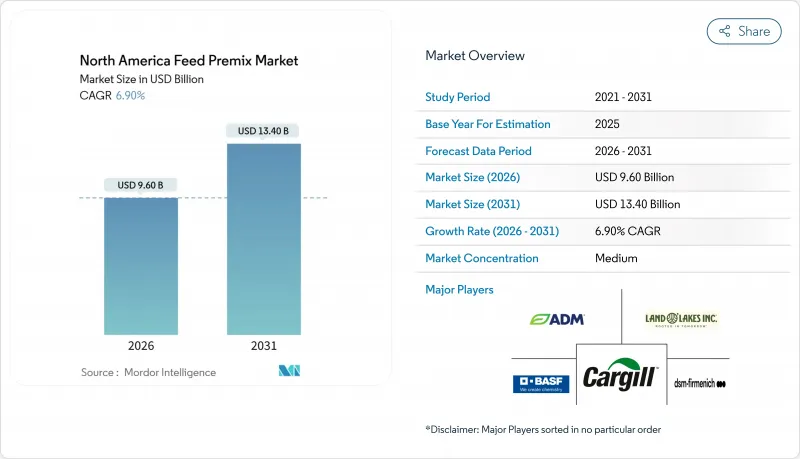
This report is Segmented by Type (Vitamins Premix, Minerals Premix, Amino Acids Premix, and More), by Form (Dry and Liquid), by Livestock (Ruminants, Poultry, Swine, Aquaculture, and More), and by Geography (United States, Canada, Mexico, and the Rest of North America). The Report Offers the Market Sizes in Value (USD) and Market Volume (Metric Tons).
North America Feed Premix Market Trends and Insights
Rising Demand for Compound Feed in the United States
Compound feed output reached 283 million metric tons in 2025, up 2.8% year-on-year. Each metric ton contains 5 to 15 kilograms of vitamin-mineral blends, so volume growth directly lifts premix uptake. Tyson Foods consolidated feed production into higher-capacity mills that accept 20 metric tons of bulk premix loads, cutting integrator working capital by roughly 13%. Dairy herds in Wisconsin and California now incorporate chelated trace minerals into total-mixed rations to reduce lameness and improve conception, thereby increasing the use of trace-mineral premixes. Larger batch sizes enable just-in-time blending, reducing in-store inventory for mills and suppliers alike. As a result, the North America feed premix market experiences a durable pull-through, even when feed conversion efficiency improves.
Growth in Commercial Poultry Production Capacity
The poultry sector in the region added 47 million square feet of housing in 2024, marking a significant annual increase from 2023. In 2024, 9.33 billion broilers were produced, up 1% from 2023. Cargill Incorporated plans to establish a vitamin-blending site adjacent to a Georgia broiler complex, aiming to reduce logistics costs by 22%. Canada's poultry market operates under supply management quotas. However, producers in British Columbia and Ontario are investing in higher-density barns to enhance feed conversion ratios. This development has indirectly increased premix intensity per kilogram of live weight. Feed-conversion efficiency in the sector is projected to improve from 1.82 in 2020 to 1.68 in 2025, resulting in a 7.6% reduction in feed required per bird to reach market weight. Simultaneously, the premix inclusion rate per metric ton has increased from 0.48% to 0.53%, driven by genetic advancements that promote faster growth and require higher levels of bioavailable micro-nutrients.
Volatility in Vitamin A and E Raw-Material Prices
Vitamin A palmitate and vitamin E acetate are synthesized using petrochemical intermediates, such as linalool and trimethylhydroquinone, which exhibit high price elasticity. In April 2024, BASF's shutdown at its citral plant in Ludwigshafen, Germany, led to an increase in the spot price of vitamin E acetate. Smaller formulators, particularly those without long-term supply contracts or hedging mechanisms, are particularly vulnerable. The concentration of vitamin production among three key suppliers, such as BASF, DSM-Firmenich, and Zhejiang Medicine, further limits buyers' negotiating power. In response, livestock producers are reformulating feed rations to lower vitamin inclusion rates. A 2025 field trial by the University of Georgia demonstrated that broilers fed 8,800 international units of vitamin A per kilogram of feed achieved the same weight gain and feed conversion efficiency as those receiving 11,000 international units, the previous industry standard. This finding suggests that historical inclusion rates included a 20% to 25% safety margin. As a result, this recalibration is estimated to reduce premix demand annually.
Other drivers and restraints analyzed in the detailed report include:
- Shift Toward Micro-Nutrient Dense Rations
- Expansion of Specialty Premix Lines for Pet Nutrition
- Stringent U.S. FDA Premix Registration Processes
For complete list of drivers and restraints, kindly check the Table Of Contents.
Segment Analysis
The vitamin premix retained a 38.8% share of 2025 revenue, underscoring its role in meeting NRC requirements for poultry, swine, and dairy. The North America feed premix market size for vitamin-rich blends is projected to expand at a moderate rate through 2031, as precision dosing reduces wastage. Chelated mineral offerings capture substitution gains, with organic trace minerals accounting for a good amount of mineral sales by 2025. Amino-acid premix posts a significant CAGR, driven by low-protein diets that ameliorate nitrogen run-off and comply with state nutrient rules.
Nucleotide premix is racing ahead at a 12.8% CAGR, fueled by salmon and shrimp farms that seek immune support after Health Canada restricted medically important antimicrobials. Elevated inclusion levels, now 1.4 kilograms per metric ton in British Columbia salmon feed, offset volume constraints in mature vitamin segments. Fiber premix and other specialty blends grow below the market pace but still benefit from functional claims like eggshell strength improvements documented by Kemin's turmeric-curcumin trials.
Complete Report Scope:
- By Type
- Vitamin Premix
- Mineral Premix
- Amino Acid Premix
- Nucleotide Premix
- Fiber Premix
- Others
- By Form
- Dry
- Liquid
- By Livestock
- Ruminants
- Poultry
- Swine
- Aquaculture
- Pet Animals
- Others
- By Country
- United States
- Canada
- Mexico
- Rest of North America
List of Companies Covered in this Report:
- Cargill Incorporated
- DSM-Firmenich AG
- Archer Daniels Midland Company
- Purina Animal Nutrition LLC (Land O'Lakes Inc.)
- Nutreco N.V.
- Alltech, Inc
- BASF SE
- Kent Nutrition Group (Kent Corporation)
- Bluestar Adisseo Company
- Zinpro Corporation
- Phibro Animal Health Corporation
- Kemin Industries, Inc
- Novus International (Mitsui & Co.)
- Bio-Agri Mix
- NEOTERRA
Additional Benefits:
- The market estimate (ME) sheet in Excel format
- 3 months of analyst support
TABLE OF CONTENTS
1 Introduction
- 1.1 Study Assumptions and Market Definition
- 1.2 Scope of the Study
2 Research Methodology
3 Executive Summary
4 Market Landscape
- 4.1 Market Overview
- 4.2 Market Drivers
- 4.2.1 Rising demand for compound feed in the United States
- 4.2.2 Growth in commercial poultry production capacity
- 4.2.3 Livestock producers' shift toward micro-nutrient dense rations
- 4.2.4 Expansion of specialty premix lines tailored for pet nutrition
- 4.2.5 Carbon-footprint labeling incentives on feed additives
- 4.2.6 Precision-fermentation vitamin cost declines
- 4.3 Market Restraints
- 4.3.1 Volatility in vitamin A and E raw-material prices
- 4.3.2 Stringent U.S. FDA premix registration processes
- 4.3.3 Mycotoxin contamination risk in premix supply chain
- 4.3.4 Competition from single-step specialty feed additives
- 4.4 Regulatory Landscape
- 4.5 Technological Outlook
- 4.6 Porter's Five Forces
- 4.6.1 Threat of New Entrants
- 4.6.2 Bargaining Power of Suppliers
- 4.6.3 Bargaining Power of Buyers
- 4.6.4 Threat of Substitutes
- 4.6.5 Intensity of Competitive Rivalry
5 Market Size and Growth Forecasts (Value, USD)
- 5.1 By Type
- 5.1.1 Vitamin Premix
- 5.1.2 Mineral Premix
- 5.1.3 Amino Acid Premix
- 5.1.4 Nucleotide Premix
- 5.1.5 Fiber Premix
- 5.1.6 Others
- 5.2 By Form
- 5.2.1 Dry
- 5.2.2 Liquid
- 5.3 By Livestock
- 5.3.1 Ruminants
- 5.3.2 Poultry
- 5.3.3 Swine
- 5.3.4 Aquaculture
- 5.3.5 Pet Animals
- 5.3.6 Others
- 5.4 By Country
- 5.4.1 United States
- 5.4.2 Canada
- 5.4.3 Mexico
- 5.4.4 Rest of North America
6 Competitive Landscape
- 6.1 Market Concentration
- 6.2 Strategic Moves
- 6.3 Market Share Analysis
- 6.4 Company Profiles (includes Global level Overview, Market Level Overview, Core Segments, Financials as available, Strategic Information, Market Rank / Share for Key Companies, Products and Services, and Recent Developments)
- 6.4.1 Cargill Incorporated
- 6.4.2 DSM-Firmenich AG
- 6.4.3 Archer Daniels Midland Company
- 6.4.4 Purina Animal Nutrition LLC (Land O'Lakes Inc.)
- 6.4.5 Nutreco N.V.
- 6.4.6 Alltech, Inc
- 6.4.7 BASF SE
- 6.4.8 Kent Nutrition Group (Kent Corporation)
- 6.4.9 Bluestar Adisseo Company
- 6.4.10 Zinpro Corporation
- 6.4.11 Phibro Animal Health Corporation
- 6.4.12 Kemin Industries, Inc
- 6.4.13 Novus International (Mitsui & Co.)
- 6.4.14 Bio-Agri Mix
- 6.4.15 NEOTERRA
7 Market Opportunities and Future Outlook

