PUBLISHER: Mordor Intelligence | PRODUCT CODE: 2113660

PUBLISHER: Mordor Intelligence | PRODUCT CODE: 2113660
Control Valve - Market Share Analysis, Industry Trends & Statistics, Growth Forecasts (2026 - 2031)
According to Mordor Intelligence, the control valve market size stood at USD 9.01 billion in 2026 and is projected to advance to USD 13.58 billion by 2031, registering an 8.55% CAGR during the forecast period.
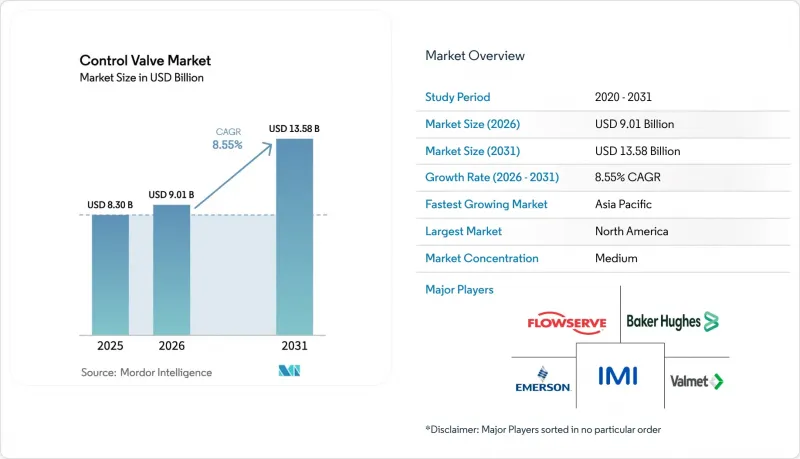
This report is Segmented by Valve Type (Globe, Ball, Butterfly, Plug, and More), Actuation Technology (Pneumatic, Hydraulic, and More), End-User Industry (Oil and Gas, Chemical, Petrochemical and Fertilizer, Energy and Power, and More), Material (Steel, Cast Iron, Alloy-Based, and Plastic), and Geography. The Market Forecasts are Provided in Terms of Value (USD).
Global Control Valve Market Trends and Insights
Rising Investments in Water and Wastewater Infrastructure
Global utilities are executing the largest capital replacement cycle in three decades. The United States Infrastructure Investment and Jobs Act allocates USD 65 billion over 10 years for water projects, prompting a wholesale switch from manual gate valves to automated butterfly and ball formats with remote diagnostics. Severn Trent Water's GBP 200 million (USD 254 million) Minworth upgrade illustrates how European tenders bundle control, safety, and signaling packages into single multi-year lots. Emerging Asia-Pacific markets follow suit, fueled by ASEAN foreign direct investment that rose 44% between 2021 and 2024, channeling USD 13 billion into water infrastructure. Utilities favor compact automated butterfly valves coupled with wireless positioners, cutting confined-space entries and extending inspection intervals mandated by EPA leak-detection programs. Valve suppliers now earn recurring revenue from diagnostics software that reduces unplanned downtime by up to 30%, creating service annuities atop hardware sales.
Modernization of Aging Power and Process Plants
Coal-to-gas conversions and fast-cycling combined-cycle gas turbines replace decades-old trim designs with cage-guided globe valves able to withstand high thermal swings. A 2025 regulating-valve retrofit in a North American turbine cooling circuit improved minimum-load capability while enabling hydrogen-ready fuel blends. Digital platforms integrate valve health with plant DCS, letting operators ramp units to meet intermittent renewable profiles without violating ramp-rate constraints. In process industries, Bluetooth-enabled electric actuators allow technicians to access diagnostics in hazardous areas without hot-work permits, extending asset life by 15-20 years and trimming fugitive emissions below tightening thresholds.
Oil-Price Volatility Curbing Oil and Gas CAPEX
Commodity swings dampen exploration appetite, deferring greenfield pipeline and LNG projects that rely heavily on high-value valves. Australian Energy Producers note that the country attracted only 1.2% of global exploration spending over five years, underscoring a conservative investment climate. PETRONAS' 2025-2027 outlook echoes this caution, emphasizing brownfield optimization over capacity expansion. While baseline maintenance keeps the installed base active, short-cycle discretionary spending remains at risk until pricing visibility improves. Deferred megaprojects such as Dow's USD 8.5 billion Fort Saskatchewan complex eliminate multiyear valve procurement pipelines, tempering the otherwise robust expansion of the control valve market.
Other drivers and restraints analyzed in the detailed report include:
- Stringent Environmental Regulations on Emissions
- Surging Post-Pandemic Pharmaceutical Capacity Expansions
- Pricing Pressure from Low-Cost Asian Suppliers
For complete list of drivers and restraints, kindly check the Table Of Contents.
Segment Analysis
Plug valves accounted for a modest portion of 2025 revenue yet are poised to post a 9.03% CAGR to 2031 as mining, pulp, and wastewater operators favor their self-cleaning, abrasion-resistant design. In contrast, butterfly valves dominated with 29.84% share thanks to their compact footprint in large-diameter water mains, although pressure-class limitations restrain their growth in severe service. The control valve market for plug valves is set to grow as slurry pipelines and mineral concentrators retrofit legacy globe valves to reduce downtime. Suppliers market hardened plug sleeves and live-loaded packing to extend mean time between failures, while operators cite easier automation with quarter-turn actuators compared with linear globe configurations. Continuous-process plants also appreciate the lower torque demands, permitting adoption of smaller electric drives that align with energy-efficiency programs.
Globe and ball variants remain indispensable in high-pressure and emergency shutdown duties, respectively, but their higher capex and space requirements temper growth. Product differentiation, therefore, centers on trim geometry and noise-attenuation cages that cut cavitation by up to 35 dB, features especially valued in SMR steam circuits. Ramen's ball-sector design illustrates how niche engineering, originally created for Swedish pulp mills, can migrate into wider slurry services. As global demand for copper, lithium, and rare-earth ores accelerates, abrasive media handling will underpin steady uptake of plug valves within the control valve market.
The electric segment will record a 10.02% CAGR through 2031, outpacing pneumatic alternatives that still commanded 47.73% share in 2025. Lower total cost of ownership stems from eliminating compressed-air generation, which can absorb 10-30% of a plant's electricity. Modern brushless-DC motors, silicon-carbide inverters, and onboard power electronics enable precise step changes, facilitating advanced model-predictive control. Remote firmware upgrades and Bluetooth diagnostics, exemplified by Rotork's IQ4 and AUMA's MATIC AM ranges, reduce technician travel and improve safety in confined spaces. Consequently, segment revenues tied to digital service contracts expand alongside hardware shipments, reinforcing the annuity profile of the control valve market.
Pneumatic actuators remain favored where intrinsic fail-safe action is paramount, especially in hydrocarbon processing units regulated by ATEX and IECEx. Hybrid packages combine pneumatics for safety shutoff with electric drives for fine throttling, a design growing popular in hydrogen compression skids that must accommodate both explosion-risk mitigation and millisecond-level stroke resolution. Hydraulic options stay confined to subsea and extra-large penstock gates, leaving the competitive frontier squarely between electric and pneumatic systems.
Complete Report Scope:
- By Valve Type
- Globe
- Ball
- Butterfly
- Plug
- Diaphragm
- Other Valve Types
- By Actuation Technology
- Pneumatic
- Hydraulic
- Electric
- Manual
- By End-user Industry
- Oil and Gas
- Chemical, Petrochemical and Fertilizer
- Energy and Power
- Water and Waste-water Treatment
- Metal and Mining
- Food and Beverage
- Pharmaceuticals
- Pulp and Paper
- Other End-user Industries
- By Material
- Steel
- Cast Iron
- Alloy-based
- Plastic (PVC, PP, PVDF)
- Other Materials
- By Geography
- North America
- United States
- Canada
- Mexico
- South America
- Brazil
- Argentina
- Rest of South America
- Europe
- Germany
- United Kingdom
- France
- Italy
- Spain
- Rest of Europe
- Asia-Pacific
- China
- Japan
- India
- South Korea
- ASEAN
- Rest of Asia-Pacific
- Middle East and Africa
- Middle East
- Saudi Arabia
- United Arab Emirates
- Rest of Middle East
- Africa
- South Africa
- Nigeria
- Rest of Africa
- Middle East
- North America
Geography Analysis
North America generated 38.73% of 2025 revenue, underpinned by USD 65 billion in federal water funding, USD 15 billion in announced pharmaceutical expansions, and upstream CAPEX expected to add USD 77 billion by 2030. EPA fugitive-emission rules accelerate adoption of low-leakage packing and digital controllers, while the Chart-Flowserve merger forms a USD 19 billion entity positioned to dominate aftermarket services. Canada's first BWRX-300 SMR at Darlington further lifts severe-service demand, with Velan booked to supply critical valves.
Asia-Pacific is the fastest-growing region at a 9.69% CAGR to 2031. ASEAN attracted USD 226 billion in FDI during 2024, with manufacturing inflows up 147% and electronics commanding 27% of greenfield value. Semiconductor fabs and data centers in Singapore, Malaysia, and Vietnam propel orders for ultrapure-water and cooling valves. India's 8.2% GDP growth and 28% jump in federal capex turbocharge infrastructure pipelines, while China's dominance in rare-earth processing provides local actuator suppliers with cost leverage, reshaping the competitive map of the control valve market.
Europe exhibits steady replacement demand driven by emission regulations and power-plant conversions, even as deindustrialization pressures slow new capacity. In the Middle East and Africa, low breakeven oil fields, petrochemical diversification, and blue-hydrogen megaprojects sustain a robust project slate. Baker Hughes's 2024 expansion of its Dukhan facility and Emerson's USD 150 million automation award for an Egyptian ethylene complex exemplify sizable regional orders. South America depends on Brazil's deepwater programs and Argentina's shale rollout, though political volatility remains a headwind.
- Emerson Electric Co.
- Flowserve Corporation
- Baker Hughes Company
- Valmet Oyj
- IMI plc
- CIRCOR International Inc.
- Christian Burkert GmbH and Co. KG
- Crane Company
- Neway Valve (Suzhou) Co., Ltd.
- ABB Ltd
- Alfa Laval AB
- Rotork plc
- AUMA Riester GmbH and Co. KG
- SAMSON Aktiengesellschaft
- KSB SE and Co. KGaA
- AVK Holding A/S
- Cla-Val Company
- Velan Inc.
- Spirax-Sarco Engineering plc
- Azbil Corporation
- SMC Corporation
- Parker Hannifin Corporation
- Belimo Holding AG
- Siemens AG
- Danfoss A/S
Additional Benefits:
- The market estimate (ME) sheet in Excel format
- 3 months of analyst support
TABLE OF CONTENTS
1 INTRODUCTION
- 1.1 Study Assumptions and Market Definition
- 1.2 Scope of the Study
2 RESEARCH METHODOLOGY
3 EXECUTIVE SUMMARY
4 MARKET LANDSCAPE
- 4.1 Market Overview
- 4.2 Market Drivers
- 4.2.1 Rising investments in water and wastewater infrastructure
- 4.2.2 Modernization of aging power and process plants
- 4.2.3 Stringent environmental regulations on emissions
- 4.2.4 Surging post-pandemic pharmaceutical capacity expansions
- 4.2.5 Hydrogen-economy scale-up requiring high-pressure valves
- 4.2.6 SMR rollout driving demand for severe-service valves
- 4.3 Market Restraints
- 4.3.1 Oil-price volatility curbing oil and gas CAPEX
- 4.3.2 Pricing pressure from low-cost Asian suppliers
- 4.3.3 Alloy supply-chain disruptions
- 4.3.4 Cyber-security risks in smart positioners
- 4.4 Indusy Value Chain Analysis
- 4.5 Regulatory Landscape
- 4.6 Technological Outlook
- 4.7 Porter's Five Forces Analysis
- 4.7.1 Bargaining Power of Suppliers
- 4.7.2 Bargaining Power of Buyers
- 4.7.3 Threat of New Entrants
- 4.7.4 Threat of Substitutes
- 4.7.5 Intensity of Competitive Rivalry
5 MARKET SIZE AND GROWTH FORECASTS (VALUE)
- 5.1 By Valve Type
- 5.1.1 Globe
- 5.1.2 Ball
- 5.1.3 Butterfly
- 5.1.4 Plug
- 5.1.5 Diaphragm
- 5.1.6 Other Valve Types
- 5.2 By Actuation Technology
- 5.2.1 Pneumatic
- 5.2.2 Hydraulic
- 5.2.3 Electric
- 5.2.4 Manual
- 5.3 By End-user Industry
- 5.3.1 Oil and Gas
- 5.3.2 Chemical, Petrochemical and Fertilizer
- 5.3.3 Energy and Power
- 5.3.4 Water and Waste-water Treatment
- 5.3.5 Metal and Mining
- 5.3.6 Food and Beverage
- 5.3.7 Pharmaceuticals
- 5.3.8 Pulp and Paper
- 5.3.9 Other End-user Industries
- 5.4 By Material
- 5.4.1 Steel
- 5.4.2 Cast Iron
- 5.4.3 Alloy-based
- 5.4.4 Plastic (PVC, PP, PVDF)
- 5.4.5 Other Materials
- 5.5 By Geography
- 5.5.1 North America
- 5.5.1.1 United States
- 5.5.1.2 Canada
- 5.5.1.3 Mexico
- 5.5.2 South America
- 5.5.2.1 Brazil
- 5.5.2.2 Argentina
- 5.5.2.3 Rest of South America
- 5.5.3 Europe
- 5.5.3.1 Germany
- 5.5.3.2 United Kingdom
- 5.5.3.3 France
- 5.5.3.4 Italy
- 5.5.3.5 Spain
- 5.5.3.6 Rest of Europe
- 5.5.4 Asia-Pacific
- 5.5.4.1 China
- 5.5.4.2 Japan
- 5.5.4.3 India
- 5.5.4.4 South Korea
- 5.5.4.5 ASEAN
- 5.5.4.6 Rest of Asia-Pacific
- 5.5.5 Middle East and Africa
- 5.5.5.1 Middle East
- 5.5.5.1.1 Saudi Arabia
- 5.5.5.1.2 United Arab Emirates
- 5.5.5.1.3 Rest of Middle East
- 5.5.5.2 Africa
- 5.5.5.2.1 South Africa
- 5.5.5.2.2 Nigeria
- 5.5.5.2.3 Rest of Africa
- 5.5.5.1 Middle East
- 5.5.1 North America
6 COMPETITIVE LANDSCAPE
- 6.1 Market Concentration
- 6.2 Strategic Moves
- 6.3 Market Share Analysis
- 6.4 Company Profiles (includes Global level Overview, Market level overview, Core Segments, Financials as available, Strategic Information, Market Rank/Share, Products and Services, Recent Developments)
- 6.4.1 Emerson Electric Co.
- 6.4.2 Flowserve Corporation
- 6.4.3 Baker Hughes Company
- 6.4.4 Valmet Oyj
- 6.4.5 IMI plc
- 6.4.6 CIRCOR International Inc.
- 6.4.7 Christian Burkert GmbH and Co. KG
- 6.4.8 Crane Company
- 6.4.9 Neway Valve (Suzhou) Co., Ltd.
- 6.4.10 ABB Ltd
- 6.4.11 Alfa Laval AB
- 6.4.12 Rotork plc
- 6.4.13 AUMA Riester GmbH and Co. KG
- 6.4.14 SAMSON Aktiengesellschaft
- 6.4.15 KSB SE and Co. KGaA
- 6.4.16 AVK Holding A/S
- 6.4.17 Cla-Val Company
- 6.4.18 Velan Inc.
- 6.4.19 Spirax-Sarco Engineering plc
- 6.4.20 Azbil Corporation
- 6.4.21 SMC Corporation
- 6.4.22 Parker Hannifin Corporation
- 6.4.23 Belimo Holding AG
- 6.4.24 Siemens AG
- 6.4.25 Danfoss A/S
7 MARKET OPPORTUNITIES AND FUTURE OUTLOOK
- 7.1 White-space and Unmet-need Assessment

