PUBLISHER: Mordor Intelligence | PRODUCT CODE: 2113673

PUBLISHER: Mordor Intelligence | PRODUCT CODE: 2113673
Digital Logistics - Market Share Analysis, Industry Trends & Statistics, Growth Forecasts (2026 - 2031)
According to Mordor Intelligence, digital logistics market size in 2026 is estimated at USD 55.57 billion, growing from 2025 value of USD 45.5 billion with 2031 projections showing USD 150.79 billion, growing at 22.1% CAGR over 2026-2031.
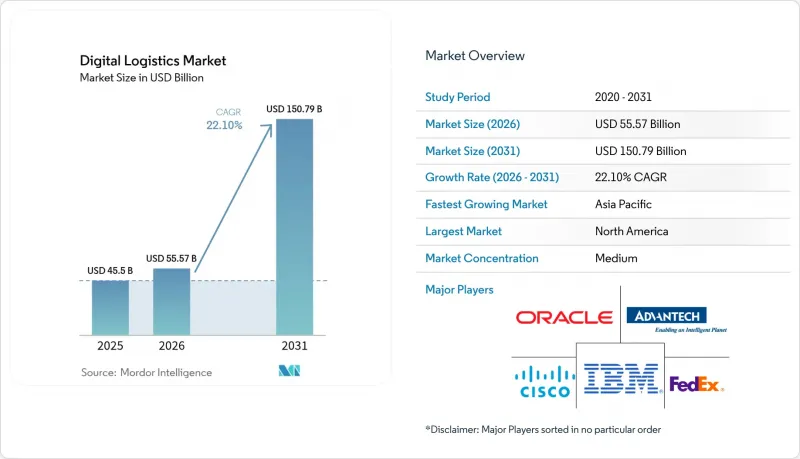
This report is Segmented by Type (Solutions, and Services), Deployment Mode (Cloud-Based, and On-Premise), System / Type (Inventory Management, Warehouse Management System (WMS), Fleet Management, and More), End-User Vertical (Retail and E-Commerce, Manufacturing, Automotive, Pharmaceuticals, and Life Sciences and More), and Geography. The Market Forecasts are Provided in Terms of Value (USD).
Global Digital Logistics Market Trends and Insights
Expansion of real-time IoT fleet telematics in North America
Connected telematics devices now stream engine health, driver behavior, and cargo data in real-time, enabling predictive maintenance that cuts downtime by 30% and fuel consumption by 15-20%. Logistics providers translate these gains into premium, guaranteed delivery windows that raise service levels while shrinking emissions. With IoT logistics spending expected to top USD 114.7 billion by 2032, fleet telematics has become a boardroom priority, particularly for carriers seeking to differentiate on sustainability.
AI-powered predictive warehouse analytics adoption by European 3PLs
European 3PLs combine machine-learning algorithms and computer vision to create digital twins of warehouses, unlocking inventory reductions of 20-30% without compromising fill rates. Scenario modelling helps operators pre-empt labor bottlenecks and reroute pick paths in minutes rather than hours. These capabilities underpin new value-added contracts that bundle demand forecasting with fulfillment, helping 3PLs move up the margin curve.
Under-investment in 5G corridors across Africa
Only 7% of key transport corridors have 5G coverage, limiting real-time visibility for cross-border hauls. Customs clearance averages 48-72 hours, compared to 4-6 hours in well-connected regions, which prolongs dwell times and increases inventory carry costs. Closing the gap requires an estimated USD 4.7 billion, a figure that exceeds current public-private commitments, though pilot corridors are starting to demonstrate productivity uplifts.
Other drivers and restraints analyzed in the detailed report include:
- Surge in same-day e-commerce fulfillment across Asia
- National green-freight digitalization incentives (Middle East)
- Fragmented data standards blocking cross-border APAC trade
For complete list of drivers and restraints, kindly check the Table Of Contents.
Segment Analysis
Digital logistics services contributed 32.65% to 2025 revenue, but their stronger 23.55% CAGR points to a growing preference for outsourced expertise. Companies short on in-house talent increasingly contract managed services to orchestrate system integration, data cleansing, and continuous optimization. Solutions still generate the remaining 67.35% of 2025 revenue and anchor many transformation roadmaps, yet buyers now expect modularity and open APIs rather than monolithic suites. Vendor success hinges on coupling a robust core platform with curated partner ecosystems that address specialized functions such as cold-chain validation or customs brokerage. Mid-market adopters illustrate the shift; 72% now favor service contracts over direct software ownership to avoid capex and accelerate ROI. Providers such as Tech Mahindra bundle low-code accelerators and AI toolkits, allowing clients to reconfigure workflows in days rather than quarters. This flexibility is crucial as regulations, demand patterns, and sustainability targets evolve. Solution vendors respond by unbundling modules and offering pay-as-you-scale commercial models, ensuring the digital logistics market continues to diversify.
Cloud platforms accounted for a 57.60% share of the digital logistics market in 2025 and are expected to grow at a 22.93% CAGR through 2031. Scalability, rapid deployment, and global accessibility make cloud architectures the default choice for omnichannel logistics networks. Companies report deployment cycles 35% faster and total cost of ownership 42% lower than on-premise alternatives, underscoring the economic rationale for migration. Security once hindered adoption, but enterprise-grade encryption, zero-trust frameworks, and sovereign cloud options have alleviated most concerns. Hybrid models persist in highly regulated verticals where data-residency rules apply, yet edge-to-cloud architectures now satisfy real-time processing demands without relinquishing governance. North America leads with 67% cloud adoption, closely followed by Europe at 63%. Emerging markets are catching up as bandwidth improves and hyperscalers launch new regional zones. On-premise deployments will continue to serve niche use cases involving ultra-low-latency robotics or proprietary legacy hardware, but their share of the digital logistics market size is projected to contract steadily.
Complete Report Scope:
- By Component
- Solutions
- Services
- By Deployment Mode
- Cloud-based
- On-premise
- By System / Type
- Inventory Management
- Warehouse Management System (WMS)
- Fleet Management
- Data Management and Analytics
- Tracking and Monitoring
- Other Types
- By End-user Vertical
- Retail and E-commerce
- Manufacturing
- Automotive
- Pharmaceuticals and Life Sciences
- Food and Beverage
- Oil and Gas and Energy
- Consumer Packaged Goods
- Other End-user Verticals
- By Geography
- North America
- United States
- Canada
- Mexico
- South America
- Brazil
- Argentina
- Rest of South America
- Europe
- United Kingdom
- Germany
- France
- Spain
- Italy
- Rest of Europe
- Asia-Pacific
- China
- India
- Japan
- Australia
- South Korea
- Rest of Asia-Pacific
- Middle East and Africa
- Middle East
- Saudi Arabia
- United Arab Emirates
- Turkey
- Rest of Middle East
- Africa
- South Africa
- Kenya
- Rest of Africa
- Middle East
- North America
Geography Analysis
North America commanded 37.55% of the digital logistics market revenue in 2025. Deep e-commerce penetration, widespread 5G rollouts and abundant venture funding nurture a vibrant ecosystem of SaaS providers, robotics firms and freight-tech start-ups. Eight in ten logistics operators plan to embed AI in at least one workflow by 2025, while regulators steadily open corridors for autonomous trucking trials.
Asia-Pacific is the growth engine, expanding at a 23.58% CAGR through 2031. China, India, and Southeast Asia underpin this trajectory with surging online consumption and ambitious national logistics corridors. Cross-border sellers benefit from duty-paid models and smart lockers, yet fragmented data standards inflate costs and curb small-business participation. Urban congestion prompts micro-fulfillment build-outs and two-wheel deliveries, whereas remote islands adopt drones to bridge infrastructure gaps. Europe blends advanced infrastructure with policy-driven sustainability. Carbon-linked road tolls and low-emission zones amplify demand for routing software and electric last-mile fleets. The region's 3PLs pioneer predictive warehouse analytics to counter labor shortages and rising wage bills. The Middle East channels sovereign funds into smart ports and rail links to diversify beyond oil. Africa's potential remains tied to 5G and customs modernization, while South America contends with talent deficits that inflate WMS implementation costs by 40%.
- SAP SE
- IBM Corporation
- Oracle Corporation
- Honeywell International Inc.
- Advantech Co. Ltd.
- Blue Yonder (Formerly JDA Software)
- Manhattan Associates Inc.
- Korber Supply Chain (HighJump)
- Tech Mahindra Ltd.
- Infosys Ltd.
- HCL Technologies Ltd.
- Amazon Web Services (AWS)
- DHL Group
- FedEx Corp.
- Cisco Systems Inc.
- Trimble Inc.
- Verizon Communications Inc.
- Bosch Software Innovations GmbH
- Maersk Digital
- Vinculum Group
- Hexaware Technologies Ltd.
Additional Benefits:
- The market estimate (ME) sheet in Excel format
- 3 months of analyst support
TABLE OF CONTENTS
1 INTRODUCTION
- 1.1 Study Assumptions and Market Definition
- 1.2 Scope of the Study
2 RESEARCH METHODOLOGY
3 EXECUTIVE SUMMARY
4 MARKET LANDSCAPE
- 4.1 Market Overview
- 4.2 Market Drivers
- 4.2.1 Expansion of Real-time IoT Fleet Telematics in North America
- 4.2.2 AI-powered Predictive Warehouse Analytics Adoption by European 3PLs
- 4.2.3 Surge in Same-day E-commerce Fulfilment Across Asia
- 4.2.4 National Green-Freight Digitalization Incentives (Middle East)
- 4.2.5 Automotive-OEM Direct-to-Consumer Digital Logistics Programs
- 4.2.6 Post-COVID Pharma Cold-Chain Digitization Mandates in Europe
- 4.3 Market Restraints
- 4.3.1 Under-investment in 5G Corridors across Africa
- 4.3.2 Fragmented Data-standards Blocking Cross-Border APAC Trade
- 4.3.3 Cyber-insurance Premium Spikes for Cloud-Logistics Platforms
- 4.3.4 Skilled-WMS-Talent Shortage in Latin America
- 4.4 Value Chain Analysis
- 4.5 Regulatory or Technological Outlook
- 4.6 Porter's Five Forces Analysis
- 4.6.1 Bargaining Power of Suppliers
- 4.6.2 Bargaining Power of Consumers
- 4.6.3 Threat of New Entrants
- 4.6.4 Intensity of Competitive Rivalry
- 4.6.5 Threat of Substitute Products
5 MARKET SIZE AND GROWTH FORECASTS (VALUE)
- 5.1 By Component
- 5.1.1 Solutions
- 5.1.2 Services
- 5.2 By Deployment Mode
- 5.2.1 Cloud-based
- 5.2.2 On-premise
- 5.3 By System / Type
- 5.3.1 Inventory Management
- 5.3.2 Warehouse Management System (WMS)
- 5.3.3 Fleet Management
- 5.3.4 Data Management and Analytics
- 5.3.5 Tracking and Monitoring
- 5.3.6 Other Types
- 5.4 By End-user Vertical
- 5.4.1 Retail and E-commerce
- 5.4.2 Manufacturing
- 5.4.3 Automotive
- 5.4.4 Pharmaceuticals and Life Sciences
- 5.4.5 Food and Beverage
- 5.4.6 Oil and Gas and Energy
- 5.4.7 Consumer Packaged Goods
- 5.4.8 Other End-user Verticals
- 5.5 By Geography
- 5.5.1 North America
- 5.5.1.1 United States
- 5.5.1.2 Canada
- 5.5.1.3 Mexico
- 5.5.2 South America
- 5.5.2.1 Brazil
- 5.5.2.2 Argentina
- 5.5.2.3 Rest of South America
- 5.5.3 Europe
- 5.5.3.1 United Kingdom
- 5.5.3.2 Germany
- 5.5.3.3 France
- 5.5.3.4 Spain
- 5.5.3.5 Italy
- 5.5.3.6 Rest of Europe
- 5.5.4 Asia-Pacific
- 5.5.4.1 China
- 5.5.4.2 India
- 5.5.4.3 Japan
- 5.5.4.4 Australia
- 5.5.4.5 South Korea
- 5.5.4.6 Rest of Asia-Pacific
- 5.5.5 Middle East and Africa
- 5.5.5.1 Middle East
- 5.5.5.1.1 Saudi Arabia
- 5.5.5.1.2 United Arab Emirates
- 5.5.5.1.3 Turkey
- 5.5.5.1.4 Rest of Middle East
- 5.5.5.2 Africa
- 5.5.5.2.1 South Africa
- 5.5.5.2.2 Kenya
- 5.5.5.2.3 Rest of Africa
- 5.5.5.1 Middle East
- 5.5.1 North America
6 COMPETITIVE LANDSCAPE
- 6.1 Market Concentration
- 6.2 Strategic Moves
- 6.3 Market Share Analysis
- 6.4 Company Profiles (includes Global level Overview, Market level overview, Core Segments, Financials as available, Strategic Information, Market Rank/Share, Products and Services, Recent Developments)
- 6.4.1 SAP SE
- 6.4.2 IBM Corporation
- 6.4.3 Oracle Corporation
- 6.4.4 Honeywell International Inc.
- 6.4.5 Advantech Co. Ltd.
- 6.4.6 Blue Yonder (Formerly JDA Software)
- 6.4.7 Manhattan Associates Inc.
- 6.4.8 Korber Supply Chain (HighJump)
- 6.4.9 Tech Mahindra Ltd.
- 6.4.10 Infosys Ltd.
- 6.4.11 HCL Technologies Ltd.
- 6.4.12 Amazon Web Services (AWS)
- 6.4.13 DHL Group
- 6.4.14 FedEx Corp.
- 6.4.15 Cisco Systems Inc.
- 6.4.16 Trimble Inc.
- 6.4.17 Verizon Communications Inc.
- 6.4.18 Bosch Software Innovations GmbH
- 6.4.19 Maersk Digital
- 6.4.20 Vinculum Group
- 6.4.21 Hexaware Technologies Ltd.
7 MARKET OPPORTUNITIES AND FUTURE OUTLOOK
- 7.1 White-space and Unmet-need Assessment

