PUBLISHER: Mordor Intelligence | PRODUCT CODE: 2113710

PUBLISHER: Mordor Intelligence | PRODUCT CODE: 2113710
Hematology - Market Share Analysis, Industry Trends & Statistics, Growth Forecasts (2026 - 2031)
According to Mordor Intelligence, the hematology market size in 2026 is estimated at USD 5.22 billion, growing from 2025 value of USD 4.96 billion with 2031 projections showing USD 6.71 billion, growing at 5.18% CAGR over 2026-2031.
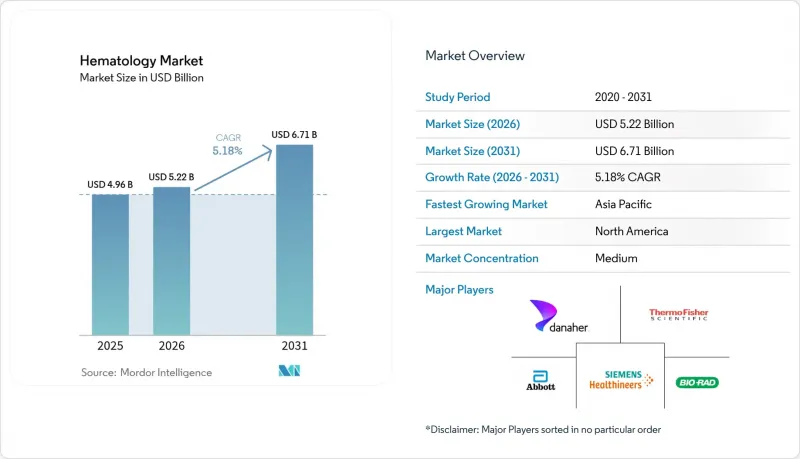
This report is Segmented by Product (Hematology Analyzers, Flow Cytometers, Coagulation Analyzers, and More), Reagent (Coagulation Reagents, Flow Cytometry Reagents & Kits, and More), Application (Drug Discovery & Toxicology, and More), End User (Hospital Laboratories, Point-Of-Care Settings, and More), and Geography (North America, Europe, and More). The Market Forecasts are Provided in Terms of Value (USD).
Global Hematology Market Trends and Insights
Growth in AI-enabled Automated CBC Platforms
Low-cost AI flow-cytometry prototypes developed at Rice University demonstrate performance comparable to high-end systems, lowering entry barriers for resource-constrained facilities. The FDA's reclassification of automated hemoglobin systems to Class II further eases U.S. market access. Machine-learning algorithms now deliver sub-second cell-morphology recognition, shrinking turnaround times and supporting adoption in high-volume hospitals. Cloud analytics also help labs benchmark quality metrics across networks, reinforcing procurement arguments. Collectively, these gains elevate analyzer utilization rates and underpin recurring reagent revenues, keeping the hematology market on a firm growth path.
Rising Incidence of Hematologic Cancers & Anemia
The Leukemia & Lymphoma Society counts 1.70 million U.S. residents living with blood cancers, with 187,740 new cases expected in 2024. Ageing populations in developed economies drive prevalence, while improved survival extends monitoring cycles that rely on routine CBC and flow-cytometry panels. Progress in targeted therapies widens patient eligibility, lifting test volumes. Advanced economies shoulder the largest caseloads, yet emerging markets are catching up as diagnostic infrastructure expands. The sustained clinical burden translates into predictable demand, anchoring the hematology market against economic volatility.
Capital-intensive Next-generation Analyzers & Reagent Contracts
Comprehensive hematology systems can exceed USD 500,000 per unit and require multi-year reagent tie-ins, straining budgets of mid-tier hospitals. Hidden costs include staff training, maintenance, and space retrofits, lengthening payback cycles. Emerging-market buyers lean toward refurbished units or staggered upgrades, slowing technology refresh rates. Service-leasing models offer relief but often translate into higher lifetime outlays. Consequently, procurement committees scrutinize large-scale roll-outs, moderating short-term expansion of the hematology market.
Other drivers and restraints analyzed in the detailed report include:
- Expansion of Decentralized POC Hematology Testing
- Surge in Complex Therapies Needing Advanced Blood Monitoring
- Data-privacy Barriers to Cloud-connected Lab Instruments
For complete list of drivers and restraints, kindly check the Table Of Contents.
Segment Analysis
Analyzers generated 37.09% revenue in 2025, underscoring their role as the operational backbone of hospital laboratories. Integrated systems combining CBC, differential, and digital morphology shorten turnaround times and free technologists for complex tasks. Flow cytometers, projected to compound at 12.4% through 2031, gain traction as immunotherapy monitoring becomes mainstream. Rising deployment of middleware accelerates result-export to electronic medical records, enhancing decision-making speed across care teams.
Premium analyzers bundle quality-control algorithms that minimize repeat tests, supporting reagent pull-through. Meanwhile, slide stainers and centrifuges remain essential for blood-banking workflows, ensuring steady baseline demand. Vendors prioritize modular designs to ease future upgrades, protecting buyer investments and anchoring the hematology market.
CBC reagents contributed 45.05% of the hematology market size in 2025, reflecting the universal role of CBC tests in patient triage. Stable pricing and high daily volumes make CBC consumables a predictable revenue engine. Flow-cytometry reagents are set to climb at an 11.62% CAGR, boosted by CAR-T and residual-disease applications. Emergence of 10-color and higher panels widens reagent pull-through, raising per-test values.
Controls and calibrators gain prominence as laboratories chase accreditation. Bioengineered heparin prototypes aim to mitigate porcine-supply risk, though full substitution will take several years. Overall reagent innovation balances cost containment with performance gains, reinforcing downstream stickiness in the hematology market.
Complete Report Scope:
- By Product
- Hematology Analyzers
- Flow Cytometers
- Coagulation Analyzers
- Slide Stainers
- Centrifuges & Blood Processing Systems
- Hemoglobinometers
- Software & Middleware
- Other Products
- By Reagent
- Coagulation Reagents
- Flow Cytometry Reagents & Kits
- Immuno-hematology Reagents
- CBC & Differential Reagents
- Controls & Calibrators
- Other Reagents
- By Application
- Drug Discovery & Toxicology
- Auto-immune Diseases
- Hemato-oncology
- Diabetes Management (HbA1c)
- Infectious Diseases & Sepsis
- Genetic & Rare Blood Disorders
- Other Applications
- By End User
- Hospital Laboratories
- Reference & Clinical Testing Labs
- Point-of-Care Settings
- Blood Banks & Transfusion Centers
- Other End Users (Academic & Research Institutes, Veterinary Diagnostics Labs, and Others)
- Geography
- North America
- United States
- Canada
- Mexico
- Europe
- Germany
- United Kingdom
- France
- Italy
- Spain
- Rest of Europe
- Asia-Pacific
- China
- Japan
- India
- Australia
- South Korea
- Rest of Asia-Pacific
- Middle East and Africa
- GCC
- South Africa
- Rest of Middle East and Africa
- South America
- Brazil
- Argentina
- Rest of South America
- North America
Geography Analysis
North America generated 37.74% of 2025 revenues on the strength of robust reimbursement and early AI adoption. Hospitals fast-tracked analyzer upgrades to mitigate staffing gaps, and national payers rewarded high-throughput platforms. Canada follows similar patterns, although procurement cycles lag the United States by one to two years.
Asia-Pacific advances at an 11.4% CAGR, underpinned by public-sector investments and chronic-disease prevalence. India and China spearhead analyzer installations as domestic manufacturers scale cost-efficient platforms. Regional governments increasingly mandate CBC screening in preventive-health programs, lifting daily test volumes.
Europe maintains steady, mid-single-digit growth as In-Vitro Diagnostic Regulation enforcement raises compliance thresholds. Laboratories consolidate purchases around established brands to simplify audit processes, indirectly benefiting large multinationals. Eastern European members allocate EU-funded grants to modernize provincial labs, expanding the addressable hematology market.
South America records moderate gains; Brazil and Mexico drive bulk demand as private insurers widen coverage for advanced flow cytometry. Currency volatility occasionally delays tenders but has not altered long-term adoption curves.
Middle East and Africa remain nascent yet promising, with Gulf Cooperation Council states piloting national cancer-screening initiatives that rely on CBC and flow cytometry. Donor-funded infrastructure projects bolster basic hematology services in sub-Saharan Africa, creating footholds for future analyzer placements.
- Abbott Laboratories
- Agilent Technologies
- Bio-Rad Laboratories
- Boule Diagnostics
- CELLAVISION AB
- Danaher Corp.
- Diatron Group
- Drew Scientific
- Everlife CPC Diagnostics
- Roche
- HORIBA
- Mindray Haematology
- Nihon Kohden Corp.
- Ortho Clinical Diagnostics
- PixCell Medical
- Mindray
- Siemens Healthineers
- Sysmex
- Sysmex Inostics
- Thermo Fisher Scientific
Additional Benefits:
- The market estimate (ME) sheet in Excel format
- 3 months of analyst support
TABLE OF CONTENTS
1 Introduction
- 1.1 Study Assumptions & Market Definition
- 1.2 Scope of the Study
2 Research Methodology
3 Executive Summary
4 Market Landscape
- 4.1 Market Overview
- 4.2 Market Drivers
- 4.2.1 Growth In AI-Enabled Automated CBC Platforms
- 4.2.2 Rising Incidence Of Hematologic Cancers & Anemia
- 4.2.3 Expansion Of Decentralized POC Hematology Testing
- 4.2.4 Surge In Complex Therapies Needing Advanced Blood Monitoring
- 4.2.5 Favourable Reimbursement For High-Throughput Analyzers
- 4.2.6 Growing Veterinary Diagnostics As A Parallel Revenue Stream
- 4.3 Market Restraints
- 4.3.1 Capital-Intensive Next-Gen Analyzers & Reagent Contracts
- 4.3.2 Data-Privacy Barriers To Cloud-Connected Lab Instruments
- 4.3.3 Shortage Of Skilled Hematopathologists In LMICs
- 4.3.4 Consumable Supply-Chain Fragility (Heparin, Antibodies)
- 4.4 Technological Outlook
- 4.5 Porter's Five Forces
- 4.5.1 Threat of New Entrants
- 4.5.2 Bargaining Power of Buyers
- 4.5.3 Bargaining Power of Suppliers
- 4.5.4 Threat of Substitutes
- 4.5.5 Competitive Rivalry
5 Market Size & Growth Forecasts (Value, USD)
- 5.1 By Product
- 5.1.1 Hematology Analyzers
- 5.1.2 Flow Cytometers
- 5.1.3 Coagulation Analyzers
- 5.1.4 Slide Stainers
- 5.1.5 Centrifuges & Blood Processing Systems
- 5.1.6 Hemoglobinometers
- 5.1.7 Software & Middleware
- 5.1.8 Other Products
- 5.2 By Reagent
- 5.2.1 Coagulation Reagents
- 5.2.2 Flow Cytometry Reagents & Kits
- 5.2.3 Immuno-hematology Reagents
- 5.2.4 CBC & Differential Reagents
- 5.2.5 Controls & Calibrators
- 5.2.6 Other Reagents
- 5.3 By Application
- 5.3.1 Drug Discovery & Toxicology
- 5.3.2 Auto-immune Diseases
- 5.3.3 Hemato-oncology
- 5.3.4 Diabetes Management (HbA1c)
- 5.3.5 Infectious Diseases & Sepsis
- 5.3.6 Genetic & Rare Blood Disorders
- 5.3.7 Other Applications
- 5.4 By End User
- 5.4.1 Hospital Laboratories
- 5.4.2 Reference & Clinical Testing Labs
- 5.4.3 Point-of-Care Settings
- 5.4.4 Blood Banks & Transfusion Centers
- 5.4.5 Other End Users (Academic & Research Institutes, Veterinary Diagnostics Labs, and Others)
- 5.5 Geography
- 5.5.1 North America
- 5.5.1.1 United States
- 5.5.1.2 Canada
- 5.5.1.3 Mexico
- 5.5.2 Europe
- 5.5.2.1 Germany
- 5.5.2.2 United Kingdom
- 5.5.2.3 France
- 5.5.2.4 Italy
- 5.5.2.5 Spain
- 5.5.2.6 Rest of Europe
- 5.5.3 Asia-Pacific
- 5.5.3.1 China
- 5.5.3.2 Japan
- 5.5.3.3 India
- 5.5.3.4 Australia
- 5.5.3.5 South Korea
- 5.5.3.6 Rest of Asia-Pacific
- 5.5.4 Middle East and Africa
- 5.5.4.1 GCC
- 5.5.4.2 South Africa
- 5.5.4.3 Rest of Middle East and Africa
- 5.5.5 South America
- 5.5.5.1 Brazil
- 5.5.5.2 Argentina
- 5.5.5.3 Rest of South America
- 5.5.1 North America
6 Competitive Landscape
- 6.1 Market Concentration
- 6.2 Market Share Analysis
- 6.3 Company Profiles (includes Global level Overview, Market level overview, Core Business Segments, Financials, Headcount, Key Information, Market Rank, Market Share, Products and Services, and analysis of Recent Developments)
- 6.3.1 Abbott Laboratories
- 6.3.2 Agilent Technologies Inc.
- 6.3.3 Bio-Rad Laboratories Inc.
- 6.3.4 Boule Diagnostics AB
- 6.3.5 CELLAVISION AB
- 6.3.6 Danaher Corp.
- 6.3.7 Diatron Group
- 6.3.8 Drew Scientific
- 6.3.9 Everlife CPC Diagnostics
- 6.3.10 F. Hoffmann-La Roche Ltd
- 6.3.11 Horiba Ltd.
- 6.3.12 Mindray Haematology
- 6.3.13 Nihon Kohden Corp.
- 6.3.14 Ortho Clinical Diagnostics
- 6.3.15 PixCell Medical
- 6.3.16 Shenzhen Mindray Bio-Medical Electronics Co. Ltd
- 6.3.17 Siemens Healthineers AG
- 6.3.18 Sysmex Corporation
- 6.3.19 Sysmex Inostics
- 6.3.20 Thermo Fisher Scientific Inc.
7 Market Opportunities & Future Outlook
- 7.1 White-space & Unmet Need Assessment

