PUBLISHER: Mordor Intelligence | PRODUCT CODE: 2113739

PUBLISHER: Mordor Intelligence | PRODUCT CODE: 2113739
Feed Palatability Enhancers - Market Share Analysis, Industry Trends & Statistics, Growth Forecasts (2026 - 2031)
According to Mordor Intelligence, the feed palatability enhancers market size is expected to grow from USD 3.41 billion in 2025 to USD 3.65 billion in 2026 and is forecast to reach USD 5.12 billion by 2031 at 7.01% CAGR over 2026-2031.
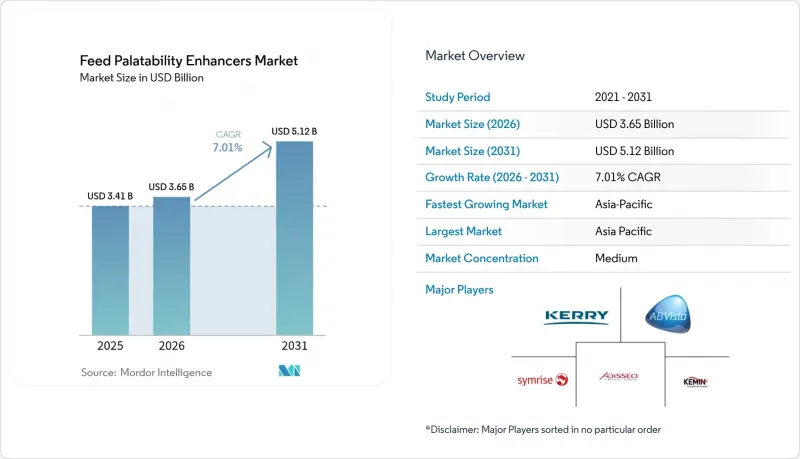
This report is Segmented by Type (Flavors, Sweeteners, and More), by Animal Type (Ruminant, Poultry, Swine, Aquaculture, and More), and by Geography (North America, Europe, Asia-Pacific, South America, and More). The Market Forecasts are Provided in Terms of Value (USD).
Global Feed Palatability Enhancers Market Trends and Insights
Rising Demand for Antibiotic-Free Livestock Production
Regulatory bans on antibiotic growth promoters have created a structural tailwind for palatability enhancers by forcing producers to maintain feed intake through sensory appeal rather than pharmaceutical appetite stimulation. The United States Food and Drug Administration's Veterinary Feed Directive, implemented in 2017 and tightened in 2023, restricts medically important antibiotics in feed, pushing integrators toward flavor-based solutions that preserve daily weight gain . In Thailand, the Department of Livestock Development reported a 22% increase in palatant adoption among contract broiler growers between 2023 and 2024, correlating with the country's phase-out of colistin and zinc bacitracin. This regulatory momentum is now extending to India, where the Food Safety and Standards Authority of India proposed antibiotic restrictions in compound feeds for poultry and aquaculture in late 2024, potentially unlocking a market serving 850 million birds annually.
Premiumization and Humanization of Pet Nutrition
Pet owners increasingly treat companion animals as family members, demanding ingredient transparency and gourmet flavor profiles that mirror human food trends. Nielsen data for 2024 indicate that super-premium pet food sales in the United States grew 14% year-over-year, with wet diets commanding a 32% price premium over dry kibble, driven largely by palatant-enhanced gravies and broths. Kerry Group's Taste and Nutrition division launched a range of fermented fish-protein palatants in early 2025, specifically targeting the feline wet-food segment, citing consumer willingness to pay USD 0.40 more per 85-gram pouch for products labeled no artificial flavors. This humanization extends to treats, where Kemin Industries introduced a palatable system in mid-2024 that replicates the umami profile of aged cheeses, addressing the premiumization of training rewards and dental chews.
Volatile Prices of Botanical and Protein-Hydrolysate Inputs
Weather-driven crop failures and export restrictions are inflating costs for key palatable raw materials, compressing margins, and forcing suppliers to reformulate or pass through price increases that dampen demand. Yeast-extract prices rose 22% between January and September 2024, driven by Brazilian sugarcane shortages that reduced molasses availability, a primary feedstock for fermentation-based palatants. Rosemary-extract quotations surged 31% in early 2024 after drought in Spain's Andalusia region cut harvest volumes by 40%, disrupting supply chains for natural pet food palatants. Smaller palatant producers lacking vertical integration into raw-material sourcing face acute pressure, with several regional suppliers in Southeast Asia exiting the market in 2024 after failing to secure long-term contracts for yeast and hydrolysate supplies.
Other drivers and restraints analyzed in the detailed report include:
- Expansion of Precision-Feeding Platforms in Poultry and Swine
- Rapid Aquaculture Intensification in Asia-Pacific
- Stringent Regional Approvals for Synthetic Sweeteners
For complete list of drivers and restraints, kindly check the Table Of Contents.
Segment Analysis
The flavors category accounted for 37.45% of the feed palatability enhancers market size in 2025 and is projected to grow at a 7.16% CAGR through 2031. Flavors remain the dominant category due to their versatility across species and feed formats. Flavor systems mask bitter notes from high-protein diets and stimulate olfactory receptors across species. Kerry Group's 2024 product pipeline included 12 new flavor systems targeting specific life stages in poultry, such as a starter-diet flavor designed to ease the transition from pre-starter to grower rations, addressing a pain point where intake dips often trigger long-term performance penalties .
Texturants, often based on hydrocolloids or modified starches, are being co-formulated with flavors to create palatable systems that improve pellet durability while masking off-notes from high-inclusion alternative proteins such as insect meal or single-cell proteins. BASF's 2024 launch of a combined flavor-texturant for pet treats addressed the dual challenge of palatability and dental-chew hardness, capturing share in a segment where functionality and sensory appeal must coexist. Blended formulations, which combine synthetic backbones with natural top-notes, are emerging as a pragmatic middle ground, offering cost efficiency while meeting no artificial flavors claims through careful regulatory interpretation.
Complete Report Scope:
- By Type
- Flavors
- Sweeteners
- Aroma Enhancers
- By Animal Type
- Poultry
- Swine
- Ruminant
- Aquaculture
- Other Animal Types
- By Geography
- North America
- United States
- Canada
- Mexico
- Rest of North America
- South America
- Brazil
- Argentina
- Rest of South America
- Europe
- Germany
- United Kingdom
- France
- Spain
- Italy
- Russia
- Rest of Europe
- Asia-Pacific
- China
- Japan
- India
- Australia
- Rest of Asia-Pacific
- Middle East
- Saudi Arabia
- United Arab Emirates
- Rest of Middle East
- Africa
- South Africa
- Egypt
- Rest of Africa
- North America
Geography Analysis
The Asia-Pacific region led the feed palatability enhancers market, holding a 33.60% share in 2025, with a projected CAGR of 8.34% through 2031, driven by China's livestock modernization, Vietnam's ambitions in shrimp exports, and India's expansion in the poultry sector. China's compound feed production reached 280 million metric tons in 2024, with palatable penetration rates in commercial feeds rising from 42% in 2020 to an estimated 58% in 2024 as integrators adopt nutritional strategies to replace banned antibiotics. Thailand's Charoen Pokphand Foods, the world's largest animal-feed producer, announced in mid-2024 that it would standardize palatable inclusion across its Asian poultry operations, a decision that affects over 20 million metric tons of annual feed output and signals mainstream acceptance of palatability enhancement.
North America and Europe are expanding, with growth concentrated in the pet food and organic livestock segments, rather than in conventional poultry and swine. The United States Department of Agriculture reported that organic broiler production grew 11% in 2024, with organic-certified palatants becoming a prerequisite for maintaining certification under National Organic Program standards. In France, the poultry sector's shift toward slower-growing breeds, driven by animal welfare regulations, is increasing palatable demand as longer grow-out periods require sustained feed intake over 56-70 day cycles, versus conventional 35-42 day programs.
The Middle East and Africa are growing regions, driven by poultry-sector expansion in Saudi Arabia, Egypt, and South Africa, alongside nascent aquaculture development in Kenya and Nigeria. Saudi Arabia's Vision 2030 agricultural diversification strategy includes targets for 70% self-sufficiency in poultry meat, with palatants identified as a tool to improve feed efficiency in desert climates where heat stress depresses intake. Egypt's poultry sector, recovering from avian influenza outbreaks in 2023, experienced increased palatable adoption in 2024 as producers sought to accelerate flock rebuilding through improved starter diet performance.
List of Companies Covered in this Report:
- Kerry Group plc
- Associated British Foods plc
- Symrise AG
- Bluestar Adisseo Co. Ltd
- Kemin Industries Inc.
- DSM-Firmenich AG
- BASF SE
- Cargill Incorporated
- ADM
- Nutreco N.V.
- Novus International Inc.
- Alltech Inc.
- Evonik Industries AG
- CJ CheilJedang Corporation
- DuPont de Nemours Inc.
Additional Benefits:
- The market estimate (ME) sheet in Excel format
- 3 months of analyst support
TABLE OF CONTENTS
1 INTRODUCTION
- 1.1 Study Assumptions and Market Definition
- 1.2 Scope of the Study
2 RESEARCH METHODOLOGY
3 EXECUTIVE SUMMARY
4 MARKET LANDSCAPE
- 4.1 Market Overview
- 4.2 Market Drivers
- 4.2.1 Rising demand for antibiotic-free livestock production
- 4.2.2 Premiumization and humanization of pet nutrition
- 4.2.3 Expansion of precision-feeding platforms in poultry and swine
- 4.2.4 Rapid aquaculture intensification in Asia-Pacific
- 4.2.5 Heat-stable natural flavor technologies for pelleted feeds
- 4.2.6 Blockchain-enabled raw-material traceability boosting clean-label claims
- 4.3 Market Restraints
- 4.3.1 Volatile prices of botanical and protein-hydrolysate inputs
- 4.3.2 Stringent regional approvals for synthetic sweeteners
- 4.3.3 Supply-chain disruptions for specialty amino acids
- 4.3.4 Consumer skepticism toward chemical aromas in premium pet food
- 4.4 Regulatory Landscape
- 4.5 Technological Outlook
- 4.6 Porter's Five Forces Analysis
- 4.6.1 Bargaining Power of Suppliers
- 4.6.2 Bargaining Power of Buyers
- 4.6.3 Threat of New Entrants
- 4.6.4 Threat of Substitutes
- 4.6.5 Intensity of Competitive Rivalry
5 MARKET SIZE AND GROWTH FORECASTS (VALUE)
- 5.1 By Type
- 5.1.1 Flavors
- 5.1.2 Sweeteners
- 5.1.3 Aroma Enhancers
- 5.2 By Animal Type
- 5.2.1 Poultry
- 5.2.2 Swine
- 5.2.3 Ruminant
- 5.2.4 Aquaculture
- 5.2.5 Other Animal Types
- 5.3 By Geography
- 5.3.1 North America
- 5.3.1.1 United States
- 5.3.1.2 Canada
- 5.3.1.3 Mexico
- 5.3.1.4 Rest of North America
- 5.3.2 South America
- 5.3.2.1 Brazil
- 5.3.2.2 Argentina
- 5.3.2.3 Rest of South America
- 5.3.3 Europe
- 5.3.3.1 Germany
- 5.3.3.2 United Kingdom
- 5.3.3.3 France
- 5.3.3.4 Spain
- 5.3.3.5 Italy
- 5.3.3.6 Russia
- 5.3.3.7 Rest of Europe
- 5.3.4 Asia-Pacific
- 5.3.4.1 China
- 5.3.4.2 Japan
- 5.3.4.3 India
- 5.3.4.4 Australia
- 5.3.4.5 Rest of Asia-Pacific
- 5.3.5 Middle East
- 5.3.5.1 Saudi Arabia
- 5.3.5.2 United Arab Emirates
- 5.3.5.3 Rest of Middle East
- 5.3.6 Africa
- 5.3.6.1 South Africa
- 5.3.6.2 Egypt
- 5.3.6.3 Rest of Africa
- 5.3.1 North America
6 COMPETITIVE LANDSCAPE
- 6.1 Strategic Moves
- 6.2 Market Share Analysis
- 6.3 Company Profiles (Includes Global Level Overview, Market Level Overview, Core Segments, Financials as Available, Strategic Information, Market Rank/Share, Products and Services, Recent Developments)
- 6.3.1 Kerry Group plc
- 6.3.2 Associated British Foods plc
- 6.3.3 Symrise AG
- 6.3.4 Bluestar Adisseo Co. Ltd
- 6.3.5 Kemin Industries Inc.
- 6.3.6 DSM-Firmenich AG
- 6.3.7 BASF SE
- 6.3.8 Cargill Incorporated
- 6.3.9 ADM
- 6.3.10 Nutreco N.V.
- 6.3.11 Novus International Inc.
- 6.3.12 Alltech Inc.
- 6.3.13 Evonik Industries AG
- 6.3.14 CJ CheilJedang Corporation
- 6.3.15 DuPont de Nemours Inc.
7 MARKET OPPORTUNITIES AND FUTURE OUTLOOK

