PUBLISHER: Mordor Intelligence | PRODUCT CODE: 2113741

PUBLISHER: Mordor Intelligence | PRODUCT CODE: 2113741
Japan Biopesticide - Market Share Analysis, Industry Trends & Statistics, Growth Forecasts (2026 - 2031)
According to Mordor Intelligence, the Japan biopesticide market size was valued at USD 185 million in 2025 and estimated to grow from USD 211.05 million in 2026 to reach USD 408.13 million by 2031, at a CAGR of 14.08% during the forecast period (2026-2031).
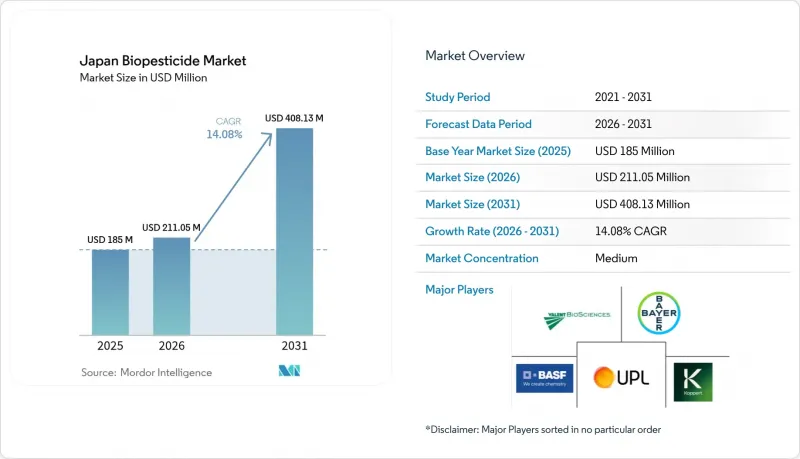
This report is Segmented by Product (Bioherbicides, Bioinsecticides, Biofungicides, and Other Products) and by Application (Food Crop and Non-Food Crop). The Market Forecasts are Provided in Terms of Value (USD).
Japan Biopesticide Market Trends and Insights
Rising Demand for Organic Farming and Produce
Japan's organic retail sales expanded, driven by consumer willingness to pay a 26 to 29% premium for pesticide-free produce, yet this premium often fails to cover the 1.35 to 1.6 times higher production costs that organic growers face. The MIDORI Strategy's target of 1 million hectares of organic farmland by 2050 represents a tenfold increase from current levels, creating a structural demand pull for biopesticides that can bridge the transition period when fields are converting from conventional to certified organic status . Retailers such as Aeon and Seven and i Holdings are expanding organic private-label lines, leveraging traceability systems that highlight reduced chemical residue as a point of differentiation in saturated fresh produce categories. This dynamic is most pronounced in Kanto's peri-urban vegetable belts, where proximity to Tokyo's affluent consumer base justifies the higher input costs and logistical complexity of organic production systems.
Regulatory Support for Sustainable Agriculture
The Ministry of Agriculture, Fisheries and Food (MAFF) introduced a fast-track approval pathway for biopesticides under the revised Agricultural Chemicals Regulation Law, reducing registration timelines from 36 months to 24 months for microbial actives with established safety profiles, thereby lowering market entry barriers for biocontrol innovators. The Green Food System Law, enacted in 2024, designated over 17,000 certified producers eligible for direct payments and technical assistance, creating a cohort of early adopters who serve as demonstration sites for biological pest management practices. These policy instruments collectively de-risk biopesticide adoption by socializing transition costs and compressing the payback period for growers who invest in new application equipment and training.
Limited Farmer Awareness and Technical Know-How
Only 28% of Japanese smallholders have received training in microbial application protocols, a knowledge deficit that manifests in suboptimal timing, dosing errors, and inadequate storage practices that degrade biopesticide efficacy and erode grower confidence in biological solutions. The aging farmer demographic, with over 70% of operators older than 65 years, creates resistance to adopting new technologies that require modified spray schedules, specialized equipment, and real-time pest monitoring to achieve performance parity with synthetic chemistries. The technical complexity of matching biopesticide modes of action to specific pest life stages and environmental conditions requires a level of agronomic sophistication that many growers lack, creating a performance gap that undermines market expansion beyond early-adopter cohorts.
Other drivers and restraints analyzed in the detailed report include:
- Environmental and Health Concerns
- Government Subsidies for Integrated Pest Management
- Higher Cost and Scalability Challenges Versus Synthetics
For complete list of drivers and restraints, kindly check the Table Of Contents.
Segment Analysis
Bioinsecticides held a 37.40% share of the Japanese biopesticide market in 2025, reflecting their established efficacy against lepidopteran pests in rice, vegetables, and fruit crops, where pyrethroid resistance has eroded the performance of conventional chemistries. Bacillus thuringiensis formulations such as DiPel and Agree dominate this segment, leveraging MAFF registrations that span over 50 crop-pest combinations and distribution networks anchored by Sumitomo Chemical's agricultural cooperative partnerships. Spinosad products, derived from the soil bacterium Saccharopolyspora spinosa, captured a share in greenhouse vegetable systems where their translaminar activity and short pre-harvest intervals align with intensive cropping schedules and export residue requirements.
Biochemical biopesticides are advancing at a 14.95% CAGR toward 2031, this acceleration is driven by turf and ornamental grass managers who prioritize residue-free solutions that preserve aesthetic quality and minimize applicator exposure risks, particularly in high-traffic areas such as golf courses and urban parks. Pheromone-based mating disruption systems are gaining adoption in apple orchards in Aomori and pear orchards in Tottori, where they provide season-long control of codling moth and Oriental fruit moth without the spray frequency and resistance risks associated with insecticides.
Complete Report Scope:
- By Product Type
- Bioherbicides
- Bioinsecticides
- Biofungicides
- Others
- By Application
- Food Crop
- Grains and cereals
- Oilseeds
- Fruits and vegetables
- Non-food Crop
- Turf and ornamental grass
- Others
- Food Crop
List of Companies Covered in this Report:
- Valent BioSciences LLC
- Bayer CropScience AG
- BASF SE
- Koppert B.V.
- UPL Limited
- Pro Farm Group Inc.
- Certis Biologicals LLC
- Mitsui Chemicals Agro, Inc.
- Ishihara Sangyo Kaisha, Ltd.
- OAT Agrio Co., Ltd.
- SDS Biotech K.K.
- Emery Oleochemicals Sdn. Bhd.
- Nihon Nohyaku Co., Ltd.
- Chr. Hansen Holding A/S
- Andermatt Biocontrol AG
Additional Benefits:
- The market estimate (ME) sheet in Excel format
- 3 months of analyst support
TABLE OF CONTENTS
1 INTRODUCTION
- 1.1 Study Assumptions and Market Definition
- 1.2 Scope of the Study
2 RESEARCH METHODOLOGY
3 EXECUTIVE SUMMARY
4 MARKET LANDSCAPE
- 4.1 Market Overview
- 4.2 Market Drivers
- 4.2.1 Rising demand for organic farming and produce
- 4.2.2 Regulatory support for sustainable agriculture
- 4.2.3 Environmental and health concerns
- 4.2.4 Government subsidies for integrated pest management
- 4.2.5 Increasing chemical-pesticide resistance in target pests
- 4.2.6 Carbon-credit programs favoring biologically derived inputs
- 4.3 Market Restraints
- 4.3.1 Limited farmer awareness and technical know-how
- 4.3.2 Higher cost and scalability challenges versus synthetics
- 4.3.3 Ultra-strict residue limits for microbial actives on exports
- 4.3.4 Dependence on imported patented microbial strains
- 4.4 Regulatory Landscape
- 4.5 Porter's Five Forces Analysis
- 4.5.1 Threat of New Entrants
- 4.5.2 Bargaining Power of Buyers/Consumers
- 4.5.3 Bargaining Power of Suppliers
- 4.5.4 Threat of Substitute Products
- 4.5.5 Intensity of Competitive Rivalry
5 MARKET SIZE AND GROWTH FORECASTS (VALUE)
- 5.1 By Product Type
- 5.1.1 Bioherbicides
- 5.1.2 Bioinsecticides
- 5.1.3 Biofungicides
- 5.1.4 Others
- 5.2 By Application
- 5.2.1 Food Crop
- 5.2.1.1 Grains and cereals
- 5.2.1.2 Oilseeds
- 5.2.1.3 Fruits and vegetables
- 5.2.2 Non-food Crop
- 5.2.2.1 Turf and ornamental grass
- 5.2.2.2 Others
- 5.2.1 Food Crop
6 COMPETITIVE LANDSCAPE
- 6.1 Market Concentration
- 6.2 Strategic Moves
- 6.3 Market Share Analysis
- 6.4 Company Profiles (Includes Global level Overview, Market level overview, Core Segments, Financials as available, Strategic Information, Market Rank/Share for key companies, Products and Services, and Recent Developments)
- 6.4.1 Valent BioSciences LLC
- 6.4.2 Bayer CropScience AG
- 6.4.3 BASF SE
- 6.4.4 Koppert B.V.
- 6.4.5 UPL Limited
- 6.4.6 Pro Farm Group Inc.
- 6.4.7 Certis Biologicals LLC
- 6.4.8 Mitsui Chemicals Agro, Inc.
- 6.4.9 Ishihara Sangyo Kaisha, Ltd.
- 6.4.10 OAT Agrio Co., Ltd.
- 6.4.11 SDS Biotech K.K.
- 6.4.12 Emery Oleochemicals Sdn. Bhd.
- 6.4.13 Nihon Nohyaku Co., Ltd.
- 6.4.14 Chr. Hansen Holding A/S
- 6.4.15 Andermatt Biocontrol AG
7 MARKET OPPORTUNITIES AND FUTURE OUTLOOK

