PUBLISHER: Mordor Intelligence | PRODUCT CODE: 2113748

PUBLISHER: Mordor Intelligence | PRODUCT CODE: 2113748
Soldier Modernization - Market Share Analysis, Industry Trends & Statistics, Growth Forecasts (2026 - 2031)
According to Mordor Intelligence, the soldier modernization market size is expected to grow from USD 17.81 billion in 2025 to USD 18.47 billion in 2026 and is forecast to reach USD 22.17 billion by 2031 at 3.72% CAGR over 2026-2031.
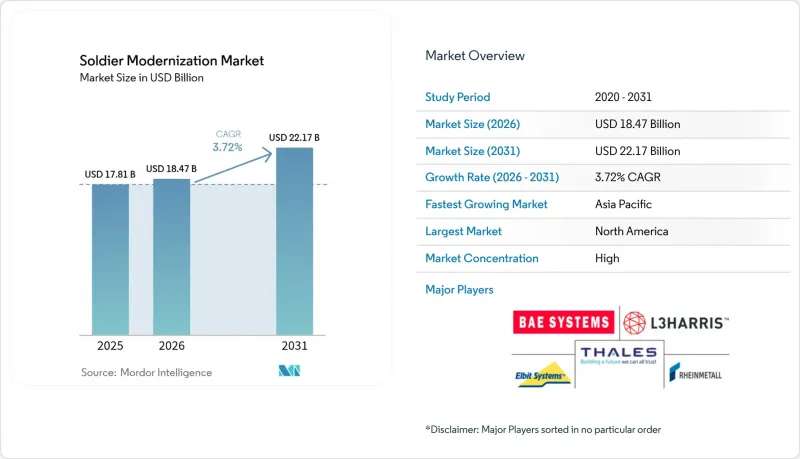
This report is Segmented by Type (Weapons and Ammunition, Personal Protection, and More), Technology (Lethal, Non-Lethal, and More), End User (Army Infantry and Special Operations Forces), Component (Hardware and Software), Platform (Dismounted Soldier, Mounted Soldier, and Wearable Robotics), and Geography (North America, Europe, and More). The Market Forecasts are Provided in Terms of Value (USD).
Global Soldier Modernization Market Trends and Insights
Next-gen AI-assisted targeting systems
Precision fire-control optics such as Smart Shooter's SMASH series deliver 95% hit probability under combat stress, compared with historical 20-30% accuracy rates, illustrating transformative lethality gains. Machine-learning algorithms embedded in the US Army ATLAS prototypes generate ballistic solutions within milliseconds, allowing moving-target engagement at extended ranges. High validation in Israel and ongoing US field testing accelerate procurement confidence. AI layers bolt onto existing weapons, minimizing retraining burdens while spurring demand for edge-compute processors ruggedized for battlefield shock and temperature extremes. Rising adoption supports premium pricing that offsets modest top-line defense growth, thus adding 1.2 percentage points to the soldier modernization market CAGR.
Soldier-worn software-defined radios adoption
L3Harris's RF-7850S SPR radio operates multiple legacy and future waveforms via field-loadable software, reducing unit-level radio inventories by 40%. Thales's AN/PRC-154 rifleman radio adds a self-forming mesh that maintains voice and data links even when individual nodes drop, raising network resilience during electronic-warfare attacks. Software-centric architectures align with NATO interoperability doctrine and slash future upgrade costs, pushing widespread fielding into active units within 24 months.
Lithium supply-chain volatility
China refines 80% of global lithium, and tightening export controls raise spot prices, jeopardizing battery pack affordability for dismounted soldiers. The US Department of Defense (DoD) funneled USD 11.8 million to domestic processors to dilute single-nation risk, yet commercial electric-vehicle demand still outstrips projected supply, constraining military allocation. Battery failure costs the Army over USD 75 million annually in premature replacements. Alternative chemistries are promising but remain five-plus years from scale, damping near-term growth by 0.3 percentage points.
Other drivers and restraints analyzed in the detailed report include:
- Lightweight ballistic-composite breakthroughs
- NATO STANAG-driven interoperability upgrades
- RF spectrum congestion on tactical bands
For complete list of drivers and restraints, kindly check the Table Of Contents.
Segment Analysis
Personal protection systems accounted for 35.02% of the 2025 soldier modernization market, cementing their role as the foundational survivability layer for every combatant. Advanced UHMWPE and ceramic-graphene plates cut weight while keeping NIJ III+ protection, which feeds consistent replacement demand from armies rotating into readiness cycles. Meanwhile, exoskeletons grew fastest at 7.28% CAGR, reflecting a pivot toward performance enhancement rather than mere protection. Programs such as Lockheed Martin ONYX documented a 27% metabolic-cost drop during 38 kg load marches, validating operational value. The soldier modernization market size for exoskeleton solutions will expand steadily as prices fall and maintenance logistics mature.
The broader protective gear category now integrates blast sensors that log concussive events for post-mission health checks. Smart textiles embed heating filaments that sustain body temperature in high-altitude deployments. Weapon and ammunition sub-clusters intertwine with AI-aiming modules, linking directly to squad C4ISR networks. Communication and target-acquisition kits increasingly arrive factory-paired with ballistic carriers, creating ecosystem stickiness that favors vendors offering bundled solutions. Exoskeleton makers partner with body-armor suppliers to align mounting points, ensuring modular compatibility across soldier equipment suites.
C4ISR and data-fusion systems held 46.20% of 2025 revenue, underscoring that situational awareness underwrites every lethality and survivability gain. Modular sensor hubs aggregate drone feeds, counter-battery radars, and AI-generated target nominations. Open-source frameworks accelerate application upgrades, preserving platform relevance across a decade of threat evolution. Concurrently, AR and HUDs clocked a 6.02% CAGR, boosted by the US Army's plan to field 3,000+ integrated visual augmentation system units valued at USD 255 million. The soldier modernization market size attributed to AR optics remains small but rises quickly as optics weight, battery life, and occlusion improve.
Artificial-intelligence modules enrich every technology node. Predictive-maintenance suites flag cooling-fan failures before mission aborts, while cognitive radio algorithms auto-de-conflict frequencies mid-battle. Non-lethal systems gain share via directed-energy dazzlers that offer escalation-of-force options for peacekeeping. Mobility and power-assist technologies dovetail with the wearable-robotics push, as passive load frames morph into powered gait-augmentation gear that halves knee strain on 24-hour patrols.
Complete Report Scope:
- Weapons and Ammunition
- Personal Protection
- Communication Systems
- Surveillance and Target Acquisition
- Exoskeletons
- Power and Energy Management
- Training and Simulation
- By Technology
- Lethal
- Non-Lethal
- C4ISR and Data Fusion
- Mobility and Power-Assist
- Augmented-Reality (AR)/Heads-Up Display (HUD)
- By End User
- Army Infantry
- Special Operations Forces
- By Component
- Hardware
- Software
- By Platform
- Dismounted Soldier
- Mounted Soldier
- Wearable Robotics
- By Geography
- North America
- United States
- Canada
- Mexico
- Europe
- United Kingdom
- France
- Germany
- Russia
- Rest of Europe
- Asia-Pacific
- China
- India
- Japan
- South Korea
- Rest of Asia-Pacific
- South America
- Brazil
- Rest of South America
- Middle East and Africa
- Middle East
- Saudi Arabia
- United Arab Emirates
- Rest of Middle East
- Africa
- South Africa
- Rest of Africa
- Middle East
- North America
Geography Analysis
North America commanded 44.92% of 2025 spending due to the US programs like the enhanced night vision goggle-binocular, which received a USD 263 million follow-on award for 40,000 goggles. Canada pursues the DICE network, emphasizing joint integration while nurturing local electronics suppliers. Mexico cooperates through foreign military sales, adding a stable baseline demand.
Asia-Pacific, propelled by sovereignty initiatives and contested-island scenarios, posts a 6.52% CAGR. Japan's record defense budgets channel funds into soldier C4ISR kits that synchronize with the US systems, whereas South Korea prototypes power armor to deter incursions. India balances cost and capability via Make in India, which mandates pairing foreign OEMs with public-sector ordnance factories.
Europe accelerates procurement under NATO readiness pledges, exemplified by Germany's USD 3.6 billion IdZ-ES contract. The UK fits next-generation modular armor on Challenger 3 without disrupting local supply chains, keeping 58 jobs while harvesting British talent. Middle East and Africa favor off-the-shelf optics and radio bundles with proven reliability in desert climates, though Gulf states increasingly pilot AR headsets for armored crews.
- BAE Systems plc
- Thales Group
- L3Harris Technologies, Inc.
- Elbit Systems Ltd.
- Rheinmetall AG
- Leonardo S.p.A.
- Safran SA
- Northrop Grumman Corporation
- General Dynamics Corporation
- Saab AB
- Teledyne Technologies Incorporated
- Ballistic Armor Co.
- RTX Corporation
- ASELSAN A.S.
- Avon Technologies plc
- Lockheed Martin Corporation
- SRI International
- MKU Limited
- Silvus Technologies, Inc. (Motorola Solutions, Inc.)
- Bharat Electronics Limited
Additional Benefits:
- The market estimate (ME) sheet in Excel format
- 3 months of analyst support
TABLE OF CONTENTS
1 INTRODUCTION
- 1.1 Study Assumptions and Market Definition
- 1.2 Scope of the Study
2 RESEARCH METHODOLOGY
3 EXECUTIVE SUMMARY
4 MARKET LANDSCAPE
- 4.1 Market Overview
- 4.2 Market Drivers
- 4.2.1 Next-gen AI-assisted targeting systems
- 4.2.2 Soldier-worn software-defined radios (SDR) adoption
- 4.2.3 Lightweight ballistic-composite breakthroughs
- 4.2.4 NATO STANAG-driven interoperability upgrades
- 4.2.5 Battery-agnostic portable power packs
- 4.2.6 Post-Ukraine rapid re-equipment programs
- 4.3 Market Restraints
- 4.3.1 Lithium supply-chain volatility
- 4.3.2 RF spectrum congestion on tactical bands
- 4.3.3 Exoskeleton cost-benefit skepticism
- 4.3.4 Export-control limitations on advanced optics
- 4.4 Value Chain Analysis
- 4.5 Regulatory Landscape
- 4.6 Technological Outlook
- 4.7 Porter's Five Forces Analysis
- 4.7.1 Threat of New Entrants
- 4.7.2 Bargaining Power of Buyers/Consumers
- 4.7.3 Bargaining Power of Suppliers
- 4.7.4 Threat of Substitute Products
- 4.7.5 Intensity of Competitive Rivalry
5 MARKET SIZE AND GROWTH FORECASTS (VALUE)
- 5.1 Weapons and Ammunition
- 5.1.1 Personal Protection
- 5.1.2 Communication Systems
- 5.1.3 Surveillance and Target Acquisition
- 5.1.4 Exoskeletons
- 5.1.5 Power and Energy Management
- 5.1.6 Training and Simulation
- 5.2 By Technology
- 5.2.1 Lethal
- 5.2.2 Non-Lethal
- 5.2.3 C4ISR and Data Fusion
- 5.2.4 Mobility and Power-Assist
- 5.2.5 Augmented-Reality (AR)/Heads-Up Display (HUD)
- 5.3 By End User
- 5.3.1 Army Infantry
- 5.3.2 Special Operations Forces
- 5.4 By Component
- 5.4.1 Hardware
- 5.4.2 Software
- 5.5 By Platform
- 5.5.1 Dismounted Soldier
- 5.5.2 Mounted Soldier
- 5.5.3 Wearable Robotics
- 5.6 By Geography
- 5.6.1 North America
- 5.6.1.1 United States
- 5.6.1.2 Canada
- 5.6.1.3 Mexico
- 5.6.2 Europe
- 5.6.2.1 United Kingdom
- 5.6.2.2 France
- 5.6.2.3 Germany
- 5.6.2.4 Russia
- 5.6.2.5 Rest of Europe
- 5.6.3 Asia-Pacific
- 5.6.3.1 China
- 5.6.3.2 India
- 5.6.3.3 Japan
- 5.6.3.4 South Korea
- 5.6.3.5 Rest of Asia-Pacific
- 5.6.4 South America
- 5.6.4.1 Brazil
- 5.6.4.2 Rest of South America
- 5.6.5 Middle East and Africa
- 5.6.5.1 Middle East
- 5.6.5.1.1 Saudi Arabia
- 5.6.5.1.2 United Arab Emirates
- 5.6.5.1.3 Rest of Middle East
- 5.6.5.2 Africa
- 5.6.5.2.1 South Africa
- 5.6.5.2.2 Rest of Africa
- 5.6.5.1 Middle East
- 5.6.1 North America
6 COMPETITIVE LANDSCAPE
- 6.1 Market Concentration
- 6.2 Strategic Moves
- 6.3 Market Share Analysis
- 6.4 Company Profiles (includes Global level Overview, Market level overview, Core Segments, Financials as available, Strategic Information, Market Rank/Share for key companies, Products and Services, and Recent Developments)
- 6.4.1 BAE Systems plc
- 6.4.2 Thales Group
- 6.4.3 L3Harris Technologies, Inc.
- 6.4.4 Elbit Systems Ltd.
- 6.4.5 Rheinmetall AG
- 6.4.6 Leonardo S.p.A.
- 6.4.7 Safran SA
- 6.4.8 Northrop Grumman Corporation
- 6.4.9 General Dynamics Corporation
- 6.4.10 Saab AB
- 6.4.11 Teledyne Technologies Incorporated
- 6.4.12 Ballistic Armor Co.
- 6.4.13 RTX Corporation
- 6.4.14 ASELSAN A.S.
- 6.4.15 Avon Technologies plc
- 6.4.16 Lockheed Martin Corporation
- 6.4.17 SRI International
- 6.4.18 MKU Limited
- 6.4.19 Silvus Technologies, Inc. (Motorola Solutions, Inc.)
- 6.4.20 Bharat Electronics Limited
7 MARKET OPPORTUNITIES AND FUTURE OUTLOOK

