PUBLISHER: Mordor Intelligence | PRODUCT CODE: 2113784

PUBLISHER: Mordor Intelligence | PRODUCT CODE: 2113784
Asia-Pacific Ablation Technologies - Market Share Analysis, Industry Trends & Statistics, Growth Forecasts (2026 - 2031)
According to Mordor Intelligence, the Asia-Pacific ablation technologies market size is expected to grow from USD 1.05 billion in 2025 to USD 1.17 billion in 2026 and is forecast to reach USD 2.02 billion by 2031 at 11.57% CAGR over 2026-2031.
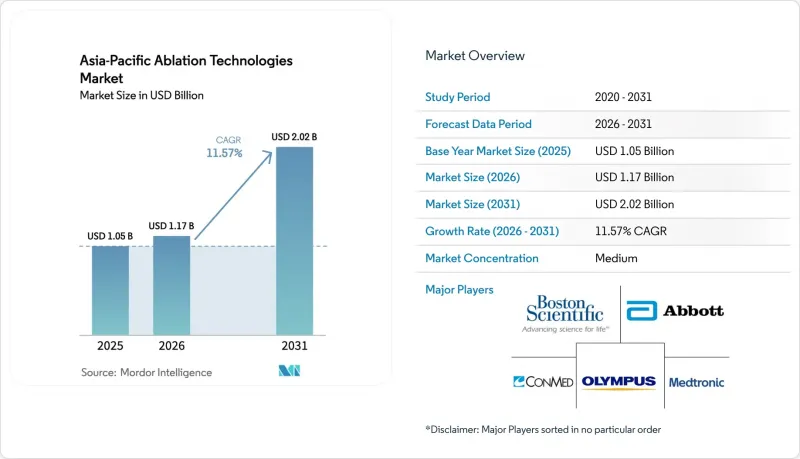
This report is Segmented by Device Technology (Radiofrequency Ablation, and More), Application (Cancer Treatment, and More), End User (Hospitals, Ambulatory Surgical Centers, and Other End Users), and Geography (China, Japan, India, South Korea, Australia, and Rest of Asia-Pacific). The Market Forecasts are Provided in Terms of Value (USD).
Asia-Pacific Ablation Technologies Market Trends and Insights
Growing Burden of Chronic Diseases
Cancer incidence across Asia-Pacific is projected to jump 59% between 2022 and 2045, lifting demand for percutaneous radiofrequency and microwave ablation in liver, lung, and gastric malignancies. Cardiovascular disease caused 10.8 million regional deaths in 2019, fueling catheter-based ablation for atrial fibrillation and ventricular tachycardia. China recorded a 12% year-on-year increase in electrophysiology procedures in 2024, following expanded reimbursement for ablation. Diabetes prevalence above 11% in India and Indonesia increases diabetic retinopathy cases that rely on laser photocoagulation. Benign prostatic hyperplasia affects nearly half of Japanese men over 60, sustaining demand for transurethral radiofrequency and water-vapor therapies.
Patient Preference for Minimally Invasive Therapy
A 2024 survey of 1,200 Japanese cardiac patients found 78% favored catheter ablation over antiarrhythmic drugs to manage atrial fibrillation, citing quality-of-life gains. South Korea's insurance data showed a 19% jump in same-day discharge ablation procedures during 2023-2025 as hospitals adopted enhanced recovery pathways. Australian private insurers lowered co-pays for microwave ablation of varicose veins and thyroid nodules, cutting average episode costs by 32% in 2025. Across high out-of-pocket markets, patients weigh the direct costs of hospital stays against income lost to prolonged recovery, accelerating outpatient adoption.
High Capital and Consumable Costs
Radiofrequency generators cost USD 80,000-120,000, while single-use catheters add USD 1,500-3,000 per case, stretching public-hospital budgets in India, Indonesia, and the Philippines that rely on capitated reimbursement models. Indonesia reimburses liver ablation at IDR 25 million (USD 1,600), below the USD 2,200 antenna cost, forcing hospitals to absorb losses or cap volumes. Pay-per-use leasing trims upfront outlays by 70% but lifts per-case costs by 15% over five years.
Other drivers and restraints analyzed in the detailed report include:
- Continuous Technology Advancements
- Expanding Healthcare Expenditure
- Limited Skilled Workforce Outside Major Cities
For complete list of drivers and restraints, kindly check the Table Of Contents.
Segment Analysis
Microwave ablation registered a 13.65% CAGR outlook through 2031, gaining on the 42.76% 2025 lead held by radiofrequency. The Asia-Pacific ablation technologies market size for microwave systems is projected to widen as oncologists value larger ablation zones and shorter procedure times in hepatocellular carcinoma and lung metastases. A 2024 meta-analysis covering 3,200 patients showed complete necrosis in 91% of sub-3 cm liver lesions with microwave versus 84% for radiofrequency, and required 19% fewer sessions. Medtronic's Emprint system, approved in China in 2024 with thermosphere stabilization, resonated with cirrhotic patient cohorts in which radiofrequency efficacy declines due to ascites.
Radiofrequency remains dominant in electrophysiology because contact-force sensing allows real-time lesion assessment during atrial fibrillation procedures. Cryoablation owns a niche in renal tumors and atrial fibrillation, with Medtronic's Arctic Front Advance capturing 18% of Japan's 2025 AF ablation market by simplifying pulmonary vein isolation. Ultrasound-based ablation, led by Chongqing Haifu, is widely installed for uterine fibroids at 2,400 Chinese hospitals, although cross-specialty adoption is slower due to lengthy treatment times. Pulsed-field ablation commands a premium price 30% above standard radiofrequency yet is winning early adopters in Japan and Australia on safety gains.
Complete Report Scope:
- By Device Technology
- Radiofrequency Ablation
- Microwave Ablation
- Laser/Light Ablation
- Ultrasound-Based
- Cryoablation
- Other Devices
- By Application
- Cancer Treatment
- Cardiovascular Disease Treatment
- Ophthalmologic Treatment
- Gynecological Treatment
- Urological Treatment
- Cosmetic Surgery
- Other Applications
- By End User
- Hospitals
- Ambulatory Surgical Centers
- Other End Users
- Geography
- China
- Japan
- India
- South Korea
- Australia
- Rest Of Asia-Pacific
List of Companies Covered in this Report:
- Abbott Laboratories
- AngioDynamics
- AtriCure
- BIOTRONIK
- Boston Scientific
- Chongqing Haifu Medical Technology Co., Ltd.
- Conmed
- EDAP TMS S.A.
- Hologic
- Integra LifeSciences
- Johnson & Johnson - Biosense Webster
- Medtronic
- Merit Medical Systems
- Olympus
- RF Medical Co., Ltd.
- Smiths Group
- STARmed Co., Ltd.
- Stryker
- Terumo
Additional Benefits:
- The market estimate (ME) sheet in Excel format
- 3 months of analyst support
TABLE OF CONTENTS
1 Introduction
- 1.1 Study Assumptions & Market Definition
- 1.2 Scope of the Study
2 Research Methodology
3 Executive Summary
4 Market Landscape
- 4.1 Market Overview
- 4.2 Market Drivers
- 4.2.1 Growing Burden of Chronic Diseases
- 4.2.2 Patient Preference for Minimally Invasive Therapies
- 4.2.3 Continuous Technology Advancements in Energy Delivery
- 4.2.4 Expanding Healthcare Expenditure Across Emerging Asian Economies
- 4.2.5 Localization of Manufacturing to Reduce Device Costs
- 4.2.6 Integration of Artificial Intelligence for Real-Time Ablation Guidance
- 4.3 Market Restraints
- 4.3.1 High Capital and Consumable Costs
- 4.3.2 Limited Skilled Workforce Outside Major Cities
- 4.3.3 Fragmented Regulatory Approval Pathways Across Asia-Pacific
- 4.3.4 Concerns Over Long-Term Efficacy Data in Non-Oncologic Indications
- 4.4 Value / Supply-Chain Analysis
- 4.5 Regulatory Landscape
- 4.6 Technological Outlook
- 4.7 Porter's Five Forces Analysis
- 4.7.1 Threat Of New Entrants
- 4.7.2 Bargaining Power Of Buyers
- 4.7.3 Bargaining Power Of Suppliers
- 4.7.4 Threat Of Substitute Products
- 4.7.5 Intensity Of Competitive Rivalry
5 Market Size & Growth Forecasts (Value, USD)
- 5.1 By Device Technology
- 5.1.1 Radiofrequency Ablation
- 5.1.2 Microwave Ablation
- 5.1.3 Laser/Light Ablation
- 5.1.4 Ultrasound-Based
- 5.1.5 Cryoablation
- 5.1.6 Other Devices
- 5.2 By Application
- 5.2.1 Cancer Treatment
- 5.2.2 Cardiovascular Disease Treatment
- 5.2.3 Ophthalmologic Treatment
- 5.2.4 Gynecological Treatment
- 5.2.5 Urological Treatment
- 5.2.6 Cosmetic Surgery
- 5.2.7 Other Applications
- 5.3 By End User
- 5.3.1 Hospitals
- 5.3.2 Ambulatory Surgical Centers
- 5.3.3 Other End Users
- 5.4 Geography
- 5.4.1 China
- 5.4.2 Japan
- 5.4.3 India
- 5.4.4 South Korea
- 5.4.5 Australia
- 5.4.6 Rest Of Asia-Pacific
6 Competitive Landscape
- 6.1 Market Concentration
- 6.2 Market Share Analysis
- 6.3 Company Profiles {(Includes Global Level Overview, Market Level Overview, Core Segments, Financials As Available, Strategic Information, Market Rank/Share For Key Companies, Products & Services, And Recent Developments)}
- 6.3.1 Abbott Laboratories
- 6.3.2 AngioDynamics, Inc.
- 6.3.3 AtriCure, Inc.
- 6.3.4 Biotronik SE & Co. KG
- 6.3.5 Boston Scientific Corporation
- 6.3.6 Chongqing Haifu Medical Technology Co., Ltd.
- 6.3.7 Conmed Corporation
- 6.3.8 EDAP TMS S.A.
- 6.3.9 Hologic, Inc.
- 6.3.10 Integra LifeSciences Holdings Corporation
- 6.3.11 Johnson & Johnson - Biosense Webster
- 6.3.12 Medtronic Plc
- 6.3.13 Merit Medical Systems, Inc.
- 6.3.14 Olympus Corporation
- 6.3.15 RF Medical Co., Ltd.
- 6.3.16 Smith & Nephew Plc
- 6.3.17 STARmed Co., Ltd.
- 6.3.18 Stryker Corporation
- 6.3.19 Terumo Corporation
7 Market Opportunities & Future Outlook
- 7.1 White-Space & Unmet-Need Assessment

