PUBLISHER: Mordor Intelligence | PRODUCT CODE: 2113788

PUBLISHER: Mordor Intelligence | PRODUCT CODE: 2113788
Bioabsorbable Stents - Market Share Analysis, Industry Trends & Statistics, Growth Forecasts (2026 - 2031)
According to Mordor Intelligence, the bioabsorbable stents market size is expected to grow from USD 497.59 million in 2025 to USD 547.7 million in 2026 and is forecast to reach USD 885.32 million by 2031 at 10.07% CAGR over 2026-2031.
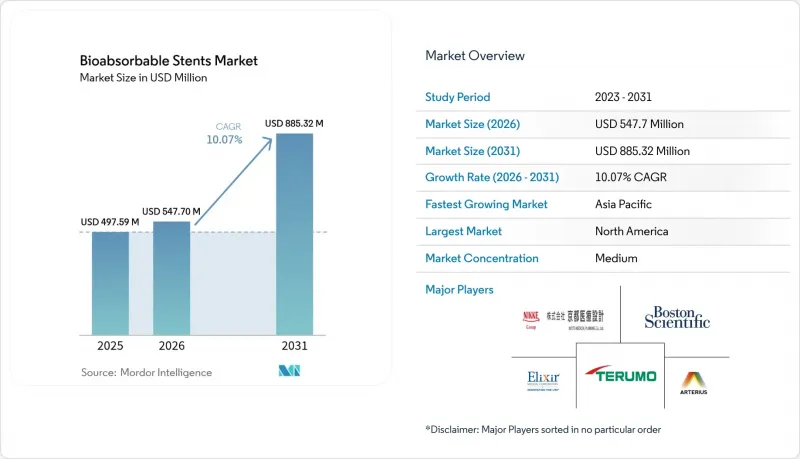
This report is Segmented by Product (Polymer-Based Bioabsorbable Stents, Metal-Based Bioabsorbable Stents), Application (Coronary Artery Disease, Peripheral Artery Disease, and Others), End User (Hospitals, Cardiac Specialty Centers, Ambulatory Surgical Centers), and Geography (North America, Europe, Asia-Pacific, and Others). The Market Forecasts are Provided in Terms of Value (USD).
Global Bioabsorbable Stents Market Trends and Insights
Rapid Rise in Minimally-Invasive PCI Volumes
Surging percutaneous coronary intervention (PCI) volumes stem from aging populations and lifestyle-driven cardiovascular risk. Hospitals worldwide are adopting same-day discharge protocols, making devices that leave no permanent metallic footprint increasingly attractive. As operators emphasize post-procedure vessel physiology, polymer scaffolds that resorb after healing are gaining favor among younger cohorts likely to need future re-interventions. Abbott's Esprit BTK approval in April 2024 for below-the-knee lesions signaled regulatory acknowledgment of bioabsorbable benefits in complex anatomies. Outpatient migration of PCI further amplifies demand for scaffolds that remove long-term surveillance burdens, reinforcing growth across the bioabsorbable stents market.
Shift from Permanent Metallic DES to "Leave-Nothing-Behind" Solutions
Late stent thrombosis and neoatherosclerosis linked to permanent metallic drug-eluting stents (DES) have intensified interest in fully dissolving alternatives. Clinical studies now document restored vessel compliance and shorter dual-antiplatelet therapy when using bioresorbable technologies. Biotronik's Freesolve scaffold secured FDA Breakthrough Device Designation in March 2024, underscoring agency support for solutions that eradicate long-term implant risk. Pediatric and young-adult segments, where lifetime device burden matters most, are accelerating the pivot, broadening the addressable base for the bioabsorbable stents market.
Historical Scaffold Thrombosis Legacy of First-Generation PLLA Devices
After higher thrombosis rates forced withdrawal of Abbott's Absorb BVS platform, cardiologists demanded stringent post-marketing evidence before adopting newer scaffolds. The ABSORB III five-year data showing late events still echo in risk-benefit discussions. Hospitals maintain prolonged dual-antiplatelet therapy to mitigate perceived risk, inflating follow-up costs and dampening uptake. Overcoming this legacy requires consistently favorable trial outcomes and real-world registries that demonstrate parity or superiority to current DES.
Other drivers and restraints analyzed in the detailed report include:
- Regulators Fast-Tracking Below-the-Knee BRS for CLI Patients
- Magnesium-Alloy Breakthroughs Enabling Sub-12-Month Scaffold Support
- Stringent Multi-Year Clinical-Endpoint Requirements
For complete list of drivers and restraints, kindly check the Table Of Contents.
Segment Analysis
Polymer-based devices accounted for 63.78% of the bioabsorbable stents market size in 2025 and are projected to grow at 10.62% CAGR to 2031. Poly-L-lactic acid scaffolds benefit from matured processing know-how, allowing manufacturers to engineer strut thickness, crystallinity, and drug-elution kinetics to match vessel healing. Over the forecast window, higher molecular weight PLLA grades are expected to lengthen radial support without extending total bioresorption beyond three years, a balance judged optimal for coronary anatomy. Despite entrenched leadership, polymer platforms face intensifying pressure from next-generation metals that promise thinner profiles and shorter resorption.
Metal-based scaffolds, led by magnesium-alloy systems, stand at an earlier part of the adoption curve yet demonstrate robust double-digit expansion prospects. Superior acute hoop strength and fluoroscopic visibility mirror the handling familiarity of metallic DES, easing operator transition. Biotronik's DREAMS 3G pivotal data showing full scaffold dissolution at 12 months positions this sub-segment as a credible alternative. Commercial momentum will hinge on achieving cost parity with polymer competitors and broadening clinical indications beyond coronary use.
Complete Report Scope:
- By Product
- Polymer-based Bioabsorbable Stents
- Metal-based Bioabsorbable Stents
- By Application
- Coronary Artery Disease
- Peripheral Artery Disease
- Structural & Non-vascular (e.g., oesophageal, ureteric)
- By End User
- Hospitals
- Cardiac Specialty Centers
- Ambulatory Surgical Centers
- By Geography
- North America
- Europe
- Asia-Pacific
- Middle East and Africa
- South America
Geography Analysis
North America led the bioabsorbable stents market with 40.72% share in 2025, a position secured by robust reimbursement and a dense clinical-trial network. FDA's Breakthrough Device pathway has shortened approval cycles for niche applications, visible in the rapid clearance of Esprit BTK. Even so, payors demand post-market evidence, slowing uptake outside guideline-endorsed coronary lesions. Hospital capital constraints and memories of first-generation scaffold recalls temper aggressive roll-outs, leading to moderate single-digit gains over the forecast window.
Asia-Pacific registers the fastest CAGR at 11.32% through 2031, underpinned by burgeoning cardiovascular disease prevalence and government incentives that cut import tariffs on in-region manufactured scaffolds. Large public tenders in India are shifting procurement to price-volume contracts, expanding device access beyond metropolitan hospitals. Domestic players are forming joint ventures with material science institutes to localize PLLA and magnesium alloy supplies, a move expected to insulate the value chain from geopolitical disruptions. Regulatory agencies in China and Singapore have issued dedicated guidance for fully degradable devices, signaling alignment with international quality benchmarks.
Europe remains a steady growth contributor, drawing on a sophisticated payer framework that ties reimbursement to real-world registry outcomes. Long-term data from German and U.K. investigator-initiated studies are feeding guideline committees, fostering confidence in second-generation devices. Middle East and Africa, while nascent, are allocating funds to cardiovascular center-of-excellence programs that include bioabsorbable platforms in procurement blueprints. Latin America's private hospital groups are piloting polymer scaffolds in high-income urban populations, setting the stage for broader adoption once insurer coverage widens.
- Abbott Laboratories
- Boston Scientific
- Terumo
- BIOTRONIK
- Elixir Medical
- Kyoto Medical Planning Co. Ltd.
- Meril Life Science
- Amaranth Medical Inc.
- REVA Medical Inc.
- Lepu Medical Technology Co. Ltd.
- Svelte Medical Systems
- Arterius
- Arterial Remodeling Technologies SA
- Magmaris (Biotronik - Mg-alloy platform)
- S3V Vascular Technologies
- MicroPort
- SINOMED
- STENTiT BV
- Kaneka
- Zorion Medical
- Tepha Inc.
Additional Benefits:
- The market estimate (ME) sheet in Excel format
- 3 months of analyst support
TABLE OF CONTENTS
1 Introduction
- 1.1 Study Assumptions & Market Definition
- 1.2 Scope of the Study
2 Research Methodology
3 Executive Summary
4 Market Landscape
- 4.1 Market Overview
- 4.2 Market Drivers
- 4.2.1 Rapid Rise in Minimally-Invasive PCI Volumes
- 4.2.2 Shift From Permanent Metallic DES To "Leave-Nothing-Behind" Solutions
- 4.2.3 Regulators Fast-Tracking Below-The-Knee BRS for CLI Patients
- 4.2.4 Magnesium-Alloy Breakthroughs Enabling Less Than 12-Month Scaffold Support
- 4.2.5 AI-Guided Intravascular Imaging Improving Operator Confidence & Outcomes
- 4.2.6 Domestic Manufacturing Incentives in India & China Lowering ASPs
- 4.3 Market Restraints
- 4.3.1 Historical Scaffold Thrombosis Legacy of First-Gen PLLA Devices
- 4.3.2 Stringent Multi-Year Clinical-Endpoint Requirements
- 4.3.3 Supply-Chain Fragility for High-Purity PLLA And Rare-Earth Mg Alloys
- 4.3.4 Reimbursement Lag for Peripheral BRS Outside OECD
- 4.4 Supply-Chain Analysis
- 4.5 Regulatory Landscape
- 4.6 Technological Outlook
- 4.7 Porter's Five Forces
- 4.7.1 Threat of New Entrants
- 4.7.2 Bargaining Power of Buyers
- 4.7.3 Bargaining Power of Suppliers
- 4.7.4 Threat of Substitutes
- 4.7.5 Competitive Rivalry
5 Market Size & Growth Forecasts (Value)
- 5.1 By Product
- 5.1.1 Polymer-based Bioabsorbable Stents
- 5.1.2 Metal-based Bioabsorbable Stents
- 5.2 By Application
- 5.2.1 Coronary Artery Disease
- 5.2.2 Peripheral Artery Disease
- 5.2.3 Structural & Non-vascular (e.g., oesophageal, ureteric)
- 5.3 By End User
- 5.3.1 Hospitals
- 5.3.2 Cardiac Specialty Centers
- 5.3.3 Ambulatory Surgical Centers
- 5.4 By Geography
- 5.4.1 North America
- 5.4.2 Europe
- 5.4.3 Asia-Pacific
- 5.4.4 Middle East and Africa
- 5.4.5 South America
6 Competitive Landscape
- 6.1 Market Concentration
- 6.2 Strategic Moves
- 6.3 Market Share Analysis
- 6.4 Company Profiles (includes Global level Overview Recent Developments)
- 6.4.1 Abbott Laboratories Inc.
- 6.4.2 Boston Scientific Corporation
- 6.4.3 Terumo Corporation
- 6.4.4 Biotronik SE & Co. KG
- 6.4.5 Elixir Medical Corporation
- 6.4.6 Kyoto Medical Planning Co. Ltd.
- 6.4.7 Meril Life Sciences Pvt. Ltd.
- 6.4.8 Amaranth Medical Inc.
- 6.4.9 REVA Medical Inc.
- 6.4.10 Lepu Medical Technology Co. Ltd.
- 6.4.11 Svelte Medical Systems
- 6.4.12 Arterius Limited
- 6.4.13 Arterial Remodeling Technologies SA
- 6.4.14 Magmaris (Biotronik - Mg-alloy platform)
- 6.4.15 S3V Vascular Technologies
- 6.4.16 MicroPort Scientific Corporation
- 6.4.17 SINOMED
- 6.4.18 STENTiT BV
- 6.4.19 Kaneka Corporation
- 6.4.20 Zorion Medical
- 6.4.21 Tepha Inc.
7 Market Opportunities & Future Outlook
- 7.1 White-space & Unmet-need Assessment

