PUBLISHER: Mordor Intelligence | PRODUCT CODE: 2113794

PUBLISHER: Mordor Intelligence | PRODUCT CODE: 2113794
Healthcare 3D Printing - Market Share Analysis, Industry Trends & Statistics, Growth Forecasts (2026 - 2031)
According to Mordor Intelligence, the healthcare 3D printing market size is projected to expand from USD 11.95 billion in 2025 and USD 14.15 billion in 2026 to USD 32.97 billion by 2031, registering a CAGR of 18.43% between 2026 to 2031.
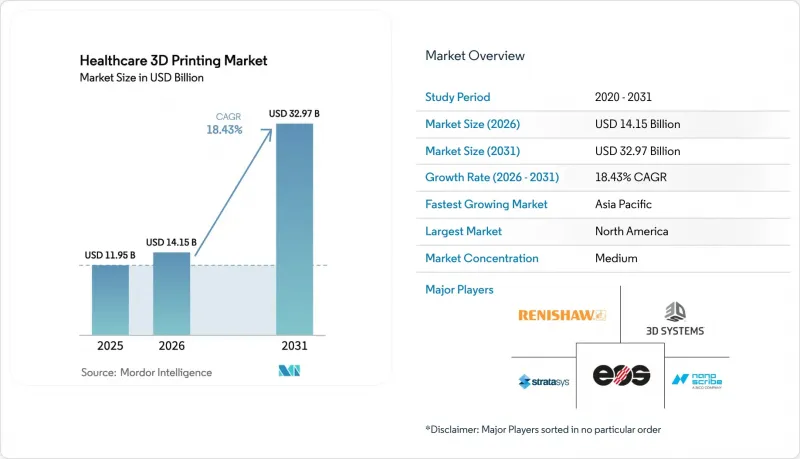
This report is Segmented by Technology (Stereo Lithography, and More), Application (Medical Implants, Prosthetics, and More), Material (Metals & Alloys, and More), and Geography (North America, Europe, Asia-Pacific, Middle East and Africa, and South America). The Market Forecasts are Provided in Terms of Value (USD).
Global Healthcare 3D Printing Market Trends and Insights
Advancements In Additive Manufacturing: Precision and Speed
Electron-beam systems now densify titanium lattices in single-digit-hour build cycles, enabling same-week delivery of patient-specific spinal cages. Multi-laser configurations double throughput without sacrificing dimensional tolerances, so batch production of 50-100 cranial plates becomes cost-competitive. Surface-finish gains reduce polishing, which formerly consumed 20%-30% of total production time. Lower per-part cost allows hospitals to match pricing on machined alternatives while retaining customization advantages. Such efficiencies collectively add roughly 4.2 percentage points to the sector's forecast CAGR.
Expanding Clinical Indications Across Orthopedics, Dental, and Tissue Engineering
Dental labs produce clear-aligner molds in under 48 hours, displacing thermoforming workflows that took 10 days. Bioprinted vascularized constructs now remain viable for multi-week toxicology tests, meeting pharmaceutical screening thresholds. The FDA's draft guidance on bioprinted tissues clarifies sterility and potency requirements, reducing filing uncertainty. As evidence accrues and reimbursement codes broaden, adoption will spread from tertiary centers to community hospitals. These factors collectively lift the CAGR contribution by 3.8 percentage points.
Stringent Regulatory Approval Pathways for 3D-Printed Medical Devices
Process variability complicates validation, extending FDA 510(k) timelines by several months and necessitating costly powder characterization tests. Under Europe's MDR, manufacturers must prove equivalence with machined predicates that lack porous architectures, inflating evidence requirements. Consulting fees can exceed USD 500,000 per device submission, deterring startups. ISO/ASTM standards harmonize terminology yet remain voluntary, so firms juggle fragmented regional rules. These factors reduce CAGR by 2.3 percentage points.
Other drivers and restraints analyzed in the detailed report include:
- Growing Acceptance of Patient-Specific Implants and Prosthetics
- Hospital-Based Point-of-Care 3D Printing Labs Reducing Surgical Lead Times
- Shortage of Skilled Additive Manufacturing Workforce in Healthcare
For complete list of drivers and restraints, kindly check the Table Of Contents.
Segment Analysis
Stereo lithography contributed 38.42% of 2025 revenue, underscoring its dominance within the healthcare 3D printing market. Ultra-fine layers below 25 microns provide the smooth surfaces required for clear aligners and craniofacial models, while biocompatible photopolymers simplify FDA material submissions. EBM adoption accelerates at a 20.43% CAGR because it fuses high-melting-point titanium without residual porosity, essential for load-bearing hip stems.
Fused deposition modeling retains appeal for budget-sensitive anatomical models, whereas selective laser sintering satisfies dental and hearing-aid niches by pairing nylon powders with autoclave stability. PolyJet's multi-material capability simulates cartilage versus bone in surgical rehearsals, and binder-jet ceramics supply bioactive scaffolds. Laminated-object manufacturing wanes as resin and powder systems match its economics with higher precision. Technologies that embed closed-loop melt-pool monitoring address FDA expectations for process validation, directing hospitals toward vendors offering turnkey compliance.
Complete Report Scope:
- By Technology
- Stereo Lithography
- Fused Deposition Modeling
- Selective Laser Sintering
- Electron Beam Melting
- PolyJet / MultiJet
- Binder Jetting
- Laminated Object Manufacturing
- By Application
- Medical Implants
- Prosthetics
- Surgical Guides & Anatomical Models
- Tissue Engineering & Bioprinting
- Wearable Devices
- By Material
- Metals & Alloys
- Polymers & Photopolymers
- Ceramics & Bioceramics
- Biomaterials / Bio-Inks
- Geography
- North America
- United States
- Canada
- Mexico
- Europe
- Germany
- United Kingdom
- France
- Italy
- Spain
- Rest Of Europe
- Asia-Pacific
- China
- Japan
- India
- Australia
- South Korea
- Rest Of Asia-Pacific
- Middle East And Africa
- GCC
- South Africa
- Rest Of Middle East And Africa
- South America
- Brazil
- Argentina
- Rest Of South America
- North America
Geography Analysis
North America contributed 40.43% of the 2025 revenue, the largest regional share of the healthcare 3D printing market. The FDA's additive-manufacturing guidance, coupled with CMS reimbursement for anatomical models, propels adoption across academic and community hospitals. Canada follows similar regulatory contours, yet provincial reimbursement heterogeneity tempers uniform uptake. Mexico utilizes duty-free zones to attract dental device contract manufacturing for export to the United States.
The Asia-Pacific region is expected to grow at a 19.54% CAGR through 2031, as China, Japan, and South Korea implement national additive manufacturing strategies. China scaled domestic powder output and expedited device approvals, reducing dependence on imports. Japan's PMDA introduced fast-track pathways, and public insurers now cover patient-specific titanium implants. South Korean research centers are focusing on vascularized bioprinting to conduct clinical trials within five years. India positions itself as an orthopedic export hub but faces workforce constraints.
Europe held a mid-20s share in 2025. German insurers reimburse surgical guides, spurring equipment orders; the United Kingdom's NHS pilots centralized 3D printing hubs to pool demand. France shortened customs implant reviews under its ANSM agency. The Middle East and Africa remain sub-10% share: the UAE's free zones host orthopedic startups, whereas broader regional adoption lags due to reimbursement gaps. South America captures a low single-digit share, with Brazil approving primarily dental devices; tariffs inflate equipment costs.
- 3D Systems
- Arcam AB
- Aspect Biosystems Ltd.
- Carbon Inc.
- Cellink AB
- EnvisionTEC GmbH
- EOS GmbH
- Formlabs Inc.
- GE Additive
- HP Inc.
- Materialise
- Medtronic
- Organovo
- Oxford Performance Materials
- Renishaw plc
- Siemens Healthineers
- SLM Solutions Group AG
- Stratasys
- Stryker
- Zimmer Biomet
Additional Benefits:
- The market estimate (ME) sheet in Excel format
- 3 months of analyst support
TABLE OF CONTENTS
1 Introduction
- 1.1 Study Assumptions & Market Definition
- 1.2 Scope of the Study
2 Research Methodology
3 Executive Summary
4 Market Landscape
- 4.1 Market Overview
- 4.2 Market Drivers
- 4.2.1 Advancements in Additive Manufacturing Precision and Speed
- 4.2.2 Expanding Clinical Indications Across Orthopedics, Dental, and Tissue Engineering
- 4.2.3 Growing Acceptance of Patient-Specific Implants and Prosthetics
- 4.2.4 Hospital-Based Point-of-Care 3D Printing Labs Reducing Surgical Lead Times
- 4.2.5 AI-Driven Automated Design Optimization Cutting Device Development Cycles
- 4.2.6 Reimbursement Codes Emerging for 3D-Printed Anatomical Models
- 4.3 Market Restraints
- 4.3.1 Stringent Regulatory Approval Pathways for 3D-Printed Medical Devices
- 4.3.2 Shortage of Skilled Additive Manufacturing Workforce in Healthcare
- 4.3.3 Lack of Standardized Sterilization Protocols for Porous Printed Implants
- 4.3.4 Rising Raw Material Supply Chain Volatility for Medical-Grade Powders & Polymers
- 4.4 Value / Supply-Chain Analysis
- 4.5 Regulatory Landscape
- 4.6 Technological Outlook
- 4.7 Porter's Five Forces Analysis
- 4.7.1 Bargaining Power of Buyers
- 4.7.2 Bargaining Power of Suppliers
- 4.7.3 Threat of New Entrants
- 4.7.4 Threat of Substitutes
- 4.7.5 Intensity of Competitive Rivalry
5 Market Size & Growth Forecasts (Value, USD)
- 5.1 By Technology
- 5.1.1 Stereo Lithography
- 5.1.2 Fused Deposition Modeling
- 5.1.3 Selective Laser Sintering
- 5.1.4 Electron Beam Melting
- 5.1.5 PolyJet / MultiJet
- 5.1.6 Binder Jetting
- 5.1.7 Laminated Object Manufacturing
- 5.2 By Application
- 5.2.1 Medical Implants
- 5.2.2 Prosthetics
- 5.2.3 Surgical Guides & Anatomical Models
- 5.2.4 Tissue Engineering & Bioprinting
- 5.2.5 Wearable Devices
- 5.3 By Material
- 5.3.1 Metals & Alloys
- 5.3.2 Polymers & Photopolymers
- 5.3.3 Ceramics & Bioceramics
- 5.3.4 Biomaterials / Bio-Inks
- 5.4 Geography
- 5.4.1 North America
- 5.4.1.1 United States
- 5.4.1.2 Canada
- 5.4.1.3 Mexico
- 5.4.2 Europe
- 5.4.2.1 Germany
- 5.4.2.2 United Kingdom
- 5.4.2.3 France
- 5.4.2.4 Italy
- 5.4.2.5 Spain
- 5.4.2.6 Rest Of Europe
- 5.4.3 Asia-Pacific
- 5.4.3.1 China
- 5.4.3.2 Japan
- 5.4.3.3 India
- 5.4.3.4 Australia
- 5.4.3.5 South Korea
- 5.4.3.6 Rest Of Asia-Pacific
- 5.4.4 Middle East And Africa
- 5.4.4.1 GCC
- 5.4.4.2 South Africa
- 5.4.4.3 Rest Of Middle East And Africa
- 5.4.5 South America
- 5.4.5.1 Brazil
- 5.4.5.2 Argentina
- 5.4.5.3 Rest Of South America
- 5.4.1 North America
6 Competitive Landscape
- 6.1 Market Concentration
- 6.2 Market Share Analysis
- 6.3 Company Profiles {(Includes Global Level Overview, Market Level Overview, Core Segments, Financials as Available, Strategic Information, Market Rank/Share for Key Companies, Products & Services, and Recent Developments)}
- 6.3.1 3D Systems Inc.
- 6.3.2 Arcam AB
- 6.3.3 Aspect Biosystems Ltd.
- 6.3.4 Carbon Inc.
- 6.3.5 Cellink AB
- 6.3.6 EnvisionTEC GmbH
- 6.3.7 EOS GmbH
- 6.3.8 Formlabs Inc.
- 6.3.9 GE Additive
- 6.3.10 HP Inc.
- 6.3.11 Materialise NV
- 6.3.12 Medtronic plc
- 6.3.13 Organovo Holdings Inc.
- 6.3.14 Oxford Performance Materials
- 6.3.15 Renishaw plc
- 6.3.16 Siemens Healthineers
- 6.3.17 SLM Solutions Group AG
- 6.3.18 Stratasys Ltd.
- 6.3.19 Stryker Corporation
- 6.3.20 Zimmer Biomet Holdings Inc.
7 Market Opportunities & Future Outlook
- 7.1 White-Space & Unmet-Need Assessment

