PUBLISHER: Mordor Intelligence | PRODUCT CODE: 2113798

PUBLISHER: Mordor Intelligence | PRODUCT CODE: 2113798
Surgical Sealant And Adhesives - Market Share Analysis, Industry Trends & Statistics, Growth Forecasts (2026 - 2031)
According to Mordor Intelligence, surgical sealants and adhesives market size in 2026 is estimated at USD 2.62 billion, growing from 2025 value of USD 2.47 billion with 2031 projections showing USD 3.51 billion, growing at 6.05% CAGR over 2026-2031.
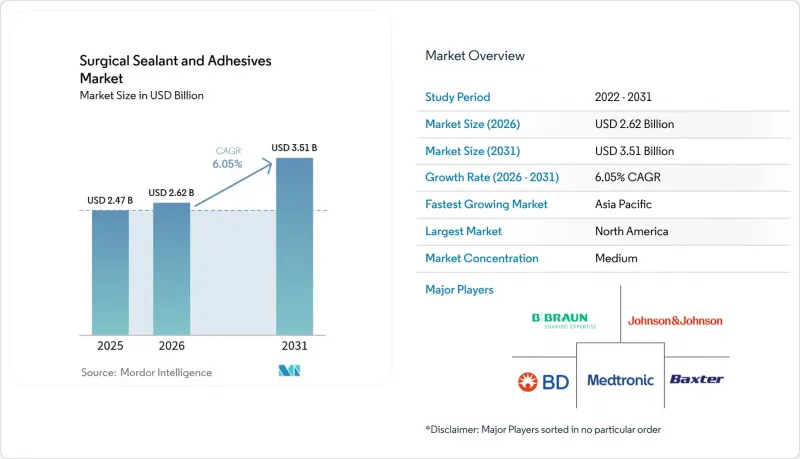
This report is Segmented by Products (Natural/Biological Sealants & Adhesives, Synthetic & Semi-Synthetic Adhesives), Application (General Surgery, Dental Surgery, Cardiovascular Surgery, and More), Indication (Tissue Sealing, Surgical Hemostasis, and More), and Geography (North America, Europe, Asia-Pacific, and More). The Market Forecasts are Provided in Terms of Value (USD).
Global Surgical Sealant And Adhesives Market Trends and Insights
Increasing Surgical Procedures
Ambulatory surgical centers (ASCs) already exceed pre-pandemic case volumes, and analysts expect 30% of large-joint reconstructions to transition to ASC settings by 2029. Higher throughput lifts unit demand for single-use sealants that shorten hemostasis time and cut readmission risk. Hospitals navigating value-based reimbursement increasingly specify products with demonstrated reductions in transfusion rates and post-operative drainage. Compliance with ISO 13485 and rapid 510(k) clearances further streamlines adoption. As procedure counts climb, the surgical sealants and adhesives market benefits from durable, volume-driven tailwinds.
Advances in Minimally Invasive Surgery
Robotic platforms create spatial constraints that legacy applicators cannot meet. Device makers now offer narrow, multi-directional nozzles and spray tips that interface with common end-effectors on da Vinci systems. Early-2025 sales spikes for LIQUIFIX internal adhesive highlight how robotics-ready designs accelerate contract wins with Group Purchasing Organizations. Flexible hydrogel patches and rapid-polymerizing cyanoacrylates allow surgeons to seal anastomoses through 8-mm ports, limiting leaks to 0.9% in recent colorectal series. The resulting efficiency gains keep the surgical sealants and adhesives market on an upward trajectory.
Reimbursement Gaps Constrain Adoption
Many U.S. procedures bundle tissue adhesive costs into global surgical payments, limiting separate billing under G0168 and depressing uptake in price-sensitive hospitals. International health technology agencies request randomized data proving cost savings before funding premium devices. Nonetheless, a multicountry analysis showed DuraSeal reduced cerebrospinal fluid leak management expenses versus fibrin glue, providing new leverage for formulary bids. If value-based contracts expand, the surgical sealants and adhesives market could recapture some currently forgone volumes.
Other drivers and restraints analyzed in the detailed report include:
- Aging Population and Chronic Disease Burden
- Shift to Biocompatible and Bio-resorbable Materials
- Availability of Alternative Closure Techniques
For complete list of drivers and restraints, kindly check the Table Of Contents.
Segment Analysis
Natural and biological sealants retained a 58.84% share of the surgical sealants and adhesives market in 2025 . Fibrin matrices secure neurosurgical dura, collagen plugs patch vascular grafts, and gelatin-based powders control liver oozing. Long safety records and native clotting pathways sustain hospital loyalty. Supply disruptions in plasma sourcing, however, expose vulnerabilities. In parallel, synthetic and semi-synthetic lines are scaling quickly, posting a 7.18% CAGR outlook, as cyanoacrylate chemistries deliver room-temperature stability and antimicrobial barriers. PEG hydrogels with controlled degradation rates appeal to pediatric cardiothoracic teams seeking absorbable seals. Competitive bidding within Integrated Delivery Networks keeps pressure on price tiers, yet innovation in applicators and dual-chamber syringes supports steady margin retention across the broader surgical sealants and adhesives market.
Newer flexible films help laparoscopic teams secure stapled anastomoses without bulky patches. Spray atomizers cut waste by 20% versus traditional dual-syringe kits, an operational saving that resonates with procurement departments. Supplier diversification continued in 2025 as regional firms launched chitosan-based prototypes aimed at trauma centers in emerging markets. Although biologics will likely remain the revenue anchor, synthetics' scalability and storage benefits should slowly rebalance mix in the surgical sealants and adhesives market.
Complete Report Scope:
- By Products
- Natural / Biological Sealants & Adhesives
- Fibrin Sealant
- Gelatin-based Adhesive
- Collagen-based Adhesive
- Synthetic & Semi-synthetic Adhesives
- Cyanoacrylates
- Polymeric Hydrogels
- PEG Polymer
- Other Synthetic & Semi-synthetic
- Natural / Biological Sealants & Adhesives
- By Application
- General Surgery
- Dental Surgery
- Cardiovascular Surgery
- Cosmetic Surgery
- Neurosurgery
- Orthopaedic Surgery
- Other Applications
- By Indication
- Tissue Sealing
- Surgical Hemostasis
- Tissue Engineering & Regeneration
- By Geography
- North America
- United States
- Canada
- Mexico
- Europe
- Germany
- United Kingdom
- France
- Italy
- Spain
- Rest of Europe
- Asia-Pacific
- China
- Japan
- India
- Australia
- South Korea
- Rest of Asia-Pacific
- Middle East and Africa
- GCC
- South Africa
- Rest of Middle East and Africa
- South America
- Brazil
- Argentina
- Rest of South America
- North America
Geography Analysis
North America generated 38.55% of global sales in 2025, led by the United States, where ASC penetration topped 6,100 facilities and payers reimburse sealants that speed discharge. Route-to-market optimization and GPO contracts lifted LiquiBand topical adhesive revenue by more than 50% year-on-year. Canada's health-technology assessment framework now endorses certain PEG hydrogels for cardiovascular repairs, while Mexico accelerates regulatory convergence to open import pathways. This demand sustains a steady cash engine for multinationals and props up overall valuations for the surgical sealants and adhesives market.
Europe mirrors mature growth, governed by the EU MDR regime that mandates clinical and post-market vigilance. Germany remains the continent's largest adopter, supported by the Paul-Ehrlich-Institut's long-standing familiarity with fibrin products. Favorable cost-utility analyses in France and Italy confirm that preventing cerebrospinal fluid leaks with dural sealants yields net savings even under Diagnosis-Related Group payments. Across the bloc, in-theater training programs now accompany most tenders, reducing skill barriers and protecting share for incumbents inside the surgical sealants and adhesives market.
Asia-Pacific posts the swiftest trajectory with a 7.26% CAGR to 2031 as Japan pioneers silk-elastin hemostats and China expands tertiary centers equipped for complex heart surgery. India's procedure backlog encourages low-temperature cyanoacrylate adoption that bypasses cold-chain hurdles. Australia's Therapeutic Goods Administration grants priority review to biodegradable PEG-based ocular sealants, sealing a route for rapid roll-out. While reimbursement heterogeneity persists, rising disposable incomes and government insurance schemes underpin a long runway for the surgical sealants and adhesives market.
- Baxter
- Johnson & Johnson
- B. Braun
- Medtronic
- CryoLife
- CSL Behring
- Cardinal Health
- Beckton Dickinson
- Advanced Medical Solutions Group
- Integra LifeSciences
- Smiths Group
- Sanofi
- Stryker
- Cohera Medical
- Ocular Therapeutix Inc.
- Vivostat
- Tricol Biomedical
- Sealantis Ltd.
- Tissuemed Ltd.
Additional Benefits:
- The market estimate (ME) sheet in Excel format
- 3 months of analyst support
TABLE OF CONTENTS
1 Introduction
- 1.1 Study Assumptions & Market Definition
- 1.2 Scope of the Study
2 Research Methodology
3 Executive Summary
4 Market Landscape
- 4.1 Market Overview
- 4.2 Market Drivers
- 4.2.1 Increasing Surgical Procedures
- 4.2.2 Advances in Minimally-Invasive Surgery
- 4.2.3 Ageing Population & Chronic-Disease Burden
- 4.2.4 Shift To Biocompatible / Bio-Resorbable Materials
- 4.2.5 Growth Of Ambulatory Surgical Centres Needing Rapid-Deploy Sealants
- 4.2.6 Integration With Robotic-Surgery Platforms Requiring Dedicated Applicators
- 4.3 Market Restraints
- 4.3.1 Reimbursement Gaps in Key Markets
- 4.3.2 Availability Of Alternative Closure Techniques
- 4.3.3 Cold-Chain Fragility for Plasma-Derived Fibrin Sealants
- 4.3.4 Regulatory Ambiguity for Next-Gen Bio-Resorbable Adhesives
- 4.4 Supply-Chain Analysis
- 4.5 Regulatory Landscape
- 4.6 Technological Outlook
- 4.7 Porter's Five Forces
- 4.7.1 Threat of New Entrants
- 4.7.2 Bargaining Power of Buyers
- 4.7.3 Bargaining Power of Suppliers
- 4.7.4 Threat of Substitutes
- 4.7.5 Competitive Rivalry
5 Market Size & Growth Forecasts (Value)
- 5.1 By Products
- 5.1.1 Natural / Biological Sealants & Adhesives
- 5.1.1.1 Fibrin Sealant
- 5.1.1.2 Gelatin-based Adhesive
- 5.1.1.3 Collagen-based Adhesive
- 5.1.2 Synthetic & Semi-synthetic Adhesives
- 5.1.2.1 Cyanoacrylates
- 5.1.2.2 Polymeric Hydrogels
- 5.1.2.3 PEG Polymer
- 5.1.2.4 Other Synthetic & Semi-synthetic
- 5.1.1 Natural / Biological Sealants & Adhesives
- 5.2 By Application
- 5.2.1 General Surgery
- 5.2.2 Dental Surgery
- 5.2.3 Cardiovascular Surgery
- 5.2.4 Cosmetic Surgery
- 5.2.5 Neurosurgery
- 5.2.6 Orthopaedic Surgery
- 5.2.7 Other Applications
- 5.3 By Indication
- 5.3.1 Tissue Sealing
- 5.3.2 Surgical Hemostasis
- 5.3.3 Tissue Engineering & Regeneration
- 5.4 By Geography
- 5.4.1 North America
- 5.4.1.1 United States
- 5.4.1.2 Canada
- 5.4.1.3 Mexico
- 5.4.2 Europe
- 5.4.2.1 Germany
- 5.4.2.2 United Kingdom
- 5.4.2.3 France
- 5.4.2.4 Italy
- 5.4.2.5 Spain
- 5.4.2.6 Rest of Europe
- 5.4.3 Asia-Pacific
- 5.4.3.1 China
- 5.4.3.2 Japan
- 5.4.3.3 India
- 5.4.3.4 Australia
- 5.4.3.5 South Korea
- 5.4.3.6 Rest of Asia-Pacific
- 5.4.4 Middle East and Africa
- 5.4.4.1 GCC
- 5.4.4.2 South Africa
- 5.4.4.3 Rest of Middle East and Africa
- 5.4.5 South America
- 5.4.5.1 Brazil
- 5.4.5.2 Argentina
- 5.4.5.3 Rest of South America
- 5.4.1 North America
6 Competitive Landscape
- 6.1 Market Concentration
- 6.2 Strategic Moves
- 6.3 Market Share Analysis
- 6.4 Company Profiles (includes Global level Overview, Market level overview, Core Segments, Financials as available, Strategic Information, Market Rank/Share for key companies, Products & Services, and Recent Developments)
- 6.4.1 Baxter International Inc.
- 6.4.2 Johnson & Johnson (Ethicon)
- 6.4.3 B. Braun SE
- 6.4.4 Medtronic plc
- 6.4.5 CryoLife Inc.
- 6.4.6 CSL Limited
- 6.4.7 Cardinal Health Inc.
- 6.4.8 Becton, Dickinson and Company
- 6.4.9 Advanced Medical Solutions Group plc
- 6.4.10 Integra LifeSciences
- 6.4.11 Smith & Nephew plc
- 6.4.12 Sanofi SA
- 6.4.13 Stryker Corporation
- 6.4.14 Cohera Medical Inc.
- 6.4.15 Ocular Therapeutix Inc.
- 6.4.16 Vivostat A/S
- 6.4.17 Tricol Biomedical
- 6.4.18 Sealantis Ltd.
- 6.4.19 Tissuemed Ltd.
7 Market Opportunities & Future Outlook
- 7.1 White-space & Unmet-need Assessment

