PUBLISHER: Mordor Intelligence | PRODUCT CODE: 2113805

PUBLISHER: Mordor Intelligence | PRODUCT CODE: 2113805
Cable Glands - Market Share Analysis, Industry Trends & Statistics, Growth Forecasts (2026 - 2031)
According to Mordor Intelligence, the cable glands market size reached USD 2.20 billion in 2026 and is forecast to climb to USD 2.75 billion by 2031, registering a 4.56% CAGR during the period.
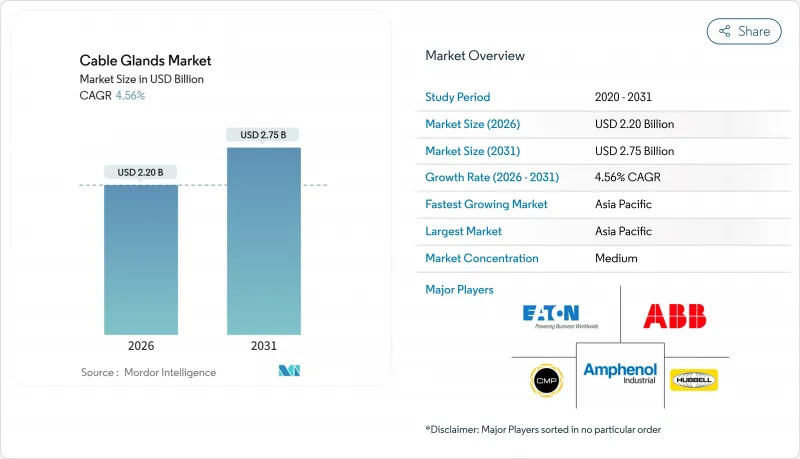
This report is Segmented by Type (Non-Hazardous Area Cable Glands, Hazardous Area Cable Glands), Cable Type (Armored Cable Glands, and More), Material (Brass, and More), End-User Industry (Mining, and More), Ingress Protection Rating (IP66, and More), Thread Type (PG, and More), Certification (UL, and More), Installation Technique, and Geography. The Market Forecasts are Provided in Terms of Value (USD).
Global Cable Glands Market Trends and Insights
Upgrading and Renewal of Legacy Power Networks
Transmission and distribution operators are now channeling record budgets into underground cable replacement, substation digitization, and wildfire-mitigation programs. The International Energy Agency values the global grid-renewal requirement at USD 600 billion per year through 2030, and every project specification includes hundreds of glands for circuit entry. The European Union's grid action plan earmarks EUR 584 billion for cross-border interconnectors, which mandates ATEX Zone 1 approvals in many switching stations. In the United States, the Department of Energy's Transmission Facilitation Program provides USD 2.5 billion in loans that call for UL-listed flameproof terminations. Urban utilities are also burying feeders to cut outage risk, a choice that multiplies the number of cable entries per vault and elevates demand for IP69K ingress protection. Prefabricated, skid-mounted substations further streamline supply chains, favoring vendors that can deliver factory-installed glands with full traceability to ISO 9001 standards.
Surge in Global Construction Activity
Rebounding infrastructure spending in emerging economies is driving orders for termination hardware in HVAC panels, elevator drives, and building automation racks. World Bank data show project starts returning to pre-pandemic levels in South and East Asia. India's National Infrastructure Pipeline schedules massive metro and airport additions, each embedding hundreds of cable entries that must adhere to IEC 60331 fire-survival standards. In Mexico, nearshoring is driving the expansion of industrial real estate, prompting contractors to specify IP66 and IP67 brass glands for use in dusty production halls. Revised European and Gulf building codes now require outdoor-grade ingress protection in indoor wash-down zones, which drives the adoption of stainless-steel IP69K variants. Higher fire-safety expectations also favor glands with integral sealing elements that hold integrity during high-temperature events, nudging buyers toward premium designs despite cost sensitivity.
Fragmentation of Regional Supplier Base
End users often juggle divergent certification labels, screw threads, and material codes when sourcing glands across multi-country projects. The Asia-Pacific and African markets are especially fragmented, with hundreds of small machine shops supplying unbranded hardware that often lacks cross-border documentation. Engineering, procurement, and construction contractors lose schedule certainty when identical part numbers carry different seismic or flameproof ratings, forcing costly requalification. The absence of universal interchangeability compounds the complexity of maintenance in global asset portfolios.
Other drivers and restraints analyzed in the detailed report include:
- Expansion of Offshore Renewable Energy Installations
- Growth in Manufacturing Investments in Emerging Economies
- Volatility in Non-Ferrous Metal Prices
For complete list of drivers and restraints, kindly check the Table Of Contents.
Segment Analysis
Hazardous-area glands are poised to erode the 65.10% share held by non-hazardous designs in 2025, as the cable glands market shifts toward hydrogen electrolyzers, floating LNG units, and advanced refineries that require wide footprints to be classified as Zone 1 or Zone 2.
Demand for non-hazardous glands will continue to grow in absolute volume; however, average selling prices will erode under pressure from plastic substitutes and simplified compression fittings. Original-equipment manufacturers lean on large-volume brass catalogs to shave bill-of-materials costs in low-risk environments. Nevertheless, the emergence of new fire-survival and hygiene codes prompts some specifiers to jump directly from basic IP66 brass to IP69K stainless steel, bypassing mid-tier options and challenging legacy pricing ladders in the cable glands market.
Armored glands preserved 54.20% of 2025 sales, driven by oil, gas, and mining circuits that need armor termination for earth continuity. Yet unarmored devices will log a 6.10% CAGR, fueled by hyperscale data halls where every millimeter of rack space counts. Miniaturized cast-metal bodies with integral EMI gaskets slot neatly into overhead tray layouts, and installers appreciate the quicker torque cycle compared with armor clamping. Data-center builders also value the lower weight of unarmored cable bundles, which reduces the need for ladder-rack reinforcement. These factors collectively swing procurement policies toward compact unarmored SKUs without compromising shielding effectiveness against high-frequency switching noise.
Heavy-industry operators remain loyal to armored glands, notably in the Middle East, where 30-year design lives and sand-storm exposure justify steel-wire or aluminum-tape armor. In these sites, utility crews prefer double-seal designs that maintain ingress protection even after repeated torque checks. The bifurcation thus pits high-volume, low-margin unarmored orders in commercial technology sectors against high-spec, high-margin armored projects in greenfield hydrocarbon complexes, keeping the overall cable glands market balanced but competitive.
Brass led materials revenue in 2025, yet stainless steel is outpacing at a 4.90% CAGR as developers pursue corrosion-proof solutions in offshore wind substations, subsea umbilical terminations, and Middle Eastern desalination lines. Grade 316L and duplex alloys withstand chloride attack and stress corrosion cracking, delivering a lower life-cycle cost than brass, despite a higher upfront investment. Additionally, new European recyclability directives favor stainless steel due to its high scrap recovery rate, which provides a sustainability credit in project bids.
Brass persists in indoor switchgear and machine tools due to its unparalleled machinability, which keeps part pricing low in high-volume runs. Nickel-plated aluminum remains a niche option in weight-sensitive rail and aerospace cabins, while plastic glands serve low-voltage sensor loops that have no grounding requirements. Growing environmental pressure to eliminate lead pigments in C36000 brass may further increase machining costs, nudging even conservative buyers toward stainless steel sooner than previously forecast, and reinforcing the premium tier within the cable glands market.
Complete Report Scope:
- By Type
- Non-Hazardous Area Cable Glands
- Hazardous Area Cable Glands
- By Cable Type
- Armored Cable Glands
- Unarmored Cable Glands
- By Material
- Brass
- Aluminium
- Stainless Steel
- Plastic
- Rest of Materials
- By End-User Industry
- Oil and Gas
- Power and Utilities
- Manufacturing and Processing
- Construction
- Aerospace
- Marine
- Mining
- Chemicals
- By Ingress Protection Rating
- IP66
- IP67
- IP68
- IP69/IP69K
- By Thread Type
- Metric
- PG
- NPT
- BSP
- By Certification
- ATEX
- IECEx
- UL
- CSA
- Other Certifications
- By Installation Technique
- Industrial Panel Mounting
- Direct Equipment Entry
- Bulkhead and Barrier Systems
- By Geography
- North America
- United States
- Canada
- Mexico
- South America
- Brazil
- Argentina
- Rest of South America
- Europe
- Germany
- United Kingdom
- France
- Italy
- Spain
- Russia
- Rest of Europe
- Asia-Pacific
- China
- India
- Japan
- South Korea
- Australia
- Rest of Asia-Pacific
- Middle East
- Saudi Arabia
- United Arab Emirates
- Turkey
- Rest of Middle East
- Africa
- South Africa
- Nigeria
- Egypt
- Rest of Africa
- North America
Geography Analysis
The Asia-Pacific region generated 38.90% of 2025 revenue and is tracking a 5.00% CAGR, as India, Vietnam, and Indonesia welcome record electronics and automotive investments. India's Production-Linked Incentive scheme alone triggered 32 new factories that rely on metric-thread stainless-steel IP68 glands in solvent areas. China is adding over 10 million t per year of ethylene equivalent on the coast, requiring dual-certified flameproof terminations compliant with GB 3836 guidelines. Japan and South Korea are rolling out hydrogen refueling corridors that specify IECEx-listed equipment, further raising Asia-Pacific's premium mix in the cable glands market.
Europe benefits from a strong offshore wind pipeline and stringent ATEX enforcement. The European Commission's EUR 584 billion grid plan funnels stainless-steel orders into Baltic interconnectors, while Germany's 7-GW auction in 2024 codified IEC 61892 ingress rules for all turbine decks. The United Kingdom's Crown Estate adds to momentum with 8 GW of new seabed leases slated for completion after 2028. These developments secure long visibility for explosion-proof gland suppliers and boost average selling prices across the region.
North America rides a dual narrative: data-center megaprojects in Virginia, Texas, and Quebec order compact multi-cable glands with EMI shielding, while grid resilience funds support UL-listed flameproof entries in high-voltage rebuilds. Mexico's nearshoring wave spurs PG and metric demand in assembly corridors along the Bajio region. The Middle East commands outsized project values in petrochemicals, notably the Jafurah gas complex and Ghasha sour-gas field, each specifying stainless-steel, dual-certified glands for Zone 1 areas. Africa and South America exhibit smaller bases but demonstrate healthy growth tied to mining and renewable energy concessions, underscoring a diversified geographic runway for the cable glands market.
- ABB Ltd
- Amphenol Corporation
- Eaton Corporation plc (Cooper Crouse-Hinds)
- Hubbell Incorporated
- CMP Products Limited
- Bartec Group
- Emerson Electric Co. (Appleton)
- TE Connectivity Ltd
- R. Stahl AG
- Hawke International (Eaton)
- Cortem S.p.A.
- Warom Technology Incorporated
- Elsewedy Electric
- Jacob GmbH
- Weidmuller Interface GmbH & Co. KG
- Pepperl+Fuchs SE
- LAPP Group
- Hummel AG
- Roxtec International AB
- Quanguan Electric
Additional Benefits:
- The market estimate (ME) sheet in Excel format
- 3 months of analyst support
TABLE OF CONTENTS
1 INTRODUCTION
- 1.1 Study Assumptions and Market Definition
- 1.2 Scope of the Study
2 RESEARCH METHODOLOGY
3 EXECUTIVE SUMMARY
4 MARKET LANDSCAPE
- 4.1 Market Overview
- 4.2 Market Drivers
- 4.2.1 Upgrading and Renewal of Legacy Power Networks
- 4.2.2 Surge in Global Construction Activity
- 4.2.3 Expansion of Offshore Renewable Energy Installations
- 4.2.4 Growth in Manufacturing Investments in Emerging Economies
- 4.2.5 Miniaturization Driven High-Density Data-Center Cabling
- 4.2.6 Hydrogen Economy Demands Explosion-Proof Glands
- 4.3 Market Restraints
- 4.3.1 Fragmentation of Regional Supplier Base
- 4.3.2 Volatility in Non-Ferrous Metal Prices
- 4.3.3 Environmental Rules on Leaded Brass Alloys
- 4.3.4 Shift Toward Wireless Sensor Networks
- 4.4 Industry Supply-Chain Analysis
- 4.5 Regulatory Landscape
- 4.6 Technological Outlook
- 4.7 Impact of Macroeconomic Factors on the Market
- 4.8 Porter's Five Forces Analysis
- 4.8.1 Bargaining Power of Suppliers
- 4.8.2 Bargaining Power of Buyers
- 4.8.3 Threat of New Entrants
- 4.8.4 Threat of Substitutes
- 4.8.5 Intensity of Competitive Rivalry
5 MARKET SIZE AND GROWTH FORECASTS (VALUE)
- 5.1 By Type
- 5.1.1 Non-Hazardous Area Cable Glands
- 5.1.2 Hazardous Area Cable Glands
- 5.2 By Cable Type
- 5.2.1 Armored Cable Glands
- 5.2.2 Unarmored Cable Glands
- 5.3 By Material
- 5.3.1 Brass
- 5.3.2 Aluminium
- 5.3.3 Stainless Steel
- 5.3.4 Plastic
- 5.3.5 Rest of Materials
- 5.4 By End-User Industry
- 5.4.1 Oil and Gas
- 5.4.2 Power and Utilities
- 5.4.3 Manufacturing and Processing
- 5.4.4 Construction
- 5.4.5 Aerospace
- 5.4.6 Marine
- 5.4.7 Mining
- 5.4.8 Chemicals
- 5.5 By Ingress Protection Rating
- 5.5.1 IP66
- 5.5.2 IP67
- 5.5.3 IP68
- 5.5.4 IP69/IP69K
- 5.6 By Thread Type
- 5.6.1 Metric
- 5.6.2 PG
- 5.6.3 NPT
- 5.6.4 BSP
- 5.7 By Certification
- 5.7.1 ATEX
- 5.7.2 IECEx
- 5.7.3 UL
- 5.7.4 CSA
- 5.7.5 Other Certifications
- 5.8 By Installation Technique
- 5.8.1 Industrial Panel Mounting
- 5.8.2 Direct Equipment Entry
- 5.8.3 Bulkhead and Barrier Systems
- 5.9 By Geography
- 5.9.1 North America
- 5.9.1.1 United States
- 5.9.1.2 Canada
- 5.9.1.3 Mexico
- 5.9.2 South America
- 5.9.2.1 Brazil
- 5.9.2.2 Argentina
- 5.9.2.3 Rest of South America
- 5.9.3 Europe
- 5.9.3.1 Germany
- 5.9.3.2 United Kingdom
- 5.9.3.3 France
- 5.9.3.4 Italy
- 5.9.3.5 Spain
- 5.9.3.6 Russia
- 5.9.3.7 Rest of Europe
- 5.9.4 Asia-Pacific
- 5.9.4.1 China
- 5.9.4.2 India
- 5.9.4.3 Japan
- 5.9.4.4 South Korea
- 5.9.4.5 Australia
- 5.9.4.6 Rest of Asia-Pacific
- 5.9.5 Middle East
- 5.9.5.1 Saudi Arabia
- 5.9.5.2 United Arab Emirates
- 5.9.5.3 Turkey
- 5.9.5.4 Rest of Middle East
- 5.9.6 Africa
- 5.9.6.1 South Africa
- 5.9.6.2 Nigeria
- 5.9.6.3 Egypt
- 5.9.6.4 Rest of Africa
- 5.9.1 North America
6 COMPETITIVE LANDSCAPE
- 6.1 Market Concentration
- 6.2 Strategic Moves
- 6.3 Market Share Analysis
- 6.4 Company Profiles (includes Global Level Overview, Market Level Overview, Core Segments, Financials as available, Strategic Information, Market Rank/Share for Key Companies, Products and Services, and Recent Developments)
- 6.4.1 ABB Ltd
- 6.4.2 Amphenol Corporation
- 6.4.3 Eaton Corporation plc (Cooper Crouse-Hinds)
- 6.4.4 Hubbell Incorporated
- 6.4.5 CMP Products Limited
- 6.4.6 Bartec Group
- 6.4.7 Emerson Electric Co. (Appleton)
- 6.4.8 TE Connectivity Ltd
- 6.4.9 R. Stahl AG
- 6.4.10 Hawke International (Eaton)
- 6.4.11 Cortem S.p.A.
- 6.4.12 Warom Technology Incorporated
- 6.4.13 Elsewedy Electric
- 6.4.14 Jacob GmbH
- 6.4.15 Weidmuller Interface GmbH & Co. KG
- 6.4.16 Pepperl+Fuchs SE
- 6.4.17 LAPP Group
- 6.4.18 Hummel AG
- 6.4.19 Roxtec International AB
- 6.4.20 Quanguan Electric
7 MARKET OPPORTUNITIES AND FUTURE OUTLOOK
- 7.1 White-Space and Unmet-Need Assessment

