PUBLISHER: Mordor Intelligence | PRODUCT CODE: 2113807

PUBLISHER: Mordor Intelligence | PRODUCT CODE: 2113807
Cardiac Monitoring - Market Share Analysis, Industry Trends & Statistics, Growth Forecasts (2026 - 2031)
According to Mordor Intelligence, the cardiac monitoring market size in 2026 is estimated at USD 29.1 billion, growing from 2025 value of USD 27.70 billion with 2031 projections showing USD 37.19 billion, growing at 5.04% CAGR over 2026-2031.
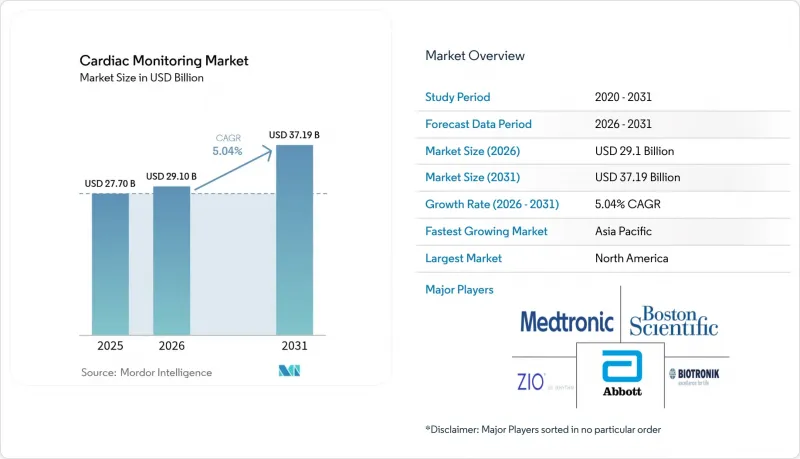
This report Segments the Industry Into Device Type (ECG Monitor, Event Recorder and More), B Technology (Conventional (Wired), Wireless & Wearable and More) End-Users (Hospitals & Clinics, Ambulatory Surgical Centers and More), and Geography (North America, Europe, Asia-Pacific, Middle East and Africa, South America). The Market Forecasts are Provided in Terms of Value (USD).
Global Cardiac Monitoring Market Trends and Insights
Rising prevalence of cardiovascular diseases
Cardiovascular disease affects 127.9 million US adults and is projected to impact 61% of the population by 2050, driving health systems toward continuous monitoring that mitigates USD 422.3 billion in annual treatment costs. Age-standardized prevalence continues to climb in middle- and low-income nations, pressuring providers to adopt scalable tele-cardiology programs. Population-specific disparities-such as diabetes rates ranging from 6.3% among Vietnamese Americans to 15.2% among Filipino Americans-further underscore the need for personalized monitoring protocols. Evidence shows early intervention via continuous ECG analytics lowers emergency admissions and improves survival.
Growing geriatric population
Stroke cases are forecast to double to 20 million older adults by 2050, amplifying chronic monitoring demand. Two-thirds of Americans already track heart data using smartwatches or blood-pressure devices, yet only 25% share the information with clinicians; integrating these data streams into care pathways remains a growth opportunity. Remote patient monitoring programs are on track to serve 70.6 million US patients by 2025, with cardiac indications comprising 21% of enrollments.
High cost of advanced implantable monitors
Cost-effectiveness studies in Europe show ePatch solutions offer 3.4-6.0X savings versus implantable loop recorders when detecting atrial fibrillation. In the US, mobile cardiac telemetry reduced 18-month care costs by USD 27,429 compared with implantables while lowering readmissions to 30.2%. With heart-failure expenditure projected above USD 70 billion in 2030, payers prioritize lower-cost external devices that still deliver predictive insight.
Other drivers and restraints analyzed in the detailed report include:
- Technological advances in wireless & wearable devices
- Expansion of AI-enabled predictive analytics
- Stringent regulatory approval timelines
For complete list of drivers and restraints, kindly check the Table Of Contents.
Segment Analysis
ECG devices accounted for 36.98% of the revenue in the cardiac monitoring market in 2025, reflecting broad clinical familiarity and near-universal reimbursement. Holter and event monitors continue to address episodic diagnostics; however, extended-wear patches now deliver 95% analyzable time and patient comfort, allowing for sustained 21-day monitoring windows. This performance, paired with a 6.35% CAGR, positions patches as the primary disruptor within the cardiac monitoring market. Investor interest is high: VitalConnect has secured USD 100 million to commercialize the VitalPatch platform, anticipating the development of hospital discharge kits paired with telehealth dashboards.
Extended monitoring also closes diagnostic gaps in paroxysmal arrhythmia detection, driving guideline revisions that recommend up to 14 days of continuous ECG monitoring for the evaluation of cryptogenic stroke. Implantable loop recorders capture long-term, asymptomatic events but face adoption barriers when the costs and surgical risks are weighed against external alternatives. Still, high-risk cohorts benefit from six-year devices such as Abbott's Assert-IQ, which adds Bluetooth telemetry, reducing clinic visits while enhancing data fidelity. Collectively, the product mix demonstrates a continuum where non-invasive, AI-enhanced patches occupy mass-market tiers, while implantables serve specialized cases in the cardiac monitoring market.
Complete Report Scope:
- By Product Type
- Electrocardiograph (Resting ECG)
- Holter Monitor
- Event Monitor
- Mobile Cardiac Telemetry (MCT)
- Implantable Loop Recorder
- Wearable Patch Monitors
- Others
- By Technology
- Conventional (Wired)
- Wireless & Wearable
- AI-enabled Analytics Platforms
- By End User
- Hospitals & Clinics
- Ambulatory Surgical Centers
- Homecare Settings
- Cardiac Centers
- Telehealth Providers
- By Geography
- North America
- United States
- Canada
- Mexico
- Europe
- Germany
- United Kingdom
- France
- Italy
- Spain
- Rest of Europe
- Asia-Pacific
- China
- Japan
- India
- Australia
- South Korea
- Rest of Asia-Pacific
- Middle East and Africa
- GCC
- South Africa
- Rest of Middle East and Africa
- South America
- Brazil
- Argentina
- Rest of South America
- North America
Geography Analysis
North America commanded 40.71% of 2025 global revenue, supported by FDA device pipelines and Medicare reimbursement that recognize remote monitoring as standard of care. New CPT codes for cardiovascular risk stratification promise additional billing avenues, while private-equity ownership of cardiology groups-now 3.9% of US practices-streamlines large-scale device deployment strategies. Semiconductor tariff proposals could elevate device manufacturing costs, yet suppliers diversify sourcing to shield availability.
Asia-Pacific delivers the swiftest 6.98% CAGR on the back of urbanization and rising hypertension prevalence. China's volume-based procurement schemes encourage cost-effective patch devices, while India's Ayushman Bharat Digital Mission integrates mobile ECG data into national health records. Japan's super-aging society accelerates adoption of continuous rhythm surveillance in community clinics. Venture financing slowed 22% from 2021 highs, yet strategic investors maintain commitments to AI-enabled diagnostics that localize languages and waveform signatures.
Europe remains a mature cluster emphasizing preventive cardiology. Germany expands Disease Management Programs to include prescribed mobile telemetry, boosting hardware uptake. The United Kingdom's NHS Long Term Plan endorses virtual wards, targeting 40-50 patients per 100,000 population equipped with cardiac monitors for post-discharge surveillance. Economic headwinds elevate value-analysis scrutiny, steering tenders toward single-use patches with lower total cost of ownership. South America and the Middle East & Africa witness incremental progress as local distributors partner with multinational vendors to pilot low-cost wearable ECGs in hypertension screening campaigns.
- Abbott Laboratories
- Medtronic
- Boston Scientific
- GE Healthcare
- Koninklijke Philips
- iRhythm Technologies
- BIOTRONIK
- Nihon Kohden
- Hill-Rom Holdings Inc. (Welch Allyn)
- AliveCor
- MicroPort
- BPL
- Zoll Medical
- Mindray Bio-Medical Electronics
- OSI Systems, Inc.
- Schiller
- Lepu Medical
- Preventice Solutions
- Fukuda Denshi Co., Ltd.
Additional Benefits:
- The market estimate (ME) sheet in Excel format
- 3 months of analyst support
TABLE OF CONTENTS
1 Introduction
- 1.1 Study Assumptions & Market Definition
- 1.2 Scope of the Study
2 Research Methodology
3 Executive Summary
4 Market Landscape
- 4.1 Market Overview
- 4.2 Market Drivers
- 4.2.1 Rising Prevalence of Cardiovascular Diseases
- 4.2.2 Growing Geriatric Population
- 4.2.3 Technological Advances in Wireless & Wearable Devices
- 4.2.4 Expansion of AI-Enabled Predictive Analytics
- 4.2.5 Reimbursement Shift To Ambulatory Continuous Monitoring
- 4.2.6 Increasing Awareness and Screening Programs For Heart Health
- 4.3 Market Restraints
- 4.3.1 High Cost of Advanced Implantable Monitors
- 4.3.2 Stringent Regulatory Approval Timelines
- 4.3.3 Cyber-Security & Data-Privacy Concerns
- 4.3.4 Semiconductor Supply-Chain Vulnerabilities
- 4.4 Value Chain Analysis
- 4.5 Regulatory Landscape
- 4.6 Technological Outlook
- 4.7 Porter's Five Forces Analysis
- 4.7.1 Threat of New Entrants
- 4.7.2 Bargaining Power of Buyers/Consumers
- 4.7.3 Bargaining Power of Suppliers
- 4.7.4 Threat of Substitute Products
- 4.7.5 Intensity of Competitive Rivalry
5 Market Size & Growth Forecasts (Value)
- 5.1 By Product Type
- 5.1.1 Electrocardiograph (Resting ECG)
- 5.1.2 Holter Monitor
- 5.1.3 Event Monitor
- 5.1.4 Mobile Cardiac Telemetry (MCT)
- 5.1.5 Implantable Loop Recorder
- 5.1.6 Wearable Patch Monitors
- 5.1.7 Others
- 5.2 By Technology
- 5.2.1 Conventional (Wired)
- 5.2.2 Wireless & Wearable
- 5.2.3 AI-enabled Analytics Platforms
- 5.3 By End User
- 5.3.1 Hospitals & Clinics
- 5.3.2 Ambulatory Surgical Centers
- 5.3.3 Homecare Settings
- 5.3.4 Cardiac Centers
- 5.3.5 Telehealth Providers
- 5.4 By Geography
- 5.4.1 North America
- 5.4.1.1 United States
- 5.4.1.2 Canada
- 5.4.1.3 Mexico
- 5.4.2 Europe
- 5.4.2.1 Germany
- 5.4.2.2 United Kingdom
- 5.4.2.3 France
- 5.4.2.4 Italy
- 5.4.2.5 Spain
- 5.4.2.6 Rest of Europe
- 5.4.3 Asia-Pacific
- 5.4.3.1 China
- 5.4.3.2 Japan
- 5.4.3.3 India
- 5.4.3.4 Australia
- 5.4.3.5 South Korea
- 5.4.3.6 Rest of Asia-Pacific
- 5.4.4 Middle East and Africa
- 5.4.4.1 GCC
- 5.4.4.2 South Africa
- 5.4.4.3 Rest of Middle East and Africa
- 5.4.5 South America
- 5.4.5.1 Brazil
- 5.4.5.2 Argentina
- 5.4.5.3 Rest of South America
- 5.4.1 North America
6 Competitive Landscape
- 6.1 Market Concentration
- 6.2 Market Share Analysis
- 6.3 Company Profiles (includes Global level Overview, Market level overview, Core Segments, Financials as available, Strategic Information, Market Rank/Share for key companies, Products & Services, and Recent Developments)
- 6.3.1 Abbott Laboratories
- 6.3.2 Medtronic plc
- 6.3.3 Boston Scientific Corporation
- 6.3.4 GE Healthcare
- 6.3.5 Koninklijke Philips N.V.
- 6.3.6 iRhythm Technologies, Inc.
- 6.3.7 BIOTRONIK SE & Co. KG
- 6.3.8 Nihon Kohden Corporation
- 6.3.9 Hill-Rom Holdings Inc. (Welch Allyn)
- 6.3.10 AliveCor, Inc.
- 6.3.11 MicroPort Scientific Corporation
- 6.3.12 BPL Medical Technologies
- 6.3.13 ZOLL Medical Corporation
- 6.3.14 Mindray Bio-Medical Electronics
- 6.3.15 OSI Systems, Inc.
- 6.3.16 Schiller AG
- 6.3.17 Lepu Medical Technology
- 6.3.18 Preventice Solutions
- 6.3.19 Fukuda Denshi Co., Ltd.
7 Market Opportunities & Future Outlook
- 7.1 White-space & Unmet-Need Assessment

