PUBLISHER: Mordor Intelligence | PRODUCT CODE: 2113837

PUBLISHER: Mordor Intelligence | PRODUCT CODE: 2113837
Europe Feed Antioxidants - Market Share Analysis, Industry Trends & Statistics, Growth Forecasts (2026 - 2031)
According to Mordor Intelligence, the Europe feed antioxidants market size was valued at USD 270.21 million in 2025 and estimated to grow from USD 288.73 million in 2026 to reach USD 402.42 million by 2031, at a CAGR of 6.86% during the forecast period (2026-2031).
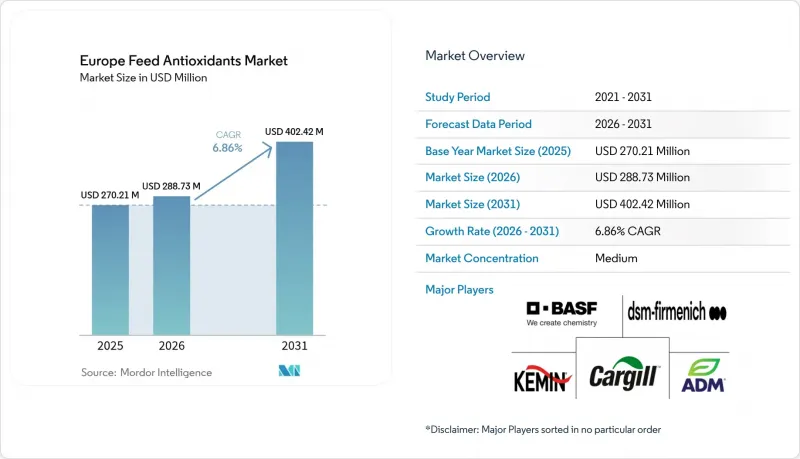
This report is Segmented by Animal Type (Poultry, Swine, Ruminant, Aquaculture, Other Animal Types), Type (BHA, BHT, Ethoxyquin, Others), Form (Dry, Liquid), and Geography (United Kingdom, Germany, France, Spain, Russia, Rest of Europe). The Market Forecasts are Provided in Terms of Value (USD) and Volume (Metric Tons).
Europe Feed Antioxidants Market Trends and Insights
Surging poultry meat production in Eastern and Southern Europe
Eastern European poultry expansion has created substantial demand for feed preservation solutions, with Poland emerging as a regional production powerhouse following significant capacity investments in 2024. The shift toward larger, integrated operations in Bulgaria and Romania has standardized antioxidant procurement practices, favoring suppliers who can deliver consistent quality at scale. This geographic concentration enables feed mills to negotiate volume-based contracts that reduce per-unit antioxidant costs while ensuring supply security. The European Commission's protein self-sufficiency initiatives have further accelerated domestic poultry production, reducing reliance on imported meat products and creating sustained demand for locally manufactured feed additives .
Tightening Europe's limits on mycotoxins is driving antioxidant preservative use
The European Food Safety Authority's progressive tightening of mycotoxin limits has elevated antioxidant preservatives from optional to essential feed components, particularly for operations handling moisture-sensitive ingredients. EFSA's ongoing work to establish enforceable PFAS limits in animal feed has created additional compliance pressures that favor antioxidant suppliers with comprehensive contamination testing protocols. The complexity of compliance requirements has also accelerated consolidation among smaller feed manufacturers who lack resources for extensive testing and documentation.
Rapid adoption of organic livestock systems limiting synthetics
Organic livestock certification requirements strictly limit synthetic antioxidant use, creating market segmentation that constrains traditional preservative demand as organic production expands across European markets. The Institute for European Environmental Policy's 2024 analysis reveals that organic transition costs initially increase by 20-66% annually, with farmers seeking cost-effective natural preservation alternatives during the conversion period. Feed manufacturers serving mixed conventional and organic customer bases increasingly maintain separate production lines to avoid cross-contamination issues that could compromise organic certification status.
Other drivers and restraints analyzed in the detailed report include:
- Industry shift toward natural-label feed additives
- Growth of integrated aquaculture clusters in Nordic countries
- Regulatory uncertainty around ethoxyquin re-authorization
For complete list of drivers and restraints, kindly check the Table Of Contents.
Segment Analysis
Poultry held 39.25% of the Europe feed antioxidants market share in 2025, the largest slice of the Europe feed antioxidants market. Growth continues as integrated growers in Poland and Romania seek shelf-life assurance for exports and adopt fermented feedstuffs rich in natural phenolics to improve gut health. Aquaculture, though smaller, grows fastest at a 8.93% CAGR, boosting specialized marine antioxidants in the Europe feed antioxidants market size through 2031. Swine adoption stays steady despite African Swine Fever biosecurity spending diverting some budgets, while ruminant formulations bank on antioxidants to protect high-fat dairy rations.
Other animal segments, such as pet food, see a premiumization lift of botanical blends that double as flavor enhancers. EFSA's unified additive dossier system ensures poultry, aquatic, and companion animal feeds alike meet stringent efficacy and safety benchmarks. Suppliers with multi-species technical expertise thus retain cross-segment clout within the Europe feed antioxidants market.
Complete Report Scope:
- By Animal Type
- Poultry
- Swine
- Ruminant
- Aquaculture
- Other Animal Types
- By Type
- BHA
- BHT
- Ethoxyquin
- Others
- By Form
- Dry
- Liquid
- By Geography
- United Kingdom
- Germany
- France
- Spain
- Russia
- Rest of Europe
List of Companies Covered in this Report:
- Archer Daniels Midland Company
- BASF SE
- DSM-Firmenich AG
- Cargill Inc.
- Alltech Inc.
- Nutreco N.V. (SHV Holdings)
- Kemin Industries
- Bluestar Adisseo Nutrition Group Limited
- Novus International Inc. (Mitsui & Co. / Nippon Soda)
- Impextraco NV
- Perstorp Holding AB (PETRONAS Chemicals Group)
- International Flavors & Fragrances Inc.(IFF)
- AB Vista Ltd. (AB Agri / Associated British Foods)
- Camlin Fine Sciences Ltd.
Additional Benefits:
- The market estimate (ME) sheet in Excel format
- 3 months of analyst support
TABLE OF CONTENTS
1 Introduction
- 1.1 Study Assumptions and Market Definition
- 1.2 Scope of the Study
2 Research Methodology
3 Executive Summary
4 Market Landscape
- 4.1 Market Overview
- 4.2 Market Drivers
- 4.2.1 Surging poultry meat production in Eastern and Southern Europe
- 4.2.2 Tightening Europe's limits on mycotoxins is driving antioxidant preservative use
- 4.2.3 Industry shift toward natural-label feed additives
- 4.2.4 Growth of integrated aquaculture clusters in Nordic countries
- 4.2.5 Rise of circular-economy valorization of food by-products into feed
- 4.2.6 AI-enabled feed-mill automation optimizing antioxidant dosing
- 4.3 Market Restraints
- 4.3.1 Rapid adoption of organic livestock systems limiting synthetics
- 4.3.2 Regulatory uncertainty around ethoxyquin re-authorization
- 4.3.3 Inflation-led feed cost-cutting curbing additive budgets
- 4.3.4 Limited proven ROI data for smallholder farmers
- 4.4 Regulatory Landscape
- 4.5 Technological Outlook
- 4.6 Porter's Five Forces Analysis
- 4.6.1 Threat of New Entrants
- 4.6.2 Bargaining Power of Buyers
- 4.6.3 Bargaining Power of Suppliers
- 4.6.4 Threat of Substitutes
- 4.6.5 Intensity of Competitive Rivalry
5 Market Size and Growth Forecasts (Value and Volume)
- 5.1 By Animal Type
- 5.1.1 Poultry
- 5.1.2 Swine
- 5.1.3 Ruminant
- 5.1.4 Aquaculture
- 5.1.5 Other Animal Types
- 5.2 By Type
- 5.2.1 BHA
- 5.2.2 BHT
- 5.2.3 Ethoxyquin
- 5.2.4 Others
- 5.3 By Form
- 5.3.1 Dry
- 5.3.2 Liquid
- 5.4 By Geography
- 5.4.1 United Kingdom
- 5.4.2 Germany
- 5.4.3 France
- 5.4.4 Spain
- 5.4.5 Russia
- 5.4.6 Rest of Europe
6 Competitive Landscape
- 6.1 Market Concentration
- 6.2 Strategic Moves
- 6.3 Market Share Analysis
- 6.4 Company Profiles (includes Global level Overview, Market level Overview, Core Segments, Financials as Available, Strategic Information, Market Rank/Share, Products and Services, Recent Developments)
- 6.4.1 Archer Daniels Midland Company
- 6.4.2 BASF SE
- 6.4.3 DSM-Firmenich AG
- 6.4.4 Cargill Inc.
- 6.4.5 Alltech Inc.
- 6.4.6 Nutreco N.V. (SHV Holdings)
- 6.4.7 Kemin Industries
- 6.4.8 Bluestar Adisseo Nutrition Group Limited
- 6.4.9 Novus International Inc. (Mitsui & Co. / Nippon Soda)
- 6.4.10 Impextraco NV
- 6.4.11 Perstorp Holding AB (PETRONAS Chemicals Group)
- 6.4.12 International Flavors & Fragrances Inc.(IFF)
- 6.4.13 AB Vista Ltd. (AB Agri / Associated British Foods)
- 6.4.14 Camlin Fine Sciences Ltd.
7 Market Opportunities and Future Outlook

