PUBLISHER: Mordor Intelligence | PRODUCT CODE: 2113842

PUBLISHER: Mordor Intelligence | PRODUCT CODE: 2113842
Italy Hospital Supplies - Market Share Analysis, Industry Trends & Statistics, Growth Forecasts (2026 - 2031)
According to Mordor Intelligence, the Italy hospital supplies market size was valued at USD 1.01 billion in 2025 and is estimated to grow from USD 1.09 billion in 2026 to reach USD 1.59 billion by 2031, at a CAGR of 7.83% during the forecast period (2026-2031).
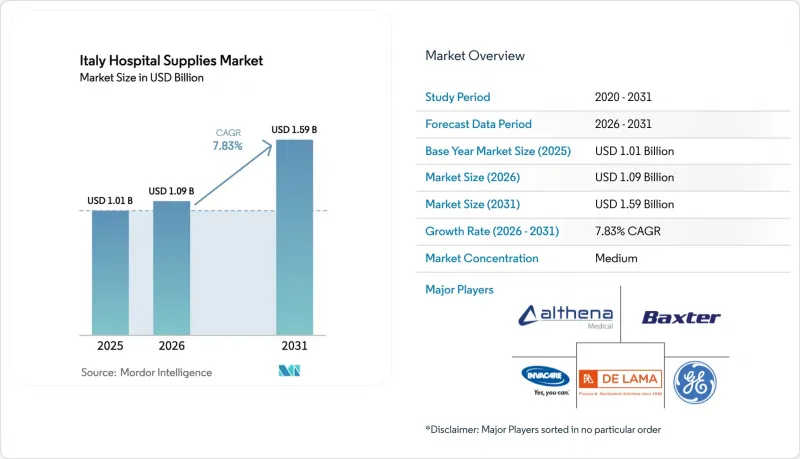
This report is Segmented by Product (Patient Examination Devices, Operating Room Equipment, Mobility Aids & Transportation Equipment, and More), End User (Ambulatory Surgical Centres, and More), and Distribution Channel (Direct Tender / Bulk Procurement, Distributor & Dealer Sales, and E-Commerce & GPO Platforms). The Market Forecasts are Provided in Terms of Value (USD).
Italy Hospital Supplies Market Trends and Insights
Expanding Chronic-Disease Burden
In 2022, 23.8% of Italy's population was aged 65 and above, a figure expected to reach 34% by 2050. This demographic trend ensures a stable demand for medical supplies such as syringes, glucose meters, and wound-care dressings. Cardiovascular diseases, responsible for 31% of deaths, along with 40.9% of the population reporting at least one chronic condition, have led hospitals to adopt multi-year CONSIP frameworks for bulk procurement of patient-examination devices. The rising incidence of diabetes is driving repeat purchases of continuous glucose monitors, particularly those integrated with electronic health records. Between 2019 and 2021, mental health diagnoses for anxiety and depression increased by 19.8% and 17.3%, respectively, fueling demand for telepsychiatry kits that connect community facilities with tertiary care centers. Suppliers offering bundled chronic-care kits, which effectively reduce hospital readmissions, are gaining competitive advantages in value-based tenders across Italy's hospital supplies market.
Government Recovery-Plan Capital Investments
The PNRR earmarked EUR 15.63 billion (USD 17.19 billion) for health spending, including EUR 4.05 billion for hospital technology upgrades and EUR 1.67 billion for digital infrastructure. Procurement targets encompass 3,100 CT, MRI, and angiography systems and 84 hospital seismic retrofits. Execution delays in 2024 require a sevenfold acceleration to meet 2026 milestones, compressing tender windows and favoring incumbents with CONSIP credentials. Southern regions receive disproportionate allocations, yet limited administrative capacity postpones approvals, intensifying a two-speed dynamic inside the Italy hospital supplies market.
Stringent Regulatory and Tender Compliance
CONSIP handled EUR 28.3 billion in centralized procurement during 2024, yet 24-36-month framework contracts lock in pricing, squeezing margins when raw-material costs rise. EU MDR imposes rigorous clinical-evaluation and UDI labeling duties, raising compliance costs by 20-30% for midsize producers. Fragmented tenders in Lazio and Campania extend award cycles by up to nine months, pressuring vendor cash flow. Multinationals absorb these hurdles with specialized regulatory teams, while smaller Italian manufacturers exit segments such as sterilization and mobility aids, subtly consolidating the Italy hospital supplies market.
Other drivers and restraints analyzed in the detailed report include:
- Rapid Digitalization of Hospital Infrastructure
- Shift Toward Outpatient and Home-Care Models
- Regional Budgetary Constraints
For complete list of drivers and restraints, kindly check the Table Of Contents.
Segment Analysis
Disposable Hospital Supplies captured 45.76% of 2025 demand as 530,000 hospital-acquired infections and 34% MRSA prevalence forced single-use workflows. The Italy hospital supplies market for disposables is forecast to reach USD 21.7 billion by 2031, supported by antimicrobial-resistant strains, including 27% of Klebsiella pneumoniae strains that are carbapenem-resistant. Operating Room Equipment will post an 8.43% CAGR, fueled by EUR 4.05 billion in PNRR funds for 3,100 large devices and by surgeon preference for robotic-assisted platforms. Value-based tenders award points for lifecycle services and predictive maintenance, elevating the portfolios of B. Braun, Stryker, and Medtronic.
Patient Examination Devices cater to 40.9% of citizens with chronic conditions and integrate Bluetooth links to FSE 2.0 dashboards. Mobility Aids gain traction among the elderly, while Sterilization equipment upgrades focus on automated cycle-logging to satisfy MDR post-market audits. Syringe and needle demand remains steady, yet safety-engineered retractable designs see faster uptake, encouraged by EU Directive 2010/32/EU.
Complete Report Scope:
- By Product
- Patient Examination Devices
- Operating Room Equipment
- Mobility Aids & Transportation Equipment
- Sterilisation & Disinfectant Equipment
- Disposable Hospital Supplies
- Syringes & Needles
- Other Products
- By End User
- Ambulatory Surgical Centres
- Diagnostic Centres
- Home-Health-Care Settings
- Hospitals
- Specialty Clinics
- Other End Users
- By Distribution Channel
- Direct Tender / Bulk Procurement
- Distributor & Dealer Sales
- E-Commerce & GPO Platforms
List of Companies Covered in this Report:
- Althena Medical
- B. Braun
- Baxter International Inc. (Hill-Rom Services)
- Cardinal Health
- ConvaTec Group plc
- DE LAMA S.p.A.
- Dragerwerk
- Favero Health Projects
- Fazzini
- Fisher & Paykel Healthcare Corp. Ltd
- GE Healthcare
- Getinge
- Invacare
- Johnson & Johnson
- Medtronic
- Pentaferte Italia
- Koninklijke Philips
- Siemens Healthineers
- Smiths Group
- Stryker
Additional Benefits:
- The market estimate (ME) sheet in Excel format
- 3 months of analyst support
TABLE OF CONTENTS
1 Introduction
- 1.1 Study Assumptions & Market Definition
- 1.2 Scope of the Study
2 Research Methodology
3 Executive Summary
4 Market Landscape
- 4.1 Market Overview
- 4.2 Market Drivers
- 4.2.1 Expanding Chronic-Disease Burden
- 4.2.2 Heightened Hospital-Infection Awareness
- 4.2.3 Government Recovery-Plan Capital Investments
- 4.2.4 Rapid Digitalization of Hospital Infrastructure
- 4.2.5 Shift Toward Outpatient & Home-Care Models
- 4.2.6 Emergence of Value-Based Procurement Practices
- 4.3 Market Restraints
- 4.3.1 Stringent Regulatory & Tender Compliance
- 4.3.2 Regional Budgetary Constraints
- 4.3.3 Healthcare Workforce Shortages
- 4.3.4 Global Supply-Chain Vulnerabilities
- 4.4 Value / Supply-Chain Analysis
- 4.5 Regulatory Landscape
- 4.6 Technological Outlook
- 4.7 Porter's Five Forces Analysis
- 4.7.1 Threat Of New Entrants
- 4.7.2 Bargaining Power Of Buyers / Consumers
- 4.7.3 Bargaining Power Of Suppliers
- 4.7.4 Threat Of Substitute Products
- 4.7.5 Intensity Of Competitive Rivalry
- 4.8 Procurement & Tendering Framework Analysis
5 Market Size & Growth Forecasts (Value, USD)
- 5.1 By Product
- 5.1.1 Patient Examination Devices
- 5.1.2 Operating Room Equipment
- 5.1.3 Mobility Aids & Transportation Equipment
- 5.1.4 Sterilisation & Disinfectant Equipment
- 5.1.5 Disposable Hospital Supplies
- 5.1.6 Syringes & Needles
- 5.1.7 Other Products
- 5.2 By End User
- 5.2.1 Ambulatory Surgical Centres
- 5.2.2 Diagnostic Centres
- 5.2.3 Home-Health-Care Settings
- 5.2.4 Hospitals
- 5.2.5 Specialty Clinics
- 5.2.6 Other End Users
- 5.3 By Distribution Channel
- 5.3.1 Direct Tender / Bulk Procurement
- 5.3.2 Distributor & Dealer Sales
- 5.3.3 E-Commerce & GPO Platforms
6 Competitive Landscape
- 6.1 Market Concentration
- 6.2 Market Share Analysis
- 6.3 Company Profiles {(Includes Global Level Overview, Market Level Overview, Core Segments, Financials as Available, Strategic Information, Market Rank/Share for Key Companies, Products & Services, and Recent Developments)}
- 6.3.1 Althena Medical
- 6.3.2 B. Braun Melsungen AG
- 6.3.3 Baxter International Inc. (Hill-Rom Services)
- 6.3.4 Cardinal Health Inc.
- 6.3.5 ConvaTec Group plc
- 6.3.6 DE LAMA S.p.A.
- 6.3.7 Dragerwerk AG & Co. KGaA
- 6.3.8 Favero Health Projects Spa
- 6.3.9 Fazzini S.r.l.
- 6.3.10 Fisher & Paykel Healthcare Corp. Ltd
- 6.3.11 General Electric Company (GE Healthcare)
- 6.3.12 Getinge AB
- 6.3.13 Invacare Corporation
- 6.3.14 Johnson & Johnson (Ethicon)
- 6.3.15 Medtronic plc
- 6.3.16 Pentaferte Italia Srl
- 6.3.17 Philips Healthcare
- 6.3.18 Siemens Healthineers AG
- 6.3.19 Smith & Nephew plc
- 6.3.20 Stryker Corporation
7 Market Opportunities & Future Outlook
- 7.1 White-Space & Unmet-Need Assessment

