PUBLISHER: Mordor Intelligence | PRODUCT CODE: 2113846

PUBLISHER: Mordor Intelligence | PRODUCT CODE: 2113846
Distiller's Dried Grains With Solubles (DDGS) Feed - Market Share Analysis, Industry Trends & Statistics, Growth Forecasts (2026 - 2031)
According to Mordor Intelligence, distiller's dried grains with solubles (DDGS) feed market size in 2026 is estimated at USD 17.97 billion, growing from 2025 value of USD 16.80 billion with 2031 projections showing USD 25.15 billion, growing at 6.95% CAGR over 2026-2031.
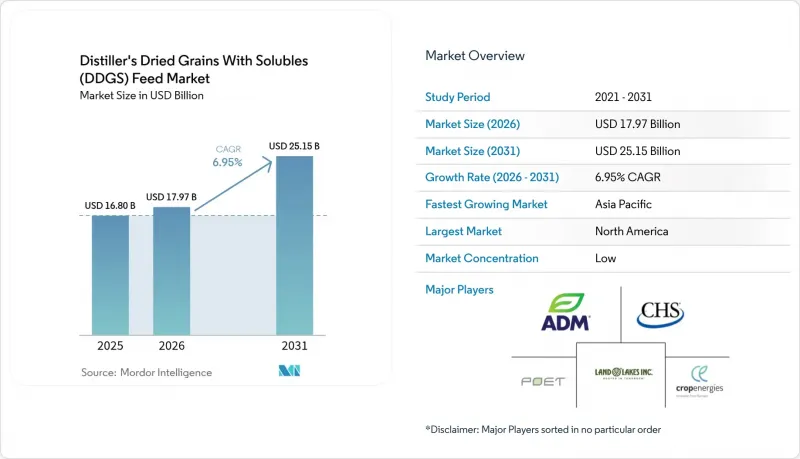
This report is Segmented by Type (Corn, Wheat, Rice, Blended Grains, and Other Types), Animal Type (Dairy Cattle, Beef Cattle, Swine, Poultry, and Other Animal Types), and by Geography (North America, Europe, Asia-Pacific, South America, and Middle East and Africa). The Market Forecasts are Provided in Terms of Value (USD).
Global Distiller's Dried Grains With Solubles (DDGS) Feed Market Trends and Insights
Rising Demand for High-Protein Cost-Effective Animal Feed
The global expansion in meat consumption drives continuous demand for protein-rich feed ingredients that provide economic value while maintaining animal performance. According to the Organization for Economic Co-operation and Development (OECD), global poultry meat consumption reached 141,274.7 thousand metric tons in 2024, increasing from 139,334.2 thousand metric tons in 2023 . DDGS provides approximately 27-30% crude protein content at costs typically 10-15% below soybean meal equivalent, creating compelling economics for feed formulators managing margin pressure. University of Nebraska research demonstrates that variable DDGS inclusion rates up to 25% in finishing cattle rations produce no significant performance differences, providing nutritionists flexibility to optimize formulations based on ingredient availability and pricing dynamics. This research challenges traditional conservative inclusion limits and suggests broader application potential across livestock species.
Expansion of the Global Ethanol/Biofuel Industry
Ethanol capacity expansion creates a direct multiplier effect on DDGS supply, with each gallon of ethanol generating approximately 17-18 pounds of DDGS co-product. In January 2025, Green Plains' Tallgrass carbon capture project in the United States demonstrates the improvement of ethanol economics through low-carbon premiums. The project reduced carbon intensity from 51 to approximately 19, allowing participation in 45Z Clean Fuel Production Credits and state low-carbon fuel markets. These environmental premiums provide economic incentives for ethanol production during periods of reduced processing margins.
Volatile Grain Prices Eroding DDGS Price Advantage
DDGS prices mirror corn because both stem from the same supply chain. When corn spikes, distillers' grains often follow within days, narrowing the normal 10-15% discount that underpins demand. January 2025 spot bids averaged USD 155 per ton while CIF NOLA export values reached USD 216 as river logistics tightened.Feed formulators maintain flexibility to substitute alternative protein sources when DDGS pricing exceeds economic thresholds, creating demand elasticity that limits pricing power during supply-constrained periods.
Other drivers and restraints analyzed in the detailed report include:
- Improved Fractionation Technologies Lowering Fiber Content
- Rising DDGS Inclusion in Poultry and Swine Rations in Asia
- Competition From Soybean, Canola, and Other Protein Meals
For complete list of drivers and restraints, kindly check the Table Of Contents.
Segment Analysis
Corn Distiller's Dried Grains With Solubles (DDGS) maintains commanding market leadership with approximately 59.20% share in 2025, reflecting North America's corn ethanol infrastructure dominance and established supply chains that deliver consistent quality and availability. This segment's maturity provides price stability and technical expertise that support reliable feed formulation. Wheat DDGS captures smaller regional markets, particularly in Europe and Canada, where wheat-based ethanol production creates localized supply streams. Rice DDGS remains niche but shows promise in Asian markets where rice processing infrastructure supports specialized applications.
While amino acid-enriched DDGS variants emerge as the fastest-growing subsegment at 9.25% CAGR through 2031, targeting premium applications where enhanced nutritional profiles justify higher pricing. Amino acid-enriched forms command further premiums when valine or lysine levels are raised through targeted enzyme additions. Even so, corn continues to anchor price discovery, ensuring steady liquidity for buyers who value consistent nutrient specs.
Complete Report Scope:
- By Type
- Corn
- Wheat
- Rice
- Amino Acids
- Blended Grains
- Other Types
- By Animal Type
- Dairy Cattle
- Beef Cattle
- Swine
- Poultry
- Aquaculture
- Other Animal Types
- By Geography
- North America
- United States
- Canada
- Mexico
- Rest of North America
- Europe
- Germany
- United Kingdom
- France
- Italy
- Spain
- Russia
- Rest of Europe
- Asia-Pacific
- China
- Japan
- India
- Thailand
- Rest of Asia-Pacific
- South America
- Brazil
- Argentina
- Rest of South America
- Middle East
- Saudi Arabia
- Turkey
- Rest of Middle East
- Africa
- South Africa
- Rest of Africa
- North America
Geography Analysis
North America retained 44.30% of the 2025 market share in 2025, driven by the United States' massive corn ethanol infrastructure that generates over 40 million metric tons of DDGS annually through facilities operated by major producers, including Archer Daniels Midland, POET, and Green Plains. Canada contributes through wheat-based ethanol production, while Mexico represents a major export destination that absorbs significant United States DDGS volumes despite occasional rail service disruptions that impact delivery reliability. Rail service into Mexico underpins steady exports, though periodic car shortages lift delivered cost and encourage seaboard feeders to diversify supply.
Asia-Pacific delivers the fastest uptick at 7.22% CAGR through 2031. China's corn ethanol expansion and India's grain-based distillery ramp-ups enlarge the regional supply pool, while booming poultry and aquaculture sectors lift consumption. Vietnam, Thailand, and Indonesia collectively imported more than 4 million metric tons in 2024, and quality-certified products are clearing customs faster as suppliers adopt aflatoxin detection protocols similar to SecureFeed.
The South American Distiller's Dried Grains With Solubles (DDGS) feed market is expanding, driven by Brazil's corn ethanol production growth of 24.5% year-on-year. Domestic livestock feed mills consume increasing volumes, with excess production targeted for Andean and Caribbean markets. Argentina's wheat-based ethanol facilities produce DDGS variants suitable for dairy operations in Chile and Uruguay.
- Archer Daniels Midland Company
- CHS Inc.
- POET LLC
- CropEnergies AG
- Land O' Lakes, Inc.
- Cargill Incorporated
- Green Plains Inc.
- Valero Energy Corporation
- The Andersons, Inc.
- Vertex Bioenergy S.L
- Globus Spirits Limited
- Nugen Feeds and Foods Private Limited
- The Andersons Inc.
- Kent Corporation
- The Scoular Company
Additional Benefits:
- The market estimate (ME) sheet in Excel format
- 3 months of analyst support
TABLE OF CONTENTS
1 Introduction
- 1.1 Study Assumptions and Market Definition
- 1.2 Scope of the Study
2 Research Methodology
3 Executive Summary
4 Market Landscape
- 4.1 Market Overview
- 4.2 Market Drivers
- 4.2.1 Rising demand for high-protein cost-effective animal feed
- 4.2.2 Expansion of the global ethanol/biofuel industry
- 4.2.3 Improved fractionation technologies lowering fiber content
- 4.2.4 Rising DDGS inclusion in poultry and swine rations in Asia
- 4.2.5 Aquaculture feed adoption driven by cost parity with fishmeal
- 4.2.6 Low-carbon fuel-standard premiums for certified green DDGS
- 4.3 Market Restraints
- 4.3.1 Volatile grain prices eroding DDGS price advantage
- 4.3.2 Competition from soybean, canola and other protein meals
- 4.3.3 Tightened mycotoxin/sulfur limits in key export markets
- 4.3.4 Rail-car shortages inflating delivered costs from inland plants
- 4.4 Technological Outlook
- 4.5 Regulatory Landscape
- 4.6 Porter's Five Forces Analysis
- 4.6.1 Bargaining Power of Suppliers
- 4.6.2 Bargaining Power of Buyers
- 4.6.3 Threat of New Entrants
- 4.6.4 Threat of Substitutes
- 4.6.5 Competitive Rivalry
5 Market Size and Growth Forecasts (Value)
- 5.1 By Type
- 5.1.1 Corn
- 5.1.2 Wheat
- 5.1.3 Rice
- 5.1.4 Amino Acids
- 5.1.5 Blended Grains
- 5.1.6 Other Types
- 5.2 By Animal Type
- 5.2.1 Dairy Cattle
- 5.2.2 Beef Cattle
- 5.2.3 Swine
- 5.2.4 Poultry
- 5.2.5 Aquaculture
- 5.2.6 Other Animal Types
- 5.3 By Geography
- 5.3.1 North America
- 5.3.1.1 United States
- 5.3.1.2 Canada
- 5.3.1.3 Mexico
- 5.3.1.4 Rest of North America
- 5.3.2 Europe
- 5.3.2.1 Germany
- 5.3.2.2 United Kingdom
- 5.3.2.3 France
- 5.3.2.4 Italy
- 5.3.2.5 Spain
- 5.3.2.6 Russia
- 5.3.2.7 Rest of Europe
- 5.3.3 Asia-Pacific
- 5.3.3.1 China
- 5.3.3.2 Japan
- 5.3.3.3 India
- 5.3.3.4 Thailand
- 5.3.3.5 Rest of Asia-Pacific
- 5.3.4 South America
- 5.3.4.1 Brazil
- 5.3.4.2 Argentina
- 5.3.4.3 Rest of South America
- 5.3.5 Middle East
- 5.3.5.1 Saudi Arabia
- 5.3.5.2 Turkey
- 5.3.5.3 Rest of Middle East
- 5.3.6 Africa
- 5.3.6.1 South Africa
- 5.3.6.2 Rest of Africa
- 5.3.1 North America
6 Competitive Landscape
- 6.1 Market Concentration
- 6.2 Strategic Moves
- 6.3 Market Share Analysis
- 6.4 Company Profiles (Includes Global Level Overview, Market Level Overview, Core Segments, Financials as Available, Strategic Information, Market Rank/Share for Key Companies, Products and Services, Recent Developments)
- 6.4.1 Archer Daniels Midland Company
- 6.4.2 CHS Inc.
- 6.4.3 POET LLC
- 6.4.4 CropEnergies AG
- 6.4.5 Land O' Lakes, Inc.
- 6.4.6 Cargill Incorporated
- 6.4.7 Green Plains Inc.
- 6.4.8 Valero Energy Corporation
- 6.4.9 The Andersons, Inc.
- 6.4.10 Vertex Bioenergy S.L
- 6.4.11 Globus Spirits Limited
- 6.4.12 Nugen Feeds and Foods Private Limited
- 6.4.13 The Andersons Inc.
- 6.4.14 Kent Corporation
- 6.4.15 The Scoular Company
7 Market Opportunities and Future Outlook

