PUBLISHER: Mordor Intelligence | PRODUCT CODE: 2113858

PUBLISHER: Mordor Intelligence | PRODUCT CODE: 2113858
Digital Commerce Software - Market Share Analysis, Industry Trends & Statistics, Growth Forecasts (2026 - 2031)
According to Mordor Intelligence, the digital commerce software market size is expected to grow from USD 6.79 billion in 2025 to USD 7.74 billion in 2026 and is forecast to reach USD 14.94 billion by 2031 at 14.05% CAGR over 2026-2031.
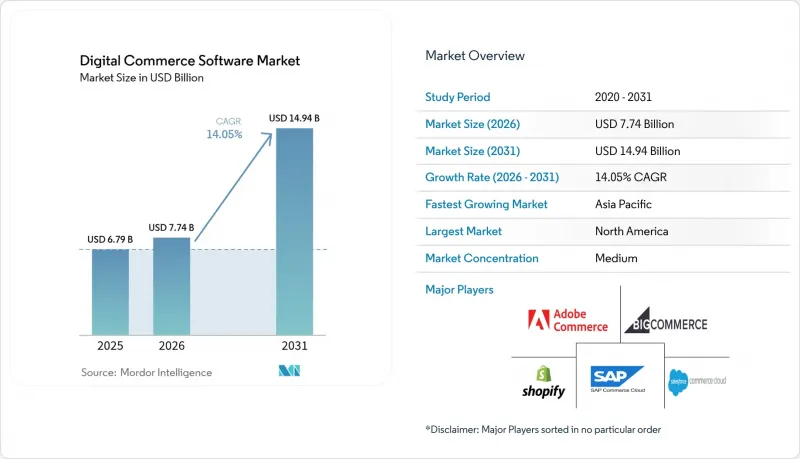
This report is Segmented by Deployment Model (On-Premises, Hybrid, and More), by Component (Platform / Software, and More), by Business Model (B2C, B2B, and More), by Organization Size (Large Enterprises, and More), by Commerce Channel, (web and More), by End-User Industries (Retail and E-Commerce, BFSI, and More), and by Geography. The Market Sizes and Forecasts are Provided in Terms of Value (USD).
Global Digital Commerce Software Market Trends and Insights
Omnichannel Shopping Demand
Enterprises are rolling out unified commerce stacks to synchronise inventory, pricing, and customer profiles across touchpoints. Research shows that firms excelling in omnichannel retention keep 89% of their customers, far outperforming peers with weak strategies. Grocery, consumer electronics, and apparel chains now embed curb-side fulfilment, in-store kiosks, and click-to-collect options into one central order management layer. Manufacturers are likewise re-platforming to support self-service portals, shortening re-order cycles and raising order accuracy. These shifts are elevating expectations in B2B procurement, where buyers want the same friction-free experience found in consumer channels. Consequently, vendors that package pre-integrated POS, CRM, and loyalty modules are gaining traction among retailers pursuing experience-led growth.
Rapid Adoption of Cloud-Native SaaS Commerce Platforms
Cloud-first principles are reshaping the digital commerce software market as 90% of enterprises use cloud services in some form. Vendor-managed environments offer automated scaling, embedded analytics, and zero-downtime upgrades, allowing retailers to reduce operating costs by 40% and accelerate feature releases by 25%. Kubernetes, micro-services, and container orchestration underpin these gains, facilitating continuous integration pipelines. AWS, Microsoft Azure, and Google Cloud collectively support the bulk of new commerce launches, while managed databases such as MongoDB Atlas simplify DevOps tasks for storefronts built on frameworks like Vue Storefront. Financial services and insurance players are deploying hybrid architectures to meet data-sovereignty mandates without compromising elasticity.
Escalating Cybersecurity and Data-Privacy Risks
Retail breaches cost an average USD 4.88 million per incident and stricter regulations magnify penalties. The EU Digital Services Act subjects platforms to fines up to 6% of annual turnover when transparency, takedown, and advertising rules are breached. North American states are enlarging CCPA-style mandates, driving up compliance overheads. Executives have to embed privacy-by-design frameworks, conduct quarterly audits, and formalise data minimisation to sustain consumer trust. Cloud-native vendors respond with field-level encryption, tokenisation, and continuous compliance tooling, yet talent shortages in security operations prolong vulnerability windows. Merchants serving regions with low financial inclusion also face authentication challenges, increasing fraud exposure.
Other drivers and restraints analyzed in the detailed report include:
- Mobile Commerce and Digital Wallet Proliferation
- Surge in Subscription and Digital-Goods Monetization
- Integration Complexity with Legacy ERP and POS Stacks
For complete list of drivers and restraints, kindly check the Table Of Contents.
Segment Analysis
Cloud deployments accounted for 61.45% of the digital commerce software market share in 2025 and are on course for a 15.1% CAGR through 2031. This commanding position highlights the desire for instant scalability and vendor-managed security updates. The digital commerce software market size for cloud solutions is projected to more than double by 2031, mirroring investments in micro-services, serverless functions, and observability tooling. Enterprises migrating from on-premise suites report 40% lower total cost of ownership within two years.
Cost savings are not the sole driver. Business teams value speed, using sandbox environments to test new promotions in hours rather than quarters. Hybrid cloud is emerging in data-sensitive verticals such as insurance, where 73% of carriers retain some workloads on private stacks to meet sovereignty rules. Multi-cloud adoption at 89% underscores demand for vendor redundancy. These dynamics ensure that the digital commerce software market remains centred on cloud-native innovation.
Platform software secured 70.90% revenue share in 2025, yet services are climbing at a 15.7% CAGR as enterprises navigate composable adoption. Implementation partners bundle change management, data migration, and headless front-end builds, capturing spend that once flowed to internal IT. Integration services focus on mapping legacy ERP, PIM, and POS datasets to new commerce APIs.
Platform vendors still anchor purchasing discussions because transactional engines, catalogue, and checkout remain core. Differentiation now revolves around AI-powered merchandizing, native search, and low-code orchestration. Commercetools introduced machine-learning models that cleanse B2B product data and automate segment-level pricing. API-first designs cut implementation time, enabling clients to launch international storefronts within weeks, cementing platform software's leadership in the digital commerce software market.
Complete Report Scope:
- By Deployment Model
- On-Premise
- Cloud-Based
- Hybrid
- By Component
- Platform / Software
- Services
- Implementation and Integration
- Managed Services
- Consulting / Advisory
- By Business Model
- B2C
- B2B
- Marketplace (B2B2C / C2C)
- By Organisation Size
- Large Enterprises
- Small and Medium-Sized Enterprises (SMEs)
- By Commerce Channel
- Web
- Mobile App
- Social Commerce
- Voice Commerce
- AR/VR Commerce
- By End-User Industry
- Retail and E-commerce
- BFSI
- Travel and Hospitality
- IT and Telecommunications
- Media and Entertainment
- Manufacturing
- Healthcare and Pharmaceuticals
- Other End-User Industry
- By Geography
- North America
- United States
- Canada
- Mexico
- South America
- Brazil
- Argentina
- Rest of South America
- Europe
- Germany
- United Kingdom
- France
- Italy
- Spain
- Russia
- Rest of Europe
- Asia Pacific
- China
- Japan
- India
- South Korea
- Southeast Asia
- Australia and New Zealand
- Rest of Asia Pacific
- Middle East and Africa
- Middle East
- Saudi Arabia
- United Arab Emirates
- Turkey
- Rest of Middle East
- Africa
- South Africa
- Nigeria
- Kenya
- Rest of Africa
- Middle East
- North America
Geography Analysis
North America generated 34.95% of global revenue in 2025, led by cloud adoption, mature payment infrastructure, and a robust vendor ecosystem. Salesforce's USD 8 billion acquisition of Informatica illustrates the region's appetite for data-driven commerce stacks that blend AI with customer experience. Government procurement is also modernising; the U.S. Army launched an e-commerce-style marketplace in 2025 to streamline IT acquisition. Mobile commerce dominance combined with social-media-led discovery positions the United States as a test bed for new commerce models.
Europe maintains significant traction despite the compliance burden of the Digital Services Act. Enterprise buyers view privacy and sustainability as strategic differentiators, favouring vendors that provide granular consent management and carbon-tracking APIs. Composable architectures offer the modularity needed to localise tax and shipping logic across multiple jurisdictions, sustaining the digital commerce software market in Europe.
Asia-Pacific is the fastest-growing region at 15.45% CAGR through 2031. Smartphone penetration, super-app ecosystems, and real-time payment networks such as UPI and Pix underpin this rise. Japanese enterprises focus on outcome-oriented modules that quicken deployment cycles.Southeast Asian merchants interlace social commerce with influencer marketing, while Africa is witnessing payment alliances that unlock cross-border acceptance. Latin America's digital commerce user base is on track to reach 418.9 million by 2029, aided by partnerships like Canva and EBANX that deliver local payment rails.
- Adobe Inc (Adobe Commerce)
- BigCommerce Holdings Inc
- Shopify Inc
- Salesforce Inc (Commerce Cloud)
- SAP SE
- Oracle Corp
- IBM Corp
- Magento Open-Source (Adobe)
- commercetools GmbH
- VTEX
- Wix.com Ltd
- Squarespace Inc
- Intershop Communications AG
- Digital River Inc
- Kibo Commerce
- Elastic Path Software
- Sitecore (OrderCloud)
- Optimizely (Episerver)
- WooCommerce / Automattic
- Volusion LLC
Additional Benefits:
- The market estimate (ME) sheet in Excel format
- 3 months of analyst support
TABLE OF CONTENTS
1 INTRODUCTION
- 1.1 Study Assumptions and Market Definition
- 1.2 Scope of the Study
2 RESEARCH METHODOLOGY
3 EXECUTIVE SUMMARY
4 MARKET LANDSCAPE
- 4.1 Market Overview
- 4.2 Market Drivers
- 4.2.1 Omnichannel shopping demand
- 4.2.2 Rapid adoption of cloud-native SaaS commerce platforms
- 4.2.3 Mobile commerce and digital wallet proliferation
- 4.2.4 Surge in subscription and digital-goods monetization
- 4.2.5 Shift toward composable / micro-services architecture
- 4.2.6 Rise of headless and API-first commerce enabling new CX
- 4.3 Market Restraints
- 4.3.1 Escalating cybersecurity and data-privacy risks
- 4.3.2 Integration complexity with legacy ERP and POS stacks
- 4.3.3 Shortage of specialised commerce-platform developers
- 4.3.4 Regulatory uncertainties around data residency and cross-border data flows
- 4.4 Industry Value Chain Analysis
- 4.5 Technological Outlook
- 4.6 Regulatory Landscape
- 4.7 Porter's Five Forces
- 4.7.1 Threat of New Entrants
- 4.7.2 Bargaining Power of Buyers
- 4.7.3 Bargaining Power of Suppliers
- 4.7.4 Threat of Substitutes
- 4.7.5 Intensity of Competitive Rivalry
5 MARKET SIZE AND GROWTH FORECASTS (VALUE)
- 5.1 By Deployment Model
- 5.1.1 On-Premise
- 5.1.2 Cloud-Based
- 5.1.3 Hybrid
- 5.2 By Component
- 5.2.1 Platform / Software
- 5.2.2 Services
- 5.2.2.1 Implementation and Integration
- 5.2.2.2 Managed Services
- 5.2.2.3 Consulting / Advisory
- 5.3 By Business Model
- 5.3.1 B2C
- 5.3.2 B2B
- 5.3.3 Marketplace (B2B2C / C2C)
- 5.4 By Organisation Size
- 5.4.1 Large Enterprises
- 5.4.2 Small and Medium-Sized Enterprises (SMEs)
- 5.5 By Commerce Channel
- 5.5.1 Web
- 5.5.2 Mobile App
- 5.5.3 Social Commerce
- 5.5.4 Voice Commerce
- 5.5.5 AR/VR Commerce
- 5.6 By End-User Industry
- 5.6.1 Retail and E-commerce
- 5.6.2 BFSI
- 5.6.3 Travel and Hospitality
- 5.6.4 IT and Telecommunications
- 5.6.5 Media and Entertainment
- 5.6.6 Manufacturing
- 5.6.7 Healthcare and Pharmaceuticals
- 5.6.8 Other End-User Industry
- 5.7 By Geography
- 5.7.1 North America
- 5.7.1.1 United States
- 5.7.1.2 Canada
- 5.7.1.3 Mexico
- 5.7.2 South America
- 5.7.2.1 Brazil
- 5.7.2.2 Argentina
- 5.7.2.3 Rest of South America
- 5.7.3 Europe
- 5.7.3.1 Germany
- 5.7.3.2 United Kingdom
- 5.7.3.3 France
- 5.7.3.4 Italy
- 5.7.3.5 Spain
- 5.7.3.6 Russia
- 5.7.3.7 Rest of Europe
- 5.7.4 Asia Pacific
- 5.7.4.1 China
- 5.7.4.2 Japan
- 5.7.4.3 India
- 5.7.4.4 South Korea
- 5.7.4.5 Southeast Asia
- 5.7.4.6 Australia and New Zealand
- 5.7.4.7 Rest of Asia Pacific
- 5.7.5 Middle East and Africa
- 5.7.5.1 Middle East
- 5.7.5.1.1 Saudi Arabia
- 5.7.5.1.2 United Arab Emirates
- 5.7.5.1.3 Turkey
- 5.7.5.1.4 Rest of Middle East
- 5.7.5.2 Africa
- 5.7.5.2.1 South Africa
- 5.7.5.2.2 Nigeria
- 5.7.5.2.3 Kenya
- 5.7.5.2.4 Rest of Africa
- 5.7.5.1 Middle East
- 5.7.1 North America
6 COMPETITIVE LANDSCAPE
- 6.1 Market Concentration
- 6.2 Strategic Moves
- 6.3 Market Share Analysis
- 6.4 Company Profiles (includes Global Level Overview, Market Level Overview, Core Segments, Financials as available, Strategic Information, Market Rank/Share for Key Companies, Products and Services, and Recent Developments)
- 6.4.1 Adobe Inc (Adobe Commerce)
- 6.4.2 BigCommerce Holdings Inc
- 6.4.3 Shopify Inc
- 6.4.4 Salesforce Inc (Commerce Cloud)
- 6.4.5 SAP SE
- 6.4.6 Oracle Corp
- 6.4.7 IBM Corp
- 6.4.8 Magento Open-Source (Adobe)
- 6.4.9 commercetools GmbH
- 6.4.10 VTEX
- 6.4.11 Wix.com Ltd
- 6.4.12 Squarespace Inc
- 6.4.13 Intershop Communications AG
- 6.4.14 Digital River Inc
- 6.4.15 Kibo Commerce
- 6.4.16 Elastic Path Software
- 6.4.17 Sitecore (OrderCloud)
- 6.4.18 Optimizely (Episerver)
- 6.4.19 WooCommerce / Automattic
- 6.4.20 Volusion LLC
7 MARKET OPPORTUNITIES AND FUTURE OUTLOOK
- 7.1 White-space and Unmet-Need Assessment

