PUBLISHER: Mordor Intelligence | PRODUCT CODE: 2113860

PUBLISHER: Mordor Intelligence | PRODUCT CODE: 2113860
Probiotic Drinks - Market Share Analysis, Industry Trends & Statistics, Growth Forecasts (2026 - 2031)
According to Mordor Intelligence, the probiotic drinks market size is expected to increase from USD 31.05 million in 2025 to USD 33.59 million in 2026 and reach USD 49.74 million by 2031, growing at a CAGR of 8.17% over 2026-2031.
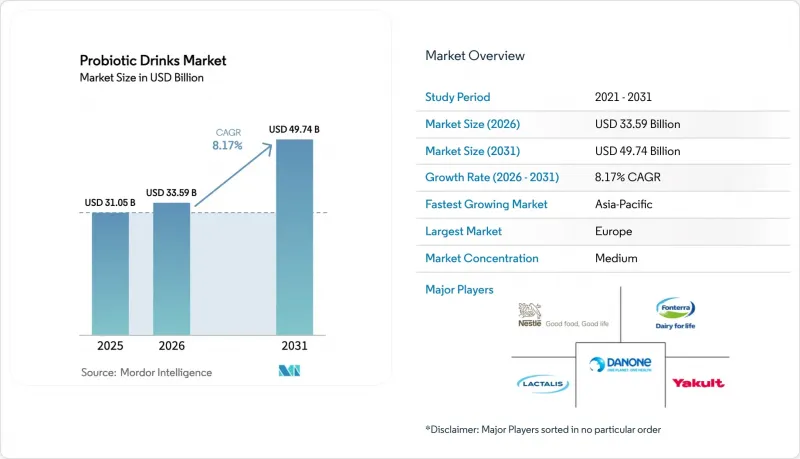
This report is Segmented by Product Type (Yogurt Drinks, Fermented Milk Drinks, Kombucha, Kefir, Probiotics Juices, Other Product Types), Flavor (Flavored, Unflavored), Packaging (Bottles, Cans, Tetra Packs, Others), Distribution Channels (On-Trade, Off-Trade), and Geography (North America, Europe, Asia-Pacific, South America, Middle East and Africa). The Market Forecasts are Provided in Terms of Value (USD).
Global Probiotic Drinks Market Trends and Insights
Rising Digestive Disorders Drive Demand for Microbiota-Supporting Functional Beverages
Consumers are increasingly choosing preventive solutions over pharmaceuticals to manage gastrointestinal issues such as irritable bowel syndrome and antibiotic-related dysbiosis. The U.S. National Institutes of Health reports that functional gastrointestinal disorders affect 35% to 40% of adults globally, driving demand for products with live microorganisms. Probiotic drinks, a more appealing alternative to capsules, seamlessly integrate gut health into daily routines. In 2024, Lifeway Foods introduced "Muscle Mates," a blend of probiotic kefir and creatine designed to support post-exercise recovery and digestive health. While research on the gut-brain axis highlights potential mental health benefits, regulatory bodies have not yet approved mood-related claims. This trend is particularly strong in North America and Europe, where rising healthcare costs encourage self-care, and in urban Asia-Pacific regions, where Western diets are contributing to increased gastrointestinal issues.
Low-Sugar, Low-Calorie Options Attract Health-Conscious Millennials and Gen Z
Younger generations are increasingly shifting away from sugary sodas, opting for functional beverages that align with their clean-eating habits and macro-tracking goals. Traditional yogurt drinks often contain over 15 grams of sugar per serving, exceeding the American Heart Association's recommended daily limits of 25 grams for women and 36 grams for men. In response, manufacturers are reformulating products by using natural sweeteners like stevia and monk fruit or removing sweeteners entirely, focusing on the unflavored segment, which is projected to grow at 8.92% through 2031. Lifeway's Probiotic Smoothie + Collagen, launching in 2025, is a zero-added-sugar product designed to meet the demand for beverages that promote both skin elasticity and gut health. This trend is most evident in North America, Western Europe, and Australia, where high nutrition-label literacy and social media influencers are driving the low-sugar movement. It is also expanding into urban centers in the Asia-Pacific region, particularly among affluent millennials in China and India, who increasingly view sugar reduction as a marker of social status.
Regulatory Hurdles Delay Product Launches and Increase Compliance Costs
Probiotic health claims face stringent pre-market scrutiny in major markets, with approval timelines of 18-24 months and costs of USD 500,000 to USD 1 million for dossier preparation. Between 2010 and 2020, the European Food Safety Authority rejected over 80% of such applications, forcing brands to use generic claims like "supports digestive health." In the U.S., the FDA's Generally Recognized as Safe pathway requires extensive safety data for novel strains, creating barriers for smaller innovators. Similarly, the EU's Novel Foods Regulation 2015/2283 mandates full safety assessments for strains not widely consumed before May 1997, delaying commercialization of next-generation species like Akkermansia muciniphila. These regulatory hurdles, particularly in Europe and North America, disproportionately affect emerging brands and result in a conservative product pipeline dominated by established Lactobacillus and Bifidobacterium strains, limiting innovation and breakthrough efficacy in the market.
Other drivers and restraints analyzed in the detailed report include:
- Clean-Label Demand for Natural, Organic Ingredients Drives Innovation
- Fermented Beverages Like Yogurt Drinks and Kefir Integrate Probiotics into Diets
- Cold Chain Logistics Increase Risks and Spoilage Potential
For complete list of drivers and restraints, kindly check the Table Of Contents.
Segment Analysis
In 2025, yogurt drinks held a 28.98% market share, driven by strong consumption habits in Europe and Asia-Pacific, where brands like Danone's Actimel and Yakult benefit from established distribution networks, consumer trust, and favorable regulatory frameworks. Danone launched Actimel+ Triple Action in 2024, adding vitamin D and zinc to meet rising immune-support demand. These drinks are staples in countries like France, Germany, Japan, and South Korea, supported by decades of marketing. However, private-label products in Europe challenge margins by offering similar live-culture counts at 20% to 30% lower prices. Meanwhile, kefir is gaining traction in North America for its diverse microbial content.
Probiotic juices, projected to grow at 9.21% through 2031, appeal to consumers seeking fruit-forward flavors or lactose-free options, with rapid growth in North America and urban Asia-Pacific. Lifeway Foods introduced Probiotic Smoothie + Collagen in 2025, combining fruit purees, kefir cultures, and collagen peptides for dual benefits. Kombucha, though niche, is attracting investment, as seen in PepsiCo's USD 1.95 billion acquisition of Poppi in March 2025, highlighting the demand for probiotic sodas. However, ensuring probiotic survival in acidic juices remains a challenge, requiring innovations like microencapsulation or strain selection.
In 2025, flavored probiotic drinks dominated 67.81% of the market, using fruit essences, vanilla, and botanical extracts to offset the sourness of fermented products. This segment drives trial and repeat purchases, with sensory appeal converting first-time buyers into loyal consumers. Lifeway Foods launched 10 new Flavor Fusions in 2024, including mango-turmeric and blueberry-lavender, targeting millennials and Gen Z with innovative flavors and visually appealing packaging. Flavored options perform well in North America, where juice-based profiles align with preferences, and in urban Asia-Pacific markets, where tropical fruits hold cultural relevance. However, balancing flavor intensity with reduced sugar content remains a challenge, prompting reformulations with natural sweeteners like stevia, monk fruit, and allulose.
Meanwhile, unflavored probiotic drinks are growing at 8.92% through 2031, driven by clean-label trends and consumer demand for purity and authenticity. Popular in Europe and North America, these products attract ingredient-conscious buyers and culinary users who incorporate them into recipes. The American Chemical Society highlights kefir's diverse microbial strains as superior for microbiome health, adding credibility to unflavored formats. Brands are educating consumers on their versatility and customization potential, but unflavored options risk staying niche unless manufacturers demonstrate clear benefits or cost savings to justify the sensory trade-off.
Complete Report Scope:
- Product Type
- Yogurt Drinks
- Fermented Milk Drinks
- Kombucha
- Kefir
- Probiotics Juices
- Other Product Types
- Flavor
- Flavored
- Unflavored
- Packaging
- Bottles
- Cans
- Tetra packs
- Others
- Distribution Channels
- On-trade
- Off-trade
- Supermarket/Hypermarkets
- Pharmacies and Drug Stores
- Convenience/Grocery Stores
- Online Stores
- Others
- Geography
- North America
- United States
- Canada
- Mexico
- Rest of North America
- Europe
- Germany
- United Kingdom
- Italy
- France
- Spain
- Netherlands
- Poland
- Belgium
- Sweden
- Rest of Europe
- Asia-Pacific
- China
- India
- Japan
- Australia
- Indonesia
- South Korea
- Thailand
- Singapore
- Rest of Asia-Pacific
- South America
- Brazil
- Argentina
- Colombia
- Chile
- Peru
- Rest of South America
- Middle East and Africa
- South Africa
- Saudi Arabia
- United Arab Emirates
- Nigeria
- Egypt
- Morocco
- Turkey
- Rest of Middle East and Africa
- North America
Geography Analysis
In 2025, Europe held a dominant 42.02% market share, bolstered by a long-standing tradition of probiotic consumption in countries like France, Germany, and the UK. Brands such as Danone and Yakult have ingrained daily probiotic intake into the culture, due to persistent marketing efforts. The European Food Safety Authority's rigorous health-claim standards lend credibility to these products; those that successfully navigate this approval process are viewed as scientifically validated by consumers. Germany boasts a particularly vibrant functional-beverage market, fueled by a cultural focus on preventive health and a willingness to spend on organic and natural products. The EU's Novel Foods Regulation 2015/2283, while ensuring product safety, poses challenges for brands eager to innovate, as they often find themselves in lengthy approval waits for new strains. Meanwhile, Eastern Europe, especially Poland and the Czech Republic, is emerging as a hotspot, with rising incomes and Westernized diets fueling a growing appetite for functional beverages.
Asia-Pacific is set to witness a robust growth rate of 9.52% through 2031, driven by increasing disposable incomes in China, India, and Indonesia. Urbanization in these nations is spurring a demand for products that prioritize health and convenience. In 2024, Yakult made a strategic move into China's tier-1 cities, capitalizing on its well-established distribution channels from Japan to promote daily probiotic habits. While India's kombucha scene is still in its infancy, it's rapidly gaining momentum, with startups like Atmosphere Kombucha and Boocha making waves in major cities such as Mumbai and Bangalore. Japan and South Korea, though boasting mature markets with high per-capita consumption, are witnessing a slowdown in growth as they near market saturation. Southeast Asia, particularly Thailand, Vietnam, and the Philippines, is emerging as a promising frontier, with beverages like kefir resonating with local fermentation traditions. However, the region grapples with cold-chain infrastructure challenges, especially in rural locales, restricting distribution primarily to urban and affluent suburban areas.
North America, South America, and the Middle East and Africa round out the global market landscape. North America shows moderate growth, with probiotic awareness reaching a plateau and competition heating up. A notable consolidation in 2025 saw PepsiCo shelling out USD 1.95 billion to acquire Poppi, underscoring the strategic value mainstream beverage giants place on probiotic platforms. Canada's market trajectory closely mirrors that of the U.S., with both kefir and kombucha carving out larger shares in natural-food outlets. In South America, while cold-chain challenges and economic fluctuations pose hurdles, urban middle-class consumers in Brazil and Argentina are leading the charge in adopting these products. The Middle East and Africa face analogous infrastructure issues, yet South Africa and the UAE stand out with their advanced modern retail penetration. However, the regulatory landscape in these regions is still maturing, presenting a dual-edged sword: swift market entry opportunities come with the risk of potential quality inconsistencies, which could jeopardize consumer trust.
- Danone SA
- Yakult Honsha Co. Ltd
- PepsiCo Inc. (KeVita)
- Fonterra Co-operative Group Ltd
- Nestle S.A.
- Groupe Lactalis
- Kerry Group PLC
- Grupo Lala
- Lifeway Foods Inc.
- Harmless Harvest Inc.
- Obi Probiotic Soda
- GT's Living Foods LLC
- Chobani LLC
- NextFoods Inc.
- Arla Foods amba
- Inner Mongolia Yili
- General Mills Inc.
- The Coca-Cola Company
- Remedy Drinks Pty Ltd
- Humm Kombucha LLC
Additional Benefits:
- The market estimate (ME) sheet in Excel format
- 3 months of analyst support
TABLE OF CONTENTS
1 INTRODUCTION
- 1.1 Study Assumptions and Market Definition
- 1.2 Scope of the Study
2 RESEARCH METHODOLOGY
3 EXECUTIVE SUMMARY
4 MARKET LANDSCAPE
- 4.1 Market Overview
- 4.2 Market Drivers
- 4.2.1 Rising digestive disorders drive demand for microbiota-supporting functional beverages
- 4.2.2 Low-sugar, low-calorie options attract health-conscious millennials and Gen Z.
- 4.2.3 Clean-label demand for natural, organic ingredients drives innovation.
- 4.2.4 Supermarkets with functional beverage aisles improve accessibility
- 4.2.5 Fermented beverages like yogurt drinks and kefir integrate probiotics into diets
- 4.2.6 Novel flavors, sparkling varieties, and prebiotic blends boost product appeal
- 4.3 Market Restraints
- 4.3.1 Regulatory hurdles delay product launches and increase compliance costs
- 4.3.2 Cold chain logistics increase risks and spoilage potential
- 4.3.3 Limited strain diversity and efficacy hinder reliable health outcomes
- 4.3.4 Competition from sugary beverages fragments market share
- 4.4 Supply Chain Analysis
- 4.5 Regulatory Landscape
- 4.6 Technological Outlook
- 4.7 Porter's Five Forces Analysis
- 4.7.1 Threat of New Entrants
- 4.7.2 Bargaining Power of Buyers
- 4.7.3 Bargaining Power of Suppliers
- 4.7.4 Threat of Substitutes
- 4.7.5 Intensity of Competitive Rivalry
5 MARKET SIZE AND GROWTH FORECASTS (VALUE)
- 5.1 Product Type
- 5.1.1 Yogurt Drinks
- 5.1.2 Fermented Milk Drinks
- 5.1.3 Kombucha
- 5.1.4 Kefir
- 5.1.5 Probiotics Juices
- 5.1.6 Other Product Types
- 5.2 Flavor
- 5.2.1 Flavored
- 5.2.2 Unflavored
- 5.3 Packaging
- 5.3.1 Bottles
- 5.3.2 Cans
- 5.3.3 Tetra packs
- 5.3.4 Others
- 5.4 Distribution Channels
- 5.4.1 On-trade
- 5.4.2 Off-trade
- 5.4.2.1 Supermarket/Hypermarkets
- 5.4.2.2 Pharmacies and Drug Stores
- 5.4.2.3 Convenience/Grocery Stores
- 5.4.2.4 Online Stores
- 5.4.2.5 Others
- 5.5 Geography
- 5.5.1 North America
- 5.5.1.1 United States
- 5.5.1.2 Canada
- 5.5.1.3 Mexico
- 5.5.1.4 Rest of North America
- 5.5.2 Europe
- 5.5.2.1 Germany
- 5.5.2.2 United Kingdom
- 5.5.2.3 Italy
- 5.5.2.4 France
- 5.5.2.5 Spain
- 5.5.2.6 Netherlands
- 5.5.2.7 Poland
- 5.5.2.8 Belgium
- 5.5.2.9 Sweden
- 5.5.2.10 Rest of Europe
- 5.5.3 Asia-Pacific
- 5.5.3.1 China
- 5.5.3.2 India
- 5.5.3.3 Japan
- 5.5.3.4 Australia
- 5.5.3.5 Indonesia
- 5.5.3.6 South Korea
- 5.5.3.7 Thailand
- 5.5.3.8 Singapore
- 5.5.3.9 Rest of Asia-Pacific
- 5.5.4 South America
- 5.5.4.1 Brazil
- 5.5.4.2 Argentina
- 5.5.4.3 Colombia
- 5.5.4.4 Chile
- 5.5.4.5 Peru
- 5.5.4.6 Rest of South America
- 5.5.5 Middle East and Africa
- 5.5.5.1 South Africa
- 5.5.5.2 Saudi Arabia
- 5.5.5.3 United Arab Emirates
- 5.5.5.4 Nigeria
- 5.5.5.5 Egypt
- 5.5.5.6 Morocco
- 5.5.5.7 Turkey
- 5.5.5.8 Rest of Middle East and Africa
- 5.5.1 North America
6 COMPETITIVE LANDSCAPE
- 6.1 Market Concentration
- 6.2 Strategic Moves
- 6.3 Market Share Analysis
- 6.4 Company Profiles (includes Global level Overview, Market level overview, Core Segments, Financials as available, Strategic Information, Market Rank/Share for key companies, Products and Services, and Recent Developments)
- 6.4.1 Danone SA
- 6.4.2 Yakult Honsha Co. Ltd
- 6.4.3 PepsiCo Inc. (KeVita)
- 6.4.4 Fonterra Co-operative Group Ltd
- 6.4.5 Nestle S.A.
- 6.4.6 Groupe Lactalis
- 6.4.7 Kerry Group PLC
- 6.4.8 Grupo Lala
- 6.4.9 Lifeway Foods Inc.
- 6.4.10 Harmless Harvest Inc.
- 6.4.11 Obi Probiotic Soda
- 6.4.12 GT's Living Foods LLC
- 6.4.13 Chobani LLC
- 6.4.14 NextFoods Inc.
- 6.4.15 Arla Foods amba
- 6.4.16 Inner Mongolia Yili
- 6.4.17 General Mills Inc.
- 6.4.18 The Coca-Cola Company
- 6.4.19 Remedy Drinks Pty Ltd
- 6.4.20 Humm Kombucha LLC
7 MARKET OPPORTUNITIES AND FUTURE OUTLOOK

