PUBLISHER: Mordor Intelligence | PRODUCT CODE: 2113869

PUBLISHER: Mordor Intelligence | PRODUCT CODE: 2113869
Probiotic Dietary Supplement - Market Share Analysis, Industry Trends & Statistics, Growth Forecasts (2026 - 2031)
According to Mordor Intelligence, the probiotic dietary supplement market size is projected to be USD 12.52 billion in 2025, USD 13.98 billion in 2026, and reach USD 24.35 billion by 2031, growing at a CAGR of 11.74% from 2026 to 2031.
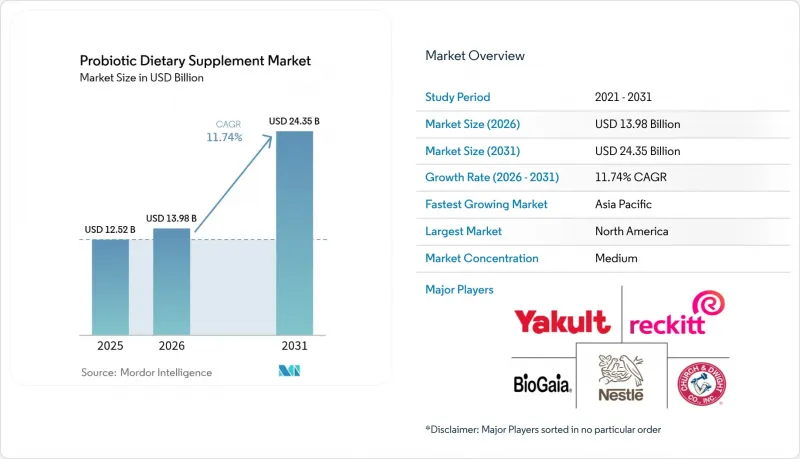
This report is Segmented by Product Type (Tablets, Capsules, Gummies and Chews, Liquids, Others), Consumer Group (Men, Women, Children), Distribution Channel (Supermarkets/Hypermarkets, Specialty Stores, and More), and Geography (North America, Europe, Asia-Pacific, South America, Middle East and Africa). Market Forecasts are Provided in Value (USD) and Volume(Tons).
Global Probiotic Dietary Supplement Market Trends and Insights
Growing prevalence of digestive disorders among ageing demographics
The aging global population is significantly influencing the demand for probiotics, particularly due to the prevalence of chronic digestive disorders among older adults. According to the World Bank, 10% of the global population in 2024 comprises individuals aged 65 and above, highlighting a substantial demographic shift. In the United States, Medicare Advantage plans introduced coverage for specific probiotic formulations in 2024 under chronic-care management codes. This development underscores the increasing institutional recognition of probiotics as cost-effective and viable alternatives to conventional treatments, such as proton-pump inhibitors and immunosuppressants, for managing chronic conditions. Moreover, the aging process is associated with a decline of up to 60% in natural Bifidobacterium levels, leading to a long-term reliance on external probiotic supplementation to maintain gut health. This structural dependency persists throughout the later stages of life, further driving demand for tailored probiotic solutions. In response, European manufacturers are innovating with targeted probiotic formulations, such as Bifidobacterium longum and Lactobacillus rhamnosus GG. These blends are specifically designed to address common age-related digestive issues, including constipation and low-grade inflammation, thereby catering to the unique needs of the aging population.
Heightened consumer awareness of gut-brain axis and immunity links
Initially regarded as a niche academic topic, the gut-brain axis has now evolved into a prominent aspect of the mainstream health narrative, with significant commercial implications. A 2024 meta-analysis published in Nature Microbiology revealed that supplementation with Lactobacillus helveticus and Bifidobacterium longum led to a reduction in cortisol levels and improved Hospital Anxiety and Depression Scale scores in adults experiencing subclinical anxiety. This growing body of evidence is prompting formulators to reposition probiotics as essential contributors to mental wellness, expanding their role beyond traditional digestive health benefits. Adding further momentum to this shift, the U.S. National Institutes of Health allocated a notable USD 87 million in 2025 to research focused on the gut-brain axis. This funding includes clinical trials investigating the potential of probiotic interventions in managing conditions such as Parkinson's disease and autism spectrum disorders, thereby providing regulatory validation to claims that were previously limited to functional-food marketing narratives.
Fragmented and inconsistent global regulatory definitions
Mid-sized manufacturers face heightened challenges when entering multiple markets due to regulatory divergence. In the U.S., the Food and Drug Administration (FDA) classifies probiotics as dietary supplements, as per the Dietary Supplement Health and Education Act. This classification mandates only New Dietary Ingredient notifications for novel strains. Moreover, the FDA allows structure-function claims without requiring pre-market proof of efficacy. Conversely, in Europe, the European Food Safety Authority (EFSA) has a more stringent approach. Their Qualified Presumption of Safety (QPS) list omits most Bacillus species. Furthermore, EFSA demands comprehensive strain-level safety dossiers for any health claims. This rigorous process can set manufacturers back by EUR 150,000-300,000 per strain and spans 18-36 months. Turning to Asia, China's 2024 revised food-safety standards for probiotics are restrictive. They only recognize 9 Lactobacillus and 3 Bifidobacterium species in conventional foods. This limitation necessitates reformulation for products already approved in other regions. Meanwhile, in India, the Food Safety and Standards Authority distinguishes between nutraceuticals and functional foods, necessitating separate approvals and thereby creating dual compliance pathways. Such regulatory fragmentation not only prolongs the time-to-market but also escalates legal expenses.
Other drivers and restraints analyzed in the detailed report include:
- Demand for clean-label, plant-based probiotic carriers
- Research and development in encapsulation and spore-forming strains improves survivability
- Stability and potency loss across long supply chains
For complete list of drivers and restraints, kindly check the Table Of Contents.
Segment Analysis
Gummies and chews are projected to experience significant growth, expanding at a strong 13.18% CAGR through 2031, surpassing the average growth rate of the probiotic dietary supplement market. Capsules, which accounted for a notable 42.98% of revenue in 2025, are now witnessing slower growth. This decline is primarily driven by a shift in consumer preferences, particularly among young adults, who favor convenient, water-free formats that resemble confectionery. A prime example of innovation in this space is the Olly-Chr. Hansen pectin gummy, which maintains an impressive 94% CFU viability at room temperature and is priced at twice the cost of a standard capsule. Tablets continue to thrive in hospital settings due to their ability to provide precise dosing, while liquid formats cater to pediatric and geriatric users. However, liquids face a significant drawback with their limited 60-day refrigerated shelf life. In the European market, claim approvals still predominantly favor capsules, creating additional challenges for novel formats, which must incur higher trial costs to achieve EFSA-approved benefit claims.
The scalability of gummies is expanding their presence across various retail channels. Convenience stores and supermarkets are increasingly stocking probiotic candies alongside traditional vitamins, contributing to larger basket sizes for consumers. Premium positioning for these products is supported by technological advancements such as microencapsulation, which enhances the survivability of probiotics and enables brands to advertise CFU counts at expiry rather than at the time of manufacture. Furthermore, spore-forming powders packaged in stick packs are gaining popularity among outdoor-lifestyle consumers who lack access to refrigeration, thereby unlocking new opportunities in emerging markets. These innovations collectively drive higher average selling prices, contributing to the growth of the probiotic dietary supplement market across both mass-market and premium segments.
Complete Report Scope:
- By Product Type
- Tablets
- Capsules
- Gummies and Chews
- Liquids
- Others
- By Consumer Group
- Men
- Women
- Children
- By Distribution Channel
- Supermarkets/Hypermarkets
- Specialty Stores
- Online Stores
- Other Distribution Channels
- By Geography
- North America
- United States
- Canada
- Mexico
- Rest of North America
- Europe
- United Kingdom
- Germany
- France
- Italy
- Spain
- Netherlands
- Poland
- Sweden
- Belgium
- Rest of Europe
- Asia-Pacific
- China
- Japan
- India
- Australia
- South Korea
- Indonesia
- Thailand
- Singapore
- Rest of Asia-Pacific
- South America
- Brazil
- Argentina
- Chile
- Colombia
- Peru
- Rest of South America
- Middle East and Africa
- Saudi Arabia
- United Arab Emirates
- Turkey
- South Africa
- Nigeria
- Egypt
- Morocco
- Rest of Middle East and Africa
- North America
Geography Analysis
In 2025, North America contributed 37.22% of the total revenue, amounting to a significant USD 3.95 billion. This growth was primarily driven by Medicare Advantage reimbursements and the adoption of hospital discharge starter packs, which facilitated increased usage. Additionally, Canada approved 18 new claims in 2025, focusing on cognition and metabolism, thereby broadening the range of applications for probiotics in the region. While 70% of U.S. adults are already familiar with the gut-health benefits of probiotics, the market continues to grow due to advancements in personalization and the development of pharma-grade live biotherapeutics, which cater to evolving consumer demands.
The Asia-Pacific region is projected to achieve a robust CAGR of 11.82%. China has taken significant steps to enhance its market by expanding the list of approved probiotic species and reducing the timeline for import approvals to just 12 months, streamlining the regulatory process. In India, the 2025 guidelines established a minimum threshold of 1 billion CFU, aligning with global standards and encouraging multinational companies to engage in local co-manufacturing initiatives. Japan remains a dominant player in the region, with an impressive daily sale of 40 million Yakult bottles, showcasing strong consumer demand. Meanwhile, South Korea is piloting innovative AI-driven subscription packs that are integrated with national health-screen data, offering a personalized approach to probiotic consumption.
Europe is navigating a complex landscape, balancing stringent EFSA regulations with a consumer base that demonstrates a high willingness to pay for premium products. This environment has allowed established players with legacy dossiers to maintain their market dominance. In Germany, pharmacies serve as a critical distribution channel, accounting for a significant share of sales at premium price points. France's focus on clean-label products has driven the popularity of tapioca capsules, reflecting a shift in consumer preferences. Post-Brexit, the UK is exploring the adoption of FDA-style regulatory pathways, which could accelerate the approval process for new entrants and foster innovation. In South America, Brazil is emerging as the fastest-growing market, supported by ANVISA's approval of weight-management claims, which has spurred market expansion. Although the Middle East and Africa currently lag behind other regions, the Gulf states and South Africa are showing potential for growth, driven by rising incomes and the implementation of preventive-care programs, signaling a promising outlook for the future.
- Church and Dwight Co., Inc.
- Reckitt Benckiser Group PLC
- Nestle S.A.
- Yakult Honsha Co., Ltd.
- BioGaia AB
- Amway Corporation
- Procter and Gamble Company
- Willmar Schwabe GmbH and Co. KG
- BIOHM Health
- Optibac Probiotics Inc.
- NOW Foods
- Herbalife Nutrition Ltd.
- Morishita Jintan Co., Ltd.
- PharmaCare Laboratories Pty Ltd
- Metagenics, Inc.
- Sabinsa Corporation
- Sanofi S.A.
- The Nue Co.
- Nature's Way
- GlaxoSmithKline Plc
Additional Benefits:
- The market estimate (ME) sheet in Excel format
- 3 months of analyst support
TABLE OF CONTENTS
1 INTRODUCTION
- 1.1 Study Assumptions and Market Definition
- 1.2 Scope of the Study
2 RESEARCH METHODOLOGY
3 EXECUTIVE SUMMARY
4 MARKET LANDSCAPE
- 4.1 Market Overview
- 4.2 Market Drivers
- 4.2.1 Growing prevalence of digestive disorders among ageing demographics
- 4.2.2 Heightened consumer awareness of gut-brain axis and immunity links
- 4.2.3 Demand for clean-label, plant-based probiotic carriers
- 4.2.4 Research and development in encapsulation and spore-forming strains improves survivability
- 4.2.5 Personalised microbiome testing driving customised probiotic packs
- 4.2.6 Increased Antibiotic Usage and Post-Antibiotic Recovery Awareness
- 4.3 Market Restraints
- 4.3.1 Fragmented and inconsistent global regulatory definitions
- 4.3.2 Stability and potency loss across long supply chains
- 4.3.3 Gene-transfer and antimicrobial resistance scrutiny in EU and ANZ
- 4.3.4 Freeze-drying capacity bottlenecks are inflating manufacturing costs
- 4.4 Regulatory Outlook
- 4.5 Technological Outlook
- 4.6 Porter's Five Forces Analysis
- 4.6.1 Threat of New Entrants
- 4.6.2 Bargaining Power of Buyers/Consumers
- 4.6.3 Bargaining Power of Suppliers
- 4.6.4 Threat of Substitute Products
- 4.6.5 Intensity of Competitive Rivalry
5 MARKET SIZE AND GROWTH FORECASTS (VALUE AND VOLUME)
- 5.1 By Product Type
- 5.1.1 Tablets
- 5.1.2 Capsules
- 5.1.3 Gummies and Chews
- 5.1.4 Liquids
- 5.1.5 Others
- 5.2 By Consumer Group
- 5.2.1 Men
- 5.2.2 Women
- 5.2.3 Children
- 5.3 By Distribution Channel
- 5.3.1 Supermarkets/Hypermarkets
- 5.3.2 Specialty Stores
- 5.3.3 Online Stores
- 5.3.4 Other Distribution Channels
- 5.4 By Geography
- 5.4.1 North America
- 5.4.1.1 United States
- 5.4.1.2 Canada
- 5.4.1.3 Mexico
- 5.4.1.4 Rest of North America
- 5.4.2 Europe
- 5.4.2.1 United Kingdom
- 5.4.2.2 Germany
- 5.4.2.3 France
- 5.4.2.4 Italy
- 5.4.2.5 Spain
- 5.4.2.6 Netherlands
- 5.4.2.7 Poland
- 5.4.2.8 Sweden
- 5.4.2.9 Belgium
- 5.4.2.10 Rest of Europe
- 5.4.3 Asia-Pacific
- 5.4.3.1 China
- 5.4.3.2 Japan
- 5.4.3.3 India
- 5.4.3.4 Australia
- 5.4.3.5 South Korea
- 5.4.3.6 Indonesia
- 5.4.3.7 Thailand
- 5.4.3.8 Singapore
- 5.4.3.9 Rest of Asia-Pacific
- 5.4.4 South America
- 5.4.4.1 Brazil
- 5.4.4.2 Argentina
- 5.4.4.3 Chile
- 5.4.4.4 Colombia
- 5.4.4.5 Peru
- 5.4.4.6 Rest of South America
- 5.4.5 Middle East and Africa
- 5.4.5.1 Saudi Arabia
- 5.4.5.2 United Arab Emirates
- 5.4.5.3 Turkey
- 5.4.5.4 South Africa
- 5.4.5.5 Nigeria
- 5.4.5.6 Egypt
- 5.4.5.7 Morocco
- 5.4.5.8 Rest of Middle East and Africa
- 5.4.1 North America
6 COMPETITIVE LANDSCAPE
- 6.1 Market Concentration
- 6.2 Strategic Moves
- 6.3 Market Share Analysis
- 6.4 Company Profiles (includes Global level Overview, Market level overview, Core Segments, Financials as available, Strategic Information, Market Rank/Share for key companies, Products and Services, and Recent Developments)
- 6.4.1 Church and Dwight Co., Inc.
- 6.4.2 Reckitt Benckiser Group PLC
- 6.4.3 Nestle S.A.
- 6.4.4 Yakult Honsha Co., Ltd.
- 6.4.5 BioGaia AB
- 6.4.6 Amway Corporation
- 6.4.7 Procter and Gamble Company
- 6.4.8 Willmar Schwabe GmbH and Co. KG
- 6.4.9 BIOHM Health
- 6.4.10 Optibac Probiotics Inc.
- 6.4.11 NOW Foods
- 6.4.12 Herbalife Nutrition Ltd.
- 6.4.13 Morishita Jintan Co., Ltd.
- 6.4.14 PharmaCare Laboratories Pty Ltd
- 6.4.15 Metagenics, Inc.
- 6.4.16 Sabinsa Corporation
- 6.4.17 Sanofi S.A.
- 6.4.18 The Nue Co.
- 6.4.19 Nature's Way
- 6.4.20 GlaxoSmithKline Plc
7 MARKET OPPORTUNITIES AND FUTURE OUTLOOK

