PUBLISHER: Mordor Intelligence | PRODUCT CODE: 2113902

PUBLISHER: Mordor Intelligence | PRODUCT CODE: 2113902
Europe Polycarbonate Sheets - Market Share Analysis, Industry Trends & Statistics, Growth Forecasts (2026 - 2031)
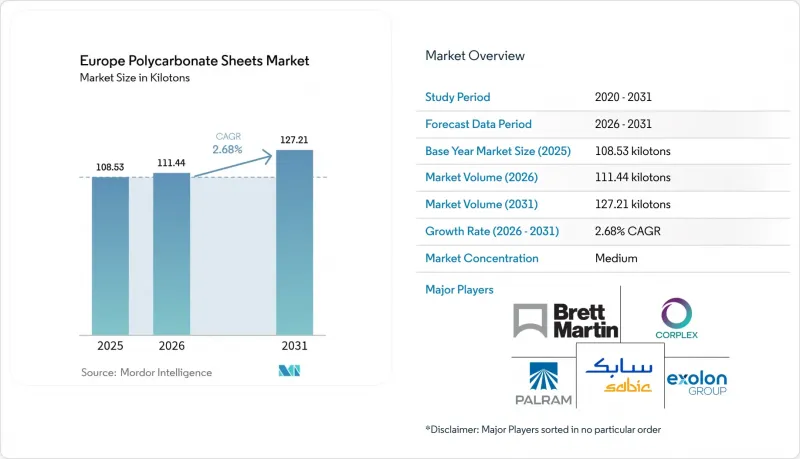
According to Mordor Intelligence, Europe polycarbonate sheets market size in 2026 is estimated at 111.44 kilotons, growing from 2025 value of 108.53 kilotons with 2031 projections showing 127.21 kilotons, growing at 2.68% CAGR over 2026-2031.
This report is Segmented by Type (Solid, Corrugated, and Multi-Walled), End-User Industry (Aerospace, Agriculture, Automotive, Construction, Electrical & Electronics, and Others), and Geography (Germany, France, Italy, Spain, Benelux, Nordics, Turkey, The United Kingdom, and Rest of Europe). Market Forecasts are Provided in Terms of Volume (Tons).
Europe Polycarbonate Sheets Market Trends and Insights
Post-Pandemic Rebound of Commercial Re-Roofing Demand
EU non-residential construction investment in 2024 reached EUR 1,422 billion, edging up 0.1%, with civil-engineering work rising 5.8%, reopening a backlog of skylight and roof-light retrofits in logistics hubs, transport terminals, and retail centers. Southern Europe leads: Spain's non-residential activity expanded 5.5% and Portugal maintained growth as deferred projects from 2020-2022 moved forward. Corrugated polycarbonate sheets provide installers with a drop-in replacement for aging asbestos or metal roofing, reducing weight by up to 60% and enabling daylighting that lowers warehouse electricity bills. Growth could accelerate if EU Recovery and Resilience Facility funding, which underpinned Italy's 21% civil-engineering jump in 2024, is extended beyond 2026. However, France (-1.4%) and Germany (-1.9%) saw declines, underscoring the importance of regional mix for sheet producers.
Mandatory European Union Energy-Efficiency Codes Boosting Daylight-Roof Usage (EN 17037, EPBD)
The EPBD (EU) 2024/1275 now requires life-cycle global-warming-potential disclosure and tighter energy-performance thresholds for roof glazing. EN 17037 daylighting standards require designers to demonstrate adequate natural-light distribution, driving demand for low-Ug multiwall panels that diffuse light while meeting structural loads. EXOLON Group's Hybrid-X multiwall sheet achieves a thermal conductivity of 0.85 W/m2K at a 50 mm thickness, while maintaining >=45% light transmission. This product offers a 20-year weathering warranty that aligns with German and Dutch building insurance requirements. The directive's renovation-passport mechanism will compel upgrades of legacy single-skin polycarbonate installed in the 1990s and 2000s, triggering a cyclical replacement wave by 2030.
Bisphenol-A Price Volatility and Feedstock Supply Shocks
European BPA spot prices swung 20% intra-year, reaching USD 1,320/t in March 2025, as Chinese oversupply met sluggish resin demand, compressing extruder margins locked into fixed-price construction contracts. German, Polish, and Czech sheet producers import BPA and diphenyl carbonate, making them vulnerable to freight cost spikes through Rotterdam or Hamburg. Sinopec and Wanhua's capacity additions of 500 kt/y through 2026 may further depress prices; yet, any outage could lift BPA costs by 30-40% within weeks, as European converters carry lean inventories.
Other drivers and restraints analyzed in the detailed report include:
- Automotive Lightweighting and Panoramic Glazing Adoption
- Government Incentives for High-Tech Greenhouse Horticulture
- Competition from Lower-Cost PMMA and Glass in Low-Spec Roofs
For complete list of drivers and restraints, kindly check the Table Of Contents.
Segment Analysis
Multiwall sheets contribute 59.18% of the polycarbonate sheets market share in 2025, buoyed by Ug <= 1.1 W/m2K performance that satisfies EPBD thresholds. The EXOLON Hybrid-X range, certified to EN 16153 and warrantied for 20 years, exemplifies five- and seven-wall configurations that balance insulation and achieve >=45% light transmission. Corrugated sheets are forecast to lead growth at 3.12% CAGR through 2031 as civil-engineering capex rises, with transport shelters and noise barriers favoring higher stiffness-to-weight ratios. Solid sheets remain a niche market-machine guards, EN 45545-2 rail interiors, and UL94 V-0 electrical enclosures-where optical clarity and flame resistance justify premiums.
Corrugated formats increasingly replace polyethylene films in Mediterranean horticulture, extending greenhouse cover life to 10-15 years. Brett Martin's new cap-and-base connector profile for 6-10 mm multiwall sheets addresses historical leak concerns that have limited adoption in high-exposure roofing, offering a 10-year water-tightness guarantee. The solid sheet trajectory hinges on broader EV adoption of polycarbonate glazing; delays in mass-market model rollouts to 2026-2028 constrain near-term volume, although rising demand for fire-retardant sheets in Europe's rail modernization pipeline offers a substitute growth avenue.
Complete Report Scope:
- By Type
- Solid
- Corrugated
- Multi-walled
- By End-user Industry
- Aerospace
- Agriculture
- Automotive
- Construction
- Electrical & Electronics
- Others (including Signage, Security and Police Gear, and Solar Panels)
- By Geography
- Germany
- France
- Italy
- Spain
- Benelux Countries
- Nordic Countries
- Turkey
- United Kingdom
- Rest of Europe
List of Companies Covered in this Report:
- 3A Composites GmbH
- AKRAPLAST Sistemi Srl
- Arla Plast
- Brett Martin
- Carboplak
- Corplex
- Danpal
- dott.gallina Srl
- EXOLON GROUP
- GI PLAST
- Isik Plastik
- NUDEC, S. A.
- Onduline
- Palram Industries Ltd.
- PLAZIT-POLYGAL
- Rodeca
- SABIC
- SafPlast Innovative
- Sintostamp SpA
- Sumer Plastik
- WZD Sp. z o.o.
Additional Benefits:
- The market estimate (ME) sheet in Excel format
- 3 months of analyst support
TABLE OF CONTENTS
1 Introduction
- 1.1 Study Assumptions & Market Definition
- 1.2 Scope of the Study
2 Research Methodology
3 Executive Summary
4 Market Landscape
- 4.1 Market Overview
- 4.2 Market Drivers
- 4.2.1 Post-pandemic rebound of commercial re-roofing demand
- 4.2.2 Mandatory European Union energy-efficiency codes boosting daylight-roof usage (EN 17037, EPBD)
- 4.2.3 Automotive lightweighting & panoramic glazing adoption
- 4.2.4 Government incentives for high-tech greenhouse horticulture
- 4.2.5 OEM shift to chemically-recycled PC sheets
- 4.3 Market Restraints
- 4.3.1 Bisphenol-A price volatility and feedstock supply shocks
- 4.3.2 Competition from lower-cost PMMA and glass in low-spec roofs
- 4.3.3 Limited recycling streams for multilayer sheets
- 4.4 Value Chain Analysis
- 4.5 Porter's Five Forces
- 4.5.1 Bargaining Power of Suppliers
- 4.5.2 Bargaining Power of Buyers
- 4.5.3 Threat of New Entrants
- 4.5.4 Threat of Substitutes
- 4.5.5 Degree of Competition
5 Market Size & Growth Forecasts (Volume)
- 5.1 By Type
- 5.1.1 Solid
- 5.1.2 Corrugated
- 5.1.3 Multi-walled
- 5.2 By End-user Industry
- 5.2.1 Aerospace
- 5.2.2 Agriculture
- 5.2.3 Automotive
- 5.2.4 Construction
- 5.2.5 Electrical & Electronics
- 5.2.6 Others (including Signage, Security and Police Gear, and Solar Panels)
- 5.3 By Geography
- 5.3.1 Germany
- 5.3.2 France
- 5.3.3 Italy
- 5.3.4 Spain
- 5.3.5 Benelux Countries
- 5.3.6 Nordic Countries
- 5.3.7 Turkey
- 5.3.8 United Kingdom
- 5.3.9 Rest of Europe
6 Competitive Landscape
- 6.1 Market Concentration
- 6.2 Strategic Moves
- 6.3 Market Share (%)/Ranking Analysis
- 6.4 Company Profiles (includes Global level Overview, Market level overview, Core Segments, Financials as available, Strategic Information, Market Rank/Share, Products & Services, Recent Developments)
- 6.4.1 3A Composites GmbH
- 6.4.2 AKRAPLAST Sistemi Srl
- 6.4.3 Arla Plast
- 6.4.4 Brett Martin
- 6.4.5 Carboplak
- 6.4.6 Corplex
- 6.4.7 Danpal
- 6.4.8 dott.gallina Srl
- 6.4.9 EXOLON GROUP
- 6.4.10 GI PLAST
- 6.4.11 Isik Plastik
- 6.4.12 NUDEC, S. A.
- 6.4.13 Onduline
- 6.4.14 Palram Industries Ltd.
- 6.4.15 PLAZIT-POLYGAL
- 6.4.16 Rodeca
- 6.4.17 SABIC
- 6.4.18 SafPlast Innovative
- 6.4.19 Sintostamp SpA
- 6.4.20 Sumer Plastik
- 6.4.21 WZD Sp. z o.o.
7 Market Opportunities & Future Outlook
- 7.1 White-space & Unmet-Need Assessment

