PUBLISHER: Mordor Intelligence | PRODUCT CODE: 2113917

PUBLISHER: Mordor Intelligence | PRODUCT CODE: 2113917
Walking Assist Devices - Market Share Analysis, Industry Trends & Statistics, Growth Forecasts (2026 - 2031)
According to Mordor Intelligence, the walking assist devices market size is expected to grow from USD 7.94 billion in 2025 to USD 8.41 billion in 2026 and is forecast to reach USD 11.23 billion by 2031 at 5.97% CAGR over 2026-2031.
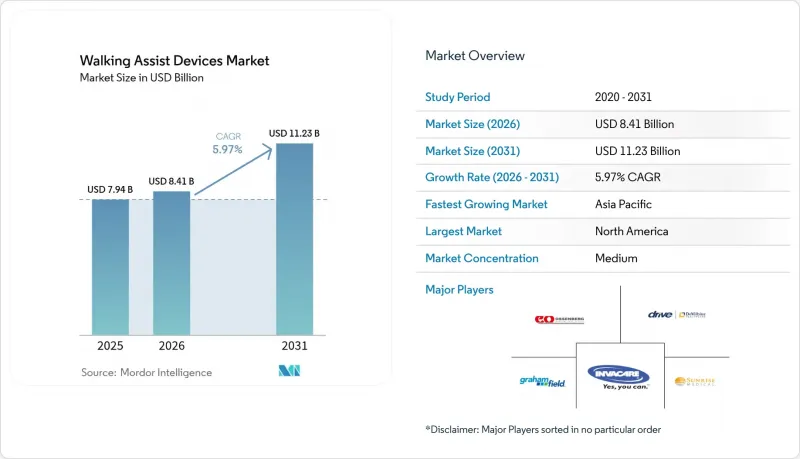
This report is Segmented by Product Type (Canes, Crutches, Walkers/Rollators, Wheelchairs, and More), by Technology (Manual Assist Devices, Powered Mobility Devices, and More), by End User (Hospitals and Clinics, Rehabilitation Centers, and More), by Distribution Channel (Pharmacy and Retail Stores, E-Commerce Platforms, Medical Supply Dealers), by Geography (North America, Europe, Asia-Pacific, and More).
Global Walking Assist Devices Market Trends and Insights
Accelerating prevalence of osteoarthritis & rheumatoid arthritis
The osteoarthritis burden is rising in tandem with obesity and sedentary lifestyles. In the United States, 32.5 million people live with osteoarthritis and direct medical costs reach USD 65 billion annually. Global prevalence now exceeds 606 million cases, and incidence climbs sharply after age 55, making assistive devices a routine component of long-term care. Rheumatoid arthritis follows a similar pattern, with 2024 data confirming smoking as a causal risk factor and showing higher rates among women in high socio-demographic regions. These trends sustain demand for wheelchairs, walkers and joint-offloading solutions.
Rising demand for post-operative rehabilitation equipment
Elective joint-replacement volumes rebounded in 2024, and hybrid telerehabilitation programmes now support outpatient recovery pathways. Continuous-passive-motion devices, sensorised walkers and lightweight wheelchairs allow earlier discharge and reduce readmission risk. Neuromuscular electrical stimulation is increasingly embedded in walkers to counter ICU-acquired weakness.
High acquisition & maintenance costs of powered devices
Entry-level powered wheelchairs such as the WHILL Model Ci retail for USD 4,999, out of reach for many patients. Lithium-ion battery packs require replacement every five to seven years, adding up to 40% of initial cost. Recent recalls, including 781 SmartDrive units linked to unintended motor activation, underline the need for rigorous quality control. Such incidents amplify cost concerns by elevating insurance premiums and service fees.
Other drivers and restraints analyzed in the detailed report include:
- Rapidly expanding geriatric population base
- Commercialization of AI-enabled smart canes & sensor walkers
- Limited reimbursement coverage in developing nations
For complete list of drivers and restraints, kindly check the Table Of Contents.
Segment Analysis
Wheelchairs held 47.12% of global revenue in 2025, confirming their central role in both acute and long-term settings. Manual models dominate today, but powered and smart variants are entering mainstream procurement as battery prices fall. Gait belts, lift vests and related transfer aids are projected to outpace other categories at 7.03% CAGR. Their rise reflects stricter worker-safety rules and the push to minimize caregiver injuries.
Regulatory clarity sustains baseline wheelchair demand, given their Class I or Class II designation under FDA and CE rules. Innovations such as the detachable two-way propulsion system improve ergonomics and widen use cases, keeping the walking assist devices market dynamic. Meanwhile, fall-prevention devices for Parkinson's and post-stroke patients are blurring traditional boundaries, hinting at convergence with wearable technologies.
The walking assist devices market size for manual devices remains the largest, yet smart sensor platforms are registering the fastest gains. Manual chairs, crutches and walkers are affordable, need no charging and carry minimal cyber-risk, explaining their 56.20% share in 2025. Smart devices, posting 7.74% CAGR, embed lidar, pressure sensors and real-time analytics to warn of obstacles or monitor vital signs. Powered chairs occupy a middle ground, benefiting from battery innovations and clearer test standards.
The Internet of Medical Things enables continuous monitoring through cloud dashboards, allowing clinicians to adjust therapy remotely. Still, cyber-security adds cost and complexity; FDA now requires software bills of materials and post-market patching plans for connected aids. In practice, users choose along a spectrum of price, maintenance capacity and information-sharing comfort.
Complete Report Scope:
- By Product Type
- Canes
- Crutches
- Walkers/Rollators
- Wheelchairs
- Gait Belts & Lift Vests
- Power Scooters
- Others
- By Technology
- Manual Assist Devices
- Powered Mobility Devices
- Smart Sensor-Enabled Devices
- By End User
- Hospitals and Clinics
- Rehabilitation Centers
- Home-care Settings
- Elderly-care Facilities
- By Distribution Channel
- Pharmacy and Retail Stores
- E-commerce Platforms
- Medical Supply Dealers
- By Geography
- North America
- United States
- Canada
- Mexico
- Europe
- Germany
- United Kingdom
- France
- Italy
- Spain
- Rest of Europe
- Asia-Pacific
- China
- Japan
- India
- Australia
- South Korea
- Rest of Asia-Pacific
- Middle East and Africa
- GCC
- South Africa
- Rest of Middle East and Africa
- South America
- Brazil
- Argentina
- Rest of South America
- North America
Geography Analysis
North America accounted for 40.21% of global revenue in 2025, anchored by robust insurance coverage and established clinical pathways. The region benefits from new FDA Quality System amendments effective in 2026, which simplify post-market surveillance and align supplier audits. Yet high list prices for powered chairs and complex coding for reimbursement can delay adoption. The recent USD 13.5 million settlement involving improper Medicare claims underscores ongoing billing scrutiny. Canada's assistive-device programmes and Mexico's growing private insurance sector add depth to regional demand.
Asia-Pacific is projected to deliver an 8.19% CAGR to 2031, the fastest worldwide. Demographic momentum, with the 80+ cohort quadrupling between 2016 and 2050, intersects with urban-density challenges that favour compact, lightweight aids. Japan's long-term-care insurance reimburses high-end wheelchairs, while China's domestic manufacturers scale up powered scooter lines for export. Approximately 40% of seniors lack pension coverage, making affordability essential; as a result, rental programmes and refurbished equipment exchanges are proliferating.
Europe maintains steady growth backed by universal healthcare and harmonised CE marking requirements. Germany and France drive volume through statutory insurance, whereas the United Kingdom adjusts post-Brexit conformity protocols. Sunrise Medical, headquartered in Germany, leverages in-region manufacturing and recent acquisitions such as Ride Designs to broaden its seating portfolio. The Medical Device Regulation (EU) 2017/745 imposes more stringent clinical evidence and post-market vigilance, benefiting suppliers with strong QA systems.
- Invacare
- Sunrise Medical
- Permobil AB
- GF Health Products, Inc.
- Pride Mobility Products Corporation
- Honda Motor Co. (Walking Assist)
- Ottobock
- Ekso Bionics
- ReWalk Robotics
- Drive DeVilbiss Healthcare (Medical Depot, Inc. )
- Medline Industries
- Karma Medical
- Yuwell Group
- Topro Industrie AS
- LifeWalker Mobility (UPWalker)
- Besco Medical
- Human Care Group
- Ossenberg
- Benmor Medical
Additional Benefits:
- The market estimate (ME) sheet in Excel format
- 3 months of analyst support
TABLE OF CONTENTS
1 Introduction
- 1.1 Study Assumptions & Market Definition
- 1.2 Scope of the Study
2 Research Methodology
3 Executive Summary
4 Market Landscape
- 4.1 Market Overview
- 4.2 Market Drivers
- 4.2.1 Accelerating prevalence of osteoarthritis & rheumatoid arthritis
- 4.2.2 Rising demand for post-operative rehabilitation equipment
- 4.2.3 Rapidly expanding geriatric population base
- 4.2.4 Increasing fall-related injuries prompting preventive walking aids
- 4.2.5 Commercialisation of AI-enabled smart canes & sensor walkers
- 4.2.6 Growth in long-COVID-linked mobility impairments
- 4.3 Market Restraints
- 4.3.1 High acquisition & maintenance costs of powered devices
- 4.3.2 Limited reimbursement coverage in developing nations
- 4.3.3 Product recalls due to safety / stability issues
- 4.3.4 Cyber-security & data-privacy risks in connected mobility aids
- 4.4 Value / Supply-Chain Analysis
- 4.5 Technological Outlook
- 4.6 Regulatory Landscape
- 4.7 Porter's Five Forces Analysis
- 4.7.1 Threat of New Entrants
- 4.7.2 Bargaining Power of Buyers
- 4.7.3 Bargaining Power of Suppliers
- 4.7.4 Threat of Substitutes
- 4.7.5 Intensity of Competitive Rivalry
5 Market Size & Growth Forecasts (Value)
- 5.1 By Product Type
- 5.1.1 Canes
- 5.1.2 Crutches
- 5.1.3 Walkers/Rollators
- 5.1.4 Wheelchairs
- 5.1.5 Gait Belts & Lift Vests
- 5.1.6 Power Scooters
- 5.1.7 Others
- 5.2 By Technology
- 5.2.1 Manual Assist Devices
- 5.2.2 Powered Mobility Devices
- 5.2.3 Smart Sensor-Enabled Devices
- 5.3 By End User
- 5.3.1 Hospitals and Clinics
- 5.3.2 Rehabilitation Centers
- 5.3.3 Home-care Settings
- 5.3.4 Elderly-care Facilities
- 5.4 By Distribution Channel
- 5.4.1 Pharmacy and Retail Stores
- 5.4.2 E-commerce Platforms
- 5.4.3 Medical Supply Dealers
- 5.5 By Geography
- 5.5.1 North America
- 5.5.1.1 United States
- 5.5.1.2 Canada
- 5.5.1.3 Mexico
- 5.5.2 Europe
- 5.5.2.1 Germany
- 5.5.2.2 United Kingdom
- 5.5.2.3 France
- 5.5.2.4 Italy
- 5.5.2.5 Spain
- 5.5.2.6 Rest of Europe
- 5.5.3 Asia-Pacific
- 5.5.3.1 China
- 5.5.3.2 Japan
- 5.5.3.3 India
- 5.5.3.4 Australia
- 5.5.3.5 South Korea
- 5.5.3.6 Rest of Asia-Pacific
- 5.5.4 Middle East and Africa
- 5.5.4.1 GCC
- 5.5.4.2 South Africa
- 5.5.4.3 Rest of Middle East and Africa
- 5.5.5 South America
- 5.5.5.1 Brazil
- 5.5.5.2 Argentina
- 5.5.5.3 Rest of South America
- 5.5.1 North America
6 Competitive Landscape
- 6.1 Market Concentration
- 6.2 Market Share Analysis
- 6.3 Company Profiles (includes Global level Overview, Market level overview, Core Segments, Financials as available, Strategic Information, Market Rank/Share for key companies, Products & Services, and Recent Developments)
- 6.3.1 Invacare Corporation
- 6.3.2 Sunrise Medical
- 6.3.3 Permobil AB
- 6.3.4 GF Health Products, Inc.
- 6.3.5 Pride Mobility Products Corporation
- 6.3.6 Honda Motor Co. (Walking Assist)
- 6.3.7 Ottobock SE & Co. KGaA
- 6.3.8 Ekso Bionics
- 6.3.9 ReWalk Robotics
- 6.3.10 Drive DeVilbiss Healthcare (Medical Depot, Inc. )
- 6.3.11 Medline Industries
- 6.3.12 Karma Medical
- 6.3.13 Yuwell Group
- 6.3.14 Topro Industrie AS
- 6.3.15 LifeWalker Mobility (UPWalker)
- 6.3.16 Besco Medical
- 6.3.17 Human Care Group
- 6.3.18 Ossenberg GmbH
- 6.3.19 Benmor Medical
7 Market Opportunities & Future Outlook
- 7.1 White-space & Unmet-need Assessment

