PUBLISHER: Mordor Intelligence | PRODUCT CODE: 2113928

PUBLISHER: Mordor Intelligence | PRODUCT CODE: 2113928
Europe Colorectal Cancer Screening - Market Share Analysis, Industry Trends & Statistics, Growth Forecasts (2026 - 2031)
According to Mordor Intelligence, the Europe colorectal cancer screening market size is estimated at USD 5.45 billion in 2026, and is expected to reach USD 6.91 billion by 2031, at a CAGR of 4.85% during the forecast period (2026-2031).
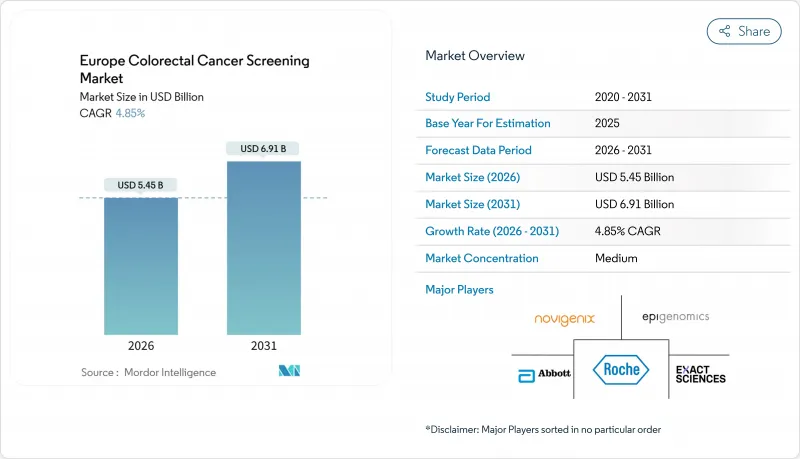
This report is Segmented by Screening Test Type (Stool-Based Tests [Fecal Immunochemical Test (FIT), and More], Imaging-Based Tests, and Blood-Based & Other Emerging Tests), End-User (Hospitals & University Medical Centres, Independent Diagnostic Laboratories, and More), and Geography (Germany, United Kingdom, France, and More). The Market Forecasts are Provided in Terms of Value (USD).
Europe Colorectal Cancer Screening Market Trends and Insights
Accelerating Shift From gFOBT to Quantitative FIT in Organized EU Programmes
Quantitative FIT has become the reference test in organized screening because it eliminates dietary restrictions, achieves pooled 87% sensitivity for colorectal cancer, and fits high-throughput laboratory workflows. National guidelines lowered hemoglobin thresholds to 10 µg/g in symptomatic triage, boosting negative predictive value above 99.6% and safely deferring colonoscopy for low-risk patients. Direct-mail FIT distribution in France and Ireland raised participation, yet overall uptake remains below the EU 90% target, indicating further headroom for reminder systems and digital invitations. Lower thresholds exponentially raise positivity, stressing colonoscopy capacity, so programs must balance sensitivity with workforce constraints. Analyzer suppliers benefit from reagent pull-through, but they must support data connectivity for real-time quality monitoring mandated by EU Beating Cancer Plan grants.
Rapid Adoption of AI-Assisted Endoscopy Improving Adenoma-Detection Rates
Computer-aided detection embedded in colonoscopes lifts quality metrics that tie directly to interval cancer prevention. Olympus OLYSENSE gained CE mark in 2024 and demonstrated a 7.4-percentage-point adenoma-detection increase, including a 2.3-fold rise in sessile-serrated lesion capture, the subtype responsible for up to 30% of missed cancers. Danish and Swedish trials of Medtronic's GI Genius showed consistent gains, reinforcing payer willingness to reimburse CADe-enabled systems. Early adoption concentrates in university centers with capital budgets and research incentives, while community units face return-on-investment questions. FUJIFILM's ELUXEO 8000 launch paired advanced chromoendoscopy with an AI-driven pathology venture, signaling convergence of imaging, analytics, and digital pathology. Over the forecast horizon, reimbursement frameworks linking payment to adenoma-detection benchmarks are expected to accelerate penetration.
Uneven Reimbursement for Advanced Non-Invasive Tests Across Member States
Coverage decisions vary widely across the EU, with cost-constrained systems favoring USD 30 FIT over USD 600 stool-DNA or blood assays. CMS's 2024 denial of Epi proColon is influencing European assessments given similar sensitivity shortfalls. Germany reimburses FIT and colonoscopy but would require new cost-effectiveness dossiers for multitarget DNA tests. France distributes FIT free of charge, further squeezing the value proposition of higher-priced alternatives. Manufacturers must therefore conduct real-world studies that link higher upfront test costs to stage-shift savings.
Other drivers and restraints analyzed in the detailed report include:
- Uptake of Blood-Based Multi-Cancer Early-Detection Assays in High-Risk Cohorts
- EU Beating Cancer Plan Funding for Population Screening Expansion
- Shortage of Endoscopy Workforce Limiting Capacity Growth
For complete list of drivers and restraints, kindly check the Table Of Contents.
Segment Analysis
Imaging-based procedures retained 52.55% of Europe colorectal cancer screening market share in 2025, anchored by colonoscopy's diagnostic-therapeutic dual role. The Europe colorectal cancer screening market size for imaging modalities is poised to expand steadily as CADe features become mainstream and CT colonography fills capacity gaps. Olympus OLYSENSE's EAGLE trial data underscore the competitive advantage of AI, while FUJIFILM's ELUXEO 8000 links advanced chromoendoscopy with digital pathology to streamline workflows. Yet staffing shortages cap throughput, nudging policymakers to reinforce FIT as the gatekeeper test.
Stool-based platforms enjoy high throughput and low cost, with quantitative FIT replacing guaiac tests across organized programs. Multitarget DNA assays promise superior cancer sensitivity but their premium prices challenge reimbursement. Blood-based tests are forecast to post a 10.25% CAGR, the highest among modalities, yet their Europe colorectal cancer screening market share will remain modest until adenoma sensitivity improves. Digital pathology, protein-augmented FIT, and AI-enhanced CT colonography represent medium-term disruptors converging toward integrated diagnostic pathways.
Complete Report Scope:
- By Screening Test Type
- Stool-Based Tests
- Fecal Immunochemical Test (FIT)
- Guaiac-based FOBT
- Multitarget Stool-DNA
- Imaging-Based Tests
- Colonoscopy
- CT Colonography (Virtual)
- Flexible Sigmoidoscopy
- Blood-Based & Other Emerging Tests
- Methylated DNA / ctDNA Assays
- Breath & Volatile Organic-compound Tests
- Stool-Based Tests
- By End User
- Hospitals & University Medical Centres
- Independent Diagnostic Laboratories
- Cancer Research Institutes
- Home-Based / Direct-to-Consumer Channels
- By Country
- Germany
- United Kingdom
- France
- Italy
- Spain
- Rest of Europe
List of Companies Covered in this Report:
- Abbott Laboratories
- Beckman Coulter (Danaher)
- Eiken Chemical Co. Ltd.
- Epigenomics
- Exact Sciences
- Roche
- FUJIFILM
- Guardant Health
- Hemosure
- Hologic
- Medtronic
- Novigenix
- Olympus
- Polymedco Inc.
- QIAGEN
- Quest Diagnostics
- QuidelOrtho
- Siemens Healthineers
- Stryker
- Sysmex
Additional Benefits:
- The market estimate (ME) sheet in Excel format
- 3 months of analyst support
TABLE OF CONTENTS
1 Introduction
- 1.1 Study Assumptions & Market Definition
- 1.2 Scope of the Study
2 Research Methodology
3 Executive Summary
4 Market Landscape
- 4.1 Market Overview
- 4.2 Market Drivers
- 4.2.1 Accelerating shift from gFOBT to quantitative FIT in organised EU programmes
- 4.2.2 Rapid adoption of AI-assisted endoscopy improving adenoma-detection rates
- 4.2.3 Uptake of blood-based multi-cancer early-detection (MCED) assays in high-risk cohorts
- 4.2.4 EU Beating Cancer Plan funding for population screening expansion
- 4.2.5 Age-standardised incidence plateauing in Western EU-demand pivot to surveillance colonoscopy
- 4.3 Market Restraints
- 4.3.1 Uneven reimbursement for advanced non-invasive tests across member states
- 4.3.2 Shortage of endoscopy workforce limiting capacity growth
- 4.3.3 Price premium of stool-DNA / ctDNA tests dampening uptake in public programmes
- 4.4 Supply-Chain Analysis
- 4.5 Regulatory Landscape
- 4.6 Technological Outlook
- 4.7 Porter's Five Forces
- 4.7.1 Threat of New Entrants
- 4.7.2 Bargaining Power of Buyers/Consumers
- 4.7.3 Bargaining Power of Suppliers
- 4.7.4 Threat of Substitute Products
- 4.7.5 Intensity of Competitive Rivalry
5 Market Size & Growth Forecasts (Value, USD)
- 5.1 By Screening Test Type
- 5.1.1 Stool-Based Tests
- 5.1.1.1 Fecal Immunochemical Test (FIT)
- 5.1.1.2 Guaiac-based FOBT
- 5.1.1.3 Multitarget Stool-DNA
- 5.1.2 Imaging-Based Tests
- 5.1.2.1 Colonoscopy
- 5.1.2.2 CT Colonography (Virtual)
- 5.1.2.3 Flexible Sigmoidoscopy
- 5.1.3 Blood-Based & Other Emerging Tests
- 5.1.3.1 Methylated DNA / ctDNA Assays
- 5.1.3.2 Breath & Volatile Organic-compound Tests
- 5.1.1 Stool-Based Tests
- 5.2 By End User
- 5.2.1 Hospitals & University Medical Centres
- 5.2.2 Independent Diagnostic Laboratories
- 5.2.3 Cancer Research Institutes
- 5.2.4 Home-Based / Direct-to-Consumer Channels
- 5.3 By Country
- 5.3.1 Germany
- 5.3.2 United Kingdom
- 5.3.3 France
- 5.3.4 Italy
- 5.3.5 Spain
- 5.3.6 Rest of Europe
6 Competitive Landscape
- 6.1 Market Concentration
- 6.2 Market Share Analysis
- 6.3 Company Profiles (includes Global level Overview, Market level overview, Core Segments, Financials as available, Strategic Information, Market Rank/Share for key companies, Products & Services, and Recent Developments)
- 6.3.1 Abbott Laboratories
- 6.3.2 Beckman Coulter (Danaher)
- 6.3.3 Eiken Chemical Co. Ltd.
- 6.3.4 Epigenomics AG
- 6.3.5 Exact Sciences Corporation
- 6.3.6 F. Hoffmann-La Roche AG
- 6.3.7 FUJIFILM Holdings Corporation
- 6.3.8 Guardant Health Inc.
- 6.3.9 Hemosure Inc.
- 6.3.10 Hologic Inc.
- 6.3.11 Medtronic plc
- 6.3.12 Novigenix SA
- 6.3.13 Olympus Corporation
- 6.3.14 Polymedco Inc.
- 6.3.15 Qiagen N.V.
- 6.3.16 Quest Diagnostics Inc.
- 6.3.17 QuidelOrtho Corporation
- 6.3.18 Siemens Healthineers AG
- 6.3.19 Stryker Corporation
- 6.3.20 Sysmex Corporation
7 Market Opportunities & Future Outlook
- 7.1 White-Space & Unmet-Need Assessment

