PUBLISHER: Mordor Intelligence | PRODUCT CODE: 2113929

PUBLISHER: Mordor Intelligence | PRODUCT CODE: 2113929
Europe Arthroscopy Devices - Market Share Analysis, Industry Trends & Statistics, Growth Forecasts (2026 - 2031)
According to Mordor Intelligence, the Europe arthroscopy devices market size is expected to grow from USD 391.86 million in 2025 to USD 401.46 million in 2026 and is forecast to reach USD 453.12 million by 2031 at 2.45% CAGR over 2026-2031.
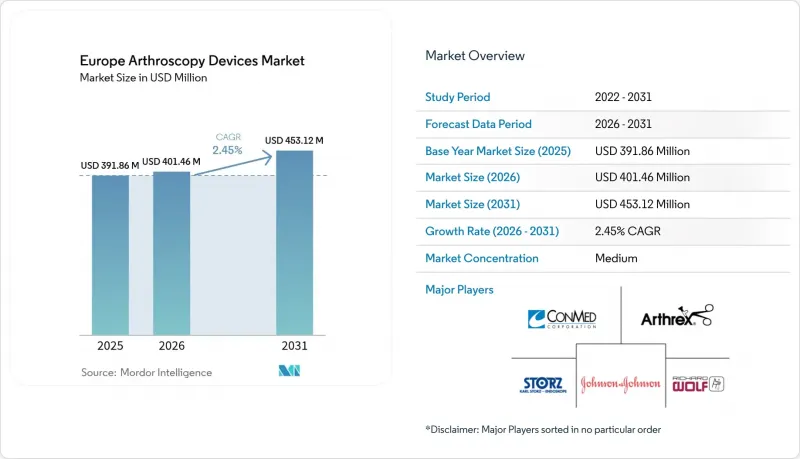
This report is Segmented by Application (Knee Arthroscopy, Hip Arthroscopy, and More), Product (Arthroscopes, Arthroscopic Implants, and More), End User (Hospitals, Ambulatory Surgical Centres, Office-Based Settings), and Country (Germany, United Kingdom, France, Italy, Spain, Rest of Europe). The Market Forecasts are Provided in Terms of Value (USD).
Europe Arthroscopy Devices Market Trends and Insights
Escalating Sports-Injury Incidence
European participation in organized recreation keeps trending upward, and the injury burden follows. UEFA surveillance reports an anterior cruciate ligament injury rate of 0.09 per 1,000 exposure hours in women's football, translating into high knee arthroscopy volumes. National cohort studies show sports-related knee injuries running 300-400% above baseline in football, basketball, and skiing demographics, which dovetail with Europe's leisure interests. Clinical consensus now favors meniscal preservation, boosting demand for repair anchors, biologic augmentation, and premium implants over basic debridement tools. Because return-to-sport protocols require anatomic restoration, surgeons lean on higher-priced fixation systems that promise faster healing. Together these factors lift procedure value even as overall case counts rise modestly.
Rapid Growth of Same-Day Arthroscopy Centers
Ambulatory surgical centers capture arthroscopy volume as payers pay close attention to cost per case. Switzerland already completes 67% of surgeries on an outpatient basis, and Hungary stands at 58%. Germany's 2025 DRG catalog unlocks new outpatient codes, tilting reimbursement in favor of same-day knee and hip scopes. The shift pressures suppliers to design single-use shavers, sealed optics, and self-contained fluid pumps that bypass central sterilization bottlenecks. Fast-setup integrated towers support compressed turnover times and lower staffing ratios, a critical benefit as Europe faces a 1.8 million healthcare-worker shortfall. Vendors able to validate workflow savings win ASC tenders despite the sector's small but fast-growing base.
Shortage of Fellowship-Trained Arthroscopists
Europe's orthopedic pipeline cannot keep pace with demand, and experienced arthroscopists migrate westward for better pay and resources. Fellowship programs add one to two years beyond residency, lengthening the path to competence and capping immediate capacity. Eastern European hospitals feel the pinch most acutely as talent exits for Germany and the Netherlands. As a result, high-complexity meniscal repairs and hip scopes often face scheduling backlogs, slowing premium device pull-through. Medical schools are enlarging sports-medicine cohorts, yet the early-career wave will not materialize before the late 2020s. This human-capital bottleneck eats into revenue potential even where patient queues are long.
Other drivers and restraints analyzed in the detailed report include:
- Aging Population with Osteoarthritis
- AI-Assisted 4K/8K Visualization Uptake
- Pan-EU Price Ceilings & Tenders
For complete list of drivers and restraints, kindly check the Table Of Contents.
Segment Analysis
Knee cases captured 52.10% of Europe arthroscopy devices market share in 2025, underscoring the joint's vulnerability to contact and pivoting sports as well as degenerative wear. Hip scopes, while newer in routine practice, chart a 4.34% CAGR to 2031, paced by growing diagnoses of femoroacetabular impingement in younger, athletic adults. ESSKA's 2024 consensus advocating meniscal repair over resection elevates per-case implant count and aligns with the premiumization trend. The Europe arthroscopy devices market size linked to knee interventions benefits from broader instrument trays, biologic scaffolds, and high-flow pumps that maintain visibility during complex repairs. Shoulder and elbow indications remain steady, driven by cuff disease in aging workers, while ankle and wrist scopes get a lift from instrument miniaturization suited to small-joint anatomy. As procedure coding standardizes across the bloc, surgeons leverage unified training modules that further entrench knee and hip techniques at the top of the case-mix hierarchy.
Surgeons performing knee scopes increasingly prefer all-inside repair systems that cut tunnel drilling time and facilitate outpatient workflows. Hip-specific portals have matured, enabling labral preservation that delays arthroplasty and justifies adoption in younger cohorts. The Europe arthroscopy devices industry also sees rising use of biologic augmentation-PRP, bone-marrow concentrate-inside the joint capsule, layering consumable sales onto base hardware. Because national registries, such as the UK's NJR, now track re-intervention rates, facilities gravitate toward implants with long-term data, reinforcing brand stickiness among leading vendors. Collectively these trends lock knee procedures into the volume leader's seat while empowering hip scopes to deliver the strongest incremental growth.
Complete Report Scope:
- By Application
- Knee Arthroscopy
- Hip Arthroscopy
- Spine Arthroscopy
- Shoulder and Elbow Arthroscopy
- Other Arthroscopy Applications
- By Product
- Arthroscopes
- Arthroscopic Implants
- Powered Shavers & Resection Systems
- Fluid Management Systems
- Radio-frequency & Energy Systems
- Visualisation & Imaging Systems
- Other Products
- By End User
- Hospitals
- Ambulatory Surgical Centres (ASCs)
- Office-based / In-clinic Settings
- By Country
- Germany
- United Kingdom
- France
- Italy
- Spain
- Rest of Europe
List of Companies Covered in this Report:
- Acumed
- Ackermann Instrumente
- Arthrex
- B. Braun
- Cannuflow Inc.
- Conmed
- Henke Sass Wolf
- HOYA (PENTAX Medical)
- Johnson & Johnson
- Karl Storz
- Medtronic
- Olympus
- Richard Wolf
- Rudolf Medical GmbH
- Smiths Group
- Stryker
- Tornier N.V.
- Wright Medical Group
- Zimmer Biomet
Additional Benefits:
- The market estimate (ME) sheet in Excel format
- 3 months of analyst support
TABLE OF CONTENTS
1 Introduction
- 1.1 Study Assumptions & Market Definition
- 1.2 Scope of the Study
2 Research Methodology
3 Executive Summary
4 Market Landscape
- 4.1 Market Overview
- 4.2 Market Drivers
- 4.2.1 Escalating Sports-injury Incidence
- 4.2.2 Rapid Growth of Same-day Arthroscopy Centres
- 4.2.3 Ageing Population with Osteoarthritis
- 4.2.4 Mini-robotic & Needle-scope Adoption
- 4.2.5 MDR Post-market-surveillance Upgrade Cycle
- 4.2.6 AI-assisted 4K/8K Visualisation Uptake
- 4.3 Market Restraints
- 4.3.1 Shortage of Fellowship-trained Arthroscopists
- 4.3.2 Pan-EU Price Ceilings & Tenders
- 4.3.3 Lengthy EU-MDR Recertification Backlog
- 4.3.4 Post-pandemic OR Staffing Deficits
- 4.4 Value / Supply-Chain Analysis
- 4.5 Regulatory Landscape
- 4.6 Technological Outlook
- 4.7 Porter's Five Forces Analysis
- 4.7.1 Threat of New Entrants
- 4.7.2 Bargaining Power of Buyers
- 4.7.3 Bargaining Power of Suppliers
- 4.7.4 Threat of Substitutes
- 4.7.5 Competitive Rivalry
5 Market Size & Growth Forecasts (Value, USD)
- 5.1 By Application
- 5.1.1 Knee Arthroscopy
- 5.1.2 Hip Arthroscopy
- 5.1.3 Spine Arthroscopy
- 5.1.4 Shoulder and Elbow Arthroscopy
- 5.1.5 Other Arthroscopy Applications
- 5.2 By Product
- 5.2.1 Arthroscopes
- 5.2.2 Arthroscopic Implants
- 5.2.3 Powered Shavers & Resection Systems
- 5.2.4 Fluid Management Systems
- 5.2.5 Radio-frequency & Energy Systems
- 5.2.6 Visualisation & Imaging Systems
- 5.2.7 Other Products
- 5.3 By End User
- 5.3.1 Hospitals
- 5.3.2 Ambulatory Surgical Centres (ASCs)
- 5.3.3 Office-based / In-clinic Settings
- 5.4 By Country
- 5.4.1 Germany
- 5.4.2 United Kingdom
- 5.4.3 France
- 5.4.4 Italy
- 5.4.5 Spain
- 5.4.6 Rest of Europe
6 Competitive Landscape
- 6.1 Market Concentration
- 6.2 Market Share Analysis
- 6.3 Company Profiles (includes Global level Overview, Market level overview, Core Segments, Financials as available, Strategic Information, Market Rank/Share for key companies, Products & Services, Recent Developments)
- 6.3.1 Acumed LLC
- 6.3.2 Ackermann Instrumente GmbH
- 6.3.3 Arthrex Inc.
- 6.3.4 B. Braun Melsungen AG
- 6.3.5 Cannuflow Inc.
- 6.3.6 Conmed Corporation
- 6.3.7 Henke Sass Wolf GmbH
- 6.3.8 HOYA (PENTAX Medical)
- 6.3.9 Johnson & Johnson (DePuy Synthes)
- 6.3.10 Karl Storz GmbH & Co. KG
- 6.3.11 Medtronic plc
- 6.3.12 Olympus Corporation
- 6.3.13 Richard Wolf GmbH
- 6.3.14 Rudolf Medical GmbH
- 6.3.15 Smith & Nephew plc
- 6.3.16 Stryker Corporation
- 6.3.17 Tornier N.V.
- 6.3.18 Wright Medical Group N.V.
- 6.3.19 Zimmer Biomet Holdings Inc.
7 Market Opportunities & Future Outlook
- 7.1 White-space & Unmet-need Assessment

