PUBLISHER: Mordor Intelligence | PRODUCT CODE: 2113930

PUBLISHER: Mordor Intelligence | PRODUCT CODE: 2113930
Europe Intraocular Lens - Market Share Analysis, Industry Trends & Statistics, Growth Forecasts (2026 - 2031)
According to Mordor Intelligence, the Europe intraocular lens market size is expected to increase from USD 2.04 billion in 2025 to USD 2.17 billion in 2026 and reach USD 3 billion by 2031, growing at a CAGR of 6.69% over 2026-2031.
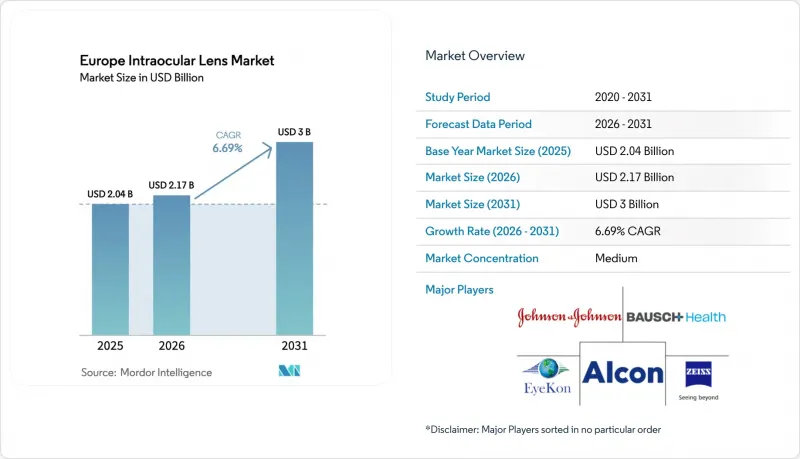
This report is Segmented by Product (Monofocal, Accommodative, Multifocal, and Toric), Indication (Age-Related Cataract, Congenital/Traumatic Cataract, and Refractive Lens Exchange), End User (Hospitals, Ambulatory Clinics, and Other End Users), and Geography (Germany, United Kingdom, France, Italy, Spain, and Rest of Europe). Market Forecasts are Provided in Terms of Value (USD).
Europe Intraocular Lens Market Trends and Insights
Growing Adoption of Premium Multifocal and Toric IOLs
Toric volumes outpace the overall Europe intraocular lens market by nearly two percentage points, and multifocal uptake accelerates as optics improve and patient expectations climb. A premium lens costs EUR 1,500-3,000 per eye, compared to EUR 300-500 for a monofocal lens; yet, the unit manufacturing cost rises only modestly, lifting gross margins beyond 70%. Germany's supplemental insurance and Spain's price-competitive medical tourism hubs create early-adopter pockets, while Johnson & Johnson's TECNIS Odyssey, launched in 2025, aims to mitigate halo and glare complaints that once limited multifocal lens penetration. Reimbursement ceilings remain the binding gatekeeper, restricting adoption largely to affluent urban cohorts.
Technological Advances in Aspheric and Blue-Light Filtering Materials
Aspheric optics flatten lens curvature to reduce spherical aberration, thereby sharpening contrast sensitivity for night driving. Meanwhile, embedded chromophores absorb sub-450 nm wavelengths that could potentially harm the retina. Alcon's Clareon platform, CE-marked in 2025, combines UV-blocking monomers with a hydrophobic surface that resists posterior capsule opacification. This complication otherwise affects up to 30% of patients within five years. Carl Zeiss Meditec's CT ASPHINA 409M reports a glistening incidence of less than 1% at two years. The EU Medical Device Regulation heightens post-market evidence requirements, favoring incumbents that maintain robust quality management systems.
High Cost of Premium Intraocular Lenses
Out-of-pocket charges range from EUR 1,500-3,000 in Germany to GBP 2,000-3,500 in the United Kingdom, effectively excluding lower-income cohorts from premium options. VAT disparities-0% in the UK versus 23% in Portugal-further skew access and invite gray-market arbitrage. Manufacturers face a balancing act: they can either widen access by lowering prices or protect R&D funding and margins; neither route resolves the equity gap in the near term.
Other drivers and restraints analyzed in the detailed report include:
- Surge in Refractive Lens Exchange Among High-Myopia Patients
- Aging Population and Rising Cataract Burden
- Reimbursement Limitations for Advanced Technology IOLs
For complete list of drivers and restraints, kindly check the Table Of Contents.
Segment Analysis
Toric lenses are expanding 8.53% a year, pulling Europe intraocular lens market revenue ahead of the broader average as surgeons increasingly prefer to eliminate pre-existing astigmatism in a single event. In contrast, monofocal implants still represent 58.65% of the Europe intraocular lens market share because public insurance covers only basic spherical models. Multifocals and extended-depth-of-focus platforms now chip away at monofocal dominance as designs like Alcon's Clareon Vivity and Johnson & Johnson's TECNIS Odyssey gain traction. Manufacturers exploit favorable economics: a toric SKU costs roughly five times a monofocal at retail yet carries only a fractional increase in production cost, sustaining premium gross margins. Post-market evidence showing stable rotational alignment within +-5° at one year further reassures surgeons who once feared axis drift. The EU MDR's post-market surveillance adds compliance overhead, but dominant suppliers leverage their established quality systems to stay ahead of emerging low-cost entrants.
Second-generation diffractive optics resolve earlier halo and glare complaints, improving satisfaction rates and widening the candidate pool to exacting younger RLE patients. Rotationally stable injector systems, such as Bausch + Lomb's enVista Aspire, reduce operating time and minimize the risk of endophthalmitis, two essential differentiators for high-throughput ambulatory centers. As clinical outcomes converge, marketing shifts toward lifestyle messaging-such as night-driving clarity and digital-screen comfort-and bundled service contracts that lock ambulatory clinics into multi-year purchase agreements. Nonetheless, premium adoption remains gated by the self-pay model, meaning toric acceleration keeps contingent on income demographics and private insurance uptake.
Complete Report Scope:
- By Product
- Monofocal Intraocular Lens
- Accommodative Intraocular Lens
- Multifocal Intraocular Lens
- Toric Intraocular Lens
- By Indication
- Age-Related Cataract
- Congenital/Traumatic Cataract
- Refractive Lens Exchange (RLE)
- By End User
- Hospitals
- Ambulatory Clinics
- Other End Users
- By Geography
- Germany
- United Kingdom
- France
- Italy
- Spain
- Rest Of Europe
List of Companies Covered in this Report:
- Alcon
- Bausch Health
- BVI Medical (PhysIOL)
- Carl Zeiss
- EyeKon Medical
- HOYA
- HumanOptics
- Johnson & Johnson
- Lenstec
- Medicontur Medical Engineering Ltd.
- Nidek
- Oculentis / Teleon Surgical
- OPHTEC BV
- Rayner
- Santen Pharmaceuticals
- SAV-IOL SA
- STAAR Surgical
Additional Benefits:
- The market estimate (ME) sheet in Excel format
- 3 months of analyst support
TABLE OF CONTENTS
1 Introduction
- 1.1 Study Assumptions & Market Definition
- 1.2 Scope Of The Study
2 Research Methodology
3 Executive Summary
4 Market Landscape
- 4.1 Market Overview
- 4.2 Market Drivers
- 4.2.1 Ageing Population and Rising Cataract Burden
- 4.2.2 Growing Adoption of Premium Multifocal and Toric IOLs
- 4.2.3 Technological Advancements in Aspheric and Blue-Light Filtering Materials
- 4.2.4 Surge in Refractive Lens Exchange Among High Myopia Patients
- 4.2.5 Expanding Day-Case Cataract Surgery Pathways Under EU Funding
- 4.2.6 Increased Utilization of AI-Driven Biometry for Personalized IOL Power Calculation
- 4.3 Market Restraints
- 4.3.1 High Cost of Premium Intraocular Lenses
- 4.3.2 Reimbursement Limitations for Advanced Technology IOLs
- 4.3.3 Supply Chain Disruptions for Hydrophobic Acrylic Polymers
- 4.3.4 Limited Surgical Capacity Owing to Ophthalmologist Shortage in Rural EU Regions
- 4.4 Value / Supply-Chain Analysis
- 4.5 Regulatory Landscape
- 4.6 Technological Outlook
- 4.7 Porter's Five Forces Analysis
- 4.7.1 Threat Of New Entrants
- 4.7.2 Bargaining Power Of Buyers/Consumers
- 4.7.3 Bargaining Power Of Suppliers
- 4.7.4 Threat Of Substitute Products
- 4.7.5 Intensity Of Competitive Rivalry
5 Market Size & Growth Forecasts (Value, USD)
- 5.1 By Product
- 5.1.1 Monofocal Intraocular Lens
- 5.1.2 Accommodative Intraocular Lens
- 5.1.3 Multifocal Intraocular Lens
- 5.1.4 Toric Intraocular Lens
- 5.2 By Indication
- 5.2.1 Age-Related Cataract
- 5.2.2 Congenital/Traumatic Cataract
- 5.2.3 Refractive Lens Exchange (RLE)
- 5.3 By End User
- 5.3.1 Hospitals
- 5.3.2 Ambulatory Clinics
- 5.3.3 Other End Users
- 5.4 By Geography
- 5.4.1 Germany
- 5.4.2 United Kingdom
- 5.4.3 France
- 5.4.4 Italy
- 5.4.5 Spain
- 5.4.6 Rest Of Europe
6 Competitive Landscape
- 6.1 Market Concentration
- 6.2 Market Share Analysis
- 6.3 Company Profiles {(Includes Global Level Overview, Market Level Overview, Core Segments, Financials as Available, Strategic Information, Market Rank/Share for Key Companies, Products & Services, and Recent Developments)}
- 6.3.1 Alcon
- 6.3.2 Bausch Health Companies Inc. (Bausch + Lomb)
- 6.3.3 BVI Medical (PhysIOL)
- 6.3.4 Carl Zeiss Meditec AG
- 6.3.5 EyeKon Medical Inc.
- 6.3.6 Hoya Corporation
- 6.3.7 HumanOptics AG
- 6.3.8 Johnson & Johnson
- 6.3.9 Lenstec Inc.
- 6.3.10 Medicontur Medical Engineering Ltd.
- 6.3.11 NIDEK Co., Ltd.
- 6.3.12 Oculentis / Teleon Surgical
- 6.3.13 OPHTEC BV
- 6.3.14 Rayner
- 6.3.15 Santen Pharmaceutical Co., Ltd.
- 6.3.16 SAV-IOL SA
- 6.3.17 STAAR Surgical Company
7 Market Opportunities & Future Outlook
- 7.1 White-Space & Unmet-Need Assessment

