PUBLISHER: Mordor Intelligence | PRODUCT CODE: 2113934

PUBLISHER: Mordor Intelligence | PRODUCT CODE: 2113934
Aircraft Brakes - Market Share Analysis, Industry Trends & Statistics, Growth Forecasts (2026 - 2031)
According to Mordor Intelligence, the aircraft brakes market size in 2026 is estimated at USD 9.8 billion, growing from 2025 value of USD 9.32 billion with 2031 projections showing USD 12.56 billion, growing at 5.11% CAGR over 2026-2031.
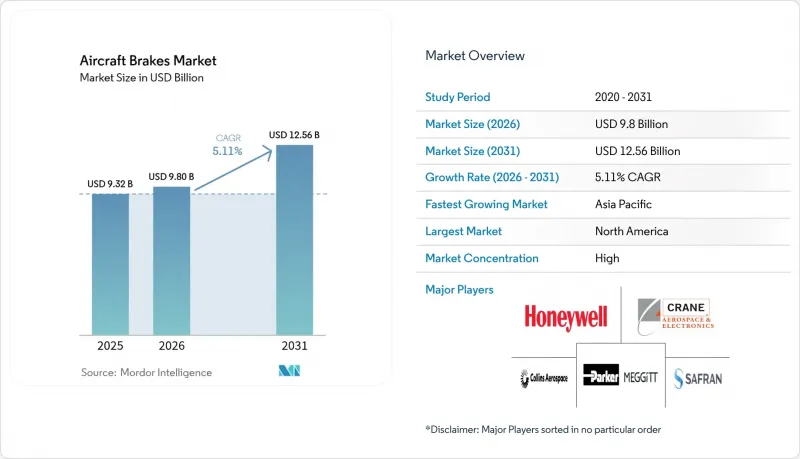
This report is Segmented by Product Type (Carbon Brakes, Steel Brakes, and Carbon-Ceramic/CMC Brakes), Actuation Technology (Conventional Hydraulic, Electro-Hydraulic, and More), Aircraft Class (Commercial, Military, and General Aviation), End User (Linefit and Retrofit), and Geography (North America, Europe, and More). The Market Forecasts are Provided in Terms of Value (USD).
Global Aircraft Brakes Market Trends and Insights
Expansion of worldwide aircraft fleets drives sustained brake demand
Boeing's 2024 outlook calls for 43,975 new jet deliveries over 2024-2043, and 76% of them are single-aisle models that operate high landing-cycle missions, accelerating brake wear and replacement frequency. India's traffic is expanding more than 7% annually, underpinning a need for 2,835 additional aircraft by 2045, which compounds brake demand in both the original-equipment and aftermarket channels. Aircraft retirements remain below historic norms, extending fleet average age and intensifying MRO cycles, including repetitive brake overhauls. Regulatory oversight by ICAO and national authorities standardizes global brake performance benchmarks, ensuring that every newly delivered or overhauled unit meets identical stopping-distance, thermal-fade, and wear-rate criteria.
Industry transition from steel to carbon braking solutions reshapes market dynamics
Operators value carbon brakes because they trim weight and last longer than steel sets; Collins Aerospace's DURACARB(R) discs deliver about 35% extra lifespan on Boeing 737NG aircraft, translating into fewer shop visits and lower fuel burn. Safran's Equipment & Defense division, which bundles landing and carbon-brake products, posted 17.70% organic revenue growth in 2024, a signal of shifting operator preferences toward premium carbon technology. Meanwhile, Mitsubishi Chemical Group has demonstrated carbon-fiber reinforced ceramic matrix composites (CMCs) capable of withstanding 1,500 °C, paving the way for next-generation brake discs that tolerate extreme heat without a mass penalty. New production capacity, such as Collins Aerospace's USD 200 million Spokane expansion, will lift global carbon brake output by 50%, helping alleviate backlog pressure.
Volatile carbon fiber supply constrains production scaling
Aerospace-grade carbon fiber capacity additions lag demand because qualification cycles stretch several years, and most new lines aim at lower-grade products for wind blades, not aircraft brakes. Heat-treatment furnaces and chemical vapor infiltration used to make carbon-carbon discs consume large amounts of electricity and natural gas; fluctuating utility prices squeeze suppliers' margins and push brake selling prices upward. Extended lead-times for titanium, specialty stainless, and alloy castings-often 30 weeks or more-delay hub and torque-tube deliveries for brake assembly. Geopolitical shipping disruptions add further risk to trans-Pacific logistics, prompting OEMs to dual-source raw materials or consider in-region production shifts.
Other drivers and restraints analyzed in the detailed report include:
- Global defense fleet modernization programs stimulate brake upgrades
- Rising MRO requirements from aging commercial fleets bolster aftermarket revenue
- Certification bottlenecks delay technology implementation
For complete list of drivers and restraints, kindly check the Table Of Contents.
Segment Analysis
Carbon technology commanded a 64.92% of the aircraft brakes market share in 2025 due to the strength of weight savings that cut fuel burn and increased payload capacity. Steel sets retain a niche in light aircraft and cost-constrained operators, yet carriers are quantifying whole-life savings and switching fleets to carbon at the next overhaul cycle. Carbon-ceramic/CMC variants are the fastest-growing sub-category at a 7.55% CAGR, driven by their 1,500 °C heat-resilience and outstanding fade resistance, critical for repeated short-haul missions.
Manufacturing investments mirror this shift. Collins Aerospace doubled Spokane output with a USD 200 million expansion, and Safran is building a new carbon brake plant in France to shore up European capacity. Certification protocols under FAA Part 25 require brake discs to withstand nine-stop rejected-takeoff tests without structural degradation, and carbon stacks routinely outperform steel in this regime. Environmental regulations favor carbon because it eliminates cadmium plating and reduces particulate emissions versus steel-based linings.
Traditional hydraulics represent 75.60% of the aircraft brakes market size, prized for proven reliability and global MRO familiarity. Electro-hydraulic hybrids add electronic precision while leveraging existing pumps and reservoirs, serving as a bridge technology for new-builds that still share line architecture with legacy fleets. Fully electric systems, or brake-by-wire, are accelerating at a 6.29% CAGR to 2031 as OEMs pursue all-electric secondary power architectures; Safran's 787 unit sets the precedent, pairing smart-sensor wear gauging with cockpit annunciations.
Military programs expedite adoption: Crane's Mark V architecture on the F-16 offers dual redundant signal paths that comply with MIL-HDBK-516C airworthiness criteria. Electric brakes reduce hydraulic fluid mass and eliminate thermal soak-back issues that raise wheel-well temperatures in composite fuselages. As battery-electric regional aircraft and eVTOL prototypes mature, lightweight distributed brake actuators with regenerative capabilities are emerging design baselines in preliminary certification packages.
Complete Report Scope:
- By Product Type
- Carbon Brakes
- Steel Brakes
- Carbon-Ceramic/CMC Brakes
- By Actuation Technology
- Conventional Hydraulic
- Electro-Hydraulic
- Fully Electric/Brake-by-Wire
- Integrated Self-Powered Systems
- By Aircraft Class
- Commercial
- Narrowbody
- Widebody
- Regional Jets
- Military
- Combat
- Transport
- Special Mission
- Military Helicopters
- General Aviation
- Business Jets
- Commercial Helicopters
- Commercial
- By End User
- Linefit
- Retrofit
- By Geography
- North America
- United States
- Canada
- Mexico
- Europe
- United Kingdom
- France
- Germany
- Italy
- Spain
- Rest of Europe
- Asia-Pacific
- China
- India
- Japan
- South Korea
- Australia
- Rest of Asia-Pacific
- South America
- Brazil
- Rest of South America
- Middle East and Africa
- Middle East
- United Arab Emirates
- Saudi Arabia
- Rest of Middile East
- Africa
- South Africa
- Rest of Africa
- Middle East
- North America
Geography Analysis
North America has the largest aircraft brakes market share, at 30.60%, because it combines the world's biggest military inventory with the densest commercial traffic flows and a mature MRO network. US-based suppliers benefit from Buy-American preferences and a robust defense budget that accelerates brake modernization cycles on legacy platforms.
Asia-Pacific registers the steepest growth at 6.72% CAGR owing to prolific fleet additions and regulatory streamlining that shortens certification lead-times for new component entrants. Domestic production incentives in China and India foster local assembly of wheels-and-brake subcomponents, reducing import dependency and creating strategic partnerships with global OEMs. Europe remains pivotal through Airbus output and stringent environmental directives that steer early adoption of low-emission brake materials. The Middle East and Africa are growing from a small base as Gulf carriers upgrade fleets and African nations add connectivity under the Single African Air Transport Market protocols.
- Safran SA
- Collins Aerospace (RTX Corporation)
- Honeywell International Inc.
- Crane Aerospace & Electronics (Crane Company)
- Meggitt Ltd. (Parker-Hannifin Corporation)
- BERINGER AERO
- Advent Aircraft Systems, Inc.
- Tactair (Young & Franklin Inc.)
- Matco Aircraft Landing Systems
- Rapco Fleet Support, Inc.
- CFC CARBON CO., LTD.
- AMETEK MRO (AMETEK, Inc.)
- Grove Aircraft Landing Gear Systems Inc.
- TAE Aerospace
- SGL Carbon SE
- Carlyle Johnson Machine Co., LLC
Additional Benefits:
- The market estimate (ME) sheet in Excel format
- 3 months of analyst support
TABLE OF CONTENTS
1 INTRODUCTION
- 1.1 Study Assumptions and Market Definition
- 1.2 Scope of the Study
2 RESEARCH METHODOLOGY
3 EXECUTIVE SUMMARY
4 MARKET LANDSCAPE
- 4.1 Market Overview
- 4.2 Market Drivers
- 4.2.1 Expansion of worldwide aircraft fleet and sustained growth in deliveries
- 4.2.2 Industry transition from steel brakes to advanced carbon braking solutions
- 4.2.3 Global defense fleet modernization programs stimulating brake demand
- 4.2.4 Rising MRO requirements from aging commercial aircraft fleets
- 4.2.5 Increasing adoption of brake-by-wire systems in more-electric aircraft architectures
- 4.2.6 Wider acceptance of PMA parts in cost-sensitive aviation markets
- 4.3 Market Restraints
- 4.3.1 Volatility in global carbon fiber supply and rising energy costs
- 4.3.2 Lengthy OEM certification processes and retrofit program backlogs
- 4.3.3 Stricter international regulations on brake particulate emissions
- 4.3.4 Growing OEM vertical integration reducing tier-2 supplier participation
- 4.4 Supply Chain Analysis
- 4.5 Regulatory Landscape
- 4.6 Technological Outlook
- 4.7 Porter's Five Forces Analysis
- 4.7.1 Bargaining Power of Buyers
- 4.7.2 Bargaining Power of Suppliers
- 4.7.3 Threat of New Entrants
- 4.7.4 Threat of Substitutes
- 4.7.5 Intensity of Competitive Rivalry
5 MARKET SIZE AND GROWTH FORECASTS (VALUE)
- 5.1 By Product Type
- 5.1.1 Carbon Brakes
- 5.1.2 Steel Brakes
- 5.1.3 Carbon-Ceramic/CMC Brakes
- 5.2 By Actuation Technology
- 5.2.1 Conventional Hydraulic
- 5.2.2 Electro-Hydraulic
- 5.2.3 Fully Electric/Brake-by-Wire
- 5.2.4 Integrated Self-Powered Systems
- 5.3 By Aircraft Class
- 5.3.1 Commercial
- 5.3.1.1 Narrowbody
- 5.3.1.2 Widebody
- 5.3.1.3 Regional Jets
- 5.3.2 Military
- 5.3.2.1 Combat
- 5.3.2.2 Transport
- 5.3.2.3 Special Mission
- 5.3.2.4 Military Helicopters
- 5.3.3 General Aviation
- 5.3.3.1 Business Jets
- 5.3.3.2 Commercial Helicopters
- 5.3.1 Commercial
- 5.4 By End User
- 5.4.1 Linefit
- 5.4.2 Retrofit
- 5.5 By Geography
- 5.5.1 North America
- 5.5.1.1 United States
- 5.5.1.2 Canada
- 5.5.1.3 Mexico
- 5.5.2 Europe
- 5.5.2.1 United Kingdom
- 5.5.2.2 France
- 5.5.2.3 Germany
- 5.5.2.4 Italy
- 5.5.2.5 Spain
- 5.5.2.6 Rest of Europe
- 5.5.3 Asia-Pacific
- 5.5.3.1 China
- 5.5.3.2 India
- 5.5.3.3 Japan
- 5.5.3.4 South Korea
- 5.5.3.5 Australia
- 5.5.3.6 Rest of Asia-Pacific
- 5.5.4 South America
- 5.5.4.1 Brazil
- 5.5.4.2 Rest of South America
- 5.5.5 Middle East and Africa
- 5.5.5.1 Middle East
- 5.5.5.1.1 United Arab Emirates
- 5.5.5.1.2 Saudi Arabia
- 5.5.5.1.3 Rest of Middile East
- 5.5.5.2 Africa
- 5.5.5.2.1 South Africa
- 5.5.5.2.2 Rest of Africa
- 5.5.5.1 Middle East
- 5.5.1 North America
6 COMPETITIVE LANDSCAPE
- 6.1 Market Concentration
- 6.2 Strategic Moves
- 6.3 Market Share Analysis
- 6.4 Company Profiles (includes Global level Overview, Market level overview, Core Segments, Financials as available, Strategic Information, Market Rank/Share for key companies, Products and Services, and Recent Developments)
- 6.4.1 Safran SA
- 6.4.2 Collins Aerospace (RTX Corporation)
- 6.4.3 Honeywell International Inc.
- 6.4.4 Crane Aerospace & Electronics (Crane Company)
- 6.4.5 Meggitt Ltd. (Parker-Hannifin Corporation)
- 6.4.6 BERINGER AERO
- 6.4.7 Advent Aircraft Systems, Inc.
- 6.4.8 Tactair (Young & Franklin Inc.)
- 6.4.9 Matco Aircraft Landing Systems
- 6.4.10 Rapco Fleet Support, Inc.
- 6.4.11 CFC CARBON CO., LTD.
- 6.4.12 AMETEK MRO (AMETEK, Inc.)
- 6.4.13 Grove Aircraft Landing Gear Systems Inc.
- 6.4.14 TAE Aerospace
- 6.4.15 SGL Carbon SE
- 6.4.16 Carlyle Johnson Machine Co., LLC
7 MARKET OPPORTUNITIES AND FUTURE OUTLOOK
- 7.1 White-space and Unmet-Need Assessment

