PUBLISHER: Mordor Intelligence | PRODUCT CODE: 2113941

PUBLISHER: Mordor Intelligence | PRODUCT CODE: 2113941
Fuel Cell UAV - Market Share Analysis, Industry Trends & Statistics, Growth Forecasts (2026 - 2031)
According to Mordor Intelligence, the fuel cell UAV market size is expected to grow from USD 0.84 billion in 2025 to USD 1.00 billion in 2026 and is forecasted to reach USD 2.38 billion by 2031 at 18.91% CAGR over 2026-2031.
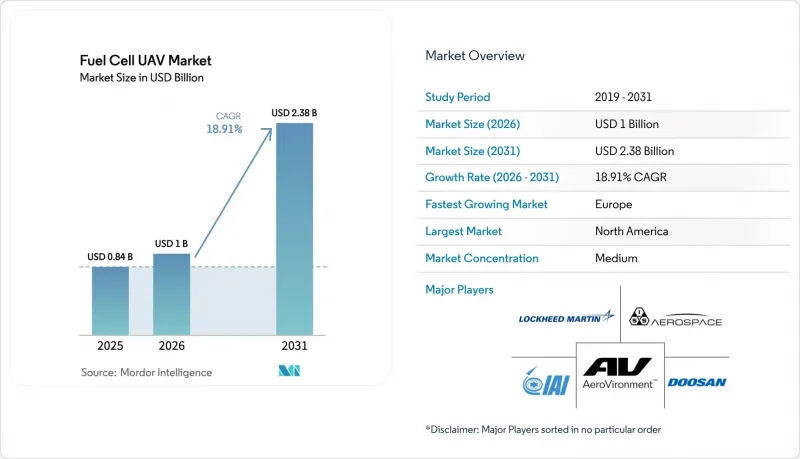
This report is Segmented by Fuel Cell Type (Proton-Exchange-Membrane Fuel Cells, Solid-Oxide Fuel Cells, and Hydrogen Fuel Cells), UAV Platform Type (Fixed-Wing, Rotary-Wing, and Hybrid), Weight Class (Less Than 10 Kg, and More), Military Application (ISR, Border Patrol, Precision Strike, and More), and Geography (North America, and More). The Market Forecasts are Provided in Terms of Value (USD).
Global Fuel Cell UAV Market Trends and Insights
Rapid-Deployment Need for Long-Endurance ISR in Contested Airspace
Missions over Ukraine's eastern corridor and the South China Sea underscore the importance of persistent surveillance. Fuel-cell UAVs extend loiter times from 90 minutes to beyond 13 hours, as demonstrated by the DS30-powered airframe during 2025 desert trials. The US Marine Corps validated similar endurance at Twentynine Palms, confirming operational viability at 40 °C. Planners value the reduced acoustic and infrared signatures that hydrogen propulsion offers, delaying adversary detection loops. Procurement offices are now considering squadron-level conversions, which will drive sustained growth in the fuel cell UAV market in the medium term. As allied forces standardize tactics around longer UAV station times, ISR fleets worldwide increasingly specify fuel-cell systems at the request-for-proposal stage.
DoD Hydrogen-Logistics Decarbonization Mandates
The 2024 Climate Adaptation Plan instructs US forces to halve operational emissions by 2030. HyTEC prototypes delivered in March 2025 produce 5 kg of hydrogen per day from renewable power, underscoring a shift away from diesel generators toward on-site electrolysis. NATO's 2025 Energy Security Framework mirrors this push, ensuring aligned funding for hydrogen infrastructure among allies. Early rollouts at Fort Eustis and Ramstein Air Base indicate a 20% reduction in convoy traffic once cylinder deliveries cease. These early wins translate into rapid growth in the fuel cell UAV market as hydrogen refueling becomes integral to forward-base design.
High Battlefield Refueling Complexity
Hydrogen cylinders require three times the volume of diesel to deliver the same energy, significantly increasing supply chain demands and logistical challenges. In May 2025, marine technicians at Twentynine Palms took 15 minutes to refuel each UAV, which is three times longer than the battery swap process, further highlighting operational inefficiencies. In regions where potable water scarcity prevents on-site electrolysis, commanders are compelled to transport cylinders over long distances, reintroducing logistical risks and increasing operational complexity. These inefficiencies currently limit near-term scalability but are expected to diminish as 700-bar quick-connect systems and water-recovery units become more advanced and widely implemented.
Other drivers and restraints analyzed in the detailed report include:
- Falling Cost of High-Power-Density PEM Stacks
- Growing Defense-Sector Interest in Quiet Propulsion for Stealth
- Safety Certification Hurdles for Compressed H2 Above 350 Bar
For complete list of drivers and restraints, kindly check the Table Of Contents.
Segment Analysis
PEMFC units dominated the market with a 67.87% share in 2025, due to their fast cold-start capabilities and lower mass. SOFC stacks, however, are projected to grow at a 22.10% CAGR through 2031, surpassing the overall fuel cell UAV market growth by 3.19 points. Continuous-loiter ISR missions now specify 24-hour thresholds, prompting buyers to consider hybrid PEM-SOFC packages. The fuel cell UAV market for SOFC solutions is expected to more than double by 2031, as heat-recovery loops reduce cold-start wait times. Engineers use PEM exhaust to preheat SOFC cores, a design that extends the operating ceiling above 3,000 m without incurring mass penalties. Suppliers report rising backlog from European border agencies that view hybrid systems as hedge-free endurance insurance.
The fuel cell UAV industry remains cautious about methanol-reformed SOFCs because logistics chains prefer a common hydrogen supply. Tests with Chile's high-altitude police units reveal methanol cartridges could permit sub-zero patrols. While PEMFC retains the majority of the fuel cell UAV market revenue, the trajectory of SOFC shifts competitive roadmaps, prompting stack makers to invest in ceramic electrolyte lines. By 2028, at least three Asian vendors plan to launch SOFCs to dilute the currently Western-heavy supply chain.
Fixed-wing airframes secured 52.20% of 2025 revenue due to aerodynamic economy over long legs. Hybrid VTOL, combining quad rotors for lift and a wing for cruise, posts the market's quickest 24.55% CAGR. Operators crave truck-bed launch without runway dependence, positioning hybrid designs at the sweet spot for procurement. The fuel cell UAV market for hybrid VTOL is forecasted to expand strongly by 2031 compared with 2026 levels. End-users from Norway to Indonesia field-test tilt-rotor drones that can fly for eight hours while landing with a footprint the size of a football field.
Rotary-wing demand lags but remains a niche for urban ISR. Fuel cells enable flights of up to three hours on 2-kW stacks, but high hover loads still limit the range. Consequently, integrators prioritize weight shaving via carbon-composite tanks. Hybrids sidestep this hurdle by cruising on half the power, a pattern likely to redirect fuel cell UAV market share away from pure rotorcraft after 2027.
Complete Report Scope:
- By Fuel Cell Type
- Proton-Exchange-Membrane Fuel Cells (PEMFC)
- Solid-Oxide Fuel Cells (SOFC)
- Hydrogen Fuel Cells
- By UAV Platform Type
- Fixed-Wing
- Rotary-Wing
- Hybrid
- By Weight Class
- Less than 10 kg
- 11 to 25 kg
- More than 26 kg
- By Military Application
- Intelligence, Surveillance and Reconnaissance (ISR)
- Border Patrol
- Precision Strike
- Logistics and Transportation
- Others
- By Geography
- North America
- United States
- Canada
- Mexico
- Europe
- United Kingdom
- France
- Germany
- Rest of Europe
- Asia-Pacific
- China
- India
- Japan
- South Korea
- Rest of Asia-Pacific
- South America
- Brazil
- Rest of South America
- Middle East and Africa
- Middle East
- Saudi Arabia
- United Arab Emirates
- Rest of Middle East
- Africa
- South Africa
- Rest of Africa
- Middle East
- North America
Geography Analysis
North America led with 41.2% of 2025 revenue, buoyed by the Blue UAS Framework's inclusion of hydrogen models. The US Army Futures Command allocates multi-year funding for squadron rollouts, thereby anchoring the regional fuel cell UAV market. Canada's DRDC partners with Intelligent Energy to trial Arctic patrol variants, signaling continental breadth of demand. The fuel cell UAV market in North America is expected to expand rapidly by 2031 as HyTEC micro-refineries proliferate at Marine Corps bases.
Europe, projected to grow at a 21.95% CAGR, benefits from European Defence Fund grants that help de-risk prototype costs: the UK, France, and Germany co-finance compressed-hydrogen tank testing and condense certification calendars. Cranfield's ST-5 Stingray illustrates domestic content strategies that bolster sovereign supply chains. Once pan-European tank interoperability is ratified in 2027, procurement pipelines are expected to flow more efficiently, propelling the fuel cell UAV market across NATO borders.
The Asia-Pacific region is home to active suppliers, notably South Korea's Doosan Mobility and Japan's new SOFC consortium. India's DRDO began flight tests using PEM-powered fixed-wing aircraft for high-altitude surveillance in Ladakh, despite experiencing cold-start issues. ASEAN members are trialling logistics drones for island resupply, albeit at a pilot scale. Market expansion hinges on the rollout of hydrogen infrastructure, which lags behind that of industrial economies but is receiving fresh impetus from Japan's 2026 "Green Defense" roadmap.
The Middle East channels petrodollar surpluses into Green-Hydrogen cities, laying the groundwork for military adoption. Saudi Arabia's NEOM hosts a test corridor where autonomous fuel-cell drones haul medical cargo between clinics. Regulatory clarity remains limited, slowing acquisitions but foreshadowing eventual upticks once airworthiness rules are finalized. South America and Africa are showing early signs of traction. Brazil's border-policing agency eyes fixed-wing fuel-cell drones for Amazon patrols, while South Africa investigates anti-poaching oversight. These regions account for less than 5% of 2025 revenue yet present long-term upside as hydrogen prices decline.
- Lockheed Martin Corporation
- AeroVironment, Inc.
- Israel Aerospace Industries Ltd.
- Heven AeroTech inc.
- ISS Group Ltd.
- The Boeing Company
- Avironix Private Limited
- Cranfield Aerospace Solutions Limited
- XSun
- Doosan Mobility Innovation
- Skyeton
- BlueBird Aero Systems Ltd.
- Aurora Flight Sciences (The Boeing Company)
Additional Benefits:
- The market estimate (ME) sheet in Excel format
- 3 months of analyst support
TABLE OF CONTENTS
1 INTRODUCTION
- 1.1 Study Assumptions and Market Definition
- 1.2 Scope of the Study
2 RESEARCH METHODOLOGY
3 EXECUTIVE SUMMARY
4 MARKET LANDSCAPE
- 4.1 Market Overview
- 4.2 Market Drivers
- 4.2.1 Rapid-deployment need for long-endurance ISR in contested airspace
- 4.2.2 DoD hydrogen-logistics decarbonisation mandates
- 4.2.3 Falling cost of high power-density PEM stacks
- 4.2.4 Growing defense-sector interest in "quiet" propulsion for stealth
- 4.2.5 PEM-SOFC hybridisation boosting sortie duration
- 4.2.6 On-site green-hydrogen micro-refineries at forward bases
- 4.3 Market Restraints
- 4.3.1 High battlefield refuelling complexity
- 4.3.2 Safety certification hurdles for compressed H2 above 350 bar
- 4.3.3 Scarcity of mil-spec fuel-cell supply chain
- 4.3.4 Cold-start performance degradation in high-altitude missions
- 4.4 Value Chain Analysis
- 4.5 Regulatory Landscape
- 4.6 Technological Outlook
- 4.7 Porter's Five Forces Analysis
- 4.7.1 Bargaining Power of Suppliers
- 4.7.2 Bargaining Power of Buyers/Consumers
- 4.7.3 Threat of New Entrants
- 4.7.4 Threat of Substitute Products
- 4.7.5 Intensity of Competitive Rivalry
5 MARKET SIZE AND GROWTH FORECASTS (VALUE)
- 5.1 By Fuel Cell Type
- 5.1.1 Proton-Exchange-Membrane Fuel Cells (PEMFC)
- 5.1.2 Solid-Oxide Fuel Cells (SOFC)
- 5.1.3 Hydrogen Fuel Cells
- 5.2 By UAV Platform Type
- 5.2.1 Fixed-Wing
- 5.2.2 Rotary-Wing
- 5.2.3 Hybrid
- 5.3 By Weight Class
- 5.3.1 Less than 10 kg
- 5.3.2 11 to 25 kg
- 5.3.3 More than 26 kg
- 5.4 By Military Application
- 5.4.1 Intelligence, Surveillance and Reconnaissance (ISR)
- 5.4.2 Border Patrol
- 5.4.3 Precision Strike
- 5.4.4 Logistics and Transportation
- 5.4.5 Others
- 5.5 By Geography
- 5.5.1 North America
- 5.5.1.1 United States
- 5.5.1.2 Canada
- 5.5.1.3 Mexico
- 5.5.2 Europe
- 5.5.2.1 United Kingdom
- 5.5.2.2 France
- 5.5.2.3 Germany
- 5.5.2.4 Rest of Europe
- 5.5.3 Asia-Pacific
- 5.5.3.1 China
- 5.5.3.2 India
- 5.5.3.3 Japan
- 5.5.3.4 South Korea
- 5.5.3.5 Rest of Asia-Pacific
- 5.5.4 South America
- 5.5.4.1 Brazil
- 5.5.4.2 Rest of South America
- 5.5.5 Middle East and Africa
- 5.5.5.1 Middle East
- 5.5.5.1.1 Saudi Arabia
- 5.5.5.1.2 United Arab Emirates
- 5.5.5.1.3 Rest of Middle East
- 5.5.5.2 Africa
- 5.5.5.2.1 South Africa
- 5.5.5.2.2 Rest of Africa
- 5.5.5.1 Middle East
- 5.5.1 North America
6 COMPETITIVE LANDSCAPE
- 6.1 Market Concentration
- 6.2 Strategic Moves
- 6.3 Market Share Analysis
- 6.4 Company Profiles (includes Global level Overview, Market level overview, Core Segments, Financials, Strategic Info, Market Rank/Share, Products and Services, Recent Developments)
- 6.4.1 Lockheed Martin Corporation
- 6.4.2 AeroVironment, Inc.
- 6.4.3 Israel Aerospace Industries Ltd.
- 6.4.4 Heven AeroTech inc.
- 6.4.5 ISS Group Ltd.
- 6.4.6 The Boeing Company
- 6.4.7 Avironix Private Limited
- 6.4.8 Cranfield Aerospace Solutions Limited
- 6.4.9 XSun
- 6.4.10 Doosan Mobility Innovation
- 6.4.11 Skyeton
- 6.4.12 BlueBird Aero Systems Ltd.
- 6.4.13 Aurora Flight Sciences (The Boeing Company)
7 MARKET OPPORTUNITIES AND FUTURE OUTLOOK
- 7.1 White-space and Unmet-Need Assessment

