PUBLISHER: Mordor Intelligence | PRODUCT CODE: 2113951

PUBLISHER: Mordor Intelligence | PRODUCT CODE: 2113951
Asia-Pacific Algae Protein - Market Share Analysis, Industry Trends & Statistics, Growth Forecasts (2026 - 2031)
According to Mordor Intelligence, the Asia-Pacific algae protein market size in 2026 is estimated at USD 60.52 million, growing from 2025 value of USD 55.98 million with 2031 projections showing USD 89.27 million, growing at 8.12% CAGR over 2026-2031.
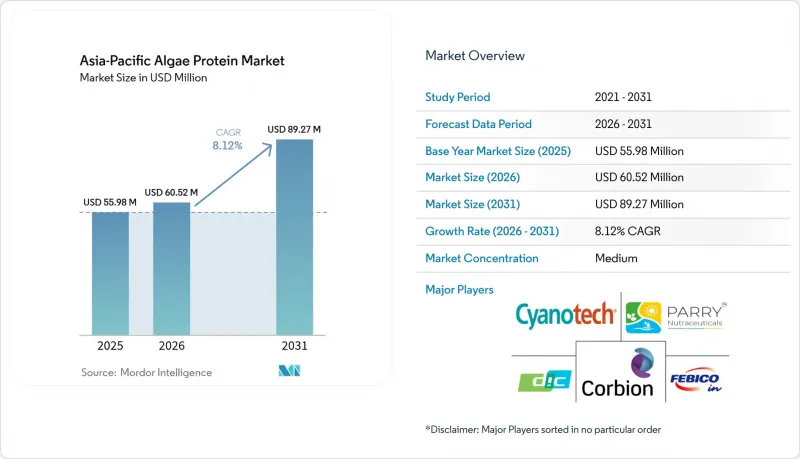
This report is Segmented by Source (Freshwater Algae, Marine Algae), Product Type (Spirulina, Chlorella, Others), Application (Food and Beverages, Supplements, Animal Feed, Others), and Geography (China, Japan, India, Thailand, Singapore, Indonesia, South Korea, Australia, New Zealand, Rest of Asia-Pacific). The Market Forecasts are Provided in Terms of Both Value (USD) and Volume (Units).
Asia-Pacific Algae Protein Market Trends and Insights
Growing demand for alternative protein sources
The algae protein market in the Asia-Pacific region is experiencing significant growth, driven by increasing demand for alternative proteins such as spirulina and chlorella in animal feed. These alternatives are progressively replacing traditional sources like soy and fishmeal, addressing sustainability challenges in aquaculture and livestock sectors. The adoption of spirulina in animal feed is accelerating at a rapid pace in the region, supported by substantial investments in large-scale cultivation and expedited regulatory approvals for eco-friendly feeds. As protein consumption per capita rises, domestic production of soy and peas in Asia-Pacific is unable to keep up, resulting in a growing protein deficit. This has created a structural demand for ingredients that do not depend on arable land. Algae, cultivated in photobioreactors or open ponds, eliminates the need for arable land and can be grown on marginal coastal or desert terrains. This geographic adaptability appeals to governments focused on enhancing food sovereignty. Additionally, China's decision to include microalgae in its 14th Five-Year Plan for bio-manufacturing highlights its efforts to reduce reliance on imported soy for animal feed.
Increasing consumer awareness of algae's nutritional benefits
In Japan and South Korea, where an aging population drives the demand for functional foods, clinical evidence highlighting the immune-boosting and antioxidant properties of spirulina and chlorella has shifted from niche wellness discussions to mainstream dietary recommendations. The World Bank indicates that in 2024, 30% of Japan's population will be aged 65 and older. These older consumers increasingly turn to algae proteins, such as spirulina and chlorella, attracted by their rich profiles of amino acids, antioxidants, omega-3 fatty acids, vitamins, and minerals. These nutrients are recognized for supporting muscle maintenance, joint health, immunity, and providing anti-aging benefits. In 2024, Japan's Ministry of Health, Labour and Welfare classified chlorella as a "Food with Function Claims." This classification permits manufacturers to market its immune-support benefits without prior approval, expediting product launches by 6 to 9 months. However, this awareness is uneven: urban consumers in Tokyo, Seoul, and Sydney are willing to pay premium prices for organic spirulina tablets, while rural consumers in India and Indonesia, being more price-sensitive, prefer fortified staples over standalone supplements. This disparity segments the market into distinct tiers based on willingness to pay.
High production costs
Algae protein remains 2-3 times more expensive than soy or pea isolates, primarily due to the significant capital expenditure and energy consumption required for photobioreactor operations. In closed photobioreactor systems, energy costs represent 30-40% of total operating expenses. Although solar energy integration offers a potential solution to reduce these costs, regions such as Thailand and Indonesia face challenges due to monsoon seasons, which result in inconsistent sunlight availability. This forces producers to rely on grid power as a backup, thereby diminishing the cost-saving advantages of solar energy. Additionally, in high-wage markets like Japan and Australia, the labor-intensive nature of harvesting and dewatering processes further drives up production costs. The adoption of automation in these regions has been slow, as the biological variability of algae cultures complicates the implementation of standardized automated systems. These factors collectively contribute to the higher cost of algae protein compared to alternative protein sources.
Other drivers and restraints analyzed in the detailed report include:
- Growing demand from dietary supplements
- Easy availability of raw material
- High availability of alternative protein sources
For complete list of drivers and restraints, kindly check the Table Of Contents.
Segment Analysis
Marine algae are projected to grow at a rate of 8.74% from 2026 to 2031, surpassing the growth of freshwater algae, which accounted for a significant 71.62% market share in 2025. This growth is primarily driven by the aquaculture industry's transition away from wild-caught fishmeal, leading to increased demand for algal omega-3 oils. In 2024, Indonesia's seaweed development initiatives focus on cultivating Gracilaria and Eucheuma for carrageenan and protein co-extraction. By leveraging its 40% share of global seaweed production, Indonesia aims to enhance downstream value rather than relying on raw biomass exports. Freshwater algae, dominated by spirulina and chlorella, continue to hold a strong position in dietary supplements and food fortification due to established GRAS approvals and consumer trust. However, they face margin pressures as generic producers from China and India flood the market with bulk powders priced below USD 10 per kilogram.
Regulatory developments are increasingly favoring marine species in specific applications. In 2024, China's National Health Commission approved Nannochloropsis oil, creating opportunities for marine microalgae in functional foods. Conversely, freshwater species have not received comparable recent approvals. Freshwater cultivation benefits from lower salinity-management costs and compatibility with inland aquaculture systems. For example, Thailand's shrimp-spirulina co-production system has effectively reduced water-treatment expenses. Marine algae, with their higher iodine and trace-mineral content, appeal to functional-food formulators. However, these attributes also raise allergenicity concerns, complicating novel-food approvals in regions like Australia and South Korea, where regulators apply stricter scrutiny to marine-derived ingredients compared to freshwater alternatives.
Complete Report Scope:
- By Source
- Freshwater Algae
- Marine Algae
- By Product Type
- Spirulina
- Chlorella
- Others
- By Application
- Food and Beverages
- Bakery
- Dairy and Dairy Alternative Products
- Meat/Poultry/Seafood and Meat Alternative Products
- Others
- Supplements
- Sport/Performance Nutrition
- Elderly Nutrition and Medical Nutrition
- Animal Feed
- Others
- Food and Beverages
- By Country
- China
- Japan
- India
- Thailand
- Singapore
- Indonesia
- South Korea
- Australia
- New Zealand
- Rest of Asia-Pacific
List of Companies Covered in this Report:
- DIC Corporation
- Cyanotech Corporation
- Parry Nutraceuticals
- Corbion N.V.
- Far East Microalgae Industries Co.
- Fuqing King Dnarmsa Spirulina Co.
- Hunan Sunfull Bio-tech Co.
- Zhejiang Binmei Biotechnology
- Heliae Development LLC
- Aliga Microalgae
- Seagrass Tech Pvt. Ltd.
- Taiwan Chlorella Mfg. Co.
- Sun Chlorella Corp.
- Qingdao Gather Great Ocean Algae
- Shandong Lidao Oceanic Technology
- Kingherbs Limited
- Allmicroalgae (Allma)
- Algatech Ltd.
- BlueBioTech GmbH
- Qingdao BrightMoon Seaweed Group
Additional Benefits:
- The market estimate (ME) sheet in Excel format
- 3 months of analyst support
TABLE OF CONTENTS
1 INTRODUCTION
- 1.1 Study Assumptions and Market Definition
- 1.2 Scope of the Study
2 RESEARCH METHODOLOGY
3 EXECUTIVE SUMMARY
4 MARKET LANDSCAPE
- 4.1 Market Overview
- 4.2 Market Drivers
- 4.2.1 Growing demand for alternative protein sources
- 4.2.2 Increasing consumer awareness of algae's nutritional benefits
- 4.2.3 Growing demand from dietary supplements
- 4.2.4 Easy availability of raw material
- 4.2.5 Increasing popularity of algae fortified products
- 4.2.6 Government initiative towards algae farming
- 4.3 Market Restraints
- 4.3.1 High production costs
- 4.3.2 High availability of alternative protein sources
- 4.3.3 Technological challenges in improving protein yield and purity.?
- 4.3.4 Stringent regulatory approvals for novel food ingredients and health claims.
- 4.4 Supply Chain Analysis
- 4.5 Regulatory Landscape
- 4.6 Technological Outlook
- 4.7 Porter's Five Forces
- 4.7.1 Threat of New Entrants
- 4.7.2 Bargaining Power of Buyers
- 4.7.3 Bargaining Power of Suppliers
- 4.7.4 Threat of Substitutes
- 4.7.5 Intensity of Competitive Rivalry
5 MARKET SIZE AND GROWTH FORECASTS (VALUE AND VOLUME)
- 5.1 By Source
- 5.1.1 Freshwater Algae
- 5.1.2 Marine Algae
- 5.2 By Product Type
- 5.2.1 Spirulina
- 5.2.2 Chlorella
- 5.2.3 Others
- 5.3 By Application
- 5.3.1 Food and Beverages
- 5.3.1.1 Bakery
- 5.3.1.2 Dairy and Dairy Alternative Products
- 5.3.1.3 Meat/Poultry/Seafood and Meat Alternative Products
- 5.3.1.4 Others
- 5.3.2 Supplements
- 5.3.2.1 Sport/Performance Nutrition
- 5.3.2.2 Elderly Nutrition and Medical Nutrition
- 5.3.3 Animal Feed
- 5.3.4 Others
- 5.3.1 Food and Beverages
- 5.4 By Country
- 5.4.1 China
- 5.4.2 Japan
- 5.4.3 India
- 5.4.4 Thailand
- 5.4.5 Singapore
- 5.4.6 Indonesia
- 5.4.7 South Korea
- 5.4.8 Australia
- 5.4.9 New Zealand
- 5.4.10 Rest of Asia-Pacific
6 COMPETITIVE LANDSCAPE
- 6.1 Market Concentration
- 6.2 Strategic Moves
- 6.3 Market Share Analysis
- 6.4 Company Profiles (includes Global level Overview, Market level overview, Core Segments, Financials as available, Strategic Information, Market Rank/Share for key companies, Products and Services, and Recent Developments)
- 6.4.1 DIC Corporation
- 6.4.2 Cyanotech Corporation
- 6.4.3 Parry Nutraceuticals
- 6.4.4 Corbion N.V.
- 6.4.5 Far East Microalgae Industries Co.
- 6.4.6 Fuqing King Dnarmsa Spirulina Co.
- 6.4.7 Hunan Sunfull Bio-tech Co.
- 6.4.8 Zhejiang Binmei Biotechnology
- 6.4.9 Heliae Development LLC
- 6.4.10 Aliga Microalgae
- 6.4.11 Seagrass Tech Pvt. Ltd.
- 6.4.12 Taiwan Chlorella Mfg. Co.
- 6.4.13 Sun Chlorella Corp.
- 6.4.14 Qingdao Gather Great Ocean Algae
- 6.4.15 Shandong Lidao Oceanic Technology
- 6.4.16 Kingherbs Limited
- 6.4.17 Allmicroalgae (Allma)
- 6.4.18 Algatech Ltd.
- 6.4.19 BlueBioTech GmbH
- 6.4.20 Qingdao BrightMoon Seaweed Group
7 MARKET OPPORTUNITIES AND FUTURE OUTLOOK

