PUBLISHER: Mordor Intelligence | PRODUCT CODE: 2113971

PUBLISHER: Mordor Intelligence | PRODUCT CODE: 2113971
Baked Food And Cereals - Market Share Analysis, Industry Trends & Statistics, Growth Forecasts (2026 - 2031)
According to Mordor Intelligence, in 2025, the baked foods and cereals market size was valued at USD 409.73 billion. baked foods and cereals market size in 2026 is estimated at USD 434.19 billion, growing from 2025 value of USD 409.73 billion with 2031 projections showing USD 580.21 billion, growing at 5.97% CAGR over 2026-2031.
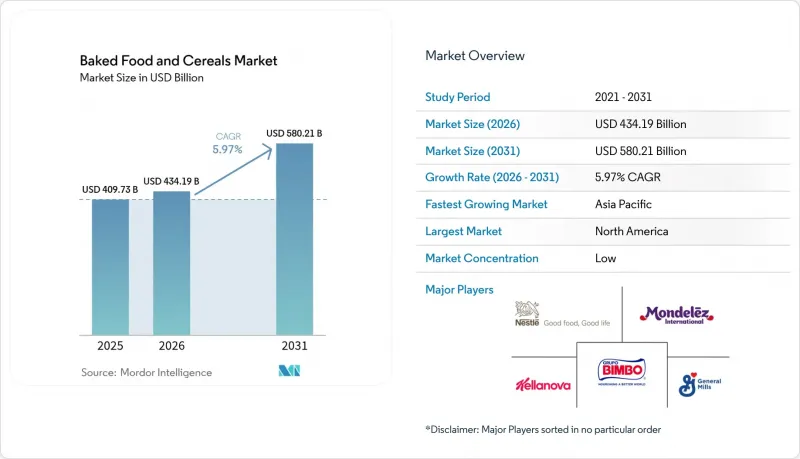
This report is Segmented by Product Type (Bread and Rolls, Cakes and Pastries, and More), Category (Conventional, Organic), Distribution Channel (Supermarket/Hypermarket, Specialist Store, Online Retail Store, Convenience Store, Others), and Geography (North America, Europe, Asia-Pacific, South America, Middle East and Africa). The Market Forecasts are Provided in Terms of Value (USD).
Global Baked Food And Cereals Market Trends and Insights
Growing Consumer Demand for Convenient and On-the-Go Breakfast and Snack Options
Urbanization and busy daily routines have made portable, shelf-stable food formats a common choice rather than a niche option. The United States Department of Agriculture reports that 83% of children and adults eat breakfast daily, often during their commute or at work This shift has encouraged manufacturers to create single-serve products that are both filling and nutritious, catering to changing eating habits that move away from traditional meal patterns. Retailers have adapted by increasing grab-and-go sections and chilled bakery areas to serve consumers looking for fresh, ready-to-eat options. The demand for convenience and nutrition has also led to innovations like protein-fortified biscuits and fiber-enriched breakfast bars, as brands strive to combine health benefits with good taste and texture. For example, Warburtons launched Protein Flatbreads in August 2024, targeting fitness-conscious consumers who value macronutrient-rich, portable food options.
Rising Interest in Organic and Clean-Label Baked Foods and Cereals
Regulatory standardization and increasing consumer concerns about synthetic additives are driving a shift toward organic and clean-label products. The organic food market in the European Union is growing at 6% annually, supported by unified certification frameworks across member states and more shelf space allocated by retailers. The United States Department of Agriculture's Organic Integrity Database lists over 41,000 certified operations worldwide, showing the significant supply chain changes needed to meet the demand for traceable and pesticide-free ingredients. A report by Puratos reveals that 73% of consumers prefer familiar ingredients in their food, highlighting a demand for simple and recognizable ingredient lists instead of complex chemical names. This preference also influences production methods, with sourdough fermentation becoming more popular for its ability to lower the glycemic index and improve mineral absorption without using synthetic additives.
Supply Chain Disruptions and Raw Material Price Volatility
Wheat supply issues and trade restrictions have caused significant instability in ingredient procurement. According to the Organisation for Economic Co-operation and Development and the Food and Agriculture Organization, global wheat stocks have fallen to 257.6 million metric tons, the lowest level in nine years. This drop has reduced supply reserves, making prices more vulnerable to weather changes and policy decisions. Following the Ukraine conflict, 63 food-related export restrictions were imposed, disrupting global trade and forcing importers to find alternative sources at higher costs. In the United States, the wheat season-average farm price for 2024/25 is projected to be between USD 5.55 and USD 5.60 per bushel. While relatively stable, this price remains higher than pre-pandemic levels, keeping costs elevated for millers and bakers. From October to December 2024, flour milling activity totaled 231 million bushels, a 2% increase from the previous year, reflecting strong demand that continues to strain supply and limit price relief.
Other drivers and restraints analyzed in the detailed report include:
- Expansion of E-Commerce and Digital Retail Channels
- Innovation in Product Formulations
- Perishability and Short Shelf Life
For complete list of drivers and restraints, kindly check the Table Of Contents.
Segment Analysis
Bread and rolls held a 34.68% market share in 2025, remaining a key category due to their widespread use in daily meals and affordability, which appeals to consumers across all income levels. Sourdough bread has seen growing demand because of its lower glycemic index and better mineral absorption, making it a popular choice for health-conscious consumers looking for nutritious options without compromising on taste or tradition. Premium products, featuring artisanal preparation and whole-grain ingredients, enable brands to stand out and maintain profitability despite competition from private-label alternatives.
Crackers and savory biscuits are expected to grow at a 6.98% CAGR from 2026 to 2031, driven by their increasing popularity as snacks and their versatility as meal accompaniments or standalone options. The demand for GMO-free crackers has grown at a positive rate, highlighting a strong consumer preference for clean-label products with simple and transparent ingredients, even at premium prices. Cheese crackers experience a seasonal surge in demand during December, while ongoing innovations in plant-based proteins and functional ingredients continue to drive steady growth throughout the year.
Complete Report Scope:
- Product Type
- Bread and Rolls
- Cakes and Pastries
- Biscuits and Cookies
- Breakfast Cereals
- Crackers and Savory Biscuits
- Others
- Category
- Conventional
- Organic
- Distribution Channel
- Supermarket/Hypermarket
- Specialist Store
- Online Retail Store
- Convenience Store
- Other Distribution Channels
- Geography
- North America
- United States
- Canada
- Mexico
- Rest of North America
- Europe
- Germany
- United Kingdom
- Italy
- France
- Spain
- Netherlands
- Poland
- Belgium
- Sweden
- Rest of Europe
- Asia-Pacific
- China
- India
- Japan
- Australia
- Indonesia
- South Korea
- Thailand
- Singapore
- Rest of Asia-Pacific
- South America
- Brazil
- Argentina
- Colombia
- Chile
- Peru
- Rest of South America
- Middle East and Africa
- South Africa
- Saudi Arabia
- United Arab Emirates
- Nigeria
- Egypt
- Morocco
- Turkey
- Rest of Middle East and Africa
- North America
Geography Analysis
In 2025, North America held a 36.18% market share, driven by high per-capita consumption of packaged bakery goods and efficient supply chains enabling broad distribution and strong promotions. The Supplemental Nutrition Assistance Program expanded online acceptance to more retailers, increasing digital access for low-income households and diversifying the e-commerce customer base for bakery and cereal products. U.S. digital grocery sales grew 18.4% year-over-year, with projections exceeding USD 330 billion by 2027, highlighting e-commerce's growing role in distribution and margins. W.K. Kellogg invested USD 500 million in supply chain upgrades across three plants to meet demand in both retail and direct-to-consumer channels. Canada and Mexico added volume, with Mexico benefiting from proximity to U.S. manufacturing hubs, enhancing cross-border supply chain efficiency.
Asia-Pacific is projected to grow at an 8.36% CAGR from 2026 to 2031, driven by rising incomes, urbanization, and the adoption of Western breakfast habits. China and India offer significant opportunities as middle-class consumers seek convenience and branded packaged foods. Japan's mature market supports demand for premium bakery products, while Australia's grocery sector, led by Coles and Woolworths, ensures stable distribution for local and imported brands. In 2024, Nissin Foods acquired ABC Pastry in Australia for AUD 33.7 million (USD 22.5 million) and Gaemi Food in South Korea for USD 35 million, reflecting Japanese manufacturers' focus on regional growth through local acquisitions. Urbanization and modern retail formats in Indonesia, Thailand, and Singapore further drive incremental growth.
Europe sustained its position through premiumization and organic product expansion. The U.K. saw growth in specialty bakery formats, with consumers willing to pay more for quality and craftsmanship. Warburtons launched Belgian Waffles in September 2024 and Protein Flatbreads in August 2024, catering to demand for indulgent and functional products at premium prices. Germany, Italy, France, Spain, and the Netherlands remain key markets, while Poland and Belgium show growth potential as incomes rise. In Brazil, wheat products account for 5% of food processing output, with clean-label and plant-based trends gaining traction among urban consumers. Argentina, Colombia, Chile, and Peru contribute volume but face challenges from economic instability and currency fluctuations. In the Middle East and Africa, Saudi Arabia, the UAE, and Turkey lead demand for packaged bakery goods, supported by expatriates and tourism. Egypt's flour milling capacity and Nigeria's large population offer long-term potential, though infrastructure and import reliance limit short-term growth.
- Grupo Bimbo, S.A.B. de C.V.
- Kellanova
- General Mills, Inc.
- Mondelez International, Inc.
- Nestle S.A.
- Aryzta AG
- Yamazaki Baking Company, Ltd.
- Flowers Foods, Inc.
- The Campbell Soup Company
- Barilla Group
- Associated British Foods plc
- Post Holdings, Inc.
- The Hain Celestial Group, Inc.
- Britannia Industries Limited
- Conagra Brands, Inc.
- Hostess Brands, Inc.
- Warburtons Limited
- Grupo Nutresa S.A.
- Pladis Global Limited
- Nature's Path Foods
Additional Benefits:
- The market estimate (ME) sheet in Excel format
- 3 months of analyst support
TABLE OF CONTENTS
1 INTRODUCTION
- 1.1 Study Assumptions and Market Definition
- 1.2 Scope of the Study
2 RESEARCH METHODOLOGY
3 EXECUTIVE SUMMARY
4 MARKET LANDSCAPE
- 4.1 Market Overview
- 4.2 Market Drivers
- 4.2.1 Growing consumer demand for convenient and on-the-go breakfast and snack options
- 4.2.2 Rising interest in organic and clean-label baked foods and cereals
- 4.2.3 Expansion of e-commerce and digital retail channels
- 4.2.4 Innovation in product formulations
- 4.2.5 Rising consumer shift towards snacking culture
- 4.2.6 Growing popularity of artisanal and specialty bakery products
- 4.3 Market Restraints
- 4.3.1 Highly fragmented market with intense competition
- 4.3.2 Supply chain disruptions and raw material price volatility
- 4.3.3 Perishability and short shelf life
- 4.3.4 Health concerns over gluten and allergen content
- 4.4 Supply Chain Analysis
- 4.5 Regulatory Landscape
- 4.6 Technological Outlook
- 4.7 Porter's Five Forces Analysis
- 4.7.1 Threat of New Entrants
- 4.7.2 Bargaining Power of Buyers
- 4.7.3 Bargaining Power of Suppliers
- 4.7.4 Threat of Substitutes
- 4.7.5 Intensity of Competitive Rivalry
5 MARKET SIZE AND GROWTH FORECASTS (VALUE)
- 5.1 Product Type
- 5.1.1 Bread and Rolls
- 5.1.2 Cakes and Pastries
- 5.1.3 Biscuits and Cookies
- 5.1.4 Breakfast Cereals
- 5.1.5 Crackers and Savory Biscuits
- 5.1.6 Others
- 5.2 Category
- 5.2.1 Conventional
- 5.2.2 Organic
- 5.3 Distribution Channel
- 5.3.1 Supermarket/Hypermarket
- 5.3.2 Specialist Store
- 5.3.3 Online Retail Store
- 5.3.4 Convenience Store
- 5.3.5 Other Distribution Channels
- 5.4 Geography
- 5.4.1 North America
- 5.4.1.1 United States
- 5.4.1.2 Canada
- 5.4.1.3 Mexico
- 5.4.1.4 Rest of North America
- 5.4.2 Europe
- 5.4.2.1 Germany
- 5.4.2.2 United Kingdom
- 5.4.2.3 Italy
- 5.4.2.4 France
- 5.4.2.5 Spain
- 5.4.2.6 Netherlands
- 5.4.2.7 Poland
- 5.4.2.8 Belgium
- 5.4.2.9 Sweden
- 5.4.2.10 Rest of Europe
- 5.4.3 Asia-Pacific
- 5.4.3.1 China
- 5.4.3.2 India
- 5.4.3.3 Japan
- 5.4.3.4 Australia
- 5.4.3.5 Indonesia
- 5.4.3.6 South Korea
- 5.4.3.7 Thailand
- 5.4.3.8 Singapore
- 5.4.3.9 Rest of Asia-Pacific
- 5.4.4 South America
- 5.4.4.1 Brazil
- 5.4.4.2 Argentina
- 5.4.4.3 Colombia
- 5.4.4.4 Chile
- 5.4.4.5 Peru
- 5.4.4.6 Rest of South America
- 5.4.5 Middle East and Africa
- 5.4.5.1 South Africa
- 5.4.5.2 Saudi Arabia
- 5.4.5.3 United Arab Emirates
- 5.4.5.4 Nigeria
- 5.4.5.5 Egypt
- 5.4.5.6 Morocco
- 5.4.5.7 Turkey
- 5.4.5.8 Rest of Middle East and Africa
- 5.4.1 North America
6 COMPETITIVE LANDSCAPE
- 6.1 Market Concentration
- 6.2 Strategic Moves
- 6.3 Market Share Analysis
- 6.4 Company Profiles (includes Global level Overview, Market level overview, Core Segments, Financials as available, Strategic Information, Market Rank/Share for key companies, Products and Services, and Recent Developments)
- 6.4.1 Grupo Bimbo, S.A.B. de C.V.
- 6.4.2 Kellanova
- 6.4.3 General Mills, Inc.
- 6.4.4 Mondelez International, Inc.
- 6.4.5 Nestle S.A.
- 6.4.6 Aryzta AG
- 6.4.7 Yamazaki Baking Company, Ltd.
- 6.4.8 Flowers Foods, Inc.
- 6.4.9 The Campbell Soup Company
- 6.4.10 Barilla Group
- 6.4.11 Associated British Foods plc
- 6.4.12 Post Holdings, Inc.
- 6.4.13 The Hain Celestial Group, Inc.
- 6.4.14 Britannia Industries Limited
- 6.4.15 Conagra Brands, Inc.
- 6.4.16 Hostess Brands, Inc.
- 6.4.17 Warburtons Limited
- 6.4.18 Grupo Nutresa S.A.
- 6.4.19 Pladis Global Limited
- 6.4.20 Nature's Path Foods
7 MARKET OPPORTUNITIES AND FUTURE OUTLOOK

