PUBLISHER: Mordor Intelligence | PRODUCT CODE: 2113981

PUBLISHER: Mordor Intelligence | PRODUCT CODE: 2113981
Non-alcoholic Steatohepatitis Therapeutics And Diagnostics - Market Share Analysis, Industry Trends & Statistics, Growth Forecasts (2026 - 2031)
According to Mordor Intelligence, the nonalcoholic steatohepatitis therapeutics and diagnostics market size is expected to grow from USD 5.81 billion in 2025 to USD 6.87 billion in 2026 and is forecast to reach USD 15.93 billion by 2031 at 18.31% CAGR over 2026-2031.
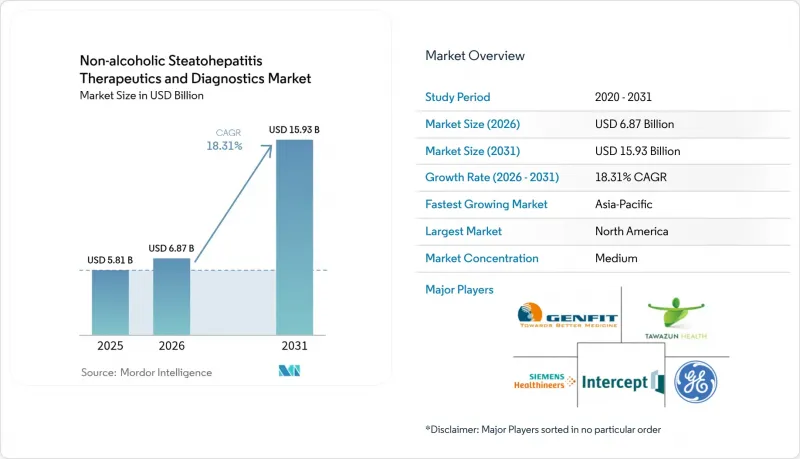
This report is Segmented by Solution (Therapeutics, Diagnostics), End User (Hospitals & Clinics, Diagnostic Centers, Academic & Research Institutes, Others), and Geography (North America, Europe, Asia-Pacific, South America, Middle East and Africa). The Market Forecasts are Provided in Terms of Value (USD).
Global Non-alcoholic Steatohepatitis Therapeutics And Diagnostics Market Trends and Insights
Rising Prevalence of Obesity & Metabolic Syndrome
Obesity and metabolic dysfunction now affect close to one-third of the global population, creating an expanding clinical pool for MASLD and, by progression, nonalcoholic steatohepatitis. The demographic tilt toward younger cohorts accelerates fibrosis at earlier ages and stretches lifetime treatment windows. Latin America illustrates the trend as prevalence nears 24%, driving payer interest in community-level screening programs. U.S. projections indicate 27 million affected adults by 2030, a 63% jump versus 2015, redefining transplant-planning models and stimulating commercial urgency. Governments and professional societies respond by integrating fibrosis scores into primary-care check-ups, further enlarging addressable volumes for both diagnostics and therapeutics.
Advancement in Non-Invasive Diagnostic Technologies
Market momentum pivots around rapid adoption of blood-based panels and elastography that replace invasive liver biopsy. Roche's Elecsys PRO-C3 returns fibrosis staging in 18 minutes, enabling same-visit clinical decisions and widening provider acceptance. AI algorithms now mine electronic health records to flag undiagnosed MASLD with 83% accuracy, adding scale without incremental imaging capacity. FibroScan, ELF, and FIB-4 scores are embedded in new treatment guidelines across the U.S. and Europe, prompting laboratories to upgrade equipment portfolios. Earlier detection increases therapeutic eligibility pools and underpins value-based reimbursement arguments that emphasize avoided transplant costs.
High Late-Stage Drug-Trial Failure Rate
Historical attrition has eroded investor sentiment each time a promising candidate underperformed in Phase 2b or Phase 3. Akero's efruxifermin missed key fibrosis endpoints with response rates of 18-29% versus 13% placebo, reviving concerns over surrogate markers versus hard histological outcomes. Companies react by tightening inclusion criteria, but smaller sample sizes raise statistical-power questions that regulators scrutinize. The cyclical pattern of hype and disappointment elongates development timelines, tempers deal valuations, and moderates the Nonalcoholic Steatohepatitis therapeutics and diagnostics market growth curve despite headline breakthroughs.
Other drivers and restraints analyzed in the detailed report include:
- Payer Willingness to Reimburse Biomarker Tests
- Combination-Therapy Pipeline Expansion
- Uncertain Reimbursement for Novel Diagnostics
For complete list of drivers and restraints, kindly check the Table Of Contents.
Segment Analysis
Diagnostics retained 59.85% revenue share in 2025 on the strength of widespread use of elastography and blood-based panels across primary and secondary care sites. Nevertheless, therapeutics exhibit the fastest momentum, expanding at a 19.11% CAGR, powered initially by resmetirom's launch. Within the solution stack, imaging tests and biomarker assays continue to diversify, while biopsy volumes contract as clinicians shift to guideline-endorsed non-invasive monitoring. Resmetirom generated USD 137 million in Q1 2025 alone, proving willingness to pay even at an annual USD 47,400 price point. Pipeline depth in GLP-1, THR-B, and FGF21 classes suggests sustained innovation cycles that can progressively narrow fibrosis progression rates.
Expanded therapeutic access is expected to rebalance spending patterns such that therapeutics account for the larger share of the nonalcoholic Steatohepatitis therapeutics and diagnostics market size by late-decade. The current gap between diagnosis and treatment adoption generates pent-up demand suited to first-in-class entrants. Diagnostics still accrue steady transactional revenue from repeat fibrosis monitoring; however, growth rates taper as market saturation rises in high-income countries. Technology suppliers pivot to value-added analytics and longitudinal patient-management platforms to protect margins. Multimodal diagnostic algorithms that integrate imaging, serum biomarkers, and electronic health record data differentiate service offerings and lock-in provider relationships.
Complete Report Scope:
- By Solution (Value)
- Therapeutics
- By Drug Class
- FXR Agonists
- THR-B Agonists
- GLP-1 Agonists
- Others
- By Drug Class
- Diagnostics
- By Diagnostic Modality
- Imaging Tests
- Biomarker-based Blood Tests
- Liver Biopsy
- Elastography
- By Diagnostic Modality
- Therapeutics
- By End User (Value)
- Hospitals & Clinics
- Diagnostic Centers
- Academic & Research Institutes
- Others
- By Geography (Value)
- North America
- United States
- Canada
- Mexico
- Europe
- Germany
- United Kingdom
- France
- Italy
- Spain
- Rest of Europe
- Asia-Pacific
- China
- India
- Japan
- South Korea
- Australia
- Rest of Asia-Pacific
- South America
- Brazil
- Argentina
- Rest of South America
- Middle East and Africa
- GCC
- South Africa
- Rest of Middle East and Africa
- North America
Geography Analysis
North America retained its 36.78% revenue lead in 2025, underpinned by early regulatory approvals, broad insurance coverage, and high obesity prevalence. U.S. hepatologists rapidly incorporated resmetirom into practice after March 2024 approval, elevating prescription volumes even before full guideline integration. Canada mirrors trends on a smaller scale, benefitting from centralized health-technology assessments that green-light non-invasive diagnostics for provincial coverage. The region's innovation ecosystem, anchored by Boston and San Diego biotech clusters, ensures a continual influx of trial candidates and venture capital, reinforcing first-mover advantages in therapeutics and AI-powered diagnostics.
Europe contributes steady, mid-teen revenue shares with Germany, the United Kingdom, and France accounting for the bulk of uptake. EMA approval of resmetirom, anticipated mid-2025, will unlock pent-up demand. National reimbursement agencies are already modeling budget impacts, suggesting quicker formulary listings than seen with earlier metabolic drugs. Non-invasive diagnostic penetration is mature, yet opportunities remain in integrating AI-triaged imaging into regional liver networks to tackle workforce shortages. Parallel import regulations may exert mild downward pressure on launch prices, but volume growth is expected to compensate.
Asia-Pacific is the fastest-growing theatre, set to surge at a 18.67% CAGR as diabetes and obesity climb across China, India, and Southeast Asia. Multinational companies localize clinical trials to satisfy diverse ethnic profiles and streamline China's National Medical Products Administration approvals. Madrigal's July 2025 USD 2 billion licensing pact with CSPC exemplifies route-to-market strategies that combine local manufacturing with multinational science. Government prevention programs and growing middle-class awareness enlarge screening volumes for fibrosis tests. Australia and South Korea, with advanced reimbursement systems, act as gateway markets for new diagnostics before broader regional rollout.
South America and the Middle East & Africa collectively represent nascent but rising prospects. Brazil's public-private hospital model experiments with capitated payments that reward early fibrosis detection. GCC nations invest in specialty liver centers, leveraging high per-capita health spending to adopt latest diagnostics. However, reimbursement fragmentation and workforce imbalances temper near-term gains, keeping their combined share in single digits through 2031.
- Madrigal Pharmaceuticals Inc.
- Gilead Sciences
- Novo Nordisk
- Intercept Pharmaceuticals
- Akero Therapeutics Inc.
- Viking Therapeutics Inc.
- Terns Pharmaceuticals Inc.
- Eli Lilly and Company
- Novartis
- Pfizer
- Galectin Therapeutics Inc.
- 89bio Inc.
- Regeneron Pharmaceuticals
- Roche
- Siemens Healthineers
- Abbott Laboratories
- Echosens SA
- Quest Diagnostics
Additional Benefits:
- The market estimate (ME) sheet in Excel format
- 3 months of analyst support
TABLE OF CONTENTS
1 Introduction
- 1.1 Study Assumptions & Market Definition
- 1.2 Scope of the Study
2 Research Methodology
3 Executive Summary
4 Market Landscape
- 4.1 Market Overview
- 4.2 Market Drivers
- 4.2.1 Rising prevalence of obesity & metabolic syndrome
- 4.2.2 Advancement in non-invasive diagnostic technologies
- 4.2.3 Accelerated clinical trials & fast-track designations
- 4.2.4 Payer willingness to reimburse biomarker tests
- 4.2.5 Combination-therapy pipeline expansion
- 4.2.6 AI-enabled imaging partnerships with liver clinics
- 4.3 Market Restraints
- 4.3.1 High late-stage drug-trial failure rate
- 4.3.2 Uncertain reimbursement for novel diagnostics
- 4.3.3 Limited patient awareness & under-diagnosis
- 4.3.4 Stringent histological endpoint requirements
- 4.4 Value / Supply-Chain Analysis
- 4.5 Regulatory Landscape
- 4.6 Technological Outlook
- 4.7 Porter's Five Forces
- 4.7.1 Threat of New Entrants
- 4.7.2 Bargaining Power of Suppliers
- 4.7.3 Bargaining Power of Buyers
- 4.7.4 Threat of Substitutes
- 4.7.5 Competitive Rivalry
5 Market Size & Growth Forecasts
- 5.1 By Solution (Value)
- 5.1.1 Therapeutics
- 5.1.1.1 By Drug Class
- 5.1.1.1.1 FXR Agonists
- 5.1.1.1.2 THR-B Agonists
- 5.1.1.1.3 GLP-1 Agonists
- 5.1.1.1.4 Others
- 5.1.1.1 By Drug Class
- 5.1.2 Diagnostics
- 5.1.2.1 By Diagnostic Modality
- 5.1.2.1.1 Imaging Tests
- 5.1.2.1.2 Biomarker-based Blood Tests
- 5.1.2.1.3 Liver Biopsy
- 5.1.2.1.4 Elastography
- 5.1.2.1 By Diagnostic Modality
- 5.1.1 Therapeutics
- 5.2 By End User (Value)
- 5.2.1 Hospitals & Clinics
- 5.2.2 Diagnostic Centers
- 5.2.3 Academic & Research Institutes
- 5.2.4 Others
- 5.3 By Geography (Value)
- 5.3.1 North America
- 5.3.1.1 United States
- 5.3.1.2 Canada
- 5.3.1.3 Mexico
- 5.3.2 Europe
- 5.3.2.1 Germany
- 5.3.2.2 United Kingdom
- 5.3.2.3 France
- 5.3.2.4 Italy
- 5.3.2.5 Spain
- 5.3.2.6 Rest of Europe
- 5.3.3 Asia-Pacific
- 5.3.3.1 China
- 5.3.3.2 India
- 5.3.3.3 Japan
- 5.3.3.4 South Korea
- 5.3.3.5 Australia
- 5.3.3.6 Rest of Asia-Pacific
- 5.3.4 South America
- 5.3.4.1 Brazil
- 5.3.4.2 Argentina
- 5.3.4.3 Rest of South America
- 5.3.5 Middle East and Africa
- 5.3.5.1 GCC
- 5.3.5.2 South Africa
- 5.3.5.3 Rest of Middle East and Africa
- 5.3.1 North America
6 Competitive Landscape
- 6.1 Market Concentration
- 6.2 Market Share Analysis
- 6.3 Company Profiles (includes Global level Overview, Market level overview, Core Segments, Financials as available, Strategic Information, Market Rank/Share for key companies, Products & Services, and Recent Developments)
- 6.3.1 Madrigal Pharmaceuticals Inc.
- 6.3.2 Gilead Sciences Inc.
- 6.3.3 Novo Nordisk A/S
- 6.3.4 Intercept Pharmaceuticals Inc.
- 6.3.5 Akero Therapeutics Inc.
- 6.3.6 Viking Therapeutics Inc.
- 6.3.7 Terns Pharmaceuticals Inc.
- 6.3.8 Eli Lilly and Company
- 6.3.9 Novartis AG
- 6.3.10 Pfizer Inc.
- 6.3.11 Galectin Therapeutics Inc.
- 6.3.12 89bio Inc.
- 6.3.13 Regeneron Pharmaceuticals Inc.
- 6.3.14 Roche Holding AG
- 6.3.15 Siemens Healthineers AG
- 6.3.16 Abbott Laboratories
- 6.3.17 Echosens SA
- 6.3.18 Quest Diagnostics Inc.
7 Market Opportunities & Future Outlook
- 7.1 White-space & Unmet-Need Assessment

