PUBLISHER: Mordor Intelligence | PRODUCT CODE: 2113995

PUBLISHER: Mordor Intelligence | PRODUCT CODE: 2113995
Aesthetic Fillers - Market Share Analysis, Industry Trends & Statistics, Growth Forecasts (2026 - 2031)
According to Mordor Intelligence, the aesthetic fillers market size is expected to grow from USD 3.75 billion in 2025 to USD 3.96 billion in 2026 and is forecast to reach USD 5.51 billion by 2031 at 6.83% CAGR over 2026-2031.
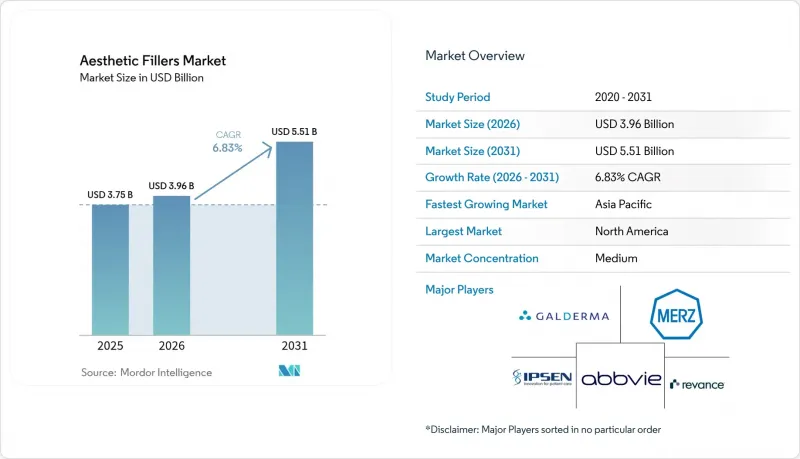
This report is Segmented by Material (Hyaluronic Acid, Calcium Hydroxylapatite, Poly-L-Lactic Acid, Polymethyl-Methacrylate, Collagen & Others), Application (Facial Line Correction, and More), End User (Dermatology & Cosmetic Surgery Clinics, and More), Gender (Female, Male), and Geography (North America, and More). The Market Forecasts are Provided in Terms of Value (USD).
Global Aesthetic Fillers Market Trends and Insights
Rising Demand for Minimally Invasive Cosmetic Procedures
Practitioners and patients favor fillers over surgical facelifts because downtime drops from weeks to hours, a trade-off that resonates when work and social calendars leave little recovery space. Millennials and Gen Z seek preventive volumization in their late twenties, expanding lifetime treatment cycles and smoothing clinic revenue. FDA pre-market approvals create a quality floor, yet enforcement gaps allow gray-market syringes to persist online. Technology-driven consultation tools reduce chair time and help practices scale volume without proportionate labor increases. Collectively, these forces keep the aesthetic filler market on a double-digit procedure-growth trajectory even when macroeconomics soften discretionary budgets.
Aging Population Seeking Anti-Ageing Solutions
Japan's health ministry projects that 31% of its residents will be 65 or older by 2030, and similar demographic inversion is unfolding in Western Europe. Older consumers use facial fillers to align appearance with extended careers and active retirement lifestyles. Poly-L-lactic acid attracts this cohort because it triggers collagen synthesis lasting up to 24 months, outpacing HA's durability. Pension assets cushion out-of-pocket spending, while social acceptance of "aging well" lowers stigma. Clinics exploit this demand with bundled annual maintenance plans that lock in repeat visits and stable cash flow.
Adverse Events & Stricter Regulatory Scrutiny
Vascular occlusion remains the gravest filler complication; 58% of affected patients lose vision permanently, prompting FDA safety communications and EU annual safety-report mandates. National seizures of counterfeit vials reached 4,700 in the United Kingdom by August 2025. Compliance costs escalate as manufacturers submit real-world performance data and fund practitioner-training grants. Small brands without regulatory teams face margin compression, nudging market consolidation.
Other drivers and restraints analyzed in the detailed report include:
- Growing Disposable Incomes in Emerging Economies
- Regenerative-Medicine Fillers with Stem-Cell Matrices Gaining Traction
- High Procedure Costs in Price-Sensitive Markets
For complete list of drivers and restraints, kindly check the Table Of Contents.
Segment Analysis
Hyaluronic acid captured 62.57% of the aesthetic filler market share in 2025 owing to reversibility and broad indications. Poly-L-lactic acid leads growth at a 10.53% CAGR, buoyed by Galderma's 2024 Sculptra acquisition and clinical proof of 24-month collagen stimulation. Calcium hydroxylapatite enjoys renewed interest in hyper-dilute protocols for skin quality, while PMMA remains niche due to permanence risks.
Regenerative blends that add stem-cell exosomes to HA promise to extend the aesthetic filler market size for premium biostimulatory offerings. FDA biologic classification hikes regulatory hurdles, yet early South Korean adopters report higher patient retention. Self-cross-linked HA removes BDDE but requires rigorous batch control. Material-choice diversity widens practitioner toolkits and cushions market growth against any single polymer's regulatory shock.
Facial line correction held 44.72% of 2025 revenue, but contouring and volume restoration is growing at 9.25% CAGR as millennials seek preventive structure in the aesthetic filler market. Lip enhancement remains visible, although subtle reshaping replaces earlier dramatic trends.
Liquid facelift protocols that deploy multiple syringes across cheeks, jawline, and temples raise per-visit spend, pushing up the aesthetic filler market size per patient episode. FDA approval of under-eye formulas opened a challenging yet lucrative anatomical niche. Off-label nose and chin sculpting expands use cases but demands advanced anatomy skills to avoid vascular events.
Complete Report Scope:
- By Material
- Hyaluronic Acid (HA)
- Calcium Hydroxylapatite (CaHA)
- Poly-L-lactic Acid (PLLA)
- Polymethyl-methacrylate (PMMA)
- Collagen & Others
- By Application
- Facial Line Correction
- Lip Enhancement
- Facial Contouring / Volume Restoration
- Scar & Acne Mark Revision
- Others
- By End User
- Dermatology & Cosmetic Surgery Clinics
- Hospitals
- Medical Spa & Beauty Clinics
- By Gender
- Female
- Male
- By Geography
- North America
- United States
- Canada
- Mexico
- Europe
- Germany
- France
- United Kingdom
- Italy
- Spain
- Rest of Europe
- Asia-Pacific
- China
- Japan
- India
- South Korea
- Australia
- Rest of Asia-Pacific
- Middle East & Africa
- GCC
- South Africa
- Rest of Middle East & Africa
- South America
- Brazil
- Argentina
- Rest of South America
- North America
Geography Analysis
North America generated 34.83% of global revenue in 2025, underpinned by robust per-capita spend, broad FDA approvals, and 5.3 million HA sessions logged in 2024. Canada mirrors U.S. pathways but varies injector scope by province. Mexico draws cost-conscious U.S. tourists, although counterfeit risks temper volumes. Ongoing FDA e-commerce crackdowns highlight enforcement gaps in cross-border sales.
Asia-Pacific is projected to grow at 9.04% CAGR, led by China's domestic-brand approvals that slice syringe prices by 30%. South Korea funnels medical tourists into AI-enabled 3D scanning clinics, while Japan's aging demographics sustain premium collagen-induction demand despite cultural caution. India's Central Drugs Standard Control Organisation is modernizing trials, yet income disparity limits conversion rates. Australia's tight post-market surveillance positions it as a regional quality gatekeeper.
Europe shows steady but slower growth as the EMA intensifies post-market reporting. Germany, France, and the United Kingdom anchor demand, backed by partial reimbursement for reconstructive uses. The UK regulator seized 4,700 counterfeit vials by August 2025, illustrating the region's vigilance. In the Middle East, Saudi Arabia and the UAE leverage Vision 2030 tourism strategies to bundle fillers with luxury services. Latin America remains dominated by Brazil's culturally normalized filler culture, while Argentina and Chile face macro-volatility headwinds.
- AbbVie (Allergan Aesthetics)
- Anika Therapeutics
- Bloomage Biotechnology
- Croma-Pharma
- Evolus Inc.
- Filorga
- Galderma
- Huadong Medicine (Bohus)
- Hugel Inc
- Huons Bio
- Ipsen
- LG Chem
- Merz Pharma
- Prollenium Medical
- Revance Therapeutics
- Shanghai Rhong
- Sinclair Pharma
- Suneva Medical
- Teoxane Laboratories
- Zhejiang Jingjia Medical
Additional Benefits:
- The market estimate (ME) sheet in Excel format
- 3 months of analyst support
TABLE OF CONTENTS
1 Introduction
- 1.1 Study Assumptions & Market Definition
- 1.2 Scope of the Study
2 Research Methodology
3 Executive Summary
4 Market Landscape
- 4.1 Market Overview
- 4.2 Market Drivers
- 4.2.1 Rising Demand for Minimally-Invasive Cosmetic Procedures
- 4.2.2 Aging Population Seeking Anti-Ageing Solutions
- 4.2.3 Growing Disposable Incomes in Emerging Economies
- 4.2.4 Regenerative-Medicine Fillers with Stem-Cell Matrices Gaining Traction
- 4.2.5 Male-Focused Aesthetic Marketing Expanding Addressable Base
- 4.2.6 AI-Assisted Injection Planning & 3D Facial Analytics Enhancing Treatment Precision
- 4.3 Market Restraints
- 4.3.1 Adverse Events & Stricter Regulatory Scrutiny
- 4.3.2 High Procedure Costs in Price-Sensitive Markets
- 4.3.3 Supply-Chain Risk for HA Raw Materials
- 4.3.4 Proliferation of Counterfeit & Gray-Market Fillers Undermines Patient Safety
- 4.4 Value / Supply-chain Analysis
- 4.5 Regulatory Landscape
- 4.6 Technological Outlook
- 4.7 Porter's Five Forces Analysis
- 4.7.1 Threat of New Entrants
- 4.7.2 Bargaining Power of Suppliers
- 4.7.3 Bargaining Power of Buyers
- 4.7.4 Threat of Substitutes
- 4.7.5 Intensity of Competitive Rivalry
5 Market Size & Growth Forecasts (Value in USD)
- 5.1 By Material
- 5.1.1 Hyaluronic Acid (HA)
- 5.1.2 Calcium Hydroxylapatite (CaHA)
- 5.1.3 Poly-L-lactic Acid (PLLA)
- 5.1.4 Polymethyl-methacrylate (PMMA)
- 5.1.5 Collagen & Others
- 5.2 By Application
- 5.2.1 Facial Line Correction
- 5.2.2 Lip Enhancement
- 5.2.3 Facial Contouring / Volume Restoration
- 5.2.4 Scar & Acne Mark Revision
- 5.2.5 Others
- 5.3 By End User
- 5.3.1 Dermatology & Cosmetic Surgery Clinics
- 5.3.2 Hospitals
- 5.3.3 Medical Spa & Beauty Clinics
- 5.4 By Gender
- 5.4.1 Female
- 5.4.2 Male
- 5.5 By Geography
- 5.5.1 North America
- 5.5.1.1 United States
- 5.5.1.2 Canada
- 5.5.1.3 Mexico
- 5.5.2 Europe
- 5.5.2.1 Germany
- 5.5.2.2 France
- 5.5.2.3 United Kingdom
- 5.5.2.4 Italy
- 5.5.2.5 Spain
- 5.5.2.6 Rest of Europe
- 5.5.3 Asia-Pacific
- 5.5.3.1 China
- 5.5.3.2 Japan
- 5.5.3.3 India
- 5.5.3.4 South Korea
- 5.5.3.5 Australia
- 5.5.3.6 Rest of Asia-Pacific
- 5.5.4 Middle East & Africa
- 5.5.4.1 GCC
- 5.5.4.2 South Africa
- 5.5.4.3 Rest of Middle East & Africa
- 5.5.5 South America
- 5.5.5.1 Brazil
- 5.5.5.2 Argentina
- 5.5.5.3 Rest of South America
- 5.5.1 North America
6 Competitive Landscape
- 6.1 Market Concentration
- 6.2 Market Share Analysis
- 6.3 Company Profiles (includes Global level Overview, Market level overview, Core Segments, Financials as available, Strategic Information, Market Rank/Share for key companies, Products and Services, and Recent Developments)
- 6.3.1 AbbVie (Allergan Aesthetics)
- 6.3.2 Anika Therapeutics
- 6.3.3 Bloomage Biotechnology
- 6.3.4 Croma-Pharma
- 6.3.5 Evolus Inc.
- 6.3.6 Filorga
- 6.3.7 Galderma
- 6.3.8 Huadong Medicine (Bohus)
- 6.3.9 Hugel Inc
- 6.3.10 Huons Bio
- 6.3.11 Ipsen
- 6.3.12 LG Chem
- 6.3.13 Merz Pharma
- 6.3.14 Prollenium Medical
- 6.3.15 Revance Therapeutics
- 6.3.16 Shanghai Rhong
- 6.3.17 Sinclair Pharma
- 6.3.18 Suneva Medical
- 6.3.19 Teoxane
- 6.3.20 Zhejiang Jingjia Medical
7 Market Opportunities & Future Outlook
- 7.1 White-space & Unmet-need Assessment

