PUBLISHER: Mordor Intelligence | PRODUCT CODE: 2113996

PUBLISHER: Mordor Intelligence | PRODUCT CODE: 2113996
Gas Engine - Market Share Analysis, Industry Trends & Statistics, Growth Forecasts (2026 - 2031)
According to Mordor Intelligence, the gas engine market size is estimated at USD 6.25 billion in 2026, and is expected to reach USD 8.26 billion by 2031, at a CAGR of 5.74% during the forecast period (2026-2031).
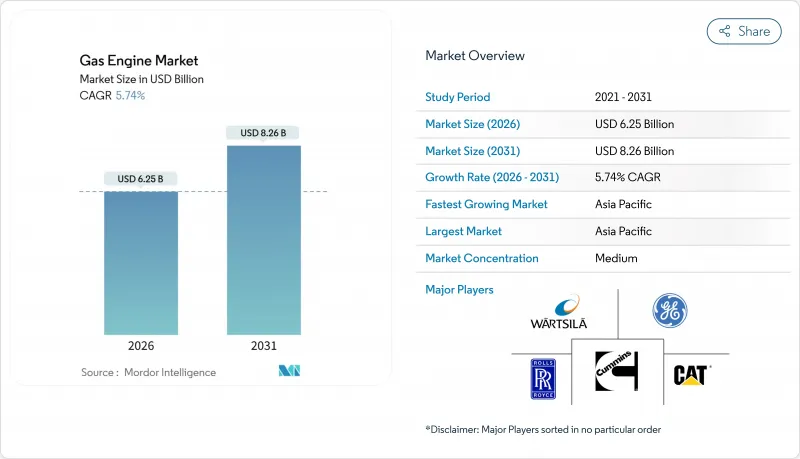
This report is Segmented by Fuel Type (Natural Gas, Hydrogen and Hydrogen Blends, and More), Engine Type (Spark-Ignited, Lean-Burn, and More), Power Output (2 To 5 MW, Above 5 MW, and More), Application (Power Generation, Decentralized/Distributed Energy Generation, Transportation/Automotive Engines, and More), End-User (Utilities, Industrial, and More), and Geography (North America, Europe, Asia-Pacific, and More)
Global Gas Engine Market Trends and Insights
Surplus Shale & LNG Availability Keeps Fuel Prices Competitive
Delivered pipeline gas averaged below USD 4/MMBtu in U.S. industrial hubs during 2025, a 30-40% discount to diesel on an energy-equivalent basis, steering CHP projects toward gas engines for petrochemical and food-processing complexes. Long-term LNG contracts at USD 10-12/MMBtu signed by India and Thailand in 2024 further stabilized input costs for Asian buyers and de-risked multi-MW installations. Global LNG trade is expected to grow 4% annually to 2030, ensuring adequate supply, although geopolitical pipeline outages can generate short-run price spikes that postpone capacity additions.
Stricter Global NOx and SOx Emission Caps Versus Diesel Gensets
The EPA's Tier 4 standards cap NOx at 0.67 g/bhp-hr, a threshold that diesel units meet only with expensive after-treatment. EU Stage V rules impose similar limits plus particulate controls, pushing operators toward lean-burn gas engines. China's GB 20891-2024 standard tightens NOx to 1.5 g/kWh for engines above 560 kW, accelerating replacement of diesel backup sets in Hebei and Shandong. Compliance costs for diesel retrofits can exceed USD 100,000 per MW, whereas new gas engines meet the limits with lower capital outlay.
Falling LCOE of Renewables-Plus-Storage Undermines Baseload Gas
Solar-plus-battery projects achieved levelized costs below USD 50 per MWh in Texas and Australia during 2025, undercutting the USD 60-70 per MWh economics of gas baseload plants. NextEra canceled a 400 MW gas project in Florida, redirecting funds to a 600 MW solar-plus-battery site. Battery costs fell to USD 150 per kWh in 2024, enabling four-hour systems that compete with gas peakers in high-renewable grids. Gas engines retain an edge in seasonal storage or low-sun regions, but economics hinge on fuel prices and carbon policies.
Other drivers and restraints analyzed in the detailed report include:
- Distributed CHP Policies Accelerating Utility and Industrial Demand
- Hydrogen-Ready Engine Retrofits for Deep Decarbonization of Assets
- Volatile Global Natural-Gas Pricing and Supply-Chain Disruptions
For complete list of drivers and restraints, kindly check the Table Of Contents.
Segment Analysis
Natural gas contributed 61.8% of 2025 revenue, yet hydrogen and hydrogen blends are projected to expand at an 8.1% CAGR, steering the gas engine market toward lower-carbon combustion portfolios. The hydrogen-ready segment benefits from Germany's 12 GW tender pipeline, guaranteeing future offtake for dual-fuel assets.
Infrastructure limitations cap blend ratios at 5-20% in legacy pipelines, but on-site electrolysis and dedicated hydrogen networks are emerging workarounds. Special gases such as biogas and landfill gas occupy resilient niches where fuel is a waste by-product, sustaining stable margins despite modest volume growth.
Spark-ignited units held 48.1% gas engine market share in 2025, favored for stationary CHP where strict emissions codes apply. Dual-fuel designs are gaining share the fastest, advancing at 7.9% CAGR as marine and mining operators seek fuel-switch agility during supply shocks.
MAN Energy Solutions' 2024 order from Maersk for 24 methanol-ready engines exemplifies commercial appetite for cross-fuel configurations. High-pressure direct-injection systems also expand the addressable heavy-duty trucking segment, though capital costs remain a hurdle for budget-sensitive buyers.
Complete Report Scope:
- By Fuel Type
- Natural Gas
- Hydrogen and Hydrogen Blends
- Special Gas
- Others
- By Engine Type
- Spark-Ignited (SI) Gas Engines
- Dual-Fuel Engines
- High-Pressure Direct Injection (HPDI) Engines
- Lean-Burn Engines
- Microturbines/Gas Turbine Engines and Others
- By Power Output
- Up to 800 kW
- 800 kW to 2 MW
- 2 MW to 5 MW
- Above 5 MW
- By Application
- Power Generation (Base and Peak)
- Decentralized/Distributed Energy Generation
- Industrial Mechanical Drive
- Transportation/Automotive Engines
- Marine and Others
- By End-User Industry
- Utilities
- Industrial
- Commercial and Residential Buildings
- Transportation/Fleet Operators
- Marine and Others
- By Geography
- North America
- United States
- Canada
- Mexico
- Europe
- Germany
- France
- United Kingdom
- Spain
- NORDIC Countries
- Russia
- Rest of Europe
- Asia-Pacific
- China
- India
- Japan
- South Korea
- ASEAN Countries
- Rest of Asia-Pacific
- South America
- Brazil
- Argentina
- Rest of South America
- Middle East and Africa
- Saudi Arabia
- United Arab Emirates
- South Africa
- Rest of Middle East and Africa
- North America
Geography Analysis
Asia-Pacific led with 39.6% 2025 revenue and is projected to grow at a 7.0% CAGR through 2031, powered by China's mandatory replacement of 50 GW coal-fired boilers and India's 15 GW gas peaker program. ASEAN markets secure concessional finance from the Asian Development Bank, while Japan and South Korea leverage existing LNG chains for district-heating deployments.
Europe followed at 28% share, with growth centered on Germany's hydrogen-ready retrofits and Nordic district-heating investments. Spain and Italy are bolstering evening-peaking fleets to integrate Mediterranean solar, commissioning fast-start reciprocating portfolios.
North America contributed roughly 22% revenue; U.S. CHP tax credits and California's SGIP incentives sustain robust order intake for micro-grids and peaking duty. Canada's rising carbon price accelerates diesel-to-gas displacement in oil-sands compressors, while Mexico's CFE targets reliability gaps in Baja and Yucatan.
- Caterpillar Inc.
- Cummins Inc.
- INNIO (Jenbacher & Waukesha)
- Wartsila Oyj Abp
- Rolls-Royce plc (MTU Friedrichshafen)
- Mitsubishi Heavy Industries Ltd.
- Siemens Energy AG
- MAN Energy Solutions SE
- Kawasaki Heavy Industries Ltd.
- Hyundai Heavy Industries Co., Ltd.
- Yanmar Holdings Co., Ltd.
- Deutz AG
- Liebherr-Components AG
- Doosan Skoda Power
- Clarke Energy (Kohler Co.)
- Bergen Engines AS
- Qingdao Yuchai Power
- Guascor Energy (Siemens division)
- Fairbanks Morse Defense
- Tedom a.s.
Additional Benefits:
- The market estimate (ME) sheet in Excel format
- 3 months of analyst support
TABLE OF CONTENTS
1 Introduction
- 1.1 Study Assumptions & Market Definition
- 1.2 Scope of the Study
2 Research Methodology
3 Executive Summary
4 Market Landscape
- 4.1 Market Overview
- 4.2 Market Drivers
- 4.2.1 Surplus shale & LNG availability keeps fuel prices competitive
- 4.2.2 Stricter global NOx/SOx emission caps versus diesel gensets
- 4.2.3 Distributed CHP policies accelerating utility & industrial demand
- 4.2.4 Hydrogen-ready engine retrofits for deep-decarbonisation of assets
- 4.2.5 Micro-grid resilience projects for data-intensive facilities
- 4.2.6 AI-enabled predictive maintenance lowering lifecycle OPEX
- 4.3 Market Restraints
- 4.3.1 Falling LCOE of renewables-plus-storage undermines baseload gas
- 4.3.2 Volatile global natural-gas pricing & supply-chain disruptions
- 4.3.3 Prospective methane-slip taxation inflates true carbon cost
- 4.3.4 Rise of green-ammonia/methanol engines in marine segment
- 4.4 Supply-Chain Analysis
- 4.5 Regulatory Landscape
- 4.6 Technological Outlook
- 4.7 Porter's Five Forces
- 4.7.1 Bargaining Power of Suppliers
- 4.7.2 Bargaining Power of Buyers
- 4.7.3 Threat of New Entrants
- 4.7.4 Threat of Substitutes
- 4.7.5 Competitive Rivalry
5 Market Size & Growth Forecasts
- 5.1 By Fuel Type
- 5.1.1 Natural Gas
- 5.1.2 Hydrogen and Hydrogen Blends
- 5.1.3 Special Gas
- 5.1.4 Others
- 5.2 By Engine Type
- 5.2.1 Spark-Ignited (SI) Gas Engines
- 5.2.2 Dual-Fuel Engines
- 5.2.3 High-Pressure Direct Injection (HPDI) Engines
- 5.2.4 Lean-Burn Engines
- 5.2.5 Microturbines/Gas Turbine Engines and Others
- 5.3 By Power Output
- 5.3.1 Up to 800 kW
- 5.3.2 800 kW to 2 MW
- 5.3.3 2 MW to 5 MW
- 5.3.4 Above 5 MW
- 5.4 By Application
- 5.4.1 Power Generation (Base and Peak)
- 5.4.2 Decentralized/Distributed Energy Generation
- 5.4.3 Industrial Mechanical Drive
- 5.4.4 Transportation/Automotive Engines
- 5.4.5 Marine and Others
- 5.5 By End-User Industry
- 5.5.1 Utilities
- 5.5.2 Industrial
- 5.5.3 Commercial and Residential Buildings
- 5.5.4 Transportation/Fleet Operators
- 5.5.5 Marine and Others
- 5.6 By Geography
- 5.6.1 North America
- 5.6.1.1 United States
- 5.6.1.2 Canada
- 5.6.1.3 Mexico
- 5.6.2 Europe
- 5.6.2.1 Germany
- 5.6.2.2 France
- 5.6.2.3 United Kingdom
- 5.6.2.4 Spain
- 5.6.2.5 NORDIC Countries
- 5.6.2.6 Russia
- 5.6.2.7 Rest of Europe
- 5.6.3 Asia-Pacific
- 5.6.3.1 China
- 5.6.3.2 India
- 5.6.3.3 Japan
- 5.6.3.4 South Korea
- 5.6.3.5 ASEAN Countries
- 5.6.3.6 Rest of Asia-Pacific
- 5.6.4 South America
- 5.6.4.1 Brazil
- 5.6.4.2 Argentina
- 5.6.4.3 Rest of South America
- 5.6.5 Middle East and Africa
- 5.6.5.1 Saudi Arabia
- 5.6.5.2 United Arab Emirates
- 5.6.5.3 South Africa
- 5.6.5.4 Rest of Middle East and Africa
- 5.6.1 North America
6 Competitive Landscape
- 6.1 Market Concentration
- 6.2 Strategic Moves (M&A, Partnerships, PPAs)
- 6.3 Market Share Analysis (Market Rank/Share for key companies)
- 6.4 Company Profiles (includes Global level Overview, Market level overview, Core Segments, Financials as available, Strategic Information, Products & Services, and Recent Developments)
- 6.4.1 Caterpillar Inc.
- 6.4.2 Cummins Inc.
- 6.4.3 INNIO (Jenbacher & Waukesha)
- 6.4.4 Wartsila Oyj Abp
- 6.4.5 Rolls-Royce plc (MTU Friedrichshafen)
- 6.4.6 Mitsubishi Heavy Industries Ltd.
- 6.4.7 Siemens Energy AG
- 6.4.8 MAN Energy Solutions SE
- 6.4.9 Kawasaki Heavy Industries Ltd.
- 6.4.10 Hyundai Heavy Industries Co., Ltd.
- 6.4.11 Yanmar Holdings Co., Ltd.
- 6.4.12 Deutz AG
- 6.4.13 Liebherr-Components AG
- 6.4.14 Doosan Skoda Power
- 6.4.15 Clarke Energy (Kohler Co.)
- 6.4.16 Bergen Engines AS
- 6.4.17 Qingdao Yuchai Power
- 6.4.18 Guascor Energy (Siemens division)
- 6.4.19 Fairbanks Morse Defense
- 6.4.20 Tedom a.s.
7 Market Opportunities & Future Outlook
- 7.1 White-space & unmet-need assessment

