PUBLISHER: Mordor Intelligence | PRODUCT CODE: 2114013

PUBLISHER: Mordor Intelligence | PRODUCT CODE: 2114013
Modified Bitumen - Market Share Analysis, Industry Trends & Statistics, Growth Forecasts (2026 - 2031)
According to Mordor Intelligence, the modified bitumen market size is projected to be USD 15.15 billion in 2025, USD 15.73 billion in 2026, and reach USD 18.97 billion by 2031, growing at a CAGR of 3.82% from 2026 to 2031.
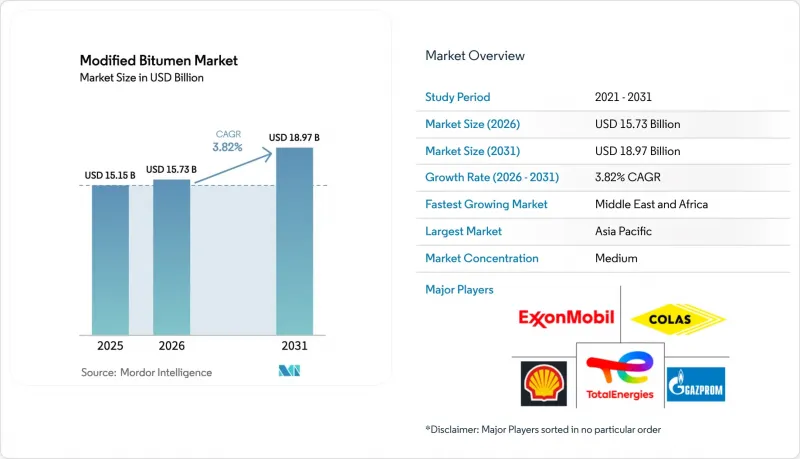
This report is Segmented by Modifier Type (SBS, APP, Crumb Rubber, Natural Rubber, and Others), Application Method (Hot Asphalt, Cold Asphalt, and Torch-Applied), Application (Road Construction and Paving, Roofing and Piping, and Others), and Geography (Asia-Pacific, North America, Europe, South America, and Middle East and Africa). Market Forecasts are Provided in Terms of Value (USD).
Global Modified Bitumen Market Trends and Insights
Road-Building Stimulus in the US IIJA, EU CEF-2, and India PM-Gatishakti
Multi-year lettings, fueled by substantial funding allocations, are driving up the consumption of polymer-modified asphalt. The US Infrastructure Investment and Jobs Act has earmarked significant funds for highways. While a large portion of this amount is obligated, only a fraction has been spent as of September 2025, hinting at a purchasing peak in the coming years. In India, the PM-Gatishakti corridors and the PMGSY-IV rural-road initiative are set to cover extensive kilometers, utilizing waste plastic and cold-mix technologies. This move is set to accelerate the adoption of SBS, especially in emerging states. Meanwhile, Europe's CEF-2 program has tied a significant portion of its budget to climate objectives, pushing projects towards using recycled rubber and bio-polymer binders. Suppliers boasting regional blending terminals, sourcing both SBS and APP, and maintaining pre-approved product lists are reaping the benefits as agencies shorten bid timelines. The cumulative result is a notable surge in volumes, albeit unevenly distributed across regions, bolstering the modified bitumen market for the foreseeable future.
Tightening Asphalt-Performance Specs in China JTGF40-2021 and Austroads Hybrid-PMB Standards
China's JTGF40-2021 has set new rutting-resistance thresholds for expressways with high daily traffic, effectively mandating the use of SBS-rich mixes. Enforcement began in 2024 in Guangdong and Zhejiang, leading to an increase in SBS demand. Austroads' guidelines for hybrid binders advocate a blend of SBS and crumb rubber, achieving a balance between high-temperature stability and low-temperature flexibility. This approach allows a reduction in polymer dosage while still meeting fatigue criteria. These evolving standards not only shorten payback periods for polymer-blending plants but also narrow competition to pre-qualified suppliers. Furthermore, they expedite the diffusion of technology to ASEAN nations that are adopting codes from Australasia. Contractors who neglect to upgrade their formulations face the risk of warranty voids and project delays. This scenario underscores the growing entrenchment of polymer-modified asphalt specifications within the modified bitumen market.
Crude-Oil Price Volatility Squeezing Modifier Economics
In 2025, Brent crude prices remained steady. However, in Asia, SBS spot prices surged due to tight butadiene supplies, leading to a reduction in blender margins. OPEC+ production curbs have kept forward prices elevated. In response to rising feedstock costs, polymer manufacturers are signaling price increases. Notably, government road contracts in India and Southeast Asia seldom incorporate price-escalation clauses, compelling blenders to shoulder the financial spread. While integrated oil majors with their own polymer assets remain shielded from these fluctuations, independent blenders are feeling the squeeze, facing pressures that could lead to consolidation and a diminished supplier diversity in the modified bitumen market.
Other drivers and restraints analyzed in the detailed report include:
- Shift to Self-Adhered and Cold-Applied Membranes Cutting Labor-Site Fires
- Recycled-Rubber Quotas in EU Green Deal Roads
- Skilled Torch-Applicator Shortages in North America and Europe
For complete list of drivers and restraints, kindly check the Table Of Contents.
Segment Analysis
SBS accounted for 39.75% of the modified bitumen market share in 2025 on the strength of its low-temperature flexibility, especially for Canadian and northern European highways where thermal cracking dictates maintenance cycles. As road agencies in China, the United States, and Europe begin to incorporate SBS performance into their design manuals, the market size for SBS-linked modified bitumen is projected to grow steadily through 2031. APP, by contrast, is forecast to grow at a 4.29% CAGR, propelled by Middle Eastern and North African roofing mandates that require high solar-reflectance membranes under ambient temperatures exceeding 70 °C.
Demand for modified bitumen adjusts according to regional climates and regulatory codes. For instance, while SBS is favored in cold-climate resurfacing initiatives-such as Japan's expressway rehabilitation-APP is the go-to choice for hot, arid regions, especially for warehouse roofs equipped with photovoltaic arrays. Hybrid blends of crumb-rubber and SBS meet the EU's recycled-content standards but remain a niche segment due to challenges in quality control. Meanwhile, early-stage bio-polymer modifiers, currently categorized under "Others," are on the brink of expansion, especially if carbon pricing helps narrow their cost disparity. Suppliers adept at balancing their capacities between SBS and APP can navigate regional fluctuations and tap into the changing dynamics of the modified bitumen market.
Complete Report Scope:
- By Modifier Type
- Styrene-Butadiene-Styrene (SBS)
- Atactic Polypropylene (APP)
- Crumb Rubber
- Natural Rubber
- Others
- By Application Method
- Hot Asphalt
- Cold Asphalt
- Torch-Applied
- By Application
- Road Construction and Paving
- Roofing and Piping
- Others
- By Geography
- Asia-Pacific
- China
- India
- Japan
- South Korea
- ASEAN Countries
- Rest of Asia-Pacific
- North America
- United States
- Canada
- Mexico
- Europe
- Germany
- United Kingdom
- France
- Italy
- Spain
- Russia
- Rest of Europe
- South America
- Brazil
- Argentina
- Rest of South America
- Middle-East and Africa
- Saudi Arabia
- South Africa
- Rest of Middle-East and Africa
- Asia-Pacific
Geography Analysis
Asia-Pacific generated 44.36% of 2025 revenue, driven by China's addition of expressways and India's expansion of highways. Yet, as eastern provinces of China approach network saturation, growth has moderated. Concurrently, India grapples with land-acquisition delays, extending its tender-to-award cycles. Japan, investing heavily annually, emphasizes SBS polymers for expressway overlays, aiming to mitigate fatigue on its aging pavements. Meanwhile, ASEAN's demand surges, buoyed by ADB-financed industrial corridor projects, though challenges like currency risks and political shifts loom large.
The Middle East and Africa region is poised for the fastest 5.98% CAGR. Major investments in transport pipelines, roads for new administrative capitals, and freeway rehabilitation spur this growth. Additionally, the GCC's building codes mandate SRI-compliant APP membranes, while South Africa pushes for recycled-rubber, both bolstering volume prospects. However, the region grapples with funding volatility tied to oil prices and overarching security concerns.
North America and Europe are set to grow at a more tempered pace. As these mature networks pivot from expansion to maintenance, challenges arise. The U.S. National Bridge Inventory flags numerous structures in need of deck membranes. Yet, with IIJA allocations set to wane post-2026 and gas-tax revenues dipping due to rising EV adoption, the future looks uncertain. Across the Atlantic, Europe's CEF-2 dedicates a limited portion of its budget to highways, confining growth to essential resurfacing and urban retrofits. South America, though small and cyclical, sees a glimmer of hope: Brazil's toll concessions for 2024-2025 spark demand, yet macroeconomic instability casts a shadow on the outlook.
- Breedon Group plc
- COLAS
- Dow
- Exxon Mobil Corporation
- Firestone Building Products Company, LLC
- Fosroc International Limited
- GAF
- Gazprom Neft PJSC
- Hincol
- Nynas AB
- ORLEN Asfalt Sp. z o.o.
- Repsol
- Rosneft Deutschland GmbH
- Saint-Gobain Weber
- Shell plc
- Sika AG
- SOPREMA S.A.S
- Texsa Systems SLU
- TotalEnergies
Additional Benefits:
- The market estimate (ME) sheet in Excel format
- 3 months of analyst support
TABLE OF CONTENTS
1 Introduction
- 1.1 Study Assumptions and Market Definition
- 1.2 Scope of the Study
2 Research Methodology
3 Executive Summary
4 Market Landscape
- 4.1 Market Overview
- 4.2 Market Drivers
- 4.2.1 Road-building stimulus in the US IIJA, EU CEF-2 and India PM-Gatishakti
- 4.2.2 Tightening asphalt-performance specs in China's JTGF40-2021 and Austroads hybrid-PMB standards
- 4.2.3 Shift to self-adhered and cold-applied membranes cutting labour-site fires
- 4.2.4 Recycled-rubber (crumb-rubber-PMB) quotas in EU Green Deal roads
- 4.2.5 Bio-polymer (lignin, algae) modified binders hitting commercial scale
- 4.3 Market Restraints
- 4.3.1 Crude-oil price volatility squeezing modifier economics
- 4.3.2 Skilled-torch-applicator shortages in North America and Europe
- 4.3.3 VOC and PAH caps on hot asphalt in California, Germany, Korea
- 4.4 Value Chain Analysis
- 4.5 Porter's Five Forces
- 4.5.1 Bargaining Power of Suppliers
- 4.5.2 Bargaining Power of Buyers
- 4.5.3 Threat of New Entrants
- 4.5.4 Threat of Substitutes
- 4.5.5 Competitive Rivalry
5 Market Size and Growth Forecasts (Value)
- 5.1 By Modifier Type
- 5.1.1 Styrene-Butadiene-Styrene (SBS)
- 5.1.2 Atactic Polypropylene (APP)
- 5.1.3 Crumb Rubber
- 5.1.4 Natural Rubber
- 5.1.5 Others
- 5.2 By Application Method
- 5.2.1 Hot Asphalt
- 5.2.2 Cold Asphalt
- 5.2.3 Torch-Applied
- 5.3 By Application
- 5.3.1 Road Construction and Paving
- 5.3.2 Roofing and Piping
- 5.3.3 Others
- 5.4 By Geography
- 5.4.1 Asia-Pacific
- 5.4.1.1 China
- 5.4.1.2 India
- 5.4.1.3 Japan
- 5.4.1.4 South Korea
- 5.4.1.5 ASEAN Countries
- 5.4.1.6 Rest of Asia-Pacific
- 5.4.2 North America
- 5.4.2.1 United States
- 5.4.2.2 Canada
- 5.4.2.3 Mexico
- 5.4.3 Europe
- 5.4.3.1 Germany
- 5.4.3.2 United Kingdom
- 5.4.3.3 France
- 5.4.3.4 Italy
- 5.4.3.5 Spain
- 5.4.3.6 Russia
- 5.4.3.7 Rest of Europe
- 5.4.4 South America
- 5.4.4.1 Brazil
- 5.4.4.2 Argentina
- 5.4.4.3 Rest of South America
- 5.4.5 Middle-East and Africa
- 5.4.5.1 Saudi Arabia
- 5.4.5.2 South Africa
- 5.4.5.3 Rest of Middle-East and Africa
- 5.4.1 Asia-Pacific
6 Competitive Landscape
- 6.1 Market Concentration
- 6.2 Strategic Moves
- 6.3 Market Share/Ranking Analysis
- 6.4 Company Profiles (includes Global level Overview, Market level overview, Core Segments, Financials as available, Strategic Information, Market Rank/Share, Products and Services, Recent Developments)
- 6.4.1 Breedon Group plc
- 6.4.2 COLAS
- 6.4.3 Dow
- 6.4.4 Exxon Mobil Corporation
- 6.4.5 Firestone Building Products Company, LLC
- 6.4.6 Fosroc International Limited
- 6.4.7 GAF
- 6.4.8 Gazprom Neft PJSC
- 6.4.9 Hincol
- 6.4.10 Nynas AB
- 6.4.11 ORLEN Asfalt Sp. z o.o.
- 6.4.12 Repsol
- 6.4.13 Rosneft Deutschland GmbH
- 6.4.14 Saint-Gobain Weber
- 6.4.15 Shell plc
- 6.4.16 Sika AG
- 6.4.17 SOPREMA S.A.S
- 6.4.18 Texsa Systems SLU
- 6.4.19 TotalEnergies
7 Market Opportunities and Future Outlook
- 7.1 White-space andandUnmet-need Assessment

