PUBLISHER: Mordor Intelligence | PRODUCT CODE: 2114022

PUBLISHER: Mordor Intelligence | PRODUCT CODE: 2114022
South America Automotive High Performance Electric Vehicles - Market Share Analysis, Industry Trends & Statistics, Growth Forecasts (2026 - 2031)
According to Mordor Intelligence, the south american automotive high-performance electric vehicle market size was valued at USD 1.26 billion in 2025 and estimated to grow from USD 1.51 billion in 2026 to reach USD 3.74 billion by 2031, at a CAGR of 19.86% during the forecast period (2026-2031).
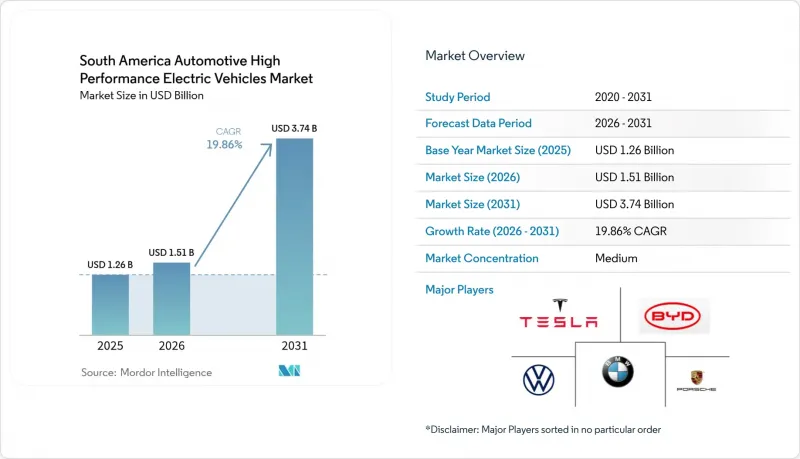
This report is Segmented by Drive Type (Battery-Electric Vehicles, and More), Vehicle Type (Passenger Cars, Light Commercial Vehicles, and More), Peak Power Output (Below 200 KW, and More), Battery Chemistry (Lithium-Iron-Phosphate (LFP), and More), Price Band (Below USD 50, 000, and More) and Country. The Market Forecasts are Provided in Terms of Value (USD).
South America Automotive High Performance Electric Vehicles Market Trends and Insights
Rapid Expansion of Public DC Fast-Charging Corridors
Brazil targets 150,000 chargers by 2035, requiring USD 2.5 billion and signalling state commitment to eliminate range anxiety. Curitiba's electrocenters manage power loads dynamically, illustrating how software optimises grid interaction and keeps deployment costs contained. BYD and Raizen Power co-installed stations that leverage Brazil's 85% renewable grid, giving the South American electric vehicle market a unique sustainability narrative. Uruguay complements this momentum with 240 chargers-40% of them rapid-funded by Evergo and Ventus, proving smaller economies can reach near-national coverage quickly. Chile anchors its roll-out on fast-growing electric bus fleets, turning public procurement into a catalyst for private-use networks.
Rising Performance-EV Imports Helped by Mercosur Tariff Waivers
Brazil's Resolution 97/2018 temporarily cut import duties from 35% to zero, allowing Chinese OEMs to seize 92% of 2023 BEV imports and flood showrooms with high-spec models at compelling prices. Argentina extended similar treatment for 2025, widening the regional window for tariff-free sales. Manufacturers rushed to pre-position 7,000 units ahead of Brazil's phased tariff reinstatement that will reach 35% in 2026. During 2024, Brazil's performance-EV imports jumped 229%, confirming pent-up demand once fiscal barriers drop. The waiver phase primes consumer expectations for next-generation products and pressures incumbents to localise production sooner rather than later.
Bio-Ethanol Lobby Delaying BEV Fiscal Incentives in Brazil
The sugarcane industry produces 35.3 billion liters annually and commands strong congressional backing, making exclusive BEV incentives politically fraught. Programs like RenovaBio channel decarbonization credits toward biofuels, sidelining electric options. Petrobras has earmarked USD 2.2 billion for ethanol infrastructure, reinforcing long-term demand expectations. As a result, hybrids that still consume liquid fuel gain easier policy passage than full BEVs, slowing the transition despite rising charging coverage.
Other drivers and restraints analyzed in the detailed report include:
- OEM Localisation - BMW Araquari PHEV Line-Up
- Prestige Motorsport Marketing (Interlagos EV Lap Records)
- Hydropower Droughts Causing Grid-Stability Concerns
For complete list of drivers and restraints, kindly check the Table Of Contents.
Segment Analysis
Plug-in hybrid electric vehicles held 67.54% share of the South American high perfromance electric vehicle market in 2025, buoyed by Brazil's nationwide ethanol pumps that deliver seamless range security. Battery-electric volumes are climbing at an 17.91% CAGR as chargers proliferate and total cost of ownership improves. Consumers weigh trip length and fueling convenience, often selecting hybrids for intercity reliability. Toyota's flex-fuel hybrid programme, scaled up at Sorocaba, demonstrates how global platforms can localize for ethanol compatibility.
The South American high perfromance electric vehicle market continues to shift as OEMs hone bio-hybrid technologies. Stellantis is allocating part of its EUR 5.6 billion budget to Bio-Hybrid drivetrains that pair smaller batteries with efficient ethanol engines, reducing purchase price while cutting tailpipe CO2. Renault-Geely's cooperation brings low-emission crossovers built on cost-efficient Chinese architectures, diversifying options in the mid-price tier. Government fleets are early adopters of pure BEVs where predictable urban duty cycles align with charger density, but private buyers gravitate toward hybrids until infrastructure reaches parity outside capitals.
Passenger cars commanded 85.76% of the South American high performance electric vehicle market size in 2025, anchored by private-use demand in Brazil's urban centers. However, light commercial vehicles grow fastest at 19.05% CAGR because delivery operators chase fuel and maintenance savings. Depot-based overnight charging minimizes downtime and sidesteps public-infrastructure gaps, making economics straightforward for fleets.
Fleet electrification also attracts policy support. Peru, Paraguay, and Chile channel green-transit grants into e-bus and van procurement, locking in bulk orders that stabilize factory volumes. U Power and Ualabee target 80,000 ride-hailing replacements using battery-swap vans, illustrating creative models for high-utilization vehicles. As supply stabilizes, commercial total-cost parity is forecasted before 2027, amplifying volumes that feed secondary markets for used EVs, catalyzing private adoption.
Complete Report Scope:
- By Drive Type
- Battery-Electric Vehicles (BEV)
- Plug-in Hybrid Electric Vehicles (PHEV)
- By Vehicle Type
- Passenger Cars
- Light Commercial/Utility Vehicles
- Medium and Heavy-Duty Commercial Vehicles
- By Peak Power Output
- Below 200 kW
- 201 - 400 kW
- Above 400 kW
- By Battery Chemistry
- Lithium-Iron-Phosphate (LFP)
- Nickel-Manganese-Cobalt (NMC)
- Nickel-Cobalt-Aluminum (NCA)
- Advanced Solid-State / High-Silicon Prototype
- By Price Band (USD)
- Less than 50,000
- 50,001 - 75,000
- 75,001 - 100,000
- More than 100 000
- By Country
- Brazil
- Argentina
- Chile
- Peru
- Colombia
- Uruguay
- Rest of South America
List of Companies Covered in this Report:
- BMW Group
- Mercedes-Benz Group AG
- Tesla Inc.
- BYD Co. Ltd.
- Porsche AG
- Nissan Motor Co.
- Ford Motor Co.
- Volkswagen AG
- Renault Group
- Geely Auto Ltd.
- Kia Corporation
- Mitsubishi Motors
- Audi AG
- Great Wall Motor (ORA)
- General Motors (Chevrolet)
- Stellantis N.V. (Peugeot, Fiat)
- Jaguar Land Rover Automotive Plc
- Chery Automobile
- JAC Motors Inc.
- Lotus Group
Additional Benefits:
- The market estimate (ME) sheet in Excel format
- 3 months of analyst support
TABLE OF CONTENTS
1 Introduction
- 1.1 Study Assumptions & Market Definition
- 1.2 Scope of the Study
2 Research Methodology
3 Executive Summary
4 Market Landscape
- 4.1 Market Overview
- 4.2 Market Drivers
- 4.2.1 Integrating Lithium-Triangle Supply Chains into Regional BEV Builds
- 4.2.2 Chinese Premium-Value Entrants Closing Price-Performance Gap
- 4.2.3 Rapid Expansion of Public DC Fast-Charging Corridors
- 4.2.4 Rising Performance-EV Imports Helped By Mercosur Tariff Waivers
- 4.2.5 OEM Localisation - E.G., BMW Araquari PHEV Line-Up
- 4.2.6 Prestige Motorsport Marketing (Interlagos EV Lap Records)
- 4.3 Market Restraints
- 4.3.1 High Sticker Prices Vs. Flex-Fuel ICE Alternatives
- 4.3.2 Bio-Ethanol Lobby Delaying BEV Fiscal Incentives In Brazil
- 4.3.3 Slow Roll-Out Of 800 V Ultra-Fast Chargers Outside Capital Cities
- 4.3.4 Hydropower Droughts Causing Grid-Stability Concerns
- 4.4 Value / Supply-Chain Analysis
- 4.5 Regulatory Landscape
- 4.6 Technological Outlook
- 4.7 Porter's Five Forces
- 4.8 Threat of New Entrants
- 4.8.1 Bargaining Power of Buyers/Consumers
- 4.8.2 Bargaining Power of Suppliers
- 4.8.3 Threat of Substitute Products
- 4.8.4 Intensity of Competitive Rivalry
- 4.8.5 Patent & Innovation Landscape
5 Market Size & Growth Forecasts (Value (USD))
- 5.1 By Drive Type
- 5.1.1 Battery-Electric Vehicles (BEV)
- 5.1.2 Plug-in Hybrid Electric Vehicles (PHEV)
- 5.2 By Vehicle Type
- 5.2.1 Passenger Cars
- 5.2.2 Light Commercial/Utility Vehicles
- 5.2.3 Medium and Heavy-Duty Commercial Vehicles
- 5.3 By Peak Power Output
- 5.3.1 Below 200 kW
- 5.3.2 201 - 400 kW
- 5.3.3 Above 400 kW
- 5.4 By Battery Chemistry
- 5.4.1 Lithium-Iron-Phosphate (LFP)
- 5.4.2 Nickel-Manganese-Cobalt (NMC)
- 5.4.3 Nickel-Cobalt-Aluminum (NCA)
- 5.4.4 Advanced Solid-State / High-Silicon Prototype
- 5.5 By Price Band (USD)
- 5.5.1 Less than 50,000
- 5.5.2 50,001 - 75,000
- 5.5.3 75,001 - 100,000
- 5.5.4 More than 100 000
- 5.6 By Country
- 5.6.1 Brazil
- 5.6.2 Argentina
- 5.6.3 Chile
- 5.6.4 Peru
- 5.6.5 Colombia
- 5.6.6 Uruguay
- 5.6.7 Rest of South America
6 Competitive Landscape
- 6.1 Market Concentration
- 6.2 Strategic Moves
- 6.3 Market Share Analysis
- 6.4 Company Profiles (includes Global level Overview, Market level overview, Core Segments, Financials as available, Strategic Information, Market Rank/Share for key companies, Products & Services, and Recent Developments)
- 6.4.1 BMW Group
- 6.4.2 Mercedes-Benz Group AG
- 6.4.3 Tesla Inc.
- 6.4.4 BYD Co. Ltd.
- 6.4.5 Porsche AG
- 6.4.6 Nissan Motor Co.
- 6.4.7 Ford Motor Co.
- 6.4.8 Volkswagen AG
- 6.4.9 Renault Group
- 6.4.10 Geely Auto Ltd.
- 6.4.11 Kia Corporation
- 6.4.12 Mitsubishi Motors
- 6.4.13 Audi AG
- 6.4.14 Great Wall Motor (ORA)
- 6.4.15 General Motors (Chevrolet)
- 6.4.16 Stellantis N.V. (Peugeot, Fiat)
- 6.4.17 Jaguar Land Rover Automotive Plc
- 6.4.18 Chery Automobile
- 6.4.19 JAC Motors Inc.
- 6.4.20 Lotus Group
7 Market Opportunities & Future Outlook

