PUBLISHER: Mordor Intelligence | PRODUCT CODE: 2114031

PUBLISHER: Mordor Intelligence | PRODUCT CODE: 2114031
Europe Cereal Bar - Market Share Analysis, Industry Trends & Statistics, Growth Forecasts (2026 - 2031)
According to Mordor Intelligence, the Europe cereal bars market size in 2026 is estimated at USD 4.41 billion, growing from 2025 value of USD 4.19 billion with 2031 projections showing USD 5.67 billion, growing at 5.17% CAGR over 2026-2031.
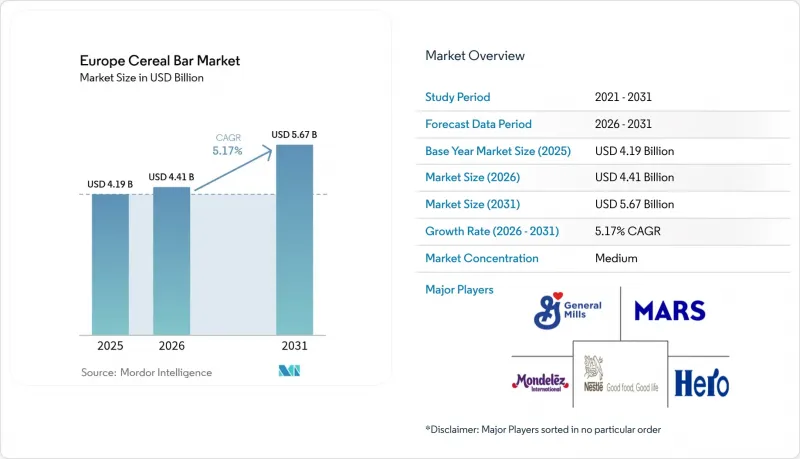
This report is Segmented by Product Type (Granola/Muesli Bars, Energy and Nutrition Bars, and Others), Functional Claim (Organic and Conventional), Distribution Channel (Supermarkets / Hypermarkets, Convenience Stores, Specialty Stores, Online Stores, and Other Distribution Channels), and Geography. The Market Forecasts are Provided in Terms of Value (USD).
Europe Cereal Bar Market Trends and Insights
Convenience-driven on-the-go snacking trend
The European cereal bar market is primarily driven by the increasing demand for convenient, on-the-go snacking options. As consumers manage busier lifestyles, they seek portable and nutritious snacks that integrate seamlessly into their daily schedules. Cereal bars meet these requirements through their practical packaging and nutritional benefits, making them a preferred choice for consumption outside homes and workplaces. This preference is particularly evident among young consumers and working professionals who prioritize products combining nutrition with convenience. According to the Italian National Institute of Statistics (Istat), in 2023, 65.2% of Italian children aged 11-13 consumed snacks at least once per week . This high snacking frequency among the younger population reflects broader European consumption patterns favoring convenient options like cereal bars. The market's alignment with current consumer preferences for convenient and health-conscious snacking supports its continued growth across Europe.
Growing preference for high-protein and fiber-rich bars
The growing consumer preference for high-protein and fiber-rich bars drives the European cereal bar market. Health-conscious consumers seek convenient snack options that provide functional benefits, including sustained energy, digestive health, and satiety. Products containing protein and dietary fiber align with these nutritional goals, making cereal bars a preferred choice for individuals focusing on active lifestyles, weight management, and overall wellness. This emphasis on nutrient-dense formulations has encouraged manufacturers to enhance their product offerings to meet the demand for healthier snacking alternatives. For instance, in August 2025, Kellogg's expanded its United Kingdom presence by launching Oaties cereal bars, containing 55% wholegrain oats and serving as a fiber source. These bars, available in Chocolate & Oat and Honey and Oat flavors, combine taste with nutritional value. This product launch demonstrates how companies are responding to the demand for high-fiber and whole-grain-based cereal bars, strengthening their market position.
High Sugar Content Concerns
Health concerns regarding high sugar content constrain the growth of the European cereal bar market. Consumers are increasingly aware of the health risks associated with excessive sugar consumption, including obesity, diabetes, and cardiovascular diseases, leading to higher demand for low-sugar or sugar-free options. Consumers examine product labels more thoroughly and frequently avoid snacks with high sugar content. This consumer behavior shift creates challenges for manufacturers who must reformulate products while maintaining taste and texture, a process that involves technical complexity and increased costs. European regulatory requirements and public health initiatives focused on sugar reduction further pressure cereal bar manufacturers. These factors restrict market growth by reducing the appeal of conventional cereal bars and creating obstacles for companies dependent on sugar-based formulations.
Other drivers and restraints analyzed in the detailed report include:
- Growing Fitness Trends Fuel Consumption of Cereal bars
- Innovation in flavors and formats
- Competition from Alternative Snacks
For complete list of drivers and restraints, kindly check the Table Of Contents.
Segment Analysis
Granola and muesli bars dominate the European cereal bar market with a 51.32% market share in 2025. This dominance stems from consumer preference for wholesome ingredients and health benefits. These bars meet the increasing demand for convenient, nutritious snacking options, particularly among health-conscious consumers with active lifestyles. The products offer diverse flavors, textures, and ingredient combinations, incorporating oats, nuts, dried fruits, seeds, and natural sweeteners. The category benefits from consumer preferences for natural, organic, and functional food products, as these bars typically contain clean-label and minimally processed ingredients.
Energy and nutrition bars are projected to grow at a CAGR of 6.13% through 2031. This growth reflects increasing consumer demand for convenient options with enhanced nutritional benefits, including higher protein content, added vitamins, and sustained energy release. Rising health and fitness awareness has positioned these bars as popular meal supplements and portable energy sources. Manufacturers are developing new formulations with functional ingredients such as protein isolates, energy-boosting compounds, and natural sweeteners to address specific dietary requirements, including keto, paleo, and plant-based diets.
Complete Report Scope:
- By Product Type
- Granola/Muesli Bars
- Energy and Nutrition Bars
- Others
- By Functional Claim
- Organic
- Conventional
- By Distribution Channel
- Supermarkets / Hypermarkets
- Convenience Stores
- Specialty Stores
- Online Stores
- Other Distribution Channels
- By Geography
- Germany
- United Kingdom
- Italy
- France
- Spain
- Netherlands
- Poland
- Belgium
- Sweden
- Rest of Europe
List of Companies Covered in this Report:
- General Mills, Inc.
- Nestle S.A.
- Mars, Incorporated
- Mondel?z International, Inc.
- Hero Group
- Eat Natural
- Cerbona Food Manufacturing Ltd.
- Weetabix Food Company
- The Kellogg Company
- Jordans Dorset Ryvita Co.
- Glanbia plc
- Nature's Bakery LLC
- Rude Health Foods Ltd.
- Hain Celestial Group
- Nakd (Natural Balance Foods)
- Graze (UniLever)
- Myprotein (THG)
- Fazer Group
- Lantmannen Cerealia
- Orkla ASA
Additional Benefits:
- The market estimate (ME) sheet in Excel format
- 3 months of analyst support
TABLE OF CONTENTS
1 INTRODUCTION
- 1.1 Study Assumptions and Market Definition
- 1.2 Scope of the Study
2 RESEARCH METHODOLOGY
3 EXECUTIVE SUMMARY
4 MARKET LANDSCAPE
- 4.1 Market Overview
- 4.2 Market Drivers
- 4.2.1 Convenience-driven on-the-go snacking trend
- 4.2.2 Growing preference for high-protein and fiber-rich bars
- 4.2.3 Growing Fitness Trends Fuel Consumption of Cereal bars
- 4.2.4 Innovation in flavors and formats
- 4.2.5 Rising awareness of dietary restrictions
- 4.2.6 Health and wellness trends
- 4.3 Market Restraints
- 4.3.1 High Sugar Content Concerns
- 4.3.2 Competition from Alternative Snacks
- 4.3.3 Supply-chain volatility for specialty proteins
- 4.3.4 Saturated shelf space in mature retail markets
- 4.4 Consumer Behaviour Analysis
- 4.5 Regulatory Landscape
- 4.6 Technological Outlook
- 4.7 Porter's Five Forces Analysis
- 4.7.1 Threat of New Entrants
- 4.7.2 Bargaining Power of Buyers
- 4.7.3 Bargaining Power of Suppliers
- 4.7.4 Threat of Substitutes
- 4.7.5 Intensity of Competitive Rivalry
5 MARKET SIZE AND GROWTH FORECASTS (VALUE)
- 5.1 By Product Type
- 5.1.1 Granola/Muesli Bars
- 5.1.2 Energy and Nutrition Bars
- 5.1.3 Others
- 5.2 By Functional Claim
- 5.2.1 Organic
- 5.2.2 Conventional
- 5.3 By Distribution Channel
- 5.3.1 Supermarkets / Hypermarkets
- 5.3.2 Convenience Stores
- 5.3.3 Specialty Stores
- 5.3.4 Online Stores
- 5.3.5 Other Distribution Channels
- 5.4 By Geography
- 5.4.1 Germany
- 5.4.2 United Kingdom
- 5.4.3 Italy
- 5.4.4 France
- 5.4.5 Spain
- 5.4.6 Netherlands
- 5.4.7 Poland
- 5.4.8 Belgium
- 5.4.9 Sweden
- 5.4.10 Rest of Europe
6 COMPETITIVE LANDSCAPE
- 6.1 Market Concentration
- 6.2 Strategic Moves
- 6.3 Market Share Analysis
- 6.4 Company Profiles (includes Global level Overview, Market level overview, Core Segments, Financials as available, Strategic Information, Market Rank/Share for key companies, Products and Services, and Recent Developments)
- 6.4.1 General Mills, Inc.
- 6.4.2 Nestle S.A.
- 6.4.3 Mars, Incorporated
- 6.4.4 Mondelez International, Inc.
- 6.4.5 Hero Group
- 6.4.6 Eat Natural
- 6.4.7 Cerbona Food Manufacturing Ltd.
- 6.4.8 Weetabix Food Company
- 6.4.9 The Kellogg Company
- 6.4.10 Jordans Dorset Ryvita Co.
- 6.4.11 Glanbia plc
- 6.4.12 Nature's Bakery LLC
- 6.4.13 Rude Health Foods Ltd.
- 6.4.14 Hain Celestial Group
- 6.4.15 Nakd (Natural Balance Foods)
- 6.4.16 Graze (UniLever)
- 6.4.17 Myprotein (THG)
- 6.4.18 Fazer Group
- 6.4.19 Lantmannen Cerealia
- 6.4.20 Orkla ASA
7 MARKET OPPORTUNITIES AND FUTURE OUTLOOK

