PUBLISHER: Mordor Intelligence | PRODUCT CODE: 2114037

PUBLISHER: Mordor Intelligence | PRODUCT CODE: 2114037
Middle East And Africa Chocolate - Market Share Analysis, Industry Trends & Statistics, Growth Forecasts (2026 - 2031)
According to Mordor Intelligence, the middle east and Africa chocolate market size was valued at USD 5.20 billion in 2025 and estimated to grow from USD 5.48 billion in 2026 to reach USD 7.15 billion by 2031, at a CAGR of 5.45% during the forecast period (2026-2031).
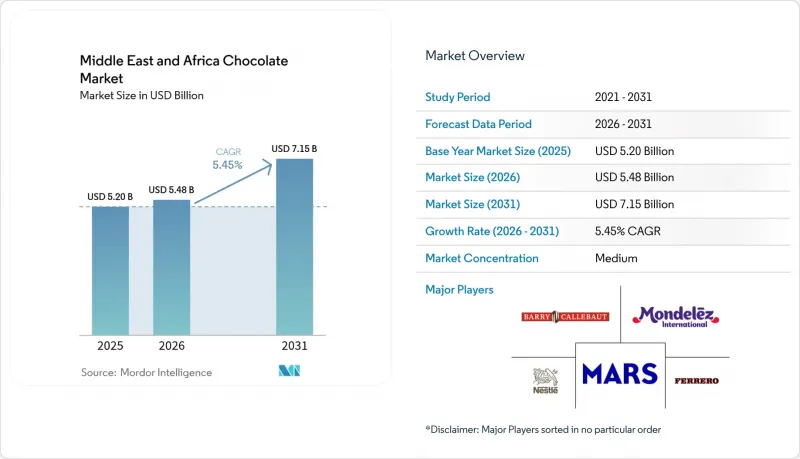
This report is Segmented by Type (Dark Chocolate, Milk and White Chocolate), Form (Tablets and Bars, and More), Price Range (Mass, Premium), Ingredient Type (Dairy-Based, Plant-Based, Single-Origin), Distribution Channel (Supermarket/Hypermarket, and More), and Geography (South Africa, Egypt, Nigeria and More). Market Forecasts are Provided in Both Value (USD) and Volume (Tons).
Middle East And Africa Chocolate Market Trends and Insights
Rising demand for premium and artisanal chocolates
In GCC cities and South African metros, affluent households are increasingly gravitating towards premium offerings. They're opting for single-origin bars, camel-milk recipes, and craft lines that follow the bean-to-bar philosophy. These premium products command a price premium of 30-50% over mainstream tablets. Brands bolster their authenticity through provenance storytelling and halal certification. This strategy has enabled premium labels to outpace the market average by 240 basis points. Take Mirzam, for example. They weave heritage narratives around Ethiopian or Tanzanian cocoa, securing duty-free listings in the process. Meanwhile, Al Nassma distinguishes itself by transforming camel milk into unique flavors, a feat that's challenging for global giants to replicate. This premium surge acts as a buffer for some manufacturers against commodity price spikes. Their loyal clientele willingly pays higher shelf prices for these limited-edition runs. In response, competitors are either making acquisitions or launching artisanal SKUs, strategically timed for seasonal gifting opportunities.
Gifting peaks during Ramadan, Eid and wedding seasons
In 2024, Ramadan and Eid accounted for 45-53% of the annual chocolate gifting in Saudi Arabia and the UAE. This trend has heightened the urgency for manufacturers to stock up their inventories months in advance. Additionally, wedding seasons in the region trigger another surge in demand, as ornate favor boxes gain prominence as a social currency. While Patchi adeptly adjusts its production schedules and Arabic-calligraphy gift sets to align with these peak times, smaller brands grapple with the challenge of unsold stock, finding it difficult to repurpose their seasonal offerings. This cash-flow unpredictability compels companies to seek extended payment terms from retailers. In contrast, multinational corporations capitalize on their global supply networks, strategically dispersing excess inventory across various markets.
Rising health consciousness and awareness of obesity/diabetes risks
In 2024, Saudi Arabia reported an adult obesity rate of 27.8%, while the UAE noted that 67.9% of its population was classified as overweight. These alarming statistics have spurred government campaigns in both nations, particularly targeting sugary foods. In response, consumers are adjusting their habits: they're downsizing portion sizes, gravitating towards dark chocolate, and opting for alternative snacks such as nuts, seeds, and low-sugar bars. Given the historical taxation on carbonated drinks, there's growing speculation about potential levies on confectionery items, which could further impact consumer behavior and market dynamics. This has led many brands to hasten their reformulation efforts, focusing on reducing sugar content and introducing healthier product lines. While premium buyers indulge in chocolate as an acceptable luxury, mainstream consumers are reducing their purchase frequency due to health concerns and potential cost increases. This shift presents a pronounced volume risk for brands targeting the mass market, compelling them to reassess their strategies to maintain competitiveness.
Other drivers and restraints analyzed in the detailed report include:
- E-commerce apps' dark-store model boosting impulse sales
- Mandatory front-of-pack "high-sugar" labels in Saudi and UAE
- Competition from traditional sweets and other snacks
For complete list of drivers and restraints, kindly check the Table Of Contents.
Segment Analysis
In 2025, milk and white chocolate dominated the Middle East and Africa chocolate market, accounting for 68.05% of sales. This stronghold underscores the deep-seated consumer affinity for these flavors, especially in mass retail and gifting contexts. Yet, as health-conscious trends rise, spotlighting sugar content, there's a subtle shift. Shoppers are gravitating towards higher-cocoa options. In response, white chocolate is infusing regional flavors like saffron and rose-water, ensuring it remains relevant amidst the sugar scrutiny. This blend of tradition and innovative flavors helps milk and white chocolates maintain their stature, even as market dynamics evolve.
Dark chocolate is emerging as the fastest-growing segment, projected to grow at a 6.92% CAGR, outpacing the broader Middle East and Africa chocolate market. This surge is fueled by heightened awareness of cardiovascular health and regulatory emphasis on sugar content, steering consumers towards bars with 70% cocoa and above. Premium brands, such as Lindt and Mirzam, are capitalizing on this trend, offering single-origin dark ranges that highlight their provenance and health benefits. Concurrently, mainstream producers are experimenting with sugar substitutes in dark chocolates, aiming to cater to both price and taste-conscious consumers. With these strategies aligning, dark chocolate is poised to seize a larger share of the market's value, even as milk and white chocolates continue to lead in volume.
In 2025, tablets dominate the chocolate market in the Middle East and Africa, making up 81.85% of the volume. Their alignment with checkout merchandising and quick-commerce fulfillment boosts their popularity. Standardized sizes and consistent price points ensure tablets are pivotal for maintaining steady sales in supermarkets and on delivery apps. This format drives volume-centric strategies, promoting accessibility and encouraging repeat purchases. Tablets are particularly effective in catering to a broad consumer base, as they offer affordability and convenience, making them a staple in everyday consumption. Consequently, tablets serve as the primary growth engine for many regional chocolate brands, even as premium formats gain traction.
Pralines, on the other hand, are the market's rising star, with projections of a 5.72% CAGR. They command price premiums of 50-100%, particularly during peak times like Ramadan and wedding seasons. These elevated margins bolster brand profitability, even with pralines holding a smaller volume share. Luxury brands, such as Patchi, heavily invest in praline assortments, using them to cement their premium image and gifting appeal. Pralines are often associated with indulgence and exclusivity, making them a preferred choice for special occasions and high-end gifting. Thus, while tablets anchor brands with scale and reach, pralines carve out a niche, emphasizing differentiation and seasonal value.
Complete Report Scope:
- By Product Type
- Chocolate
- Dark Chocolate
- Milk and White Chocolate
- By Form
- Tablets and Bars
- Molded Blocks
- Pralines and Truffles
- Other Forms
- By Price Range
- Mass
- Premium
- By Ingredient Type
- Dairy-based
- Plant-based
- Single-origin
- By Distribution Channel
- Supermarket/Hypermarket
- Convenience Store
- Sugar Chewing Gum
- Online Retail
- Sugar-free Chewing Gum
- Others
- Chocolate
- By Geography
- South Africa
- Egypt
- Nigeria
- Kenya
- Saudi Arabia
- United Arab Emirates
- Qatar
- Kuwait
- Rest of Middle East and Africa
List of Companies Covered in this Report:
- Nestle SA
- Mondel?z International Inc.
- Mars Incorporated
- Ferrero Group
- Barry Callebaut AG
- The Hershey Company
- Lindt & Sprungli AG
- Patchi SAL
- Al Nassma Chocolate LLC
- Bateel International LLC
- Gandour Group
- Deemah United Co.
- Tiger Brands Ltd.
- IFFCO (Creative Food Labs)
- Shirin Asal Co.
- Afrikoa Chocolate
- Mirzam Chocolate Makers
- Co Chocolat Corp.
- Kees Beyers Chocolate CC
- Cocoa Processing Company Ltd.
Additional Benefits:
- The market estimate (ME) sheet in Excel format
- 3 months of analyst support
TABLE OF CONTENTS
1 INTRODUCTION
- 1.1 Study Assumptions and Market Definition
- 1.2 Scope of the Study
2 RESEARCH METHODOLOGY
3 EXECUTIVE SUMMARY
4 MARKET LANDSCAPE
- 4.1 Market Overview
- 4.2 Market Drivers
- 4.2.1 Rising demand for premium and artisanal chocolates
- 4.2.2 Gifting peaks during Ramadan, Eid and wedding seasons
- 4.2.3 E-commerce apps' dark-store model boosting impulse sales
- 4.2.4 Mandatory front-of-pack 'High-Sugar' labels in Saudi and UAE
- 4.2.5 Innovation in flavors, formats and occasions
- 4.2.6 Youthful demographics and snacking behavior
- 4.3 Market Restraints
- 4.3.1 Rising health consciousness and awareness of obesity/diabetes risks
- 4.3.2 Competition from traditional sweets and other snacks
- 4.3.3 Cocoa-yield losses from swollen-shoot spread in Ghana
- 4.3.4 Limited availability of premium raw materials
- 4.4 Consumer Behavior Analysis
- 4.5 Regulatory Landscape
- 4.6 Porter's Five Forces
- 4.6.1 Bargaining Power of Suppliers
- 4.6.2 Bargaining Power of Buyers
- 4.6.3 Threat of New Entrants
- 4.6.4 Threat of Substitutes
- 4.6.5 Competitive Rivalry
5 MARKET SIZE AND GROWTH FORECASTS (VALUE AND VOLUME)
- 5.1 By Product Type
- 5.1.1 Chocolate
- 5.1.1.1 Dark Chocolate
- 5.1.1.2 Milk and White Chocolate
- 5.1.2 By Form
- 5.1.2.1 Tablets and Bars
- 5.1.2.2 Molded Blocks
- 5.1.2.3 Pralines and Truffles
- 5.1.2.4 Other Forms
- 5.1.3 By Price Range
- 5.1.3.1 Mass
- 5.1.3.2 Premium
- 5.1.4 By Ingredient Type
- 5.1.4.1 Dairy-based
- 5.1.4.2 Plant-based
- 5.1.4.3 Single-origin
- 5.1.5 By Distribution Channel
- 5.1.5.1 Supermarket/Hypermarket
- 5.1.5.2 Convenience Store
- 5.1.5.2.1 Sugar Chewing Gum
- 5.1.5.3 Online Retail
- 5.1.5.3.1 Sugar-free Chewing Gum
- 5.1.5.4 Others
- 5.1.1 Chocolate
- 5.2 By Geography
- 5.2.1 South Africa
- 5.2.2 Egypt
- 5.2.3 Nigeria
- 5.2.4 Kenya
- 5.2.5 Saudi Arabia
- 5.2.6 United Arab Emirates
- 5.2.7 Qatar
- 5.2.8 Kuwait
- 5.2.9 Rest of Middle East and Africa
6 COMPETITIVE LANDSCAPE
- 6.1 Market Concentration
- 6.2 Strategic Moves
- 6.3 Market Share Analysis
- 6.4 Company Profiles (includes Global level Overview, Market level overview, Core Segments, Financials as available, Strategic Information, Market Rank/Share for key companies, Products and Services, and Recent Developments)
- 6.4.1 Nestle SA
- 6.4.2 Mondel?z International Inc.
- 6.4.3 Mars Incorporated
- 6.4.4 Ferrero Group
- 6.4.5 Barry Callebaut AG
- 6.4.6 The Hershey Company
- 6.4.7 Lindt & Sprungli AG
- 6.4.8 Patchi SAL
- 6.4.9 Al Nassma Chocolate LLC
- 6.4.10 Bateel International LLC
- 6.4.11 Gandour Group
- 6.4.12 Deemah United Co.
- 6.4.13 Tiger Brands Ltd.
- 6.4.14 IFFCO (Creative Food Labs)
- 6.4.15 Shirin Asal Co.
- 6.4.16 Afrikoa Chocolate
- 6.4.17 Mirzam Chocolate Makers
- 6.4.18 Co Chocolat Corp.
- 6.4.19 Kees Beyers Chocolate CC
- 6.4.20 Cocoa Processing Company Ltd.
7 MARKET OPPORTUNITIES AND FUTURE OUTLOOK

