PUBLISHER: Mordor Intelligence | PRODUCT CODE: 2114043

PUBLISHER: Mordor Intelligence | PRODUCT CODE: 2114043
Philippines Hybrid Rice Seed - Market Share Analysis, Industry Trends & Statistics, Growth Forecasts (2026 - 2031)
According to Mordor Intelligence, the philippines' hybrid rice seed market size is expected to grow from USD 115 million in 2025 to USD 126.53 million in 2026 and is forecast to reach USD 203.86 million by 2031 at 10.03% CAGR over 2026-2031.
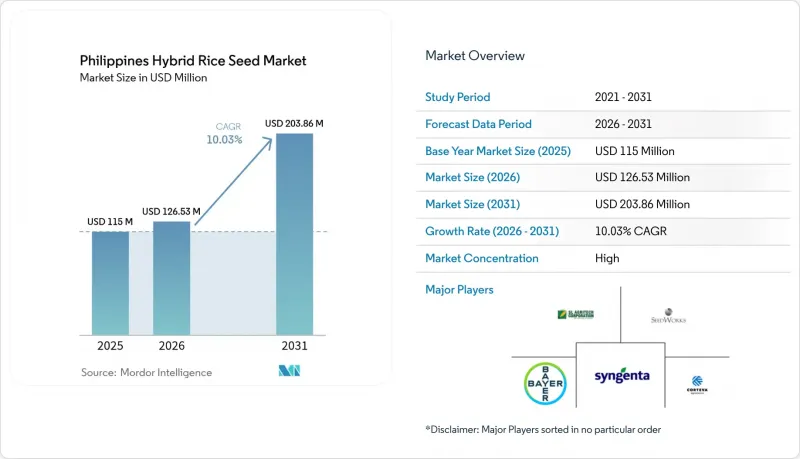
This report is Segmented by Type (Transgenic and Non-Transgenic). The Market Forecasts are Provided in Terms of Value (USD).
Philippines Hybrid Rice Seed Market Trends and Insights
Rapid Rise in Hybrid-Seed Acreage Under DA Subsidy Programs
The Department of Agriculture aims to plant hybrid varieties across 1.9 million hectares by 2028, up from 614,619 hectares in 2024. Budgeted outlays through the Rice Competitiveness Enhancement Fund rose to PHP 30 billion (USD 536 million) in 2025, supplying free hybrid seed, fertilizer, and training that reduce adoption cost hurdles. Western Visayas alone secured PHP 1.06 billion (approximately USD 19 million) for seed and fertilizer subsidies, covering 68,234 hectares. Central Luzon earmarked 70% of its seed budget for hybrids and distributed 285,000 bags annually. These systemic incentives shorten payback periods and institutionalize hybrids across farmer networks.
Higher Yield Potential Versus Inbred Varieties
Hybrid rice varieties consistently deliver 7-15 metric tons per hectare compared to 3-6 metric tons for conventional inbred varieties, creating compelling economic returns that offset higher seed costs through increased production value. Field results demonstrate that hybrids consistently record 7-15 metric tons per hectare, double the output of inbred rice. Farmers such as George Pasion harvested 14.3 metric tons per hectare with SL-8H, while Genaro Tamon achieved 15.78 metric tons using US 88 Premium Long Grain. Gross income gains reach PHP 160,000 (USD 2,857) per hectare, delivering four-fold returns despite steeper seed prices. When drought stress hit, IRRI's resilient hybrids still yielded 1.2 metric tons more than inbred controls, highlighting income stability . Peer-to-peer endorsements further accelerate acceptance among smallholders.
High Seed Cost
The substantial cost differential between hybrid rice seeds at ₱366 per kilogram (USD 6.31) and conventional inbred varieties at ₱29 per kilogram (USD 0.50) creates a significant adoption barrier for smallholder farmers operating on tight margins in 2024. The need for annual seed purchases compounds the cost challenge, as hybrid varieties do not breed true, preventing farmers from saving seeds for subsequent seasons as they traditionally do with inbred varieties. Government subsidy programs through RCEF partially address this constraint by providing free hybrid seeds to qualified farmers, but coverage remains limited to priority areas and registered beneficiaries, leaving many potential adopters without financial support.The economic viability equation becomes more complex when considering that hybrid rice requires higher fertilizer inputs and more precise management practices, further increasing production costs beyond the initial seed investment.
Other drivers and restraints analyzed in the detailed report include:
- Strong Government Push for Rice Self-Sufficiency
- Growing Private-Sector R&D
- Limited Farmer Technical Know-How on Hybrid Agronomy
For complete list of drivers and restraints, kindly check the Table Of Contents.
Segment Analysis
The non-transgenic segment captured 84.20% of the Philippines' hybrid rice seed market in 2025, underpinned by regulatory clarity, farmer familiarity, and RCEF (Rice Competitiveness Enhancement Fund) procurement preferences that favor conventionally bred hybrids. These hybrids, led by SL-8H and US 88, anchor seed distributors' revenue streams and ensure wide geographic coverage across irrigated plains where management practices are well understood.
Growth in transgenic and gene-edited hybrids, projected at a 21.92% CAGR through 2031, centers on stacked traits that mitigate herbicide drift and stem borer pressure. Although commercialization timelines face uncertainty after the Golden Rice injunction, ongoing biosafety reviews of Bt eggplant and CRISPR-derived iron-fortified lines suggest eventual regulatory pathways. The regulatory landscape significantly influences segment dynamics, with the Court of Appeals' April 2024 ruling halting Golden Rice commercialization creating uncertainty around transgenic varieties while simultaneously highlighting their potential value for addressing nutritional deficiencies
Complete Report Scope:
- By Type
- Transgenic Hybrids
- Non-transgenic Hybrids
List of Companies Covered in this Report:
- SL Agritech Corporation
- SeedWorks International Private Limited
- Bayer AG
- Syngenta Group
- Corteva Agriscience
- UPL Limited
- Yuan Longping High-Tech Agriculture Co Ltd
- Vietnam National Seed Corporation (Vinaseed)
- Bioseed
- Allied Botanical Corporation
Additional Benefits:
- The market estimate (ME) sheet in Excel format
- 3 months of analyst support
TABLE OF CONTENTS
1 Introduction
- 1.1 Study Assumptions and Market Definition
- 1.2 Scope of the Study
2 Research Methodology
3 Executive Summary
4 Market Landscape
- 4.1 Market Overview
- 4.2 Market Drivers
- 4.2.1 Rapid rise in hybrid-seed acreage under DA subsidy programs
- 4.2.2 Higher yield potential versus inbred varieties
- 4.2.3 Strong government push for rice self-sufficiency
- 4.2.4 Growing private-sector R&D
- 4.2.5 Shift to locally produced seeds
- 4.2.6 Climate-resilient hybrids positioned for drought-prone Western Visayas
- 4.3 Market Restraints
- 4.3.1 High seed cost
- 4.3.2 Limited farmer technical know-how on hybrid agronomy
- 4.3.3 Slow irrigation build-out in rain-fed regions
- 4.3.4 Emerging consumer pushback on GM traits
- 4.4 Regulatory Landscape
- 4.5 Technological Outlook
- 4.6 Porter's Five Forces Analysis
- 4.6.1 Threat of New Entrants
- 4.6.2 Bargaining Power of Buyers
- 4.6.3 Bargaining Power of Suppliers
- 4.6.4 Threat of Substitutes
- 4.6.5 Competitive Rivalry
5 Market Size and Growth Forecasts (Value )
- 5.1 By Type
- 5.1.1 Transgenic Hybrids
- 5.1.2 Non-transgenic Hybrids
6 Competitive Landscape
- 6.1 Market Concentration
- 6.2 Strategic Moves
- 6.3 Market Share Analysis
- 6.4 Company Profiles (includes Global level Overview, Market level overview, Core Segments, Financials as available, Strategic Information, Market Rank/Share for key companies, Products and Services, and Recent Developments)
- 6.4.1 SL Agritech Corporation
- 6.4.2 SeedWorks International Private Limited
- 6.4.3 Bayer AG
- 6.4.4 Syngenta Group
- 6.4.5 Corteva Agriscience
- 6.4.6 UPL Limited
- 6.4.7 Yuan Longping High-Tech Agriculture Co Ltd
- 6.4.8 Vietnam National Seed Corporation (Vinaseed)
- 6.4.9 Bioseed
- 6.4.10 Allied Botanical Corporation
7 Market Opportunities and Future Outlook

