PUBLISHER: Mordor Intelligence | PRODUCT CODE: 2114045

PUBLISHER: Mordor Intelligence | PRODUCT CODE: 2114045
Biodefense - Market Share Analysis, Industry Trends & Statistics, Growth Forecasts (2026 - 2031)
According to Mordor Intelligence, the biodefense market size is projected to expand from USD 19.33 billion in 2025 and USD 20.81 billion in 2026 to USD 30.75 billion by 2031, registering a CAGR of 8.12% between 2026 to 2031.
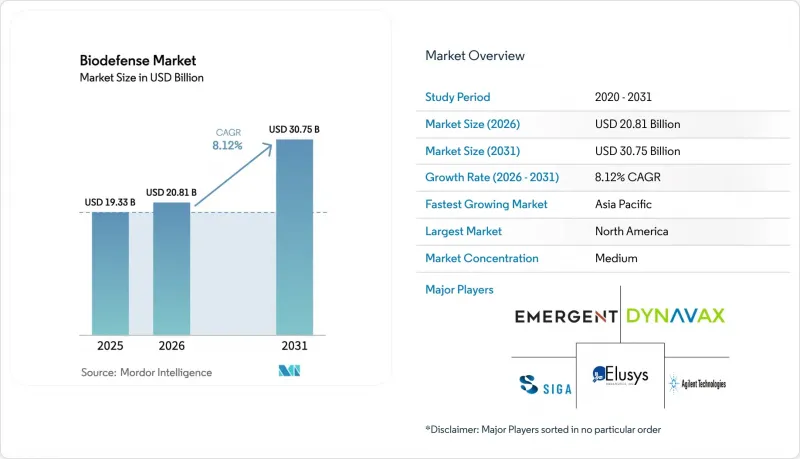
This report is Segmented by Product (Anthrax, Smallpox/Orthopox, Botulism, Plague, Tularemia, and Other Products), Countermeasure Type (Vaccines, Antibodies & Antitoxins, Antivirals & Antibiotics, and More), End User (Military Forces, and More), and Geography (North America, Europe, Asia-Pacific, Middle East & Africa, South America). Market Forecasts are Provided in Terms of Value (USD).
Global Biodefense Market Trends and Insights
Government Funding and Strategic Stockpiling Programs
Record-level appropriations continue to anchor biodefense growth. In 2025 the U.S. Congress authorized USD 4.2 billion for the Public Health Emergency Medical Countermeasures Enterprise, representing a 12% increase over the prior year. The Strategic National Stockpile purchased 10 million doses of Bavarian Nordic's Jynneos vaccine at a contract value of USD 300 million to bolster orthopox readiness. The European Union mirrored this approach by committing EUR 1.3 billion in 2025 to build continental stockpiles under the Health Emergency Preparedness and Response Authority. Japan increased its biodefense budget by 18%, allocating JPY 45 billion (approximately USD 300 million) for countermeasures against anthrax and plague. These multi-year funding streams provide manufacturers with visibility into demand and support long-term capacity planning.
Advancements in Biothreat Detection and Biosurveillance
Field-deployable detection technologies are reshaping response timelines. The U.S. Department of Homeland Security completed a BioWatch Generation-3 upgrade in early 2025, deploying 500 autonomous aerosol samplers across 30 cities. Each unit integrates next-generation sequencing with cloud-hosted threat libraries to deliver actionable data within four hours. Teledyne FLIR won a USD 85 million contract to supply handheld mass-spectrometers capable of identifying 20 priority agents in under ten minutes. BioFire Defense launched a multiplexed PCR panel that reduces diagnostic turnaround to 45 minutes for anthrax, plague, and tularemia. The World Health Organization added these data feeds to its Early Warning, Alert and Response System, enabling cross-border genomic sharing.
Budget Constraints and Uneven Global Preparedness
Fiscal limitations hamper countermeasure acquisition in resource-constrained settings. The World Bank estimated that low- and middle-income countries spent less than 0.5% of health budgets on preparedness in 2025, versus 3-5% in high-income economies. Sub-Saharan Africa's aggregate biodefense outlay totaled only USD 180 million, well below recommended benchmarks. Even advanced markets encounter volatility; U.S. lawmakers debated a 7% cut to BARDA funding in mid-2025, delaying contract awards. The United Kingdom's National Audit Office flagged a USD 100 million shortfall in its 2025 stockpile budget, forcing product prioritization.
Other drivers and restraints analyzed in the detailed report include:
- Regulatory Approvals and Stockpile Readiness Initiatives
- Public Health Emergency Preparedness and Response Frameworks
- Animal Rule Evidence Requirements and Liability Complexities
For complete list of drivers and restraints, kindly check the Table Of Contents.
Segment Analysis
Anthrax products commanded 28.43% of 2025 revenue, supported by decades-long procurement programs within the biodefense market. Smallpox and broader orthopox solutions are forecast to rise at a 10.34% CAGR, reflecting mpox-driven diversification and Strategic National Stockpile expansion. Bavarian Nordic's Jynneos generated USD 520 million in 2024-2025 government sales across the United States, Canada, and Japan. SIGA Technologies secured a USD 113 million BARDA contract extension for oral and intravenous tecovirimat. Botulism products remain niche, yet Emergent BioSolutions' BAT antitoxin enjoys a sole-source contract valued at USD 85 million annually.
Future growth will hinge on platform adaptability. The biodefense market size for orthopox countermeasures is expected to widen as mRNA architectures cut development lead times, and thermostable formulations improve logistical reach. Ricin and staphylococcal enterotoxin B candidates in Phase II trials indicate a pipeline that could shift revenue distribution once approved.
Complete Report Scope:
- By Product
- Anthrax
- Smallpox / Orthopox (Smallpox & Mpox)
- Botulism
- Plague
- Tularemia
- Other Products
- By Countermeasure Type
- Vaccines
- Antibodies & Antitoxins
- Antivirals & Antibiotics
- Detection & Surveillance Systems
- Decontamination Systems & PPE
- Biodosimetry & Radiological Agents
- By End User
- Military Forces
- Homeland Security & Emergency Agencies
- Hospitals & Clinics
- Pharmaceutical & Biotech Companies
- Virological Research Institutes
- Geography
- North America
- United States
- Canada
- Mexico
- Europe
- Germany
- United Kingdom
- France
- Italy
- Spain
- Rest of Europe
- Asia-Pacific
- China
- Japan
- India
- Australia
- South Korea
- Rest of Asia-Pacific
- Middle East & Africa
- GCC
- South Africa
- Rest of Middle East & Africa
- South America
- Brazil
- Argentina
- Rest of South America
- North America
Geography Analysis
North America delivered 42.45% of 2025 biodefense revenue, driven by the Biomedical Advanced Research and Development Authority's USD 1.8 billion in fiscal-year contracts. Canada committed USD 135 million to refresh its National Emergency Strategic Stockpile in 2025. Regulatory mechanisms, including the Animal Rule and Emergency Use Authorization, shorten approval timelines and sustain demand predictability. The biodefense market size in North America benefits from concentrated manufacturing nodes operated by Emergent BioSolutions, Grand River Aseptic Manufacturing, and National Resilience.
Asia-Pacific is forecast to grow at a 9.54% CAGR through 2031, reflecting sovereign biosecurity mandates. Japan allocated JPY 38 billion (USD 255 million) in its 2025 defense budget for vaccines and detection equipment. South Korea's Agency for Defense Development initiated a USD 90 million domestic-vaccine program. Australia partnered with CSL Limited to establish a regional manufacturing hub supported by AUD 150 million (USD 100 million). India's Biotechnology Industry Research Assistance Council funded three vaccine developers with INR 1.2 billion (USD 14 million) in grants.
Europe generated 23% of global revenue in 2025. The Health Emergency Preparedness and Response Authority earmarked EUR 800 million for stockpile creation across Poland, Spain, and Italy. The United Kingdom's Vaccine Manufacturing and Innovation Centre secured GBP 120 million in contracts for biodefense vaccines. Middle East and Africa combined produced 8% of revenue, led by Gulf Cooperation Council purchases; the United Arab Emirates committed USD 45 million in 2025 under its National Resilience Strategy. South America remains embryonic but Brazil allocated BRL 220 million (USD 44 million) for antibiotic and vaccine reserves.
- Agilent Technologies
- Battelle
- Bavarian Nordic
- BioFire Defense, LLC
- Bruker
- Cepheid (Danaher)
- Dynavax Technologies
- Elusys Therapeutics Inc. (NightHawk Biosciences)
- Emergent Bio Solutions
- Grand River Aseptic Manufacturing (GRAM)
- Jubilant HollisterStier LLC
- Leidos Biomedical Research, Inc. (Leidos)
- National Resilience, Inc. (Ology Bioservices)
- QIAGEN
- SIGA Technologies Inc.
- Smiths Detection (Smiths Group plc)
- Soligenix, Inc.
- Teledyne FLIR Detection, Inc.
- Tetracore, Inc.
- Tonix Pharmaceuticals
Additional Benefits:
- The market estimate (ME) sheet in Excel format
- 3 months of analyst support
TABLE OF CONTENTS
1 Introduction
- 1.1 Study Assumptions & Market Definition
- 1.2 Scope of the Study
2 Research Methodology
3 Executive Summary
4 Market Landscape
- 4.1 Market Overview
- 4.2 Market Drivers
- 4.2.1 Government Funding and Strategic Stockpiling Programs
- 4.2.2 Advancements in Biothreat Detection and Biosurveillance
- 4.2.3 Regulatory Approvals and Stockpile Readiness Initiatives
- 4.2.4 Public Health Emergency Preparedness and Response Frameworks
- 4.2.5 Platform-Based Medical Countermeasure Strategies
- 4.2.6 Shelf-Life Extension and Cold-Chain Optimization Programs
- 4.3 Market Restraints
- 4.3.1 Budget Constraints and Uneven Global Preparedness
- 4.3.2 Animal Rule Evidence Requirements and Liability Complexities
- 4.3.3 Procurement Cyclicality and Demand Volatility
- 4.3.4 Biomanufacturing Capacity and Critical Supply Chain Constraints
- 4.4 Value / Supply-Chain Analysis
- 4.5 Regulatory Landscape
- 4.6 Technological Outlook
- 4.7 Porter's Five Forces Analysis
- 4.7.1 Threat of New Entrants
- 4.7.2 Bargaining Power of Buyers
- 4.7.3 Bargaining Power of Suppliers
- 4.7.4 Threat of Substitutes
- 4.7.5 Competitive Rivalry
5 Market Size & Growth Forecasts (Value, USD)
- 5.1 By Product
- 5.1.1 Anthrax
- 5.1.2 Smallpox / Orthopox (Smallpox & Mpox)
- 5.1.3 Botulism
- 5.1.4 Plague
- 5.1.5 Tularemia
- 5.1.6 Other Products
- 5.2 By Countermeasure Type
- 5.2.1 Vaccines
- 5.2.2 Antibodies & Antitoxins
- 5.2.3 Antivirals & Antibiotics
- 5.2.4 Detection & Surveillance Systems
- 5.2.5 Decontamination Systems & PPE
- 5.2.6 Biodosimetry & Radiological Agents
- 5.3 By End User
- 5.3.1 Military Forces
- 5.3.2 Homeland Security & Emergency Agencies
- 5.3.3 Hospitals & Clinics
- 5.3.4 Pharmaceutical & Biotech Companies
- 5.3.5 Virological Research Institutes
- 5.4 Geography
- 5.4.1 North America
- 5.4.1.1 United States
- 5.4.1.2 Canada
- 5.4.1.3 Mexico
- 5.4.2 Europe
- 5.4.2.1 Germany
- 5.4.2.2 United Kingdom
- 5.4.2.3 France
- 5.4.2.4 Italy
- 5.4.2.5 Spain
- 5.4.2.6 Rest of Europe
- 5.4.3 Asia-Pacific
- 5.4.3.1 China
- 5.4.3.2 Japan
- 5.4.3.3 India
- 5.4.3.4 Australia
- 5.4.3.5 South Korea
- 5.4.3.6 Rest of Asia-Pacific
- 5.4.4 Middle East & Africa
- 5.4.4.1 GCC
- 5.4.4.2 South Africa
- 5.4.4.3 Rest of Middle East & Africa
- 5.4.5 South America
- 5.4.5.1 Brazil
- 5.4.5.2 Argentina
- 5.4.5.3 Rest of South America
- 5.4.1 North America
6 Competitive Landscape
- 6.1 Market Concentration
- 6.2 Market Share Analysis
- 6.3 Company Profiles (includes Global Level Overview, Market Level Overview, Core Segments, Financials As Available, Strategic Information, Market Rank/Share For Key Companies, Products & Services, And Recent Developments)
- 6.3.1 Agilent Technologies, Inc.
- 6.3.2 Battelle
- 6.3.3 Bavarian Nordic A/S
- 6.3.4 BioFire Defense, LLC
- 6.3.5 Bruker Corporation
- 6.3.6 Cepheid (Danaher)
- 6.3.7 Dynavax Technologies Corporation
- 6.3.8 Elusys Therapeutics Inc. (NightHawk Biosciences)
- 6.3.9 Emergent BioSolutions Inc.
- 6.3.10 Grand River Aseptic Manufacturing (GRAM)
- 6.3.11 Jubilant HollisterStier LLC
- 6.3.12 Leidos Biomedical Research, Inc. (Leidos)
- 6.3.13 National Resilience, Inc. (Ology Bioservices)
- 6.3.14 QIAGEN N.V.
- 6.3.15 SIGA Technologies Inc.
- 6.3.16 Smiths Detection (Smiths Group plc)
- 6.3.17 Soligenix, Inc.
- 6.3.18 Teledyne FLIR Detection, Inc.
- 6.3.19 Tetracore, Inc.
- 6.3.20 Tonix Pharmaceuticals Holding Corp.
7 Market Opportunities & Future Outlook
- 7.1 White-space & Unmet-need Assessment

